סיכום קצר: Digital transformation for museums involves adopting technologies like AI, virtual experiences, and smart visitor management systems to enhance engagement, streamline operations, and expand accessibility. Museums are moving beyond static exhibitions toward interactive, data-driven experiences that connect with modern audiences while preserving cultural heritage. Successful transformation requires addressing challenges like workforce training, ethical AI implementation, and strategic planning.
Museums aren’t what they used to be. Walk into most cultural institutions today and the experience extends far beyond dusty display cases and velvet ropes. Digital transformation has fundamentally altered how museums operate, engage audiences, and preserve heritage.
The shift accelerated dramatically during the pandemic. When doors closed, museums turned to virtual tours, online collections, and digital programming. But this wasn’t just emergency pivoting. It revealed something deeper: audiences want technology-enhanced experiences that blend physical and digital worlds.
According to the American Alliance of Museums, artificial intelligence in museums is shaping a new era for the sector. As one AAM article notes: “The future has arrived: artificial intelligence (AI) in museums is shaping a new era for the sector.” Institutions that resist risk irrelevance.
The Evolution From Static Galleries to Dynamic Digital Spaces
Museum digital transformation isn’t about replacing human experiences with screens. It’s about augmenting what museums do best: telling stories, preserving culture, and creating connections.
Traditional museums faced inherent limitations. Physical space constraints meant only a fraction of collections could be displayed. Geographic barriers prevented many people from ever visiting. Paper-based operations created inefficiencies that drained resources.
Digital tools eliminate these constraints. Museums can now share entire collections online, reaching global audiences. Virtual reality transports visitors to reconstructed ancient sites. Smart data analytics reveal visitor patterns that inform better curation.
The San Diego Natural History Museum exemplifies this shift. During pandemic closures, they produced a “Career Spotlight” video series connecting audiences with collection managers through Zoom. This wasn’t replacing in-person visits—it was creating entirely new engagement pathways.
Some institutions even monetized virtual experiences. According to AAM’s Digital Awakening report, the Cincinnati Zoo offered paid Zoom appearances, with Fiona the Hippo available at the rate of $750 for 15 minutes. Museums have sustained revenue by tying free content to membership pitches and underwriting by funders.
Build Immersive Cultural Experiences With Specialized Engineering Support
Modernizing museum operations—from digital archiving and virtual tours to interactive visitor apps—requires specialized technical skills that are often difficult to find within the nonprofit sector. Building an internal development team from the ground up can be slow and cost-prohibitive. A-Listware solves this by providing dedicated development teams and IT staff augmentation, allowing museums to integrate modern technology into their exhibits and management systems without the friction of traditional hiring.
- Targeted Technical Skills: Access developers experienced in AR/VR, mobile applications, and secure cloud storage.
- Reduced Overhead: Minimize the costs of recruitment, training, and long-term employee benefits.
- Flexible Project Scaling: Quickly expand your technical capacity for specific exhibitions or digital launches.
- שיתוף פעולה חלק: Dedicated specialists work as a direct extension of your staff to modernize legacy databases.
התחילו את תהליך הטרנספורמציה הדיגיטלית שלכם עם A-Listware.
Key Technologies Reshaping Museum Operations
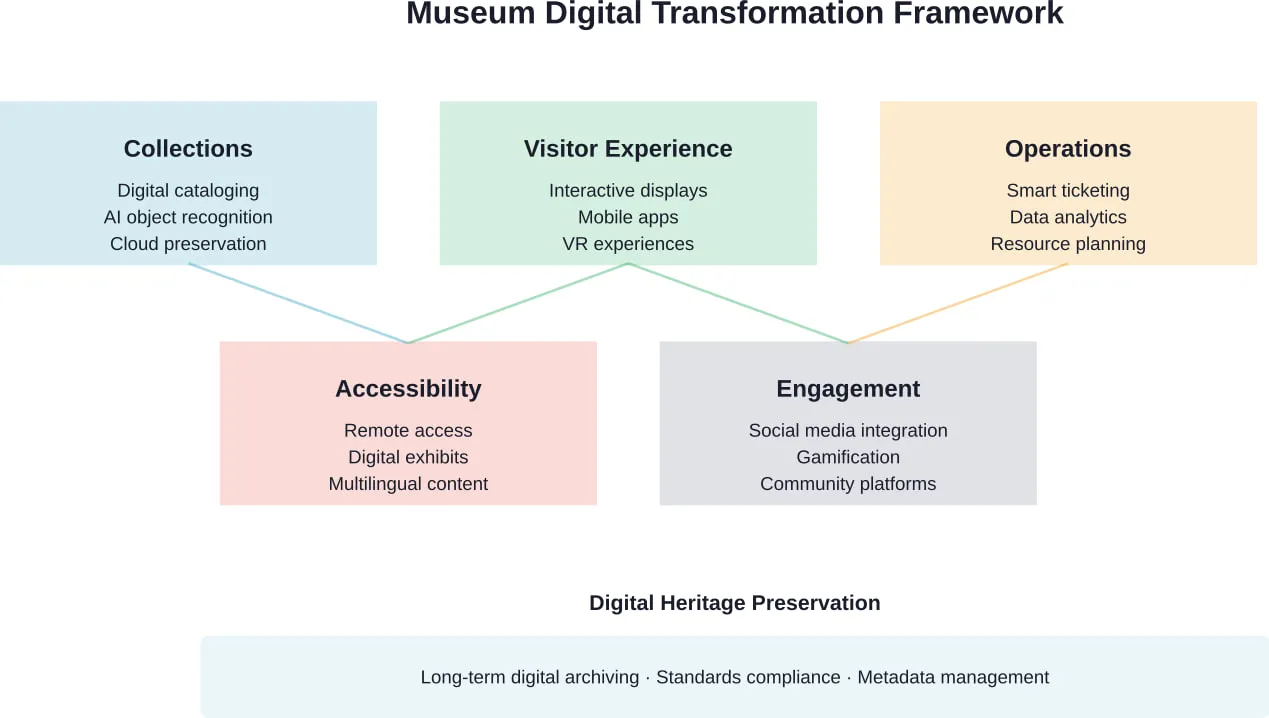
Several technology trends are driving transformation across the museum sector. Each addresses specific operational challenges while opening new possibilities for visitor engagement.
בינה מלאכותית ולמידת מכונה
AI applications in museums extend far beyond chatbots. According to the American Alliance of Museums, 89 percent of survey respondents from their “AI for Career Growth” workshop indicated they are using AI, predominantly for professional purposes—signaling this is no longer just an IT department concern.
AI transforms museum workflows through automated cataloging, pattern recognition in collections data, and predictive analytics for visitor management. Machine learning algorithms can identify objects in photographs, suggest conservation priorities, and even detect forgeries.
But AI raises ethical questions. Science museums have focused exhibitions on exploring AI’s potential while examining its limitations. The conversation around ethical AI implementation has moved beyond IT offices into broader institutional planning.
As researchers noted in the journal Exhibition, AI in museums requires solving for ethics across entire organizations, not just technical departments. This means establishing governance frameworks, ensuring algorithmic transparency, and addressing bias in training data.
Digital Collections Management
Collections documentation has undergone radical transformation. The International Council of Museums promotes standards like LIDO (Lightweight Information for Describing Objects) for digital documentation. Current version 7.1 of CIDOC-CRM (The CIDOC Conceptual Reference Model), published in 2021, provides frameworks for museum object information.
Digital asset management systems centralize photographs, condition reports, provenance research, and conservation records. Cloud storage ensures accessibility while backup protocols protect against loss.
The Institute of Museum and Library Services invests in digital technology grants focused on expanding digital content in library and museum collections, building capacity for managing digital assets, and promoting innovative uses of technology.
מציאות מדומה ומציאות רבודה
Immersive technologies create experiences impossible in physical space. VR reconstructions let visitors walk through demolished buildings or see artifacts in original contexts. Augmented reality overlays digital information onto physical exhibits.
These aren’t gimmicks. They’re pedagogical tools that deepen understanding. A visitor examining Roman pottery can see how it looked intact, watch it being made, or explore the archaeological site where it was discovered.
The technology has matured rapidly. Early VR required expensive headsets and dedicated spaces. Now web-based experiences work on smartphones, dramatically lowering barriers to access.
Smart Visitor Management Systems
Paper tickets and manual counting belong to the past. Digital visitor management platforms integrate ticketing, capacity monitoring, contact tracing, and analytics into unified systems.
These platforms provide real-time data on visitor flow, popular exhibits, and dwell times. Museums can identify bottlenecks, optimize staffing, and improve visitor routing. During health crises, they enable timed entry and capacity limits.
The data collected feeds strategic planning. Which exhibits attract return visits? What times see highest attendance? How do different demographics engage with collections? Answers inform everything from exhibition design to marketing campaigns.
Overcoming Barriers to Digital Adoption
Despite clear benefits, many museums struggle with digital transformation. Research from the University of Leicester’s “One by One” project identified lack of confidence as a key challenge in building digitally confident museums.
Several barriers consistently emerge across institutions.
פערים במיומנויות כוח העבודה
Curators trained in art history or archaeology didn’t learn database management or web development. Expecting existing staff to master new technologies without support is unrealistic.
The Institute of Museum and Library Services addresses this through the 21st Century Museum Professionals program, which builds career pathways, strengthens professional networks, and shares effective workforce education practices across the museum field.
Training programs must go beyond technical skills. Staff need to understand how digital tools serve institutional missions. A collections manager should see how databases improve scholarship, not just administrative efficiency.
אילוצים תקציביים
Digital infrastructure requires investment. Software licenses, hardware upgrades, cloud storage, and technical staff all cost money. Smaller institutions operating on tight budgets struggle to allocate resources.
Grant funding helps. The Institute of Museum and Library Services distributes over $160 million annually through the Grants to States program, the largest source of federal funding support for library services in the U.S. Administrative discretionary grants have supported digital initiatives from fiscal year 1996 through fiscal year 2014, according to IMLS grant data.
But grants aren’t sustainable long-term funding. Museums need business models that generate revenue from digital offerings—whether through virtual memberships, online programming fees, or e-commerce tied to digital collections.
| אֶתגָר | השפעה | גישת הפתרון |
|---|---|---|
| Staff digital literacy gaps | Low technology adoption rates | Targeted training programs, peer mentorship |
| Limited budgets | Outdated systems, missed opportunities | Grant funding, phased implementation, open-source tools |
| שילוב מערכות מדור קודם | Data silos, workflow inefficiencies | API-based integration, gradual migration strategies |
| Resistance to change | Slow adoption, staff frustration | Change management, demonstrating quick wins |
| Data governance uncertainty | Privacy risks, compliance issues | Clear policies, ethical frameworks, legal consultation |
Institutional Resistance
Museums are inherently conservative institutions. Their mission centers on preservation—maintaining things as they are. Digital transformation asks them to embrace change, which can feel contradictory.
Senior leadership often lacks technology expertise. Board members may prioritize traditional metrics like attendance over digital engagement. Changing organizational culture requires demonstrating value in terms stakeholders understand.
Quick wins help. A successful virtual exhibition that reaches thousands builds credibility for larger initiatives. Pilot projects with measurable outcomes prove concepts before major investments.
The Role of Data in Modern Museum Strategy
Museums have always collected data—accession records, visitor counts, donor information. But digital transformation enables entirely new approaches to data collection, analysis, and application.
According to Dexbit founder Angie Judge and digital strategist Dacia Massengill, understanding how to collect data and knowing what to use it for are essential for the museum field. Data literacy has become a core professional competency.
Analytics platforms track digital engagement metrics: website traffic, social media interactions, virtual tour completions, app downloads. These complement physical attendance data, creating comprehensive pictures of audience behavior.
The challenge lies in interpretation. Raw numbers don’t tell stories—context does. A spike in website traffic means little without understanding what content attracted visitors or whether engagement translated to donations or memberships.
Privacy concerns complicate data collection. Regulations like GDPR impose requirements on how visitor information can be gathered and used. Museums must balance analytical benefits against ethical obligations to protect privacy.
Digital Transformation and Accessibility
One of digital transformation’s most significant benefits is expanded accessibility. Technology removes barriers that excluded many people from museum experiences.
Geographic barriers disappear when collections go online. Someone in rural Montana can explore the Metropolitan Museum’s holdings as easily as a Manhattan resident. Global audiences access cultural heritage previously available only to those who could travel.
Physical disabilities become less limiting. Visitors with mobility challenges can take virtual tours of spaces they couldn’t physically navigate. Audio descriptions and screen reader compatibility help visually impaired visitors engage with digital collections.
Language barriers shrink through automated translation. Digital content can be offered in dozens of languages without the cost of printing multilingual labels or hiring interpreters.
But digital accessibility isn’t automatic. Poorly designed websites create new barriers. Videos without captions exclude deaf visitors. Complex interfaces frustrate those with cognitive disabilities. True accessibility requires intentional design following WCAG guidelines.
The Future of Digital Museums
Digital transformation isn’t a destination—it’s an ongoing process. Technologies evolve, audience expectations shift, and new possibilities emerge constantly.
Several trends will shape the next phase of museum digitalization.
Hybrid Experiences Become Standard
The pandemic forced museums to choose between physical and digital. Post-pandemic reality recognizes this is a false dichotomy. The most effective approach combines both.
Visitors might explore collections online before visiting, use apps during their visit for enhanced information, then continue engagement through virtual programs afterward. Each mode reinforces the others.
Museums are increasingly designing exhibitions with digital components from the start, rather than as afterthoughts. Physical and virtual experiences are increasingly being conceived as integrated wholes.
Artificial Intelligence Deepens Personalization
AI enables personalized experiences at scale. Recommendation algorithms suggest content based on interests. Chatbots answer questions in multiple languages. Computer vision identifies visitor engagement patterns.
But personalization raises privacy questions. How much data should museums collect? How long should it be retained? Who has access? Museums must develop ethical frameworks that balance personalization benefits against privacy rights.
Collaborative Digital Platforms
Individual museums have finite resources. Collaborative platforms let institutions share infrastructure, expertise, and content.
The “Towards a National Collection” initiative represents collaborative digital approaches—a five-year research program connecting people to the UK’s industrial past. The Congruence Engine is a three-year research project (one of the five Discovery Projects under the ‘Towards a National Collection’ programme) that uses AI and digital tools to connect industrial heritage collections across the UK.
Similar collaborative efforts will proliferate, enabling smaller institutions to access capabilities they couldn’t develop independently.
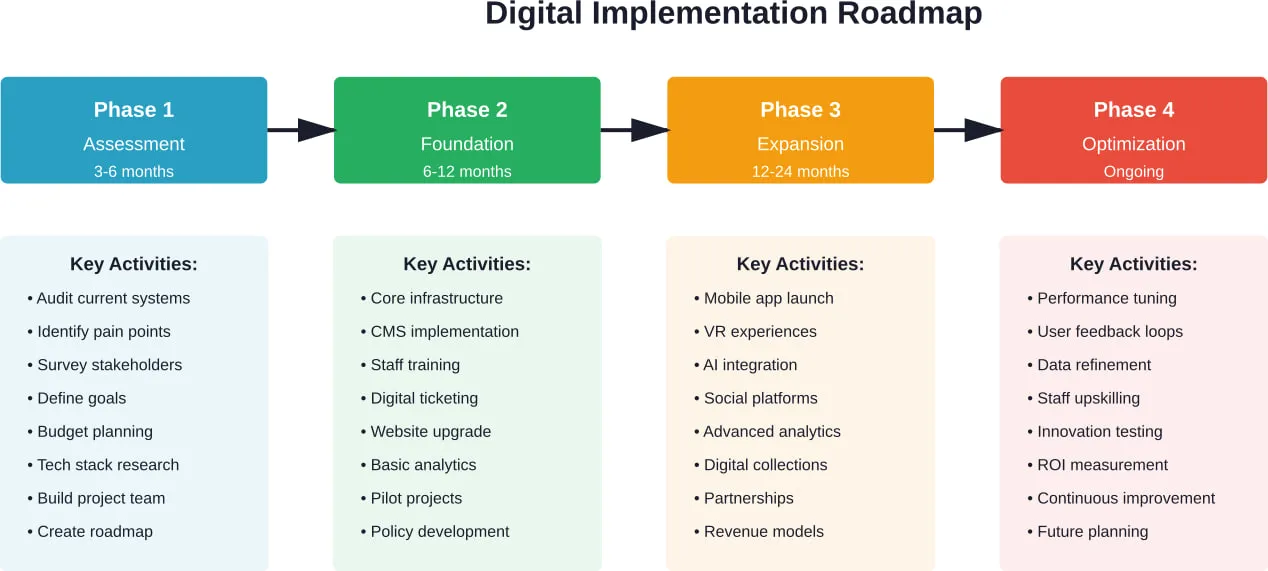
Implementing Your Digital Strategy
Museums considering digital transformation should approach it strategically, not haphazardly. Successful implementation requires planning, resources, and stakeholder buy-in.
Start with clear goals. What problems need solving? Improved visitor engagement? Better collections management? Expanded accessibility? Goals determine which technologies make sense.
Audit existing capabilities honestly. What systems are in place? What skills does staff possess? Where are the gaps? Understanding the starting point informs realistic planning.
Prioritize quick wins alongside long-term initiatives. A successful pilot project builds momentum and credibility. It demonstrates value to skeptics and generates enthusiasm among staff.
Invest in training. Technology alone doesn’t create transformation—people using technology effectively do. Staff development is as important as software licenses.
Build partnerships. Other museums, technology vendors, academic institutions, and funders all bring valuable resources. Collaboration accelerates progress and shares risk.
Measure outcomes. Define success metrics upfront. Track progress regularly. Adjust strategies based on data, not assumptions.
שאלות נפוצות
- What is digital transformation for museums?
Digital transformation for museums involves integrating technology across operations—from collections management and visitor engagement to educational programming and accessibility. It’s not just adding websites or apps, but fundamentally rethinking how museums serve missions through digital capabilities. This includes AI-powered cataloging, virtual exhibitions, smart visitor management systems, and data analytics that inform strategic decisions.
- How much does museum digital transformation cost?
Costs vary enormously based on institution size, existing infrastructure, and scope. Small museums might start with basic website upgrades and digital ticketing for under $50,000, while comprehensive transformations at large institutions can require millions. The Institute of Museum and Library Services provides grants that help offset costs—check official grant programs for current funding opportunities. Many museums phase implementation to spread expenses over multiple budget cycles.
- What are the biggest challenges museums face in digital transformation?
Research identifies several key barriers: staff digital literacy gaps, limited budgets, legacy system integration difficulties, institutional resistance to change, and data governance uncertainties. The University of Leicester’s “One by One” project found lack of confidence particularly prevalent. According to the American Alliance of Museums, 89 percent of survey respondents from their “AI for Career Growth” workshop indicated they are using AI, but many lack implementation guidance. Addressing these requires strategic training, change management, and demonstrating clear value.
- How can small museums with limited budgets pursue digital transformation?
Small institutions should focus on phased implementation and leveraging free or low-cost tools. Open-source collections management systems, social media platforms, and cloud storage offer capabilities without major licensing fees. Grant funding from programs like the Institute of Museum and Library Services’ Grants to States program distributes over $160 million annually to support digital initiatives. Collaborative platforms allow resource sharing with other institutions. Starting with one successful pilot project builds momentum for larger efforts.
- What role does AI play in modern museums?
Artificial intelligence transforms museum workflows through automated cataloging, pattern recognition in collections data, predictive visitor analytics, and enhanced accessibility features like automated translations or image descriptions. Science museums have explored AI’s potential through exhibitions while addressing ethical concerns. According to the American Alliance of Museums, AI implementation should extend beyond IT departments to involve ethical governance frameworks, algorithmic transparency, and bias mitigation across entire organizations.
- How does digital transformation improve museum accessibility?
Digital tools remove geographic, physical, and language barriers. Online collections reach global audiences who can’t travel to physical locations. Virtual tours accommodate visitors with mobility challenges. Audio descriptions and screen reader compatibility help visually impaired audiences engage. Automated translation makes content available in multiple languages without printing costs. However, true accessibility requires intentional design following WCAG guidelines—poorly designed digital experiences can create new barriers rather than removing them.
- What standards exist for museum digital collections?
The International Council of Museums promotes standards like LIDO (Lightweight Information for Describing Objects) and CIDOC-CRM for museum documentation. Current CIDOC-CRM version 7.1, published in 2021, provides frameworks for museum object information in both English and French. These standards ensure interoperability between institutions, support long-term digital preservation, and enable collaborative platforms. The ICOM Documentation committee maintains guidelines covering acquisition, documentation, terminology, security, and conservation best practices.
Embracing the Digital Future
Digital transformation represents both challenge and opportunity for museums. Technology won’t replace the fundamental human experiences museums provide—the wonder of standing before original artifacts, the serendipity of unexpected discoveries, the social connections formed during visits.
But digital tools extend these experiences beyond physical walls. They make collections accessible to people who could never visit in person. They provide context and connections that deepen understanding. They enable operations that would be impossible manually.
Museums that embrace transformation thoughtfully—with clear strategies, adequate resources, and commitment to their core missions—will thrive. Those that resist risk becoming irrelevant to audiences who increasingly expect digital engagement.
The future of museums is neither purely physical nor entirely virtual. It’s hybrid, integrated, and constantly evolving. Success requires viewing digital transformation not as a threat to traditional practices but as an enhancement that makes museums more effective at what they’ve always done best: preserving culture and connecting people with heritage.
Start planning your institution’s digital journey today. Audit capabilities, identify goals, build stakeholder support, and take that first step. The future is already here—museums just need to catch up.


