סיכום קצר: Digital transformation empowers women-led businesses through e-commerce platforms, AI automation, and data analytics tools that level the playing field. Women entrepreneurs leveraging these technologies see faster growth, improved customer reach, and operational efficiency—despite facing adoption barriers like limited funding and digital skills gaps.
Women-owned businesses are among the fastest-growing firms in the global marketplace. Yet they face unique challenges that digital transformation can help address—or worsen if adoption barriers aren’t tackled.
The paradox is striking. According to the World Bank, men are 21% more likely to be online than women globally. That figure rises to 52% in low-income countries. Meanwhile, women represent 28% of engineering graduates and 22% of artificial intelligence workers globally.
But here’s the thing: when women entrepreneurs do adopt digital tools, they’re seeing remarkable results. According to the U.S. Small Business Administration’s 2025 trends analysis, 53% of small businesses now use AI-powered chatbots and virtual assistants for customer service. Those who implement these technologies streamline processes, reduce human error, and free up time for strategic growth.
So what’s holding women-led businesses back? And more importantly, how can digital transformation become the equalizer rather than another barrier?
The Current State of Digital Adoption for Women Entrepreneurs
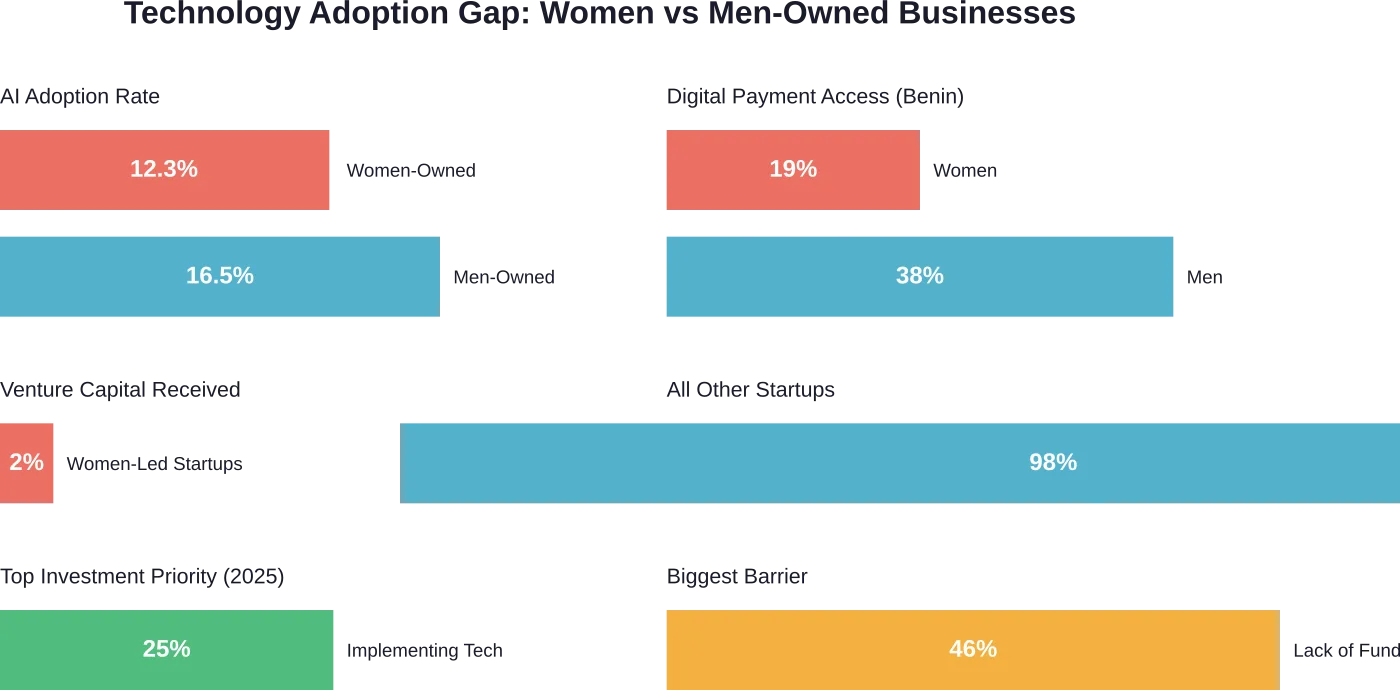
Women-owned enterprises face a technology adoption gap that’s both measurable and concerning. According to research on Canadian women entrepreneurs, women-owned enterprises adopt AI at lower rates (12.3% vs. 16.5% for men-owned).
Funding remains the primary obstacle. According to BDC’s 2025 survey, nearly half (46%) of female entrepreneurs cite lack of funding as their biggest barrier to technology implementation. The same survey found 25% of women-owned companies listed implementing new technologies as a top investment priority.
The digital skills gap compounds the problem. Investing in digital capabilities early in life proves critical for women to prosper in the internet economy. Societal norms, limited education access, and scarce role models reinforce these gaps across generations.
Real talk: the barriers are systemic, not individual. Women-led startups receive approximately 3% of venture capital. That means doing more with less isn’t optional—it’s mandatory.
Why Digital Transformation Hits Different for Women-Led Businesses
Digital tools solve problems that disproportionately affect women entrepreneurs. Limited time. Stretched resources. Wearing every operational hat simultaneously.
AI automation doesn’t just save time—it fundamentally changes what’s possible for solo entrepreneurs and small teams. Think about automating customer service inquiries, inventory predictions, or marketing content creation. That’s not a minor convenience. For a founder managing everything alone, that’s the difference between working in the business and working on it.
E-commerce platforms eliminate geographic barriers. A woman running a business from a small town can reach global customers just as effectively as established urban competitors. Social media advertising levels the playing field against companies with massive marketing budgets.
Data analytics tools provide insights previously available only to enterprises with dedicated analytics teams. Understanding customer behavior, optimizing pricing, tracking conversion rates—these capabilities now fit within small business budgets.
But wait. Technology adoption isn’t automatic. The World Bank Group’s Gender Strategy 2030 targets accelerating use of broadband internet, social protection programs, and capital access by 2030. These foundational elements must be in place for digital transformation to work.
Strategic Digital Tools for Women Entrepreneurs
Not all digital tools deliver equal value. Women-led businesses benefit most from technologies that multiply effort rather than just digitize existing processes.
E-Commerce Platforms and Online Marketplaces
Establishing an online presence through platforms like Shopify, Etsy, or Amazon opens global markets without physical infrastructure costs. These platforms handle payment processing, inventory management, and often provide built-in marketing tools.
Cross-border e-commerce capabilities particularly benefit women entrepreneurs in developing economies. Selling to international customers who pay in stronger currencies can dramatically improve profit margins.
AI-Powered Business Operations
Practical AI applications solve specific bottlenecks. Chatbots handle routine customer inquiries 24/7. Predictive analytics optimize inventory—avoiding both stockouts and excess capital tied up in unsold goods. Content generation tools accelerate marketing output.
According to competitor content, a sustainable fashion brand used AI demand forecasting that resulted in a 25% reduction in material waste, and the founder gained back approximately 10 hours weekly by automating customer service and email marketing.
Mobile Payment Solutions
Digital payment infrastructure matters enormously in markets where women have limited banking access. Mobile payment solutions enable transactions without traditional bank accounts, removing a critical barrier to commerce.
According to World Bank materials, a digital payment initiative (referenced in the G2Px context) has specifically focused on this challenge. In Benin, in 2023, an estimated 19% of women make or receive digital payments compared to 38% of men—highlighting both the gap and the opportunity. As of 2024, approximately 38% of women in Benin make or receive digital payments, compared to 53% of men.
שיווק דיגיטלי וקידום אתרים (SEO)
Search engine optimization and social media marketing provide cost-effective customer acquisition. These channels reward quality content and strategic thinking over pure budget size.
Investing in SEO fundamentals—keyword research, quality content, technical optimization—builds sustainable traffic that compounds over time. Social media allows direct audience building and community engagement without advertising spend.
התגברות על מכשולים ביישום
Knowing which tools to use matters less than actually implementing them. Women entrepreneurs face specific obstacles that require targeted solutions.
Addressing the Funding Gap
Traditional venture capital remains largely inaccessible. Alternative funding sources deserve exploration: microloans, crowdfunding platforms, government grants specifically for women-owned businesses, and angel investor networks focused on gender equity.
According to competitor content, the Program for Digital Strategic Leadership at the Discovery Foundation (WeBC) is designed for female entrepreneurs generating at least $200,000 in revenue. These initiatives combine funding access with strategic guidance.
Building Digital Capabilities
Skills gaps close through deliberate investment in training. Free and low-cost resources abound—from platform-specific tutorials to broader digital marketing certifications.
Peer learning accelerates adoption. Joining communities of women entrepreneurs creates accountability and shared problem-solving. What works for someone facing similar constraints often translates directly.
Managing Time and Resource Constraints
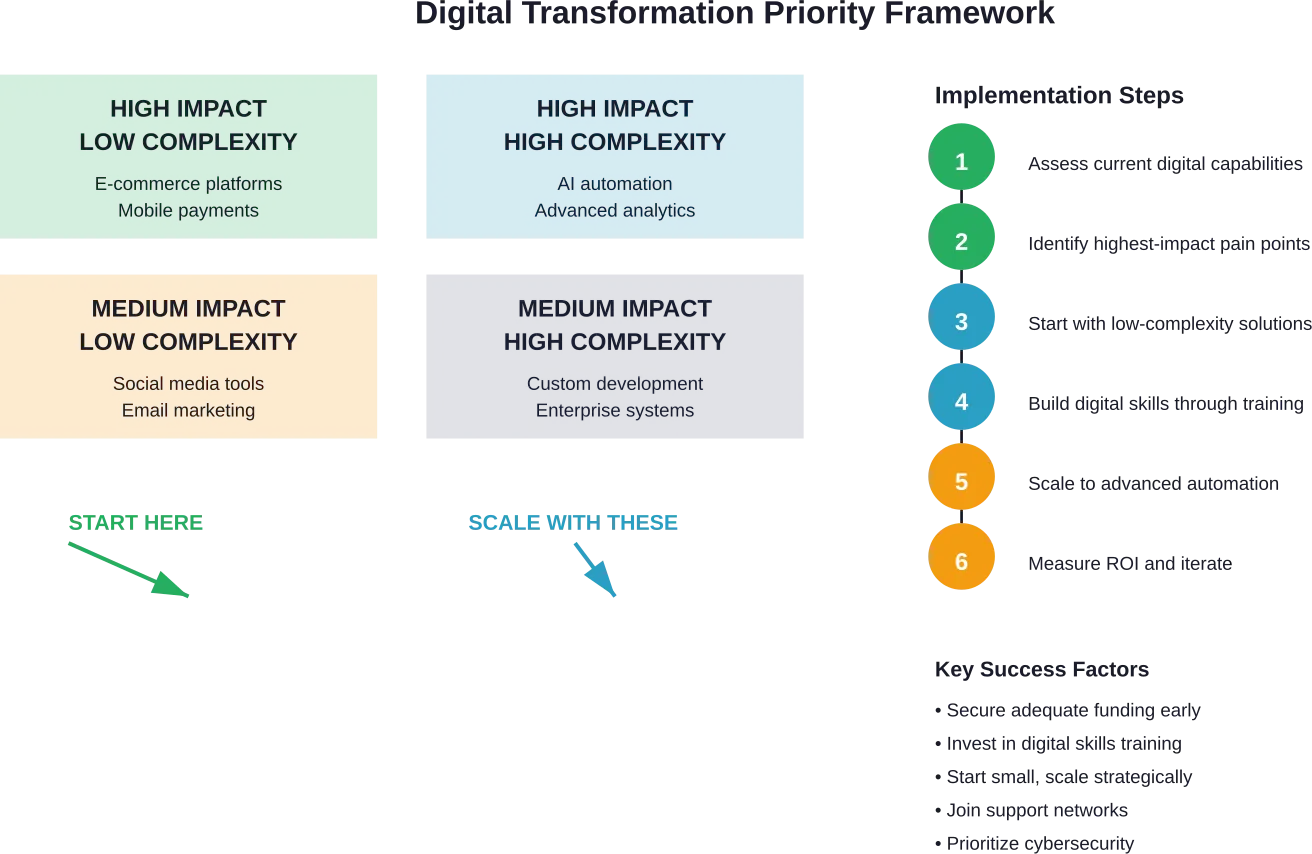
The solution isn’t finding more time—it’s using technology to create it. Start with the highest-impact, lowest-complexity tools. A simple e-commerce platform integration might take one day to set up but generate sales for years.
Automation specifically addresses the time crunch. Every recurring task that gets automated frees up hours for strategic thinking and relationship building.
| אֶתגָר | הגישה המסורתית | פתרון דיגיטלי | השפעה |
|---|---|---|---|
| Limited market reach | Local physical presence | E-commerce platforms, global shipping | Geographic expansion without overhead |
| 24/7 customer service | Hire support staff | AI chatbots, automated FAQs | Reduced labor costs, instant responses |
| ניהול מלאי | Manual tracking, guesswork | Predictive analytics, automated reordering | Optimized cash flow, reduced waste |
| Marketing budget limitations | Pay for advertising | SEO, content marketing, social media | Sustainable organic traffic growth |
| Payment processing barriers | Cash or check only | Mobile payment solutions, digital wallets | Expanded customer base, faster transactions |
Build Systems That Support How Your Business Actually Runs
Digital transformation in growing businesses is often less about scaling fast and more about removing friction. When tools don’t connect well or processes evolve without structure, it creates extra work that slows teams down. A-listware helps companies step back, assess how their current setup works, and redesign workflows so operations feel more stable and easier to manage day to day. Their approach is based on analyzing the current state, building a clear strategy, and then implementing changes that fit the business instead of forcing standard solutions.
They support the full cycle – from investigation and planning to implementation and ongoing support. That includes improving how systems connect, updating outdated infrastructure, and reducing inefficiencies that build up over time. If your business is growing but operations are becoming harder to control, it’s worth taking a step back and talking to רשימת מוצרים א' about how to make your systems work with you, not against you.
Real-World Applications and Results
Theory matters less than execution. Women entrepreneurs implementing digital transformation report tangible improvements across multiple metrics.
Customer service automation through chatbots reduces response time from hours to seconds. According to SBA guidance, AI can help businesses streamline processes, limit human error, and enable employees to complete everyday tasks faster and focus on other important aspects of the business.
E-commerce integration expands addressable markets exponentially. A business limited to local walk-in traffic suddenly serves customers across continents. Payment barriers disappear through integrated checkout systems supporting multiple currencies and payment methods.
Data-driven decision making replaces intuition with evidence. Understanding which products sell best, which marketing channels drive conversions, and which customer segments offer highest lifetime value transforms strategic planning.
Sound familiar? These aren’t theoretical benefits. They’re the operational realities for women-led businesses that commit to digital transformation.
Looking Forward: Technology as Equalizer
Digital transformation isn’t just about adopting new tools. It’s about fundamentally changing how women-led businesses compete, scale, and sustain themselves.
The World Bank’s Gender Strategy 2030 recognizes technology access as foundational to economic participation. Accelerating broadband internet adoption, expanding digital payment infrastructure, and increasing capital access all create enabling conditions for women entrepreneurs.
But policy initiatives alone won’t close the gap. Women-owned businesses must actively pursue digital capabilities despite barriers. The competitive advantage goes to those who move first, learn fastest, and implement most effectively.
Technology adoption rates will continue diverging—widening the gap between digitally mature businesses and traditional operators. Women entrepreneurs can’t afford to fall on the wrong side of that divide.
The optimism is justified. The majority of small business owners feel positive about economic prospects heading into 2025 and beyond. Pairing that optimism with strategic technology implementation creates real competitive advantage.
שאלות נפוצות
- What digital tools should women-led businesses prioritize first?
Start with high-impact, low-complexity solutions: e-commerce platforms for expanded market reach, mobile payment systems for transaction flexibility, and basic automation tools for customer service. These provide immediate operational benefits without requiring extensive technical expertise or large upfront investments.
- How can women entrepreneurs overcome limited technology budgets?
Explore alternative funding sources including microloans, crowdfunding, government grants for women-owned businesses, and angel investor networks focused on gender equity. Many digital tools offer free tiers or affordable starter plans. Prioritize tools with clear ROI that pay for themselves through efficiency gains or revenue growth.
- What’s the biggest barrier to digital transformation for women-led businesses?
Funding limitations represent the primary obstacle, with 46% of female entrepreneurs citing lack of funding as their biggest barrier. Digital skills gaps and time constraints compound the challenge. Addressing these requires strategic resource allocation and leveraging free or low-cost training resources.
- How does AI specifically benefit women-owned businesses?
AI automation addresses core constraints facing women entrepreneurs: limited time, stretched resources, and small teams. Chatbots handle customer service 24/7, predictive analytics optimize inventory and reduce waste, and content generation accelerates marketing output. These tools multiply individual effort without proportional cost increases.
- Why do women-owned businesses adopt technology at lower rates than men-owned firms?
Multiple factors contribute: women-led startups receive only nearly 3% of venture capital, limiting investment capacity; women represent just 28% of engineering graduates, creating skills gaps; and systemic barriers including limited access to technical networks and role models. Despite these challenges, women entrepreneurs show high interest in technology adoption when barriers are addressed.
- What role does e-commerce play in leveling the business playing field?
E-commerce eliminates geographic limitations, allowing businesses in any location to reach global customers. It reduces infrastructure costs compared to physical retail expansion, provides built-in marketing and analytics tools, and enables small businesses to compete directly with larger competitors based on product quality and customer service rather than physical presence.
- How can women entrepreneurs build digital skills without formal technical education?
Leverage free online resources, platform-specific tutorials, digital marketing certifications, and peer learning through women entrepreneur communities. Many technology providers offer extensive documentation and training specifically for business users without technical backgrounds. Starting with user-friendly tools and gradually expanding capabilities builds confidence and competence over time.
נקיטת צעדים לקראת טרנספורמציה דיגיטלית
Digital transformation for women-led businesses isn’t optional anymore—it’s a strategic necessity. The gap between digitally mature firms and traditional operators widens every quarter. Early adopters capture disproportionate advantages in customer reach, operational efficiency, and competitive positioning.
Start small but start now. Pick one high-impact tool that addresses your biggest operational pain point. Implement it fully before adding complexity. Build momentum through early wins rather than attempting comprehensive transformation simultaneously.
The barriers are real but not insurmountable. Funding gaps require creative solutions and persistence. Skills development takes time but compounds exponentially. Resource constraints demand strategic prioritization rather than preventing action entirely.
Women entrepreneurs driving digital transformation aren’t just modernizing their businesses—they’re reshaping entire industries. The question isn’t whether to embrace these technologies. It’s how quickly implementation happens and how effectively tools get leveraged for sustainable growth.
The opportunity is now. The tools are available. The only thing missing is committed action.


