סיכום קצר: AI agent orchestration coordinates multiple specialized AI agents within a unified system to tackle complex tasks that single agents can’t handle alone. It manages agent communication, task distribution, and workflow coordination through frameworks like LangGraph, CrewAI, and AutoGen. Organizations adopting this approach report measurable improvements in automation capabilities and task completion rates.
Single AI agents have limits. They excel at focused tasks but struggle when complexity scales. This reality is driving a fundamental shift in how organizations deploy artificial intelligence.
Enter agent orchestration.
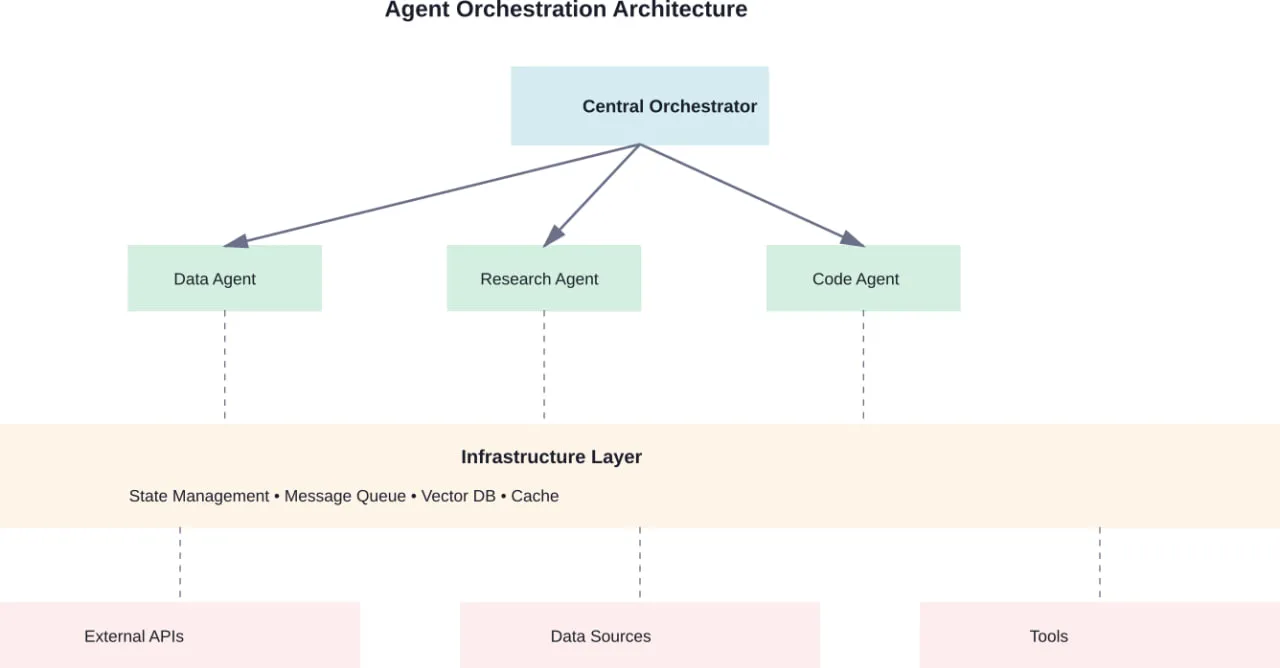
Instead of building one massive agent that attempts everything, orchestration coordinates multiple specialized agents. Each agent handles what it does best. A central coordinator ensures they work together seamlessly.
According to MIT Sloan Management Review and BCG research, traditional AI adoption has climbed to 72% over the past eight years. But here’s the interesting part: organizations are adopting agentic AI rapidly, well before they have orchestration strategies in place.
That gap creates both opportunity and risk.
What Is AI Agent Orchestration?
AI agent orchestration is the process of coordinating multiple specialized AI agents within a unified system to efficiently achieve shared objectives. Rather than relying on a single, general-purpose AI solution, orchestration employs a network of agents that collaborate through defined protocols and workflows.
Think of it like conducting an orchestra. Each musician plays a different instrument with unique capabilities. The conductor doesn’t play every instrument—they coordinate timing, balance, and collaboration to create something no individual musician could achieve alone.
The same principle applies to AI agents.
According to research published in arXiv, orchestrated multi-agent systems represent the next stage in artificial intelligence deployment. The paper “The Orchestration of Multi-Agent Systems: Architectures, Protocols, and Enterprise Adoption” by Adimulam, Gupta, and Kumar describes how enterprise adoption requires careful attention to both technical architecture and organizational protocols.
Core Components of Agent Orchestration
Effective orchestration systems include several essential elements:
- Central coordinator: Manages task distribution and workflow execution
- Specialized agents: Individual agents optimized for specific capabilities
- Communication protocols: Standardized methods for agents to exchange information
- State management: Tracks progress, context, and intermediate results
- Tool integration: Connects agents to external systems and data sources
The AgentOrchestra framework introduced by Zhang et al. implements a hierarchical multi-agent system using the Tool-Environment-Agent (TEA) Protocol. This approach allows a central planner to orchestrate specialized sub-agents for web navigation, data analysis, and file operations while supporting continual adaptation.
Why Multi-Agent Systems Outperform Single Agents
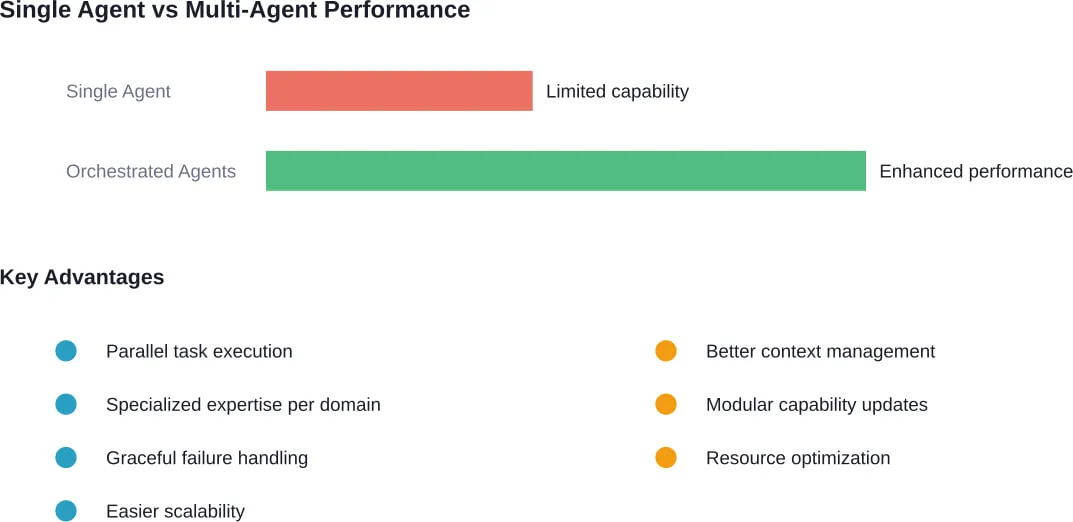
Single agents face fundamental limitations. As tasks grow more complex, monolithic agents struggle with context management, specialized knowledge, and parallel processing.
Anthropic’s engineering team documented this reality when building their Research feature. Anthropic’s internal evaluations show that multi-agent research systems excel especially for breadth-first queries that involve pursuing multiple independent directions simultaneously.
Here’s why orchestrated systems win:
- Specialization beats generalization: A data analysis agent optimized for statistical work will outperform a general-purpose agent attempting the same task. Orchestration lets teams deploy the right tool for each job.
- Parallel processing accelerates completion: Multiple agents can tackle different aspects of a problem simultaneously. One agent researches background information while another analyzes data and a third drafts documentation.
- Failure isolation improves reliability: When one specialized agent fails, others continue working. The system degrades gracefully instead of collapsing entirely.
- Scalability becomes manageable: Adding new capabilities means creating a new specialized agent, not retraining an entire monolithic system.
Common Orchestration Patterns and Architectures
Not all orchestration looks the same. Different use cases demand different architectural approaches.
Hierarchical Orchestration
A central coordinator agent receives tasks, breaks them into subtasks, and delegates them to specialized agents. The coordinator monitors progress, handles errors, and synthesizes results.
This pattern works well for complex workflows with clear task decomposition. The AgentOrchestra framework implements this approach with a central planner managing specialized sub-agents for distinct capabilities.
Peer-to-Peer Collaboration
Agents communicate directly without a central coordinator. Each agent maintains awareness of other agents’ capabilities and negotiates task distribution collaboratively.
Research on “Multi-Agent Collaboration via Evolving Orchestration” by Dang et al. explores how agents can evolve their coordination patterns over time without rigid hierarchical structures.
Pipeline Orchestration
Agents operate in sequence, with each agent’s output becoming the next agent’s input. This linear flow works well for data processing pipelines and sequential workflows.
Dynamic Orchestration
The orchestration pattern adapts based on task requirements. According to the AdaptOrch research by Yu, task-adaptive multi-agent orchestration becomes increasingly important as large language models from diverse providers converge toward comparable benchmark performance.
When model capabilities converge, the differentiator becomes how effectively systems orchestrate those models for specific tasks.
Leading AI Agent Orchestration Frameworks
Several frameworks have emerged as leaders in the orchestration space. Each brings different strengths and trade-offs.
| Framework | הכי מתאים ל | Key Strength | שימוש עיקרי |
|---|---|---|---|
| LangGraph | Complex workflows | State management | Multi-step reasoning tasks |
| CrewAI | Role-based teams | Agent specialization | Collaborative workflows |
| AutoGen | Conversational agents | Dialogue management | Interactive systems |
| OpenAI Agents SDK | Native integration | שילוב פלטפורמה | OpenAI-centric stacks |
| AWS Bedrock | Enterprise deployment | אבטחה ותאימות | Regulated industries |
LangGraph
Built on LangChain, LangGraph excels at managing stateful workflows. It represents agent interactions as graphs, where nodes represent agents or operations and edges represent data flow.
The framework provides robust state persistence, making it suitable for long-running workflows that need to pause and resume.
CrewAI
CrewAI emphasizes role-based agent design. Teams define agents with specific roles, goals, and backstories. The framework handles task delegation based on agent capabilities.
This approach feels natural for teams thinking about agent systems in terms of organizational roles.
AutoGen
Developed by Microsoft Research, AutoGen focuses on conversational agent systems. Agents communicate through structured dialogues, with built-in support for human-in-the-loop interactions.
AutoGen works particularly well for applications requiring back-and-forth reasoning between multiple agents.
OpenAI Agents SDK
OpenAI’s native SDK provides tight integration with their models and tools. According to documentation on multi-agent portfolio collaboration, the SDK simplifies orchestration for teams already invested in the OpenAI ecosystem.
The SDK handles much of the coordination complexity automatically, though it offers less flexibility than framework-agnostic options.
Infrastructure Requirements for Production Orchestration
Orchestration frameworks need robust infrastructure. State management, message queuing, and data persistence become critical at scale.
Redis has emerged as a popular infrastructure layer for production orchestration. According to analysis comparing orchestration platforms, Redis provides several primitives that multi-agent systems require:
- Low-latency state storage: Agents need fast access to shared state
- Message queuing: Task distribution and inter-agent communication
- Pub/sub messaging: Event-driven coordination patterns
- Vector storage: Semantic search for agent knowledge bases
According to Redis platform comparisons, Redis 8 delivers up to 87% faster command execution, up to 2x throughput improvement, and up to 35% memory savings. Performance matters when agents need to coordinate in real-time.
Implementing Agent Orchestration: Practical Steps
Moving from concept to production requires methodical execution. Here’s how successful implementations typically unfold.
Step 1: Define Task Boundaries
Start by mapping the complete workflow. Which tasks can be isolated? Which requires coordination? Which needs sequential execution versus parallel processing?
Clear task boundaries enable effective agent specialization.
Step 2: Design Agent Specializations
Create agents optimized for specific capabilities. A data extraction agent needs different tools and prompts than a summarization agent or a code generation agent.
According to MAS-Orchestra research by Ke et al., understanding and improving multi-agent reasoning requires holistic orchestration with controlled benchmarks. Testing agent capabilities individually before orchestrating them together reduces debugging complexity.
Step 3: Establish Communication Protocols
Agents need standardized ways to exchange information. The Tool-Environment-Agent (TEA) Protocol used by AgentOrchestra provides one model: agents interact through a shared environment using standardized tool interfaces.
Define message formats, error handling conventions, and state update protocols before building complex workflows.
Step 4: Implement State Management
Multi-agent systems accumulate state across multiple interactions. Which agent maintains which state? How do agents access shared context?
Robust state management prevents inconsistencies and enables workflow resumption after failures.
Step 5: Build Monitoring and Observability
Orchestrated systems are harder to debug than single agents. Implement logging, tracing, and metrics from the start.
Track agent interactions, task completion times, error rates, and resource utilization. Observability isn’t optional at scale.
Step 6: Test Failure Scenarios
What happens when an agent times out? When external APIs return errors? When agents provide contradictory outputs?
Testing failure modes reveals whether orchestration logic handles edge cases gracefully or cascades failures across the system.
Build the System Around Your Agents with A-listware
Multi-agent systems don’t fail at the logic level – they break at integration, data flow, and coordination between services. Orchestration means APIs, backend services, cloud infrastructure, and stable communication between components. A-listware focuses on custom software development and dedicated engineering teams that handle this layer, from architecture and API design to integration and deployment.
When multiple agents need to work together, the challenge is building a system that stays reliable over time, not just in a demo. A-listware supports the full development cycle, including backend engineering, integrations, and cloud setup, so everything runs as one system instead of separate parts. Talk to רשימת מוצרים א' to build the system around your multi-agent setup.
Benefits of Agent Orchestration
Organizations adopting orchestration report several tangible benefits:
- Improved task completion rates: Specialized agents handle complex workflows more reliably than general-purpose alternatives. Each agent focuses on what it does best.
- Faster development cycles: Teams can develop and test individual agents independently. Adding new capabilities doesn’t require retraining entire systems.
- Better resource utilization: Orchestration enables dynamic scaling. Expensive agents run only when needed, while lighter agents handle routine tasks.
- Enhanced maintainability: Debugging a specific agent is simpler than debugging a monolithic system. Issues can be isolated to individual components.
- Flexibility in model selection: Different agents can use different underlying models. Use the most cost-effective model for each task rather than paying for premium models unnecessarily.
Challenges and Limitations
Orchestration isn’t without trade-offs. Several challenges complicate implementation.
Increased System Complexity
Managing multiple agents introduces coordination overhead. More components mean more potential failure points. Development teams need orchestration expertise beyond basic prompt engineering.
Latency Accumulation
Each agent interaction adds latency. Sequential workflows with multiple agents can take significantly longer than single-agent approaches. Careful design is required to minimize unnecessary round trips.
Cost Management
Multiple agents mean multiple API calls. Without careful cost controls, orchestrated systems can become expensive quickly. Monitoring token usage across all agents becomes essential.
Testing Complexity
Testing multi-agent interactions requires sophisticated test environments. Simple unit tests don’t capture emergent behaviors from agent collaboration. Integration testing becomes critical but time-consuming.
Security and Access Control
Different agents may need different permission levels. Research from IEEE on accountability-based architectural tactics for agent cooperation in LLM-based multi-agent systems highlights the importance of proper access controls.
An agent with database write access shouldn’t have the same permissions as a read-only research agent.
Enterprise Adoption Considerations
Enterprise deployment raises additional concerns beyond technical implementation.
Governance and Compliance
Regulated industries need audit trails showing which agent made which decision. NIST’s AI Risk Management Framework provides guidance on cultivating trust in AI technologies while mitigating risk.
Agent orchestration systems should log agent interactions, decision rationale, and data access patterns to support compliance requirements.
ניהול שינויים
According to MIT Sloan Management Review research on the emerging agentic enterprise, leaders must rethink workforce design when deploying agent systems. Digital agents are rapidly becoming crucial workforce components.
Organizations need frameworks for determining when agents should act autonomously versus when human oversight is required.
Skill Development
Teams need training in orchestration frameworks, prompt engineering, and distributed system design. The skill set differs from traditional software development.
Investing in education early prevents technical debt accumulation.
Real-World Use Cases
Orchestration shines in specific scenarios where single agents struggle.
Research and Analysis
Anthropic’s multi-agent research system demonstrates orchestration’s power for complex research tasks. Multiple agents pursue independent research directions simultaneously, synthesizing findings into comprehensive reports.
Breadth-first queries that require exploring multiple angles benefit significantly from parallel agent execution.
פיתוח תוכנה
Code generation workflows benefit from specialized agents handling different aspects. One agent analyzes requirements, another designs architecture, a third writes code, and a fourth handles testing.
Each agent focuses on its specialty rather than attempting end-to-end generation.
שירות לקוחות
Customer inquiries often require multiple capabilities: understanding intent, retrieving account information, processing transactions, and generating responses. Orchestrating specialized agents for each step creates more reliable customer experiences.
Data Processing Pipelines
Extract-transform-load workflows map naturally to orchestrated agents. One agent handles data extraction, another performs transformations, a third validates quality, and a fourth loads results.
Pipeline orchestration provides clear boundaries between processing stages.
Best Practices for Successful Orchestration
Based on successful implementations across industries, several patterns consistently emerge:
- Start simple and scale gradually: Begin with two or three agents handling well-defined tasks. Add complexity only after validating core orchestration logic works reliably.
- Design for observability from day one: Implement comprehensive logging and monitoring before workflows become complex. Debugging multi-agent systems without proper observability is nearly impossible.
- Use idempotent operations: Design agent actions so repeated execution produces the same result. This enables safe retry logic when failures occur.
- Implement circuit breakers: When an agent or external service fails repeatedly, stop sending requests. Circuit breakers prevent cascading failures across the orchestration system.
- Version agent definitions: As agents evolve, maintain version history. This enables rollback when changes introduce regressions and supports A/B testing different agent implementations.
- Separate orchestration logic from agent logic: Orchestration code should focus on coordination, not domain-specific processing. This separation makes both components easier to test and maintain.
The Future of Agent Orchestration
Several trends are shaping where orchestration technology heads next:
- Self-optimizing orchestration: Systems that automatically adjust orchestration patterns based on observed performance. The AdaptOrch research on task-adaptive multi-agent orchestration points toward frameworks that dynamically reconfigure themselves.
- Standardized protocols: As adoption grows, industry standardization becomes inevitable. IEEE AI Standards for Agentic Systems indicate growing attention to interoperability and shared protocols.
- Enhanced security models: More sophisticated access control and permission systems tailored specifically for agent interactions.
- Cross-organization orchestration: Agents from different organizations collaborating through secure, standardized interfaces. This enables new business models and partnership structures.
- Hybrid human-agent teams: Orchestration frameworks increasingly incorporate human workers alongside AI agents, managing coordination between both types of participants seamlessly.
שאלות נפוצות
- What’s the difference between agent orchestration and workflow automation?
Agent orchestration specifically coordinates AI agents that make autonomous decisions, while workflow automation executes predefined sequences without intelligent decision-making. Orchestrated agents adapt to context and handle exceptions dynamically, whereas traditional automation follows rigid rules. The distinction matters because orchestrated systems can handle complexity and ambiguity that breaks traditional automation.
- Do I need multiple LLMs for agent orchestration?
Not necessarily. Orchestration can use a single LLM with different prompts and tools for each agent, or mix different models optimized for specific tasks. Cost-conscious implementations often use one powerful model for complex reasoning agents and lighter models for simpler tasks. The choice depends on performance requirements and budget constraints.
- How many agents should an orchestration system include?
Start with 2-3 agents and expand based on demonstrated need. More agents increase coordination complexity exponentially. Many successful implementations use 3-7 specialized agents. Beyond 10 agents, hierarchical orchestration with sub-coordinators becomes necessary to manage complexity.
- Can orchestrated agents work with existing APIs and databases?
Yes. Agents access external systems through tool integrations. Most frameworks support function calling that lets agents interact with APIs, databases, and internal services. The infrastructure layer handles authentication, rate limiting, and access control for these integrations.
- What’s the typical latency overhead from orchestration?
Each agent interaction adds 1-5 seconds depending on model speed and complexity. Sequential workflows with 5 agents might add 5-25 seconds compared to a single agent. Parallel execution reduces this overhead significantly. Latency-sensitive applications should minimize sequential dependencies and use faster models for coordination agents.
- How do I handle conflicting outputs from different agents?
Implement a resolution strategy in the coordinator: voting mechanisms, confidence scoring, or designated authority hierarchies. Some frameworks allow a supervisory agent to evaluate conflicting outputs and make final decisions. Testing should include scenarios where agents disagree to validate resolution logic works correctly.
- Is agent orchestration suitable for real-time applications?
It depends on latency requirements. Applications tolerating 5-10 second response times work well with orchestration. For sub-second requirements, orchestration overhead may be prohibitive unless using highly optimized infrastructure and parallel execution. Real-time systems should benchmark carefully before committing to orchestrated architectures.
מַסְקָנָה
AI agent orchestration represents a fundamental shift in how organizations deploy artificial intelligence. Single agents hit capability ceilings that orchestrated systems transcend through specialization and coordination.
The technical foundations are maturing rapidly. Frameworks like LangGraph, CrewAI, and AutoGen provide production-ready orchestration capabilities. Infrastructure layers like Redis deliver the performance and reliability needed at scale.
But technology alone doesn’t guarantee success.
Effective orchestration requires thoughtful architecture, robust observability, and careful change management. Organizations racing to adopt agentic AI without orchestration strategies risk building fragile systems that fail under production load.
The opportunity is significant. Research shows orchestrated multi-agent systems excel at complex tasks that single agents cannot handle reliably. Organizations that master orchestration gain competitive advantages in automation capabilities and operational efficiency.
Start with well-defined use cases. Build simple orchestration patterns first. Invest in infrastructure and observability from the beginning. Scale complexity gradually as teams develop expertise.
The orchestrated future is arriving faster than most organizations expect. Teams that develop orchestration capabilities now will lead their industries. Those waiting for perfect clarity will find themselves perpetually behind.
The choice is straightforward: master coordination now, or struggle with complexity later.


