Kurze Zusammenfassung: Digital transformation for nonprofits involves strategic integration of technology to enhance operations, donor engagement, and mission delivery. While 81% of nonprofit leaders recognize its importance, only nearly 12%-18% have achieved digital maturity, primarily due to funding constraints, skills gaps, and resistance to change. Success requires a clear roadmap, leadership buy-in, phased implementation, and treating technology as a core operating cost rather than a luxury.
Nonprofit organizations face mounting pressure to modernize. Donors expect seamless digital experiences. Staff need tools that actually work. And beneficiaries deserve efficient service delivery.
But here’s the challenge: According to the 2022 Nonprofit Trends Report sponsored by Salesforce, 74 percent of nonprofit leaders agree that digital transformation is important, yet only 12 percent have achieved digital maturity. According to the 2024 Nonprofit Trends Report sponsored by Salesforce, 81 percent of nonprofit leaders agree that digital transformation is important, but it is still a staggering gap.
This disconnect isn’t about lack of awareness. Nonprofits understand the stakes. The issue runs deeper—into funding models, organizational culture, and systemic barriers that make transformation feel impossible rather than inevitable.
What Digital Transformation Actually Means for Nonprofits
Digital transformation isn’t just upgrading software or migrating to the cloud. It’s a fundamental rethinking of how organizations deliver their missions using technology as an enabler.
For a behavioral health nonprofit in Maryland, transformation meant implementing real-time dashboards that flag clients at risk of hospitalization before crisis hits. For food banks across the country facing rising demand and shrinking donations, it means inventory systems that optimize distribution and reduce waste.
The scope extends across operations: donor management, program delivery, data analytics, staff collaboration, and constituent engagement. Technology becomes the connective tissue that makes everything work better.
Yet nonprofits operate under unique constraints. Mission-driven goals must balance with resource limitations. Technology decisions compete with direct program funding. And the consequences of failure aren’t just financial—they directly impact communities served.
The Barriers Holding Nonprofits Back
Understanding why transformation stalls is the first step toward breaking through those obstacles.
Funding Constraints and the Overhead Myth
Only 20 percent of funders adequately support technology costs, according to data from The Bridgespan Group. Most grants still restrict overhead spending, treating technology as an administrative luxury rather than mission-critical infrastructure.
This creates a vicious cycle. Nonprofits can’t invest in systems. Operations remain inefficient. Staff burn out managing manual processes. And the organization struggles to scale impact.
Jean Westrick, executive director of the Technology Association of Grantmakers, argues that technology “is a mission enabler that facilitates nonprofits’ ability to achieve greater impact, generate efficiencies, and deepen engagement with their constituents.” Funders need to adopt a pay-what-it-takes approach, treating technology as core operating infrastructure.
Die digitale Qualifikationslücke
In the United States, 9 in 10 nonprofit employees report lacking the digital skills needed for the future, according to research cited by TechSoup. Less than half of nonprofits say their staff has the digital or data capabilities required for transformation, and 47 percent cite skills gaps as a major barrier.
This isn’t about hiring developers or IT specialists. It’s about baseline digital literacy—understanding data privacy, evaluating tools, managing cloud systems, and adapting workflows as technology evolves.
Training budgets remain scarce. Staff turnover is high. And the pace of change means yesterday’s skills become obsolete quickly.
Resistance to Change and Organizational Culture
Here’s something surprising: 87 percent of nonprofit professionals reported satisfaction with their current enterprise systems in a Unit4 study. This “good enough” mentality creates complacency.
When teams are used to workarounds, spreadsheet chaos, and manual data entry, those inefficiencies become normalized. Proposing change feels disruptive rather than empowering.
Leadership buy-in matters enormously. Without board and executive support, transformation initiatives die in planning stages. Staff need permission to experiment, fail, and iterate—a cultural shift many traditional nonprofits struggle to embrace.
Siloed Data and Legacy Systems
Many nonprofits run on patchwork technology—a donor database that doesn’t talk to the email platform, program data trapped in spreadsheets, financial systems isolated from operations.
This fragmentation cripples decision-making. Leaders can’t see real-time performance. Reporting becomes a manual nightmare. And opportunities for data-driven insights vanish in the noise.
Legacy systems compound the problem. Migration feels risky and expensive. Staff resist learning new platforms. And the technical debt keeps growing.

Why AI and Emerging Tech Matter Now
Artificial intelligence represents both opportunity and urgency for the nonprofit sector. According to TechSoup case studies, around 74 percent of nonprofits surveyed are already using AI in multiple ways as a transformative tool to address operational and mission challenges.
AI applications span program delivery, fundraising, operations, and constituent services. Chatbots handle routine donor inquiries. Predictive analytics identify at-risk clients. Natural language processing analyzes program feedback at scale. And automation eliminates hours of manual data entry.
But there’s a darker side to this shift. As Uyi Stewart, vice president of inclusive innovation and analytics at Mastercard, noted at a recent development sector gathering: “It scares me what tomorrow looks like for those who are excluded. In Africa, about 98 percent of languages are undigitized, which means they are not available online, and therefore are cut out from whatever we are talking about today.”
Digital transformation can’t just be about efficiency. It must advance equity. Nonprofits need to ensure technology amplifies marginalized voices rather than further excluding them.
Erstellung einer Roadmap für die digitale Transformation
A roadmap prevents digital initiatives from becoming random technology purchases. It creates strategic alignment between mission goals and technical capabilities.
Start With Assessment, Not Solutions
Before selecting tools, understand the current state: What processes consume the most staff time? Where do data bottlenecks occur? Which stakeholder experiences need improvement?
Map existing systems and workflows. Identify pain points through staff surveys and stakeholder interviews. Benchmark against organizations of similar size and focus.
This assessment reveals priorities. Maybe donor retention matters more than acquisition right now. Perhaps program measurement needs fixing before expansion. The roadmap should address the highest-impact opportunities first.
Define Clear, Measurable Goals
Vague aspirations like “improve operations” won’t drive transformation. Specific targets create accountability.
Good goals might include: reduce donor response time from 48 hours to 4 hours, increase program data collection completeness from 60 percent to 95 percent, or cut monthly reporting time from 20 staff hours to 5 hours.
These metrics tie technology investments to tangible outcomes. They also help communicate value to skeptical board members and funders.
Prioritize Integration Over Point Solutions
Every new tool that doesn’t connect to existing systems creates another data silo. Prioritize platforms with robust APIs and integration capabilities.
Consider ecosystem approaches. A connected stack—CRM, email marketing, program management, and financial systems that share data—delivers exponentially more value than isolated tools.
This doesn’t mean everything needs replacement immediately. Phased migration works. But each phase should move toward greater integration, not more fragmentation.
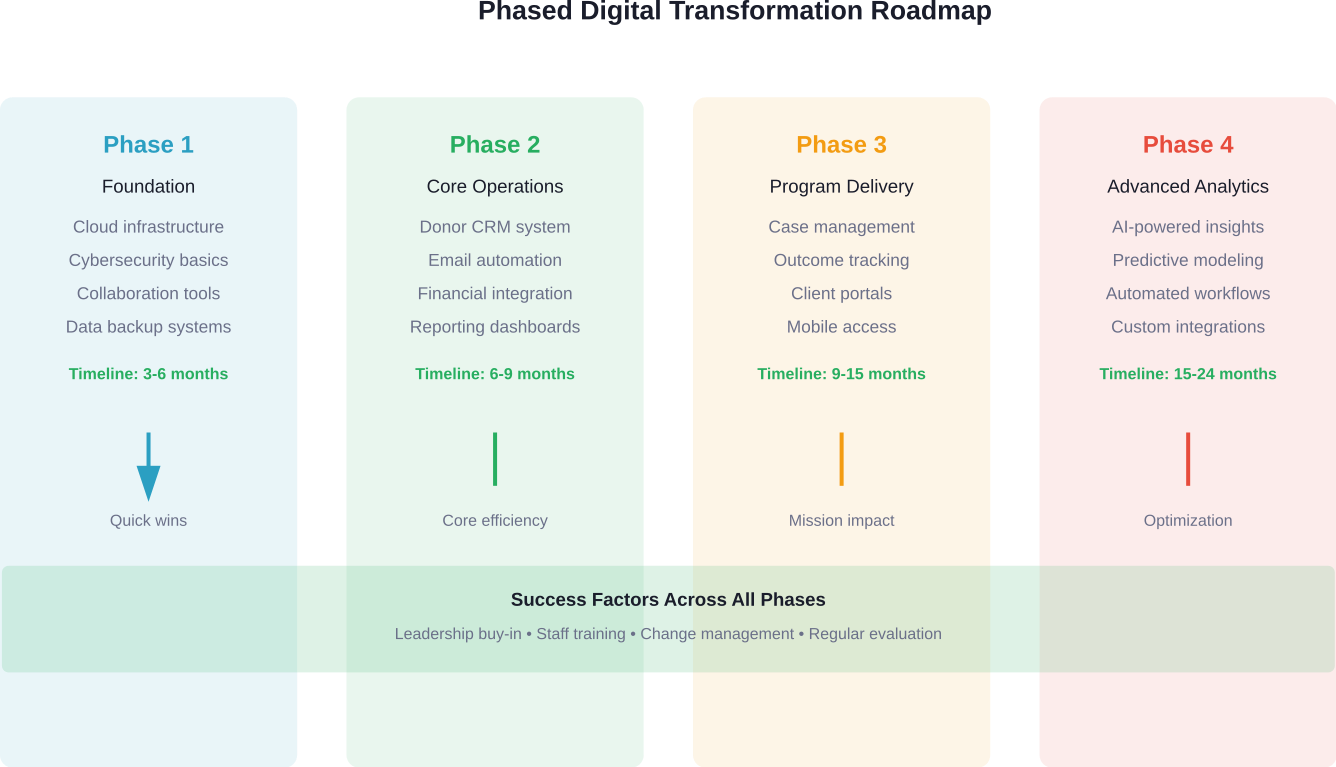
Phase Implementation Strategically
Attempting everything simultaneously guarantees failure. Break transformation into manageable phases with quick wins early.
Phase one might focus on foundational infrastructure—secure cloud storage, reliable email systems, basic collaboration tools. Phase two tackles donor management. Phase three addresses program delivery systems.
Early successes build momentum and buy-in for later, more complex changes. Staff see tangible benefits, which reduces resistance to subsequent phases.

Invest in Training and Change Management
New systems fail when staff can’t or won’t use them. Training can’t be a one-time orientation. It needs ongoing support, documentation, and coaching.
Identify digital champions within each department—early adopters who can mentor colleagues and troubleshoot basic issues. Create peer learning opportunities where staff share tips and workflows.
Change management addresses emotional and cultural resistance. Communicate why changes matter. Celebrate small wins. And acknowledge that learning new systems feels uncomfortable at first.
Start Modernizing Your Nonprofit Systems With A-listware
Nonprofits often operate with limited resources while managing donations, reporting, and internal coordination across multiple tools. A-listware helps organizations modernize these systems by reviewing existing infrastructure and building digital solutions that simplify data management, automate routine processes, and improve collaboration between teams. Their work usually focuses on replacing outdated tools with more structured platforms that support everyday operations.
The team also supports nonprofits with custom software development, cloud infrastructure, analytics, and long term technical support. Instead of adding more disconnected tools, the goal is to create systems that actually work together and make daily work easier for staff and volunteers. If your nonprofit relies on outdated software or manual workflows, contact A-listware and discuss how to move your operations to a more reliable digital setup.
Securing Funding for Digital Initiatives
The funding problem requires advocacy and creativity. Nonprofits need to make the case that technology investments drive mission outcomes, not distract from them.
Build technology costs into grant proposals explicitly. Quantify how system improvements will increase program reach or effectiveness. Show funders the return on investment in concrete terms—more clients served per dollar, faster response times, better outcome measurement.
Some organizations successfully negotiate overhead restrictions by demonstrating how specific technology enables grant deliverables. Others pursue dedicated technology grants from foundations that understand infrastructure needs.
Corporate partnerships offer another avenue. Many technology companies provide discounted or donated software through programs like TechSoup. These aren’t complete solutions, but they reduce acquisition costs significantly.
Critical Considerations: Cybersecurity and Data Privacy
Digital transformation expands attack surfaces. Nonprofits hold sensitive data—donor financial information, client health records, beneficiary demographics—that makes them targets.
Yet cybersecurity often gets treated as an afterthought. Budget constraints lead to inadequate protections. Staff lack awareness of phishing tactics and password hygiene. And incident response plans don’t exist.
Basic security hygiene isn’t optional: multi-factor authentication on all systems, regular software updates, encrypted data storage, access controls based on role requirements, and routine backups stored securely offsite.
NTEN’s Cybersecurity Resource Hub provides nonprofit-specific guidance and assessment tools. These resources help organizations identify vulnerabilities and prioritize security improvements within budget constraints.
Data privacy regulations like GDPR and state-level privacy laws add compliance requirements. Nonprofits need clear data policies covering collection, storage, usage, and deletion. Transparency with constituents about data practices builds trust.
Real-World Success Patterns
Organizations that succeed with digital transformation share common characteristics. Leadership commitment matters more than budget size. Executive teams that champion technology create permission for innovation throughout the organization.
Starting small with high-impact pilots works better than big-bang implementations. Proving value with quick wins builds credibility for larger initiatives.
External expertise accelerates progress. Consultants who understand nonprofit workflows can challenge assumptions and identify hidden roadblocks. They bring cross-sector insights and help avoid costly mistakes.
Finally, successful organizations embrace iteration. Digital transformation isn’t a destination. Technology evolves, organizational needs shift, and continuous improvement becomes the operating model.
| Erfolgsfaktor | What It Looks Like | Häufig zu vermeidende Fallstricke |
|---|---|---|
| Leadership Buy-In | Board and executives actively champion technology initiatives, include tech in strategic planning, allocate budget | Delegating all tech decisions to IT staff without strategic oversight, treating technology as separate from mission |
| Staff Engagement | Frontline staff participate in tool selection, receive ongoing training, have input on workflow design | Top-down mandates without user input, inadequate training, ignoring staff feedback about system problems |
| Phased Approach | Clear phases with defined milestones, quick wins early, evaluation between phases | Attempting everything simultaneously, no clear prioritization, scope creep without reassessment |
| Integration von Daten | Systems connected via APIs, single source of truth for key data, automated data flow between platforms | Accepting siloed systems, manual data transfer between tools, duplicate entry requirements |
| Änderungsmanagement | Clear communication about why changes matter, champions in each department, celebration of wins | Assuming staff will adapt automatically, no support for learning curve, ignoring resistance signals |
Looking Ahead: 2026 and Beyond
The gap between digitally mature nonprofits and those stuck in outdated systems will widen. Organizations that transform now gain compounding advantages in efficiency, donor engagement, and program effectiveness.
AI capabilities will become increasingly accessible and essential. Nonprofits that develop AI readiness—strong data governance, clean datasets, staff digital literacy—will leverage these tools effectively. Those that don’t risk falling further behind.
But technology alone won’t solve sector challenges. Food banks need technology and funding and policy reform. Social services need systems and staff and community trust. Digital transformation is necessary but not sufficient.
The most successful nonprofits will use technology strategically to amplify human capabilities, not replace them. They’ll ensure digital inclusion remains central to their approach. And they’ll demand that funders recognize technology as mission-critical infrastructure deserving investment.
Häufig gestellte Fragen
- How much should nonprofits budget for digital transformation?
Budget requirements vary widely based on organization size and current technology state. Generally speaking, technology costs should represent 3-10 percent of operating budgets for adequately resourced nonprofits. This includes software licenses, hardware, training, support, and staff time. Start by assessing current spending and identifying high-priority gaps rather than setting arbitrary targets.
- Should small nonprofits pursue digital transformation or wait until they grow?
Small organizations benefit enormously from right-sized digital tools. Cloud-based systems with affordable pricing tiers make transformation accessible at any size. Waiting creates technical debt that becomes harder to address later. Focus on foundational systems—donor management, email, collaboration—that provide immediate efficiency gains without overwhelming limited capacity.
- What’s the biggest mistake nonprofits make with digital transformation?
Treating it as a technology project rather than an organizational change initiative. Buying tools without addressing workflows, culture, and skills leads to expensive shelfware. Successful transformation requires equal investment in change management, training, and process redesign alongside technology acquisition.
- How can nonprofits address AI concerns about bias and equity?
Start by auditing AI tools for demographic bias in training data and outputs. Establish human oversight for AI-generated decisions affecting constituents. Prioritize vendors committed to algorithmic transparency and fairness. Include diverse voices in AI implementation decisions. And remember that AI should augment human judgment in mission work, not replace it entirely.
- What role should board members play in digital transformation?
Boards provide governance oversight, ensure adequate budget allocation, and hold leadership accountable for progress. Tech-savvy board members can offer expertise, but shouldn’t micromanage implementation. The board’s job is asking strategic questions: Does this align with mission? Are risks being managed? Is ROI being measured? Are staff supported through change?
- How do nonprofits measure digital transformation success?
Define metrics tied to organizational goals before starting. Common measures include staff time saved on administrative tasks, donor retention rates, program data completeness, constituent satisfaction scores, and cost per beneficiary served. Track baseline metrics, set improvement targets, and measure progress regularly. Qualitative indicators matter too—staff confidence with systems, ease of collaboration, and decision-making speed.
- Can nonprofits achieve digital transformation without dedicated IT staff?
Yes, with the right approach. Many small and mid-size nonprofits succeed using managed service providers, consultants, and volunteer tech expertise. Cloud-based tools reduce the need for in-house technical management. Focus on user-friendly systems with strong vendor support. Join nonprofit technology communities like NTEN for peer learning and resources. Consider part-time or fractional technology leadership rather than full-time hires initially.
Den ersten Schritt tun
Digital transformation feels overwhelming when viewed as a whole. Break it into manageable pieces.
Start with assessment. Where does technology currently hinder rather than help? What processes consume disproportionate staff time? Which stakeholder experiences need improvement most urgently?
Then identify one high-impact initiative—maybe migrating to integrated donor management, implementing collaboration tools, or automating monthly reporting. Make that Phase One.
Secure leadership buy-in by quantifying expected outcomes. Build a realistic budget including training and support. Create a timeline with clear milestones.
And remember: the organizations achieving digital maturity didn’t start there. They started exactly where most nonprofits are now—aware of the gap, uncertain about the path, but committed to forward movement.
The mission your organization serves deserves the efficiency, insight, and impact that thoughtful digital transformation enables. Technology won’t solve everything, but it can unlock the capacity to do more of what matters most.


