Kurze Zusammenfassung: Digital transformation for advertising represents the fundamental shift from traditional advertising methods to AI-powered, data-driven strategies that enable personalized customer experiences at scale. Companies now spend 19.9% of marketing budgets on marketing technology, projected to reach 30.9% within five years, as AI and automation reshape how brands connect with audiences across digital channels.
The advertising industry stands at a crossroads. Traditional methods that dominated for decades are giving way to sophisticated digital systems powered by artificial intelligence, automation, and real-time data analytics.
But here’s the thing—this isn’t just about swapping billboards for banner ads. The transformation runs deeper, fundamentally changing how brands understand audiences, deliver messages, and measure success.
According to Forrester, global tech spend reached $4.7 trillion in 2024, growing 5.3% as economic conditions improved. Media and advertising captured a significant portion of this investment, with companies betting heavily on technologies that promise better reach and engagement.
What Digital Transformation Actually Means for Advertising
Digital transformation in advertising refers to the comprehensive integration of digital technologies into all aspects of advertising operations. This fundamentally changes how agencies and brands create, distribute, and optimize campaigns.
The shift goes beyond simply adding digital channels. It involves rethinking entire workflows, data strategies, and customer engagement models.
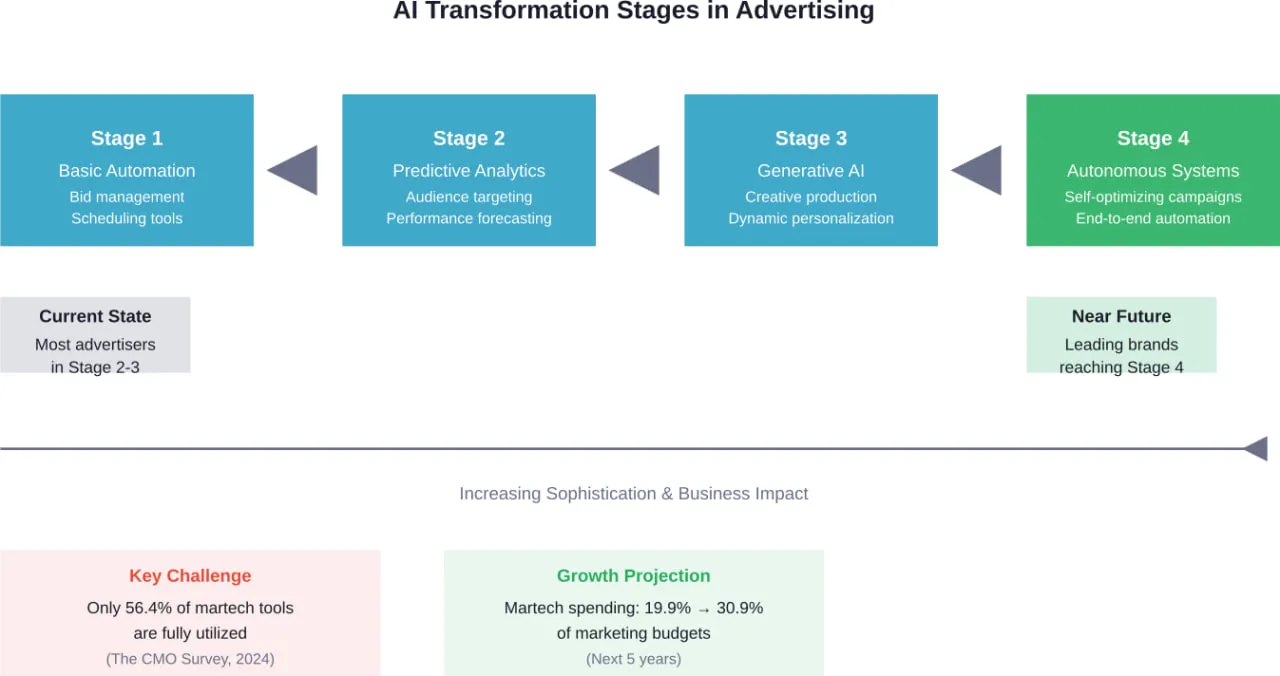
Marketing technology adoption has accelerated dramatically. Companies now allocate 19.9% of marketing budgets to martech, with projections showing this will grow to 30.9% over the next five years, according to The CMO Survey from Duke’s Fuqua School of Business.
Yet there’s a catch. Only 56.4% of purchased martech tools are being fully utilized, signaling a gap between adoption and effective implementation.
The Core Components Driving Change
Several key technologies form the foundation of advertising’s digital transformation:
- Artificial intelligence and machine learning for audience targeting and creative optimization
- Programmatic advertising platforms that automate media buying
- Customer data platforms that unify disparate data sources
- Marketing automation systems for personalized campaign delivery
- Advanced analytics and attribution modeling
In the USA alone, programmatic advertising spending reached approximately $123.22 billion in 2022, compared to $103.52 billion in 2021. The automation of media buying has become table stakes for competitive advertising operations.
Access Specialized Developers to Build High-Performance Adtech
Developing custom programmatic platforms, attribution models, or automated creative tools requires engineering talent that is often scarce and expensive to hire locally. For advertising agencies and networks, the delay in finding the right developers can lead to lost opportunities in a fast-moving market. A-Listware solves this by providing dedicated development teams and IT staff augmentation, allowing you to deploy the technical resources needed to build and scale your advertising technology.
- Engineering Expertise: Access developers skilled in high-load systems, data analytics, and cloud infrastructure.
- Faster Time-to-Market: Skip the lengthy recruitment cycle and start building your product immediately.
- Cost Control: Lower operational overhead by utilizing a flexible, external team model without compromising on quality.
- Direct Control: Dedicated developers work exclusively for you, integrating directly into your existing workflows.
Beginnen Sie Ihre digitale Transformation mit A-Listware.
AI’s Role in Reshaping Advertising Fundamentals
Artificial intelligence has moved from experimental to essential. The IAB’s State of Data 2025 report revealed that AI is set to transform the advertising industry at its core, though full transformation hasn’t arrived yet.
Look, the gap between potential and reality remains significant. The IAB’s 2026 research uncovered a disconnect between advertiser optimism and consumer sentiment toward AI-generated ads, prompting the release of the industry’s first AI Transparency and Disclosure Framework in January 2026.
This framework aims to balance transparency with operational efficiency, helping brands navigate responsible AI use without creating disclosure fatigue through universal labeling requirements.
Practical Applications Showing Results
Marketing Mix Modeling has re-emerged as a critical tool, but only when modernized for today’s reality. According to IAB’s December 2025 guidance, planning cycles are moving faster, privacy constraints are limiting identifiers, and traditional MMM approaches can’t keep pace.
The solution? AI-powered MMM that incorporates real-time data streams and adapts to signal loss from privacy regulations.
Digital audio presents another interesting case. While 80% of Americans listen to digital audio monthly, the channel lags in advertising investment. IAB’s guide on measuring digital audio in MMM explores why this gap exists and how better measurement can unlock budgets.
The Data Transparency Challenge
Transparency remains a long-standing challenge in advertising. While ad spending grows by leaps and bounds, trust in advertising transparency continues to fall.
The statistics are sobering: around 74% of marketers would increase ad spending by as much as 50% if they had better transparency into where their money goes and what results it generates.
That’s a massive amount of potential revenue locked behind trust issues.
First-Party Data Becomes Essential
Privacy regulations have accelerated the shift toward first-party data strategies. Brands can no longer rely on third-party cookies and external data brokers to the same degree.
This forces a fundamental rethinking of data collection and audience building. Companies must now create direct relationships with customers, gathering data through owned channels and interactions.
The FTC’s guidelines on online advertising and marketing emphasize that truth-in-advertising standards apply across digital channels, with specific attention to how websites and apps collect and use consumer information.
Personalisierung in großem Maßstab
Personalized experiences across channels represent one of digital transformation’s most significant opportunities. Customers expect brands to recognize them and tailor messages to their preferences, regardless of touchpoint.
According to a study by McKinsey, firms that engage in co-creation claim a 20 percent increase in consumer satisfaction and willingness to pay premium prices.
But delivering personalization requires sophisticated data infrastructure, content management systems, and automation platforms working in concert.
| Personalization Level | Technology Required | Typical Results | Komplexität der Implementierung |
|---|---|---|---|
| Basic Segmentation | Email platform, CRM | 10-15% engagement lift | Niedrig |
| Behavioral Targeting | Analytics, DMP, automation | 20-30% engagement lift | Mittel |
| Dynamic Content | CDP, CMS, AI engines | 35-50% engagement lift | Hoch |
| Real-time 1:1 | AI, streaming data, orchestration | 50%+ engagement lift | Sehr hoch |
The Channel Coordination Problem
Delivering consistent personalization across email, social media, websites, mobile apps, and offline channels requires orchestration tools that most organizations still lack.
Different teams often manage different channels using separate platforms with isolated data. Breaking down these silos represents a major hurdle in digital transformation efforts.
Reaching Younger Audiences in Digital Environments
Forrester’s Q2 2023 B2C Marketing CMO Pulse Survey found that 86% of B2C marketing executives said finding better ways to reach Gen Z and Millennials is a priority.
These audiences spend their entertainment time on nonpremium video and gaming environments, with around 40% of young adults in the US and the UK saying that they’re on TikTok constantly.
Traditional advertising approaches don’t resonate. These demographics expect authenticity, value exchange, and entertainment—not interruption.
The rise of generative AI, combined with stabilizing advertising revenue, gave media companies renewed confidence in 2024, according to Forrester’s predictions. Meta’s strong Q2 performance and the overall resilience of platforms like Google, Meta, and TikTok despite legal challenges demonstrated the industry’s fundamental strength.
Automation of Advertising Operations
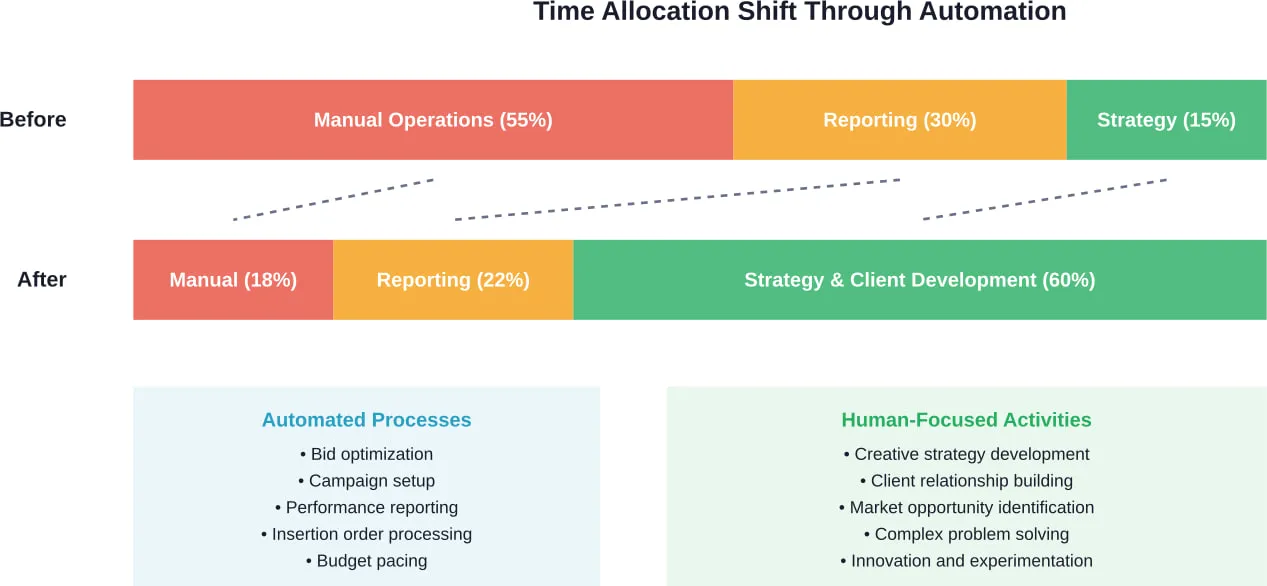
Repeatable processes in ad sales teams have become prime candidates for automation. Manual tasks that once consumed hours—proposal generation, insertion order processing, campaign reporting—can now be handled by software.
This frees teams to focus on strategic activities: developing creative concepts, building client relationships, and identifying new opportunities.
The ROI of Process Automation
Automation delivers benefits beyond time savings. Error rates drop significantly when systems handle data entry and calculations. Consistency improves across campaigns and clients.
Response times accelerate—proposals that took days can be generated in hours. Campaign optimizations that happened weekly can occur in real-time.
Implementation Challenges That Derail Transformation
Many businesses say they don’t have the budget to properly embark on digital transformation. According to IDC, companies spend as much as 90% of IT budgets on current systems, leaving little for future investments.
Legacy systems and the services that support them consume huge portions of digital budgets. In fact, 68% of digital business leaders plan to increase budgets for tech maintenance and updates, according to Forrester. About 25% of this budget will be redirected toward new tech implementations and strategies.
The Skills Gap
Technology is only part of the equation. Organizations need people who understand how to leverage these tools effectively.
The CMO Survey found that while martech spending is increasing, only 56.4% of tools are being used to their full potential. This utilization gap often stems from insufficient training, unclear processes, or lack of integration with existing workflows.
Marketing professionals must blend cutting-edge technology knowledge with customer insights. This combination of technical and strategic skills remains scarce in the talent market.
Komplexität der Integration
Modern marketing stacks often include 20-30 different tools. Getting these systems to communicate and share data seamlessly presents enormous technical challenges.
APIs break, data formats conflict, and systems that should work together often require expensive middleware or custom development to integrate properly.
| Challenge Category | Primary Issue | Impact on Timeline | Typical Solution |
|---|---|---|---|
| Haushaltszwänge | 90% spent on legacy systems | Delays start by 6-12 months | Phased implementation approach |
| Qualifikationsdefizit | Low tool utilization rates | Reduces ROI by 40-50% | Training programs and hiring |
| Fragen der Integration | System incompatibility | Extends timeline by 3-6 months | Middleware or platform consolidation |
| Veränderungswiderstand | Team adoption reluctance | Limits effectiveness indefinitely | Change management and incentives |
Measuring Success in Digital Advertising
Marketing performance has never mattered more—and yet the systems used to measure it are under strain. Privacy regulation, signal loss, platform-embedded optimization, and fragmented data environments have made it harder to connect media exposure to outcomes with confidence.
The IAB’s State of Data 2026 report explores how AI is reshaping marketing measurement, from attribution to MMM, and identifies gaps that must be closed to scale responsibly.
Real talk: traditional metrics like impressions and clicks no longer tell the full story. Advertisers need to understand business outcomes—revenue influenced, customer lifetime value impact, brand perception shifts.
Attribution in a Privacy-First World
Multi-touch attribution models that relied on tracking users across devices and platforms are breaking down as privacy regulations expand and third-party cookies disappear.
Measurement strategies must evolve to work within these constraints. Techniques include:
- Incrementality testing to isolate true campaign impact
- Media mix modeling updated with faster refresh rates
- Conversion lift studies using holdout groups
- Synthetic control methods for causal inference
Industry Standards Shaping the Future
The IAB released General Terms for Digital Advertising Agreements for public comment in May 2025, aiming to cut complexity, lower costs, and speed deal-making across the digital ecosystem.
After more than one year of collaboration with agencies, brands, publishers, and technology providers, the framework addresses common friction points in advertising contracts.
Standards like these create a foundation for interoperability. When systems and agreements follow common frameworks, integration becomes easier and innovation accelerates.
The IAB’s AI Transparency and Disclosure Framework, released in January 2026, provides another example. It helps balance transparency with operational efficiency, avoiding disclosure fatigue while maintaining consumer trust.
Practical Steps to Start Transformation
So how do organizations actually begin this journey? The scope can feel overwhelming, but successful transformations typically follow a pattern.
Start with Data Infrastructure
Before adding sophisticated tools, establish a solid data foundation. This means:
- Auditing current data sources and quality
- Implementing a customer data platform or data warehouse
- Establishing data governance policies
- Creating unified customer identifiers where privacy allows
Without clean, accessible data, advanced tools can’t deliver their promised value.
Prioritize High-Impact Use Cases
Don’t try to transform everything at once. Identify specific use cases where digital tools can deliver measurable improvements quickly.
Common high-impact starting points include campaign reporting automation, audience segmentation refinement, or creative testing frameworks.
Win early, demonstrate value, build momentum. Then expand to more complex use cases.
Invest in Team Capabilities
Technology without skilled operators delivers little value. Allocate budget for training existing teams and hiring specialized talent where needed.
Consider the mix of in-house expertise versus agency partnerships. Many organizations find success with a hybrid model—strategic capabilities in-house, specialized execution through partners.
Der Weg in die Zukunft
Digital transformation in advertising isn’t a destination—it’s an ongoing evolution as technology advances and consumer behaviors shift.
AI capabilities will continue expanding. Privacy regulations will tighten further. New channels and formats will emerge.
Organizations that build adaptable systems, invest in continuous learning, and maintain focus on customer value will thrive. Those that treat digital transformation as a one-time project risk falling behind competitors who understand the perpetual nature of change.
The advertising industry stands at an inflection point. The tools and technologies exist to deliver more relevant, effective campaigns than ever before. But realizing that potential requires thoughtful strategy, proper investment, and commitment to fundamental operational change.
Häufig gestellte Fragen
- What percentage of marketing budgets should go toward digital transformation?
Companies currently spend 19.9% of marketing budgets on marketing technology, with projections showing growth to 30.9% over the next five years according to The CMO Survey. The right allocation depends on industry, current capabilities, and strategic priorities, but this range provides a helpful benchmark.
- How long does digital transformation typically take for advertising operations?
There’s no fixed timeline as transformation is ongoing rather than a single project. Initial implementations of core platforms typically take 6-18 months, but optimization and expansion continue indefinitely. Organizations should plan for multi-year journeys rather than quick fixes.
- What’s the biggest obstacle to successful digital transformation in advertising?
Budget constraints rank high, with companies spending up to 90% of IT budgets maintaining legacy systems according to IDC. However, the skills gap and low utilization rates often present bigger challenges—only 56.4% of purchased martech tools are fully utilized, suggesting adoption and expertise issues limit success more than technology availability.
- How does AI transparency affect advertising effectiveness?
The IAB’s 2026 research revealed a disconnect between advertiser optimism and consumer sentiment toward AI-generated ads. The AI Transparency and Disclosure Framework released in January 2026 aims to close this trust gap through balanced disclosure practices that build credibility without creating disclosure fatigue.
- Can small advertising agencies compete in a digitally transformed landscape?
Yes, though the approach differs from large agencies. Smaller agencies can leverage cloud-based platforms that require lower upfront investment, focus on specialized niches where they can build deep expertise, and partner with technology providers for capabilities they can’t build in-house. Agility and focus often trump scale in digital environments.
- What role does programmatic advertising play in digital transformation?
Programmatic advertising represents a fundamental shift from manual media buying to automated, data-driven purchasing. In the USA alone, programmatic advertising spending is expected to reach nearly $95 billion in 2022, compared to $79 billion in 2021. It’s become table stakes for competitive operations, enabling real-time optimization and audience targeting at scale.
- How do privacy regulations impact digital transformation strategies?
Privacy regulations fundamentally reshape data strategies, forcing shifts from third-party to first-party data collection. This accelerates investment in owned channels, customer data platforms, and direct relationship building. While adding complexity, these constraints also push innovation in privacy-preserving measurement techniques like incrementality testing and synthetic controls.
Mit Zuversicht voranschreiten
The advertising industry’s digital transformation continues accelerating. Organizations that approach this shift strategically—balancing technology investment with skills development, starting with high-impact use cases, and maintaining focus on customer outcomes—position themselves for sustained success.
The data shows clear momentum. Tech spending is growing, AI capabilities are maturing, and the tools for delivering personalized experiences at scale are more accessible than ever.
What separates successful transformations from failed attempts? Realistic expectations, proper resource allocation, and commitment to ongoing evolution rather than one-time projects.
Start where current pain points are sharpest. Build from there. The transformation journey may be long, but the competitive advantages it delivers make the effort worthwhile.


