Résumé rapide : Digital transformation for service businesses involves integrating modern technology into all aspects of service delivery, operations, and customer experience. It enhances efficiency, customer satisfaction, and competitive advantage through automation, data-driven insights, and digital tools. Nearly half of all digital transformations aim to deliver uniquely better customer experiences while addressing challenges like inefficient scheduling, communication breakdowns, and resource constraints.
Service businesses face a stark reality: inefficient scheduling, communication breakdowns, and mountains of paperwork consume resources daily. With budgets tightening and skilled labor becoming scarcer, these operational challenges aren’t just inconvenient—they’re existential threats.
But here’s where it gets interesting. Digital transformation offers service organizations a path forward, fundamentally reshaping how they operate and deliver value to customers.
What Digital Transformation Means for Service Organizations
Digital transformation bridges the gap between traditional service delivery and modern customer expectations. According to Gartner’s definition, it involves applying digital technologies to support overall business strategy.
For service businesses specifically, this means more than just adopting new software. It’s about rethinking entire operational models.
The Digital Government Strategy was issued by the Federal Chief Information Officer in 2012, but it was a White House initiative (Office of Management and Budget) for all federal agencies, not a specific recognition by the U.S. Small Business Administration. This wasn’t just government bureaucracy—it signaled a fundamental change in how organizations needed to approach customer interaction.
Les éléments essentiels
Service business transformation typically encompasses several key areas. Technology infrastructure forms the foundation, but that’s just the starting point.
Process optimization follows, streamlining workflows that have remained unchanged for decades. Then comes data utilization—turning raw information into actionable insights that drive decision-making.
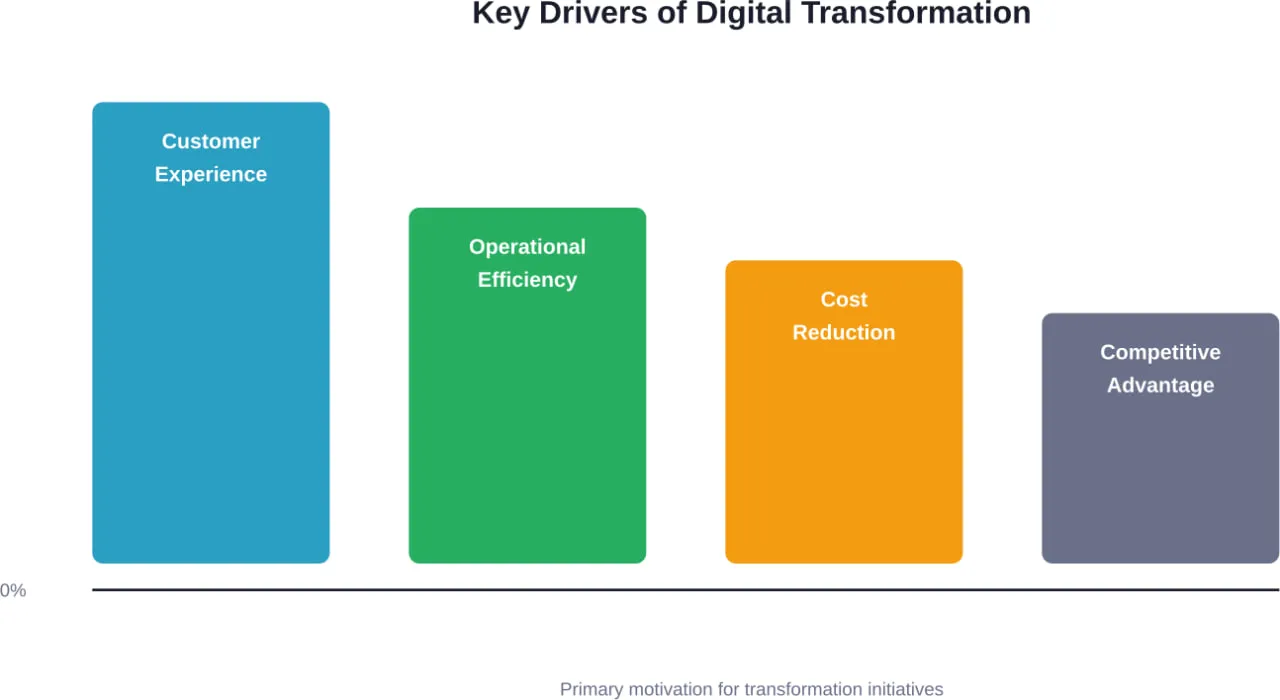
Customer experience sits at the center of everything. Research indicates that the key driving factor for nearly half of all digital transformations is the ability to provide uniquely better customer experiences.
Scale Your Service Platform with Dedicated Technical Talent
Transitioning to a digital-first service model requires reliable software to handle scheduling, client communications, and automated billing. Many service businesses struggle with the high cost and long timelines of hiring local developers to build these custom tools. A-Listware solves this by providing dedicated engineering teams and IT staff augmentation, allowing you to deploy professional software solutions without the overhead of a traditional in-house IT department.
- Vetted Developers: Access specialists in mobile app development, cloud infrastructure, and data security.
- Cost Efficiency: Reduce the expenses associated with recruitment, office space, and employee benefits.
- Déploiement rapide : Scale your technical capacity quickly to meet new project demands or seasonal peaks.
- Intégration directe : Dedicated teams work as a seamless extension of your business to modernize legacy systems.
Commencez votre transformation numérique avec A-Listware.
Why Service Businesses Must Transform Now
The pressure to digitize isn’t just about keeping up with trends. Real operational challenges demand immediate attention.
Field service management teams contend with scheduling nightmares daily. Communication gaps lead to missed appointments and frustrated customers. Paper-based systems create delays and errors that cascade through entire organizations.
With tightening budgets and worsening skilled labor shortages, organizations can’t afford to waste resources on inefficient processes. Digital transformation directly addresses these pain points.
The Financial Reality
Organizations can’t ignore the investment required. A Forbes and McKinsey study found that $900 billion was wasted on digital transformation initiatives, with 70% of projects failing.
That’s a sobering statistic. But it doesn’t mean transformation should be avoided—it means it must be done strategically.
More recent research on AI implementation costs reveals that becoming an AI-enabled organization requires long-term commitment. Technology, data integration, and talent investments all add up quickly.
Harvard Business School research from November 25, 2025 emphasizes that while AI can accelerate insights and increase efficiency, achieving those benefits demands significant upfront investment.
Essential Capabilities for Service Business Transformation
Field service operations represent one of the most transformation-ready areas in service businesses. Seven core capabilities drive successful digitization in this space.
Ordonnancement et répartition intelligents
Manual scheduling wastes hours every week. Digital platforms optimize technician assignments based on skills, location, availability, and job requirements automatically.
This capability alone transforms operational efficiency. Technicians spend more time serving customers and less time driving or waiting for assignment clarity.
Mobile Workforce Enablement
Technicians need access to information in the field. Mobile applications provide real-time access to customer history, service documentation, and troubleshooting guides.
Communication flows bidirectionally. Field workers update job status instantly while office teams monitor progress and respond to changing circumstances.
Données et analyses en temps réel
Data becomes truly valuable when it informs decisions. Service management platforms collect information from every customer interaction, job completion, and system transaction.
Analytics turn this data into insights about performance trends, customer satisfaction patterns, and operational bottlenecks. Organizations can identify problems before they escalate.
Customer Self-Service Portals
Customers expect convenience. Self-service portals let them schedule appointments, track technician arrival, access service history, and submit feedback without phone calls or emails.
This reduces administrative burden while improving customer satisfaction. People appreciate control over their service experience.
| Digital Capability | Bénéfice principal | Complexité de la mise en œuvre |
|---|---|---|
| Programmation intelligente | Reduces travel time 30-40% | Moyen |
| Mobile Workforce Tools | Eliminates paperwork delays | Faible à moyen |
| Real-Time Analytics | Improves decision speed | Haut |
| Self-Service Portals | Reduces call volume 25-35% | Moyen |
| Intégration de l'IdO | Enables predictive maintenance | Haut |
| Payment Automation | Accelerates cash flow | Faible |
| Knowledge Management | Reduces resolution time | Moyen |
Intégration avec les systèmes existants
Digital tools can’t exist in isolation. Integration with enterprise resource planning systems, customer relationship management platforms, and accounting software ensures data consistency.
The National Institute of Standards and Technology published guidance on July 20, 2021 about supporting digital transformation with legacy components. Organizations don’t need to abandon existing investments—they need to connect them strategically.
Professional Services Face Unique Transformation Challenges
Professional services organizations—consultancies, legal firms, accounting practices, and similar businesses—face different pressures than field service operations.
The shift to remote work during the pandemic accelerated change. Organizations that resisted digital collaboration tools suddenly had no choice.
Subscription-Style Service Models
Traditional project-based billing is giving way to subscription models. Customers prefer predictable costs and ongoing relationships over one-time engagements.
This shift requires new operational capabilities. Service delivery must be standardized enough to scale while remaining flexible enough to address individual client needs.
Centralized Talent Pools
Geographic constraints used to limit who could work on which projects. Digital collaboration tools eliminate these boundaries.
Organizations can now build centralized talent pools, matching the best-qualified professionals to client needs regardless of location. This improves service quality while optimizing resource utilization.
Automation of Routine Work
Much professional services work involves repetitive tasks. Document preparation, data analysis, research, and reporting often follow predictable patterns.
Automation handles these tasks more efficiently. Professionals focus on high-value activities like strategy, relationship management, and complex problem-solving.
The Service Management Framework for Transformation
IT Service Management provides a proven framework for transformation. The ISO/IEC 20000-1 standard offers guidance that extends beyond IT departments.
Orange Business Services, part of the Orange Group which boasts 260 million customers across 28 countries and an annual sales revenue of EUR 41 billion, uses this standard to help organizations turn data into business assets.
Service management principles apply to any service business. Define services clearly. Establish service level agreements. Measure performance consistently. Continuously improve based on data.
Critical Success Factors for Implementation
Digital transformation projects fail more often than they succeed. Understanding why helps organizations avoid common pitfalls.
Leadership Commitment
Transformation requires executive sponsorship. Technology investments mean nothing without organizational commitment to change.
Leaders must communicate vision clearly. They need to allocate resources, remove obstacles, and hold teams accountable for progress.
Change Management Focus
Technology is the easy part. People make transformation hard.
Employees resist change when they don’t understand it or fear it threatens their roles. Effective change management addresses these concerns proactively through communication, training, and involvement in the transformation process.
Starting with Business Outcomes
Too many organizations pick technology first and figure out applications later. This backwards approach leads to expensive tools that don’t solve real problems.
Define desired business outcomes first. What needs to improve? Customer satisfaction? Operational efficiency? Revenue growth? Cost reduction?
Then identify technology that drives those specific outcomes.
Measuring What Matters
Berkeley Executive Education research from September 17, 2025 challenges conventional wisdom about measuring transformation success. Return on investment may be the wrong metric entirely.
The research proposes Return on Efficiency as an alternative. Time savings and productivity gains matter more than pure revenue increases in many service contexts.
When marketing teams reduce content creation time from hours to minutes, or legal teams accelerate contract review, those efficiency gains create value even if revenue stays constant.
Les pièges les plus courants et comment les éviter
Understanding failure patterns helps organizations navigate transformation more successfully.
Underestimating Implementation Complexity
Organizations often expect transformation to happen faster and easier than reality allows. Systems don’t integrate seamlessly. Data migration uncovers quality issues. Users need more training than anticipated.
Build realistic timelines with buffer for inevitable complications. Plan for the unexpected.
Neglecting Cybersecurity
Digital transformation expands the attack surface for cyber threats. More connected systems mean more potential vulnerabilities.
The National Institute of Standards and Technology maintains a comprehensive Cybersecurity Framework specifically to help organizations manage risk during digital change. Cybersecurity can’t be an afterthought—it must be built into transformation from the beginning.
Ignoring the Human Element
Industry expert Sami Kallio noted that digital transformation efforts must be built around people and their expectations, not the technology itself.
Organizations that focus exclusively on technical implementation miss the point. Service businesses exist to serve people—both customers and employees. Technology should enhance those human relationships, not replace them.
| Common Pitfall | Warning Signs | Stratégie de prévention |
|---|---|---|
| Poor executive buy-in | Inconsistent funding, conflicting priorities | Secure commitment before starting |
| Inadequate training | Low adoption rates, workarounds | Invest in comprehensive training programs |
| Technology-first approach | Tools seeking problems to solve | Define business outcomes first |
| Weak change management | Resistance, complaints, turnover | Communicate early and often |
| Ignoring data quality | Unreliable reports, duplicate records | Clean data before migration |
| Attempting too much | Project delays, scope creep | Phase implementation strategically |
Practical Steps to Begin Transformation
Where should service businesses start? The journey seems overwhelming when viewed as a whole.
Break it into manageable phases.
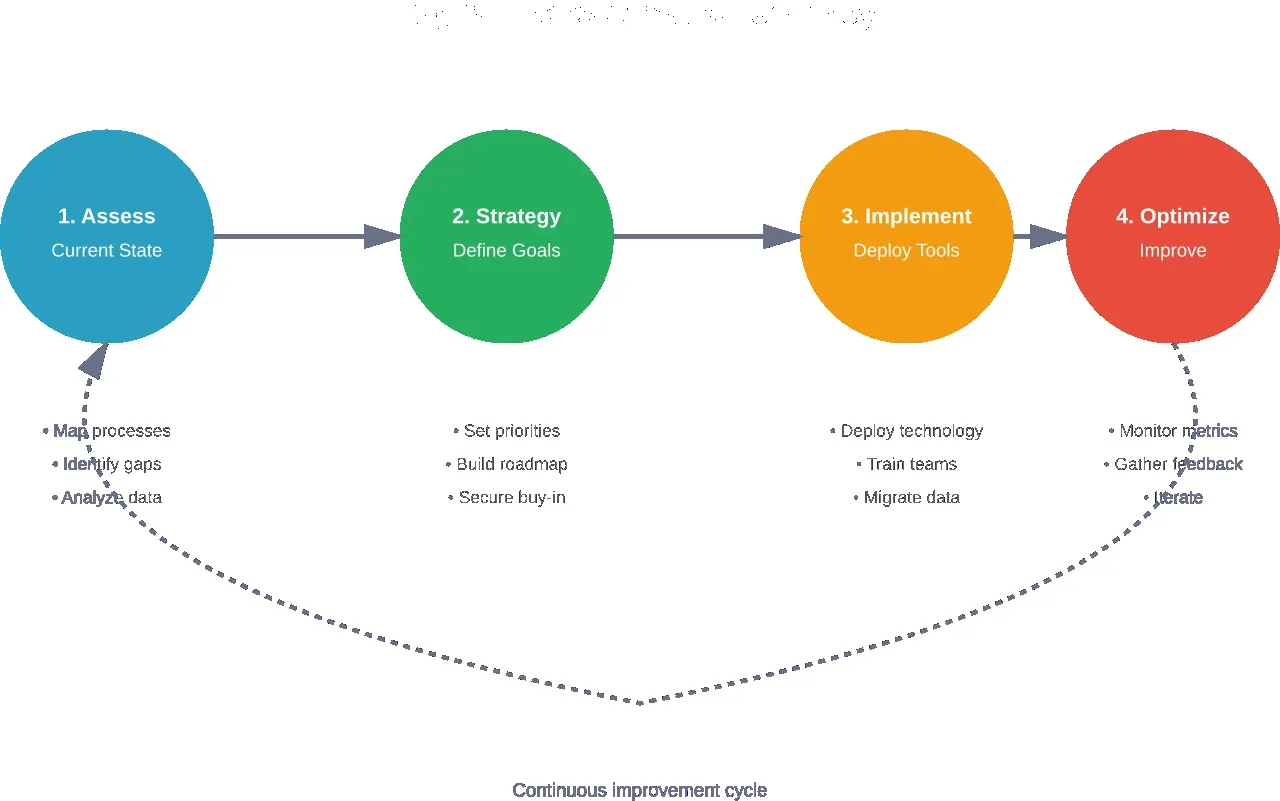
Phase One: Assessment and Planning
Document current processes thoroughly. Where do bottlenecks occur? What tasks consume the most time? Which customer complaints repeat most frequently?
Talk to frontline employees. They understand operational realities better than executives often realize.
Analyze existing data. Even organizations without sophisticated analytics typically have useful information buried in spreadsheets, databases, and transaction logs.
Phase Two: Quick Wins
Identify high-impact, low-complexity improvements. These quick wins build momentum and demonstrate value.
Perhaps that’s automating appointment confirmations. Maybe it’s implementing mobile access to work orders. Could be digitizing paper forms that technicians currently complete by hand.
Quick wins prove the concept and generate enthusiasm for larger changes.
Phase Three: Core Platform Implementation
After proving value with quick wins, tackle more substantial platform investments. This might mean implementing a comprehensive field service management system or adopting an integrated service management platform.
These larger projects require careful planning, phased rollout, and intensive change management.
Phase Four: Advanced Capabilities
Once core platforms are stable, organizations can add advanced capabilities. Predictive analytics. Artificial intelligence for scheduling optimization. Internet of Things integration for proactive maintenance.
Advanced capabilities deliver significant value but require mature operational foundations.
Mesurer le succès de la transformation
How do organizations know if transformation efforts are working? Multiple metrics matter.
Customer-Focused Metrics
Customer satisfaction scores should improve. Net promoter scores indicate whether customers would recommend services to others. First-contact resolution rates show whether issues get solved efficiently.
These metrics directly measure whether transformation enhances customer experience—the primary goal for nearly half of all transformation initiatives.
Operational Efficiency Indicators
Time to complete service calls should decrease. Technician utilization rates should increase. Administrative overhead should decline.
These efficiency gains translate directly to cost savings and capacity for growth.
Performance financière
Revenue per employee indicates productivity improvements. Profit margins show whether efficiency gains reach the bottom line. Cash flow metrics reveal whether process improvements accelerate payment collection.
But remember Berkeley’s insight: traditional ROI measurements may miss important value creation.
The Government Perspective on Small Business Digitization
The U.S. Small Business Administration hasn’t just encouraged digital transformation—it has actively facilitated it.
In January 2022, the SBA partnered with Business Forward to launch the Small Business Digital Alliance. This public-private collaboration helps small businesses accelerate online and social media strategies to power e-commerce and better engage customers.
More recently, in July 2024, Administrator Isabel Casillas Guzman announced the transformation of customer experience for federal contracting certifications. The MySBA Certifications platform gives small business owners an enhanced digital experience for applying and managing certifications for programs including Women-Owned Small Business, Veteran-Owned Small Business, and related designations.
These government initiatives recognize that small service businesses need support navigating digital transformation. The resources exist—organizations just need to access them.
Looking Toward the Future
Digital transformation isn’t a destination. It’s an ongoing journey of adaptation and improvement.
As the world continues rebounding from the global pandemic, 80% of organizations have accelerated their digital transformation initiatives. This shift is permanent.
Service businesses that resist transformation risk obsolescence. Competitors will deliver better experiences, operate more efficiently, and adapt faster to changing customer expectations.
But transformation doesn’t require perfection. It requires commitment to continuous improvement, willingness to experiment, and focus on delivering value to customers and employees alike.
Start where it makes sense for your organization. Build on successes. Learn from failures. Keep moving forward.
Questions fréquemment posées
- What is digital transformation for service businesses?
Digital transformation involves integrating modern technology throughout all aspects of a service business, fundamentally changing how the organization operates and delivers value. It encompasses process automation, data analytics, mobile capabilities, and customer-facing digital tools that improve efficiency and experience.
- How much does digital transformation cost for a service business?
Costs vary dramatically based on organization size, existing technology infrastructure, and transformation scope. Small implementations might cost tens of thousands, while enterprise-wide transformations can require millions. Focus on phased approaches that deliver quick wins before major platform investments to manage costs and demonstrate value progressively.
- Why do so many digital transformation projects fail?
Research shows 70% of digital transformation projects fail, often due to inadequate change management, poor executive sponsorship, technology-first approaches that ignore business outcomes, underestimated complexity, and insufficient attention to people and culture. Success requires equal focus on technology, process, and human elements.
- Combien de temps dure la transformation numérique ?
Transformation is an ongoing journey rather than a finite project. Initial quick wins might take weeks or months, core platform implementations typically require 6-18 months, and full maturity takes years. Organizations should think in terms of continuous improvement rather than completion.
- What metrics should service businesses track during transformation?
Track customer satisfaction scores, first-contact resolution rates, technician utilization, time to complete service calls, administrative overhead, revenue per employee, and cash flow metrics. Consider Return on Efficiency alongside traditional ROI, measuring time savings and productivity gains that may not immediately show in revenue increases.
- Do service businesses need to replace all existing systems?
Not necessarily. The National Institute of Standards and Technology provides guidance on supporting digital transformation with legacy components. Integration often makes more sense than wholesale replacement. Modern platforms can connect existing systems, preserving past investments while adding new capabilities.
- How can small service businesses afford digital transformation?
Small businesses should start with affordable quick wins that demonstrate value before major investments. The U.S. Small Business Administration offers resources through the Small Business Digital Alliance. Cloud-based platforms reduce upfront costs through subscription models. Focus on solving specific pain points rather than attempting comprehensive transformation immediately.
Agir pour la transformation numérique
Service businesses can’t afford to delay digital transformation. Customer expectations continue rising. Competitive pressures intensify. Operational inefficiencies compound.
But successful transformation doesn’t happen accidentally. It requires strategy, commitment, and disciplined execution.
Start by assessing current capabilities honestly. Identify the biggest pain points limiting growth or frustrating customers. Define clear business outcomes that matter most to your organization.
Then take action. Build momentum with quick wins. Invest in core platforms that address priority needs. Measure results rigorously and adjust based on data.
The organizations that thrive in the coming years will be those that embrace change, learn continuously, and put both customers and employees at the center of transformation efforts.
Digital transformation isn’t about technology. It’s about building service businesses capable of delivering exceptional value in an increasingly digital world.


