Résumé rapide : La transformation numérique des stations de radio implique l'adoption de plateformes de diffusion en continu, de podcasts, d'applications mobiles et d'analyses de données pour atteindre le public sur plusieurs canaux. Les stations qui réussissent équilibrent la diffusion traditionnelle et la distribution numérique, en tirant parti de stratégies de contenu multiplateforme et d'informations sur l'audience. La transformation nécessite des mises à niveau de l'infrastructure technique, des flux de travail pour la réutilisation du contenu et un changement culturel vers une pensée numérique d'abord, tout en conservant les forces fondamentales de la radio, à savoir la confiance et la connexion locale.
Il y a vingt ans, le secteur de la radio était confronté à ce qui semblait être une menace existentielle. Les services de diffusion en continu, les médias sociaux et le contenu à la demande ont commencé à détourner les oreilles des signaux de diffusion traditionnels. Nombreux étaient ceux qui prédisaient la disparition de la radio.
Mais voilà, la radio ne s'est pas contentée de survivre. Elle a évolué.
Aujourd'hui, les stations de radio fonctionnent comme des entreprises médiatiques multiplateformes, distribuant du contenu sur des signaux FM/AM, des applications de streaming, des podcasts, des médias sociaux et des haut-parleurs intelligents. Les stations qui prospèrent dans cet environnement n'ont pas abandonné leurs points forts. Elles les ont étendus aux canaux numériques tout en s'adaptant à la façon dont le public consomme désormais le contenu audio.
Selon les ressources industrielles de NAB.org, cultiver une large audience numérique est une priorité absolue pour de nombreux programmateurs de stations, les revenus durables provenant des plateformes numériques étant une priorité pour de nombreux directeurs de stations.
La transformation n'est plus facultative. C'est une question de survie.
Pourquoi la radio a besoin d'une transformation numérique
La radiodiffusion traditionnelle a bâti son empire sur un modèle simple : émettre un signal, attirer des auditeurs, vendre de la publicité en fonction de la taille estimée de l'audience. Cela a fonctionné à merveille pendant des décennies.
Puis l'ère numérique est arrivée et a tout changé.
Le comportement du public a radicalement changé. Les gens ont commencé à consommer des contenus audio à la demande plutôt que de les écouter à des heures programmées. Les habitudes de déplacement ont changé. Les appareils intelligents ont proliféré. La concurrence a explosé à partir de sources qui n'existaient même pas il y a quinze ans.
En réalité, les stations de radio qui ont attendu trop longtemps pour s'adapter ont vu leur part d'audience fondre au profit de Spotify, des réseaux de podcasts et des plateformes de diffusion en continu qui offraient une personnalisation, un accès à la demande et des expériences multi-appareils.
L'industrie a été confrontée à des perturbations, mais elle a aussi découvert des opportunités. Les plateformes numériques offrent ce que la radiodiffusion traditionnelle n'a jamais pu offrir : des données d'audience détaillées, des relations directes avec les auditeurs et des canaux de distribution qui s'étendent bien au-delà des zones géographiques de radiodiffusion.
Ce que la transformation numérique signifie réellement pour les stations de radio
La transformation numérique ne se limite pas à l'ajout d'une application de diffusion en continu. Il s'agit de repenser fondamentalement la manière dont les stations de radio créent, distribuent et monétisent leur contenu.
Pour la station de radio publique KUOW à Seattle, la transformation numérique signifiait l'élaboration d'une stratégie équilibrant l'investissement et le retour sur investissement. Depuis les années 1950, KUOW est une source fiable de nouvelles et d'informations pour sa communauté par le biais de la radiodiffusion traditionnelle. À l'ère du numérique et du mobile, elle a dû maintenir cette confiance tout en répondant aux attentes des auditeurs là où ils consomment désormais du contenu.
Les éléments essentiels
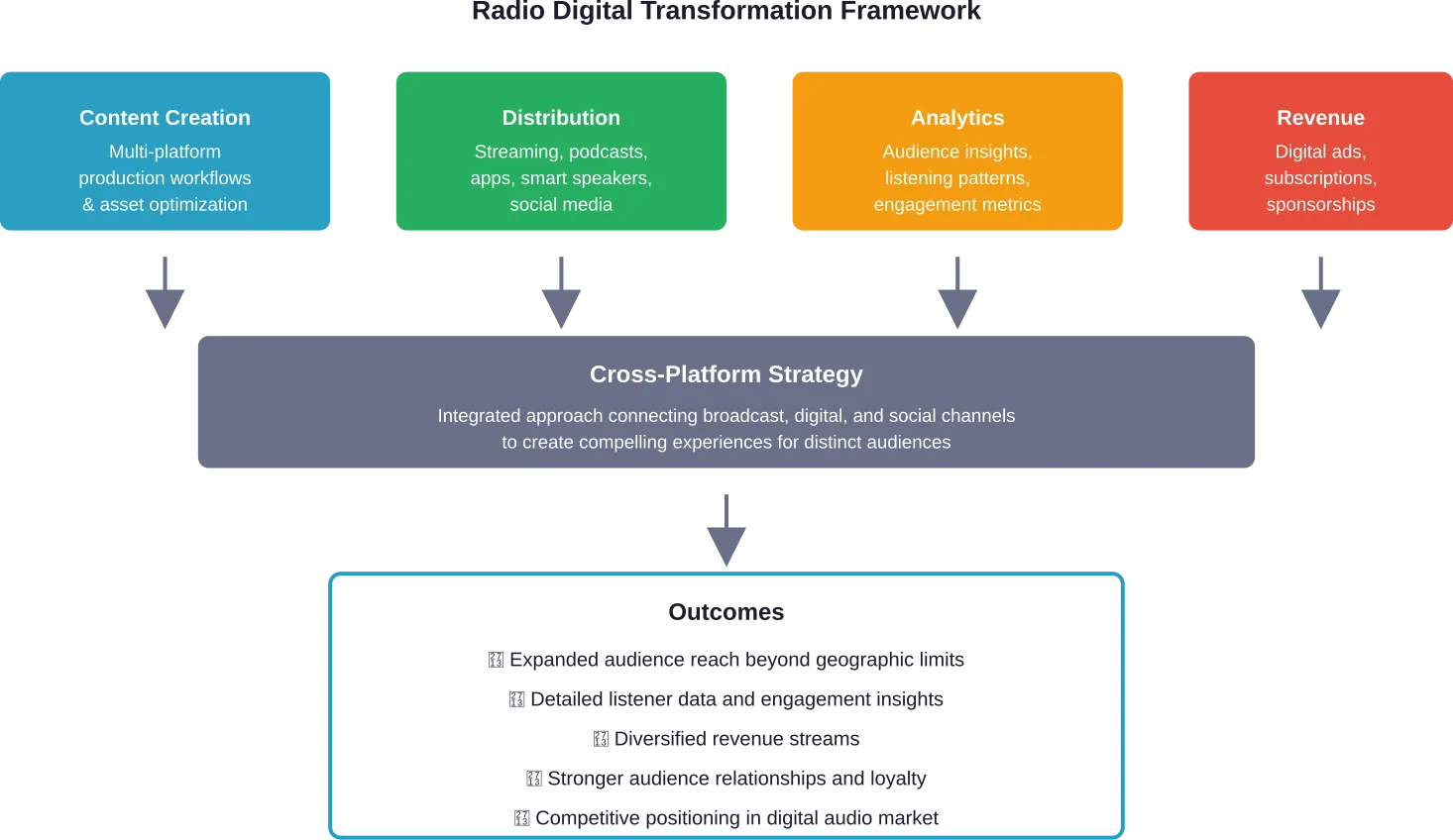
Une transformation numérique réussie touche tous les aspects des opérations des stations :
- Des flux de travail pour la création de contenu qui produisent des actifs optimisés pour plusieurs plateformes simultanément
- Infrastructure de distribution couvrant les applications de diffusion en continu, les flux de podcasts, les médias sociaux et les compétences des haut-parleurs intelligents
- Des analyses d'audience qui révèlent les habitudes d'écoute, les préférences et les mesures d'engagement.
- Des modèles de revenus qui vont au-delà de la publicité traditionnelle pour inclure des publicités numériques, des abonnements et du contenu sponsorisé.
- Systèmes techniques pour la production, l'édition et la distribution de fichiers audio numériques
La transformation numérique de l'enregistrement à l'antenne a en fait renforcé la confiance qui fait de la radio l'une des formes de communication les plus appréciées dans le monde. Les outils modernes d'édition audio permettent une production de meilleure qualité et une diffusion plus fiable du contenu.
Le modèle de réussite multiplateforme
Les stations qui réussissent leur transformation numérique ont une approche commune : elles ne traitent pas le numérique comme une entité distincte de la radiodiffusion traditionnelle. Elles créent des expériences multiplateformes intégrées.
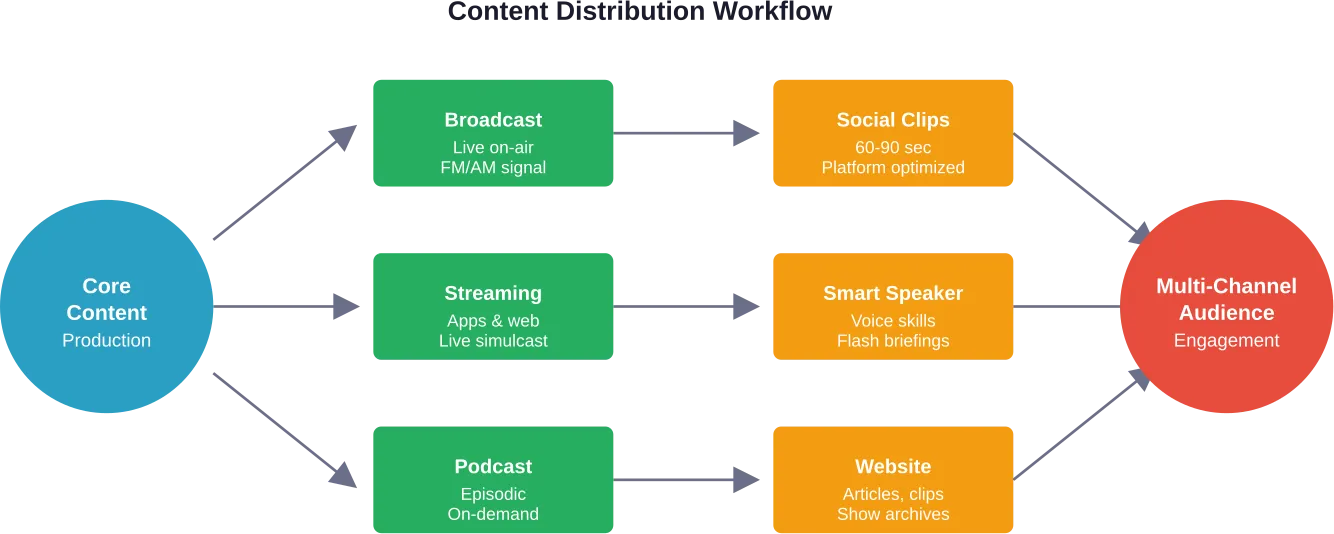
Qu'il s'agisse d'interviews musicales ou de podcasts axés sur la personnalité, l'objectif est de créer des expériences attrayantes qui trouvent un écho auprès de publics distincts sur différentes plateformes. Une émission matinale ne se contente plus d'être diffusée sur la bande FM : elle est retransmise en direct, découpée en segments de médias sociaux, transformée en épisodes de podcasts et génère du contenu écrit pour les sites web et les bulletins d'information.
Cette approche multiplateforme apporte un élément essentiel : elle permet de rencontrer le public là où il se trouve déjà plutôt que de l'obliger à se rendre sur les canaux de diffusion traditionnels.
Le numérique comme facteur d'évaluation et de revenus
Certaines stations ont découvert que les chaînes numériques ne se contentent pas de compléter la diffusion, mais qu'elles génèrent activement de l'audience et des revenus.
Les haut-parleurs intelligents ont permis d'augmenter la consommation de radio à domicile. Environ 25% de l'écoute numérique de la radio commerciale se fait sur des haut-parleurs intelligents. Bien que le succès de la radio ait fait couler beaucoup d'encre, il ne représente qu'un quart des 12% de radio écoutée sur n'importe quel appareil numérique.
Cette statistique révèle à la fois une opportunité et un défi. Après environ 15 ans de streaming audio et cinq ans de haut-parleurs intelligents dans les foyers, l'écoute de la radio sur des appareils numériques a été rapportée à 12% dans l'ensemble. Près de neuf minutes sur dix d'écoute de la radio se font encore par le biais de signaux de diffusion traditionnels.
Les stations qui comblent ce fossé s'efforcent de supprimer les obstacles à l'accès numérique, de créer des contenus spécifiquement optimisés pour les plateformes numériques et de donner au public des raisons convaincantes de les suivre sur tous les canaux.
| Plate-forme | Force primaire | Format du contenu | Monétisation |
|---|---|---|---|
| Diffusion FM/AM | Portée de masse, habitude, connexion locale | Programmation en direct, émissions programmées | Publicité ponctuelle, parrainage |
| Applications de diffusion en continu | Accès à la demande, portabilité | Diffusion simultanée en direct, contenu enregistré | Annonces numériques, abonnements |
| Podcasts | Consommation décalée, contenu de niche | Séries épisodiques, interviews, approfondissements | Parrainages, publicités programmatiques |
| Haut-parleurs intelligents | Commodité à commande vocale, écoute à domicile | Compétences, flash briefings, live stream | Expériences de marque, publicités audio |
| Médias sociaux | Découvrabilité, partageabilité, communauté | Clips, citations, coulisses, vidéo en direct | Contenu sponsorisé, partenariats avec les marques |
Infrastructure technologique pour les stations modernes
L'ossature technique de la transformation numérique implique des mises à jour matérielles et logicielles. L'équipement de diffusion traditionnel reste essentiel, mais les stations modernes superposent des outils de production et de distribution numériques.
Les technologies clés qui transforment la radiodiffusion sont les suivantes :
- Stations de travail audio numériques (DAW) qui permettent un montage, un mixage et une production sophistiqués pour des contenus destinés à de multiples plateformes. Les systèmes modernes permettent aux producteurs de produire des versions optimisées pour la diffusion, le streaming et la distribution de podcasts à partir d'un seul projet.
- Systèmes de gestion de contenu conçus pour l'audio qui gèrent les métadonnées, la gestion des droits et la distribution multiplateforme. Ces systèmes deviennent le pivot central reliant la production à tous les canaux de distribution.
- Infrastructure de diffusion en continu qui fournit un son fiable et de haute qualité aux auditeurs, quels que soient les appareils et les conditions du réseau. Elle comprend les serveurs d'encodage, les réseaux de diffusion de contenu et les applications de lecture.
- Plateformes d'analyse qui collectent et analysent les données des auditeurs à partir de points de contact numériques. Comprendre qui écoute, quand, pendant combien de temps et sur quels appareils transforme les suppositions en prises de décisions basées sur des données.
Selon les normes techniques relatives à la technologie DRM+, la radio numérique étend ses capacités. Les signaux DRM dans la bande FM peuvent atteindre une capacité de 186,4 kbps par signal, ce qui permet d'utiliser trois canaux audio stéréo et des services multimédias.
La stratégie de contenu à l'ère numérique
Le contenu reste roi, mais l'ère numérique exige des approches différentes en matière de création, de formatage et de distribution.
Les stations qui réussissent développent des stratégies de contenu qui reconnaissent les caractéristiques uniques de chaque plateforme et les attentes du public. Un auditeur de podcast qui s'installe pour un épisode de 45 minutes a des besoins différents de ceux d'une personne qui capte un clip de 60 secondes sur les médias sociaux ou qui écoute une émission en direct pendant son trajet domicile-travail.
Réutilisation ou réimagination
Il y a une différence essentielle entre la réutilisation d'un contenu et sa réimagination pour différentes plateformes.
La réutilisation consiste à reformater un contenu existant - une interview radiophonique devient un épisode de podcast, une séquence d'émission matinale devient une vidéo YouTube. C'est précieux et efficace.
Mais les stations qui connaissent la plus forte croissance numérique vont plus loin. Elles réimaginent le contenu en fonction des points forts de chaque plateforme. La version podcast peut inclure de longues conversations coupées de l'émission. La version pour les médias sociaux est restructurée sous la forme d'un récit convaincant de 90 secondes. L'application de diffusion en continu offre un contenu exclusif qui n'est pas disponible à l'antenne.
Cette approche crée une valeur spécifique à la plateforme qui donne au public des raisons de s'engager sur plusieurs points de contact.
Surmonter les défis de la transformation numérique
La transformation numérique est une excellente idée en théorie. La mise en œuvre ? C'est là que les stations se heurtent à des obstacles.
Les plus grands défis ne sont généralement pas d'ordre technique. Ils sont d'ordre organisationnel et culturel.
Contraintes de ressources
Les petites stations sont particulièrement confrontées à des budgets et des effectifs limités. La transformation numérique nécessite des investissements dans la technologie, la formation et, souvent, l'embauche de personnel spécialisé dans le numérique.
La solution ne consiste pas nécessairement à injecter de l'argent dans chaque nouvelle plateforme. Les stations intelligentes établissent des priorités en fonction de l'endroit où leur public spécifique passe réellement du temps. Une station ciblant les auditeurs de la génération Z peut investir massivement dans TikTok et Instagram. Une station d'information/de talk qui s'adresse à un public plus âgé peut se concentrer sur la distribution de podcasts et l'optimisation de son site web.
Perturbation des flux de travail
Les stations établies ont affiné leurs flux de travail de diffusion au fil des années, voire des décennies. L'ajout de la distribution numérique perturbe ces schémas confortables.
Pour y parvenir, il faut procéder à une intégration progressive plutôt qu'à un remplacement en bloc. Commencez par une émission ou un programme qui expérimente la distribution de podcasts. Développez progressivement vos compétences numériques. Laissez les premiers succès démontrer leur valeur et susciter l'adhésion.
Mesurer le succès
La mesure traditionnelle de la radio par le biais d'indices d'écoute et d'enquêtes auprès des auditeurs ne s'applique pas directement aux canaux numériques. Les stations doivent développer de nouveaux cadres pour comprendre le succès à travers les plateformes.
L'analyse numérique fournit des données granulaires - qui a écouté quoi, pendant combien de temps, avec quel taux d'achèvement. Mais ces détails peuvent être accablants si l'on ne dispose pas d'indicateurs de performance clairs liés aux objectifs de l'entreprise.
Élaborer votre stratégie de transformation numérique
Comment une station peut-elle réellement mettre en œuvre la transformation numérique ?
Commencez par un audit honnête des capacités et des lacunes actuelles. Où l'infrastructure numérique existe-t-elle ? Où manque-t-elle ? Quels sont les contenus qui s'adaptent bien à d'autres plateformes ? Quels sont les segments de public mal desservis ?
Le New York Times a été confronté à des questions similaires lors de l'élaboration de sa stratégie numérique. La fuite d'un rapport interne sur l'innovation datant de 2014 a déclenché d'importants efforts de transformation numérique. Bien que les stations de radio opèrent à des échelles différentes, le principe reste le même : comprendre l'état actuel, définir l'état futur, tracer le chemin entre les deux.
Premiers pas pratiques
Pour les stations qui commencent leur parcours numérique :
- Distribution en continu sécurisée : Au minimum, il faut s'assurer que la diffusion en direct est fiable sur une application mobile et un site web. Cela permet d'étendre la portée au-delà des limites géographiques de la diffusion.
- Lancer un podcast : Commencez par l'émission qui a déjà la plus forte personnalité et la plus forte connexion avec le public. Apprenez le flux de travail, la promotion et la monétisation avant de vous étendre.
- Revendiquez la présence d'un haut-parleur intelligent : Développer des compétences pour Alexa et Google Assistant qui permettent aux auditeurs d'accéder au contenu par le biais de commandes vocales.
- Établir une stratégie en matière de médias sociaux : Choisissez 2 ou 3 plateformes où le public cible existe réellement. Publiez régulièrement du contenu adapté à la plateforme.
- Mettre en œuvre des analyses de base : Commencez à suivre les mesures d'écoute numérique, le trafic sur le site web et l'engagement social. Utilisez les données pour éclairer vos décisions.
Aucune de ces étapes ne nécessite un investissement massif, mais ensemble, elles permettent d'établir une présence numérique sur les canaux les plus importants.
La transformation culturelle est l'élément le plus important
La technologie et la stratégie sont importantes. Mais les stations qui réussissent le mieux leur transformation numérique se concentrent sur le changement culturel.
Cela signifie qu'il faut passer d'un mode de pensée exclusivement radiodiffusé à un mode de pensée multiplateforme. Cela signifie qu'il faut donner au personnel les moyens d'expérimenter de nouveaux formats et de nouvelles plateformes. Cela signifie qu'il faut accepter que certaines initiatives numériques échouent et que ce n'est pas grave - l'apprentissage compte plus que la perfection.
La transformation numérique nécessite un positionnement de leader et une mise sur le marché qui reconnaissent les forces fondamentales de la radio tout en embrassant les nouvelles réalités de la distribution.
Modernisez le fonctionnement de votre station de radio
La transformation numérique de la radio s'arrête souvent au niveau opérationnel. Le contenu peut passer d'une équipe à l'autre par des étapes manuelles, les outils de programmation peuvent ne pas se connecter correctement et les données d'audience peuvent se trouver dans des systèmes distincts sans image claire. A-listware travaille avec les entreprises pour examiner comment ces processus se déroulent au jour le jour, puis redéfinir les flux de travail afin que les systèmes, les données et les équipes soient mieux alignés.
Ils interviennent pour restructurer les flux de travail, améliorer la façon dont les systèmes traitent le contenu et les données, et réduire la nécessité d'une coordination manuelle constante entre les équipes. Il peut s'agir de mettre à jour l'infrastructure existante, de connecter les plateformes et de faciliter l'accès aux informations en temps réel. Si votre station s'adapte aux canaux numériques mais que les opérations semblent encore fragmentées, il est intéressant de discuter avec Logiciel de liste A où se situent les lacunes les plus importantes et comment les combler.
L'avenir de la radio dans un monde numérique
La radio a survécu à la révolution numérique parce qu'elle s'est adaptée sans abandonner ses points forts.
Le média reste l'une des formes de communication les plus fiables au monde. Cette confiance, combinée à une connexion locale, à un contenu axé sur la personnalité et à l'intimité de l'audio, crée quelque chose que les algorithmes de diffusion en continu ne peuvent pas reproduire.
La transformation numérique ne remplace pas ces atouts. Elle les étend à de nouvelles plateformes et à de nouveaux segments d'audience.
À l'avenir, les stations de radio performantes continueront à fonctionner comme des entreprises hybrides de médias traditionnels et numériques. Elles diffuseront leurs programmes par voie hertzienne tout en les distribuant par l'intermédiaire d'applications, de podcasts, de médias sociaux et de toutes les autres plateformes qui verront le jour par la suite.
Les stations qui prospéreront en 2026 et au-delà sont celles qui ont entamé leur transformation numérique il y a plusieurs années et qui continuent d'évoluer en fonction de la technologie et du comportement du public.
Car la réalité est là : la transformation numérique n'est pas une destination. C'est un processus continu d'adaptation, d'expérimentation et d'évolution.
Questions fréquemment posées
- Qu'est-ce que la transformation numérique pour les stations de radio ?
La transformation numérique implique que les stations de radio adoptent des plateformes de diffusion en continu, des applications mobiles, la baladodiffusion, les médias sociaux et l'analyse de données pour distribuer du contenu sur de multiples canaux au-delà de la diffusion traditionnelle. Elle comprend la mise à jour des flux de production, la mise en œuvre d'une nouvelle infrastructure technologique et l'élaboration de stratégies de contenu multiplateforme qui répondent aux besoins des auditeurs là où ils consomment du contenu audio.
- Quel est le coût de la transformation numérique pour une station de radio ?
Les coûts varient considérablement en fonction de la taille de la station et de l'infrastructure existante. Une présence numérique de base par le biais d'applications de streaming et de distribution de podcasts peut commencer par un investissement modeste de l'ordre de quelques milliers de dollars. Une transformation complète comprenant des applications personnalisées, des plateformes d'analyse avancées et l'augmentation du personnel peut nécessiter des centaines de milliers d'euros. Les stations intelligentes établissent des priorités d'investissement en fonction des données d'audience et du potentiel de revenus, plutôt que de mettre en œuvre tous les canaux numériques simultanément.
- Pourquoi seulement 12% de l'écoute de la radio se fait-elle sur des appareils numériques ?
Malgré 15 ans de disponibilité du streaming audio, les habitudes de consommation de la radio traditionnelle restent fortes, en particulier pendant les trajets domicile-travail et l'écoute sur le lieu de travail. De nombreuses stations ont été lentes à optimiser leur contenu spécifiquement pour les plateformes numériques plutôt que de se contenter de diffuser des signaux de radiodiffusion. Les stations qui comblent cette lacune s'attachent à créer de la valeur spécifique à la plateforme, à supprimer les obstacles à l'accès numérique et à donner aux auditeurs des raisons convaincantes de les suivre sur tous les canaux.
- De quelle infrastructure technologique les stations de radio ont-elles besoin pour la transformation numérique ?
Les technologies essentielles comprennent des stations de travail audio numériques pour la production de contenu multiplateforme, une infrastructure de diffusion en continu avec des réseaux d'encodage et de diffusion de contenu fiables, des applications mobiles ou des partenariats avec des plateformes d'agrégation, des systèmes d'hébergement et de distribution de podcasts, des plateformes d'analyse pour le suivi de l'engagement numérique et des systèmes de gestion de contenu qui gèrent les métadonnées et la distribution multi-canal à partir d'un centre central.
- Les stations de radio doivent-elles créer des podcasts ?
Le podcasting étend le contenu radio à la consommation à la demande et permet d'atteindre des audiences au-delà des limites géographiques de diffusion. Les podcasts réussis des stations réutilisent des émissions existantes solides ou créent un contenu original spécialement conçu pour les formats de podcast. Commencer par un podcast basé sur le contenu le plus personnel de la station permet aux stations d'apprendre les processus de production, de promotion et de monétisation avant de passer à plusieurs émissions.
- Comment les stations de radio monétisent-elles les plateformes numériques ?
La monétisation numérique comprend la publicité programmatique insérée dans les flux et les podcasts, les abonnements offrant un contenu exclusif ou sans publicité, le contenu sponsorisé et les partenariats de marque, le marketing d'affiliation, la promotion d'événements en direct et la billetterie, ainsi que le contenu premium vendu directement aux téléspectateurs. La plupart des stations qui réussissent développent des stratégies de revenus diversifiées combinant la publicité traditionnelle et de multiples sources de revenus numériques.
- Quel est le plus grand défi de la transformation numérique de la radio ?
L'obstacle le plus important est généralement d'ordre culturel plutôt que technique : il s'agit d'amener le personnel et les dirigeants à passer d'une logique de radiodiffusion à des stratégies intégrées multiplateformes. Il faut pour cela accepter de perturber le flux de travail, favoriser l'expérimentation, développer de nouveaux cadres de mesure au-delà des classements traditionnels et maintenir l'engagement tout au long de la courbe d'apprentissage. Les stations qui abordent la transformation culturelle en même temps que la mise en œuvre technique obtiennent de meilleurs résultats.
Conclusion
La transformation numérique représente à la fois un défi et une opportunité pour les stations de radio. Le secteur dont beaucoup prédisaient la disparition a au contraire évolué vers un paysage médiatique multiplateforme où les atouts de la radiodiffusion traditionnelle s'allient aux capacités de distribution numérique.
Les stations qui prospèrent dans cet environnement ne considèrent pas le numérique comme une initiative distincte. Elles l'intègrent dans leurs activités de base, en créant des stratégies de contenu multiplateformes qui répondent aux besoins du public, quel que soit l'endroit où il consomme de l'audio.
Cette transformation nécessite des investissements technologiques, l'adaptation des flux de travail et des changements culturels. Mais elle préserve également ce qui fait la valeur de la radio : la confiance, la connexion locale, le contenu axé sur la personnalité et l'intimité unique de la communication audio.
Commencez votre transformation numérique dès aujourd'hui. Vérifiez vos capacités actuelles, donnez la priorité aux plateformes sur lesquelles votre public est présent et commencez à développer une présence multiplateforme qui permettra à votre station de connaître un succès durable dans un paysage médiatique de plus en plus numérique.


