Résumé rapide : Digital transformation for investment management involves modernizing operations, client experiences, and decision-making through AI, automation, and data analytics. According to CFA Institute research, AI is shifting from exuberance to measured implementation with emphasis on augmentation rather than replacement. Success requires balancing innovation with regulatory compliance, investing in talent development, and maintaining human judgment in strategic decisions.
Investment management isn’t the industry it was five years ago. Technology has pushed its way into every corner, from portfolio construction to client communications. But here’s the thing—digital transformation isn’t just about adopting new tools.
It’s about fundamentally rethinking how investment firms operate, serve clients, and make decisions. The pressure to deliver customized experiences while managing costs and regulatory requirements has never been higher.
According to CFA Institute research on AI in investment management, the field is shifting from exuberance to realism, with emphasis on measured implementation and augmentation rather than replacement. That’s the reality facing investment managers today.
The Current State of Digital Transformation in Investment Management
The wealth management sector faces mounting pressure. Clients expect the same frictionless digital experiences they get from consumer tech companies. Advisors need better data tools. Operations teams struggle with legacy systems that can’t keep pace.
Industry reports show that achieving end-to-end digital transformation requires more than upgrading software. It demands organizational change, new skill sets, and a willingness to challenge decades-old processes.
Real talk: most firms are somewhere in the middle of this journey. They’ve digitized some processes but haven’t truly transformed their business models. The gap between digital leaders and laggards continues to widen.
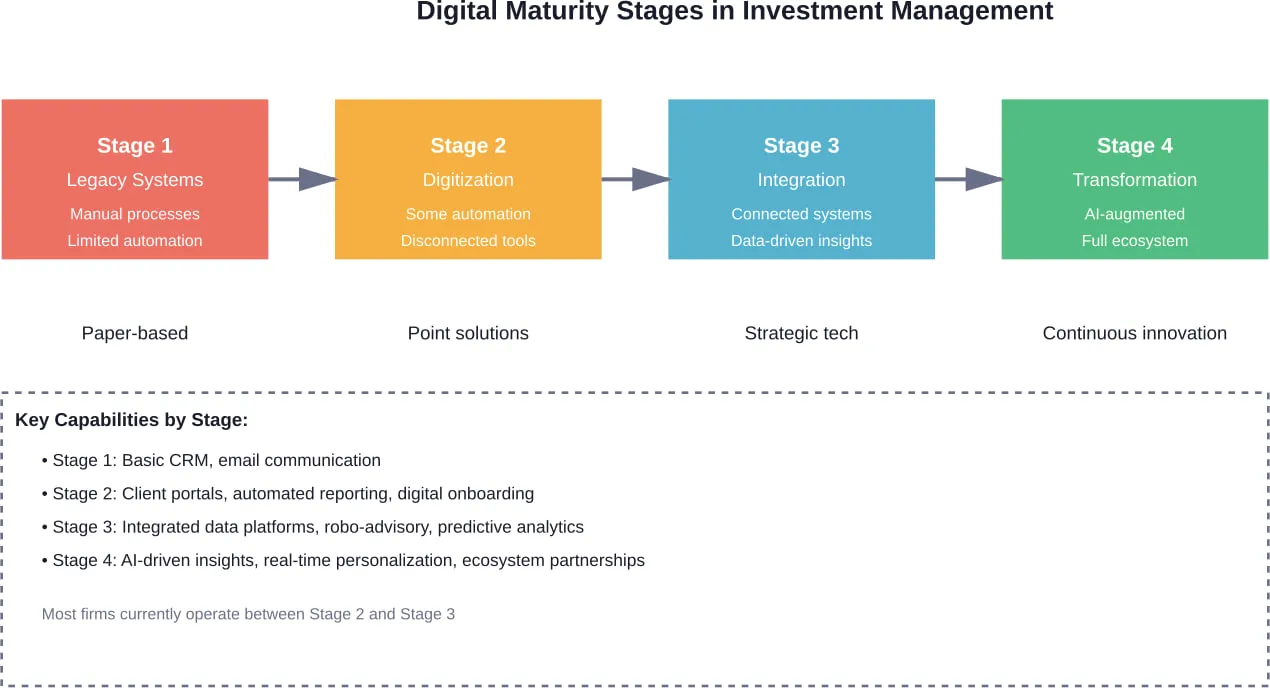
AI’s Measured Impact on Investment Workflows
The CFA Institute’s research on AI in investment management reveals a shift from exuberance to realism. GenAI is transforming investment workflows, but it’s raising critical questions about human judgment, task design, and the future of the profession.
Here’s what’s actually happening on the ground. AI tools are augmenting analyst capabilities rather than replacing them. Portfolio managers use machine learning models to identify patterns in market data. Risk teams deploy AI for scenario analysis and stress testing.
But wait. Reliability gaps persist. AI models can hallucinate or produce unexplainable results. This creates oversight challenges that investment firms can’t ignore.
Five Lessons From AI Implementation
According to CFA Institute research, AI is shifting from exuberance to measured implementation, with focus on augmentation rather than replacement of human judgment.
Successful implementations prioritize strategic insight over automation for automation’s sake. They demand explainability. Investors and regulators won’t accept black-box decision-making, no matter how accurate the predictions.
The most important lesson? Evolving investor competencies matters more than technology selection. Teams need new skills to work effectively alongside AI systems.
| AI Application Area | Current Adoption | Primary Challenge | Success Factor |
|---|---|---|---|
| Portfolio Construction | Modéré | Model explainability | Hybrid human-AI approach |
| Risk Analysis | Haut | Qualité des données | Robust governance frameworks |
| Client Communications | Growing | Personalization accuracy | Human oversight protocols |
| Research Automation | Haut | Context understanding | Analyst validation processes |
| Trade Execution | Mature | Market impact | Continuous monitoring systems |
| Contrôle de conformité | Modéré | False positives | Exception handling workflows |
Scale Your Investment Platform with Dedicated Technical Talent
Modernizing portfolio management systems and investor portals requires specialized technical talent that understands the high stakes of financial data security and real-time processing. Building an internal IT department from scratch often leads to significant recruitment delays and high operational overhead. A-Listware addresses this by providing dedicated development teams and IT staff augmentation, allowing investment firms to deploy custom fintech solutions and automate workflows without the friction of traditional hiring.
- Expertise technique de niche : Accès à des développeurs vérifiés compétents en matière d'IA, de big data et d'infrastructure cloud sécurisée.
- Rapid Resource Deployment: Scale your engineering capacity quickly to meet shifting market demands or regulatory changes.
- Efficacité opérationnelle : Reduce long-term overhead by utilizing a flexible, high-performance delivery model.
- Intégration directe : Dedicated specialists work as a seamless extension of your existing team to modernize legacy systems.
Commencez votre transformation numérique avec A-Listware.
Building the Technology Backbone for Asset Management
Legacy technology stacks weren’t designed for today’s demands. They can’t handle real-time data processing. They don’t integrate with modern analytics platforms. They create operational bottlenecks that frustrate advisors and clients alike.
Building the tech backbone requires strategic investment in cloud infrastructure, data architecture, and API-first platforms. This isn’t about ripping out everything and starting fresh—that’s rarely practical.
The short answer? Most successful transformations follow a modular approach. They identify the highest-value use cases and modernize those areas first. Then they expand systematically.
Core Technology Components
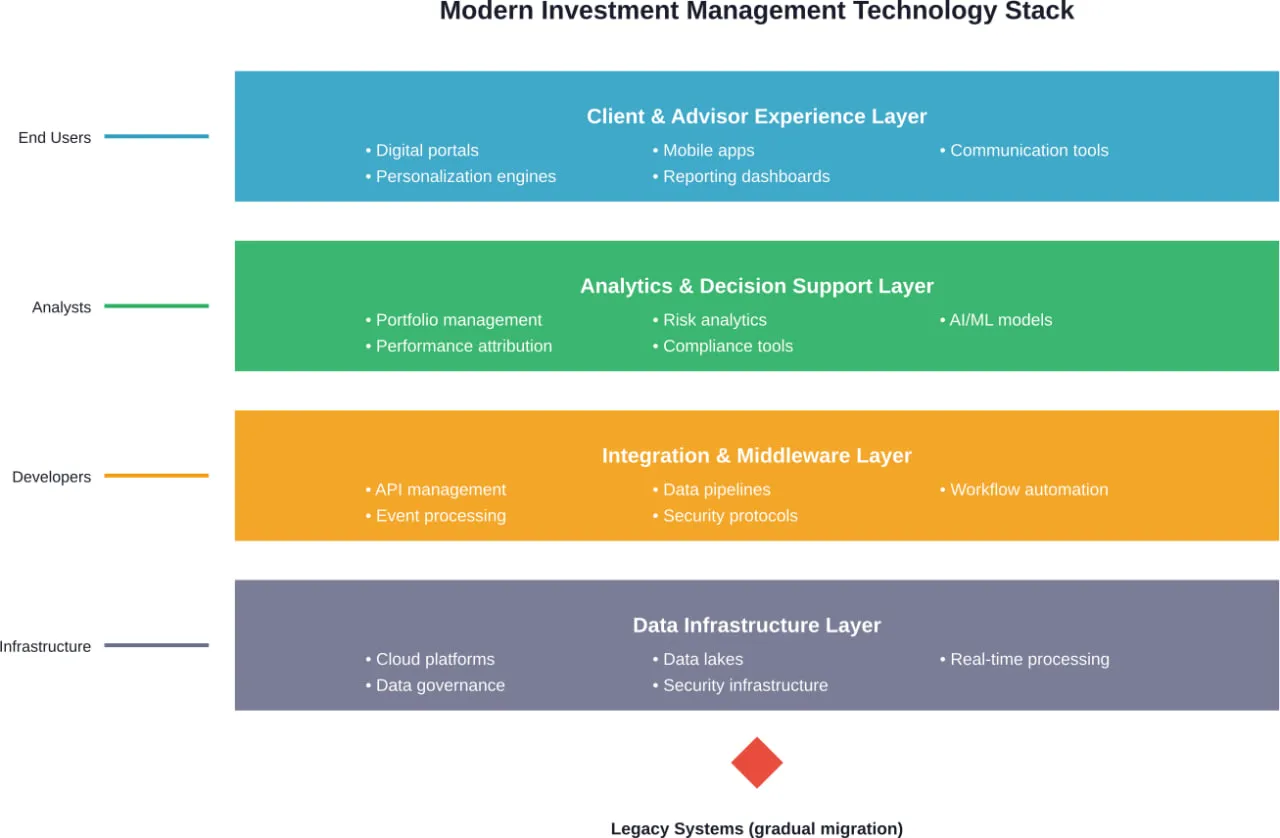
A modern investment management technology stack includes several layers. Data infrastructure sits at the foundation—cloud storage, data lakes, and real-time processing capabilities.
The middle layer consists of analytics and decision support tools. This includes portfolio management systems, risk platforms, and AI/ML frameworks. Integration middleware connects these systems and enables data flow.
The top layer focuses on client and advisor experiences. Digital portals, mobile apps, and communication tools live here. Each layer must work seamlessly with the others.
Transforming Client and Advisor Experiences
Wealth management clients expect more than quarterly statements. They want real-time portfolio visibility, personalized insights, and seamless communication across channels. Meeting these expectations requires rethinking the entire client experience.
Advisors need transformation too. They’re drowning in administrative tasks that technology could handle. Data sits in disconnected systems. Building comprehensive client views requires manual effort.
Industry discussions highlight that empowering wealth management advisors through data represents a critical success factor. When advisors have the right information at the right time, they can focus on what they do best—building relationships and providing strategic guidance.
La personnalisation à grande échelle
Delivering customized experiences to thousands of clients seems impossible. But that’s exactly what digital tools enable. Personalization engines analyze client preferences, behaviors, and goals to tailor communications and recommendations.
This isn’t about mass customization with superficial tweaks. It’s about genuinely understanding individual client needs and delivering relevant value. The technology exists—implementation requires careful strategy and change management.
The roadblocks? Data quality issues, organizational silos, and resistance to new workflows. Overcoming these challenges demands executive commitment and cross-functional collaboration.
Tackling Organizational Change and Culture
Technology transformation fails when organizations ignore the human side. Investment firms have deep-rooted cultures built over decades. Changing how people work requires more than new software licenses.
Moving from legacy systems to modern platforms means retraining staff, redesigning processes, and sometimes restructuring teams. It’s uncomfortable. Some employees resist. Others lack the skills for new roles.
The most successful transformations establish robust guardrails while removing speed bumps. They create clear governance frameworks for technology use. They invest heavily in training and support. They communicate constantly about why change matters.
The Role Evolution in Investment Management
Job roles are evolving rapidly. Traditional analyst positions now require data science skills. Advisors need technological fluency. Operations teams must understand automation and workflow design.
According to CFA Institute research on AI in investment management, questions arise about task design and professional development. What work should humans do? Where does AI add the most value? How should teams restructure to leverage both effectively?
These aren’t theoretical questions. They’re practical challenges that firms face daily. Getting the answers right determines whether transformation initiatives succeed or stall.
| Traditional Role | Evolving Capabilities | Technology Impact |
|---|---|---|
| Investment Analyst | Data science, AI model validation, alternative data analysis | Augmented research, automated data collection |
| Portfolio Manager | Algorithmic strategy oversight, scenario modeling, tech-enabled alpha generation | AI-driven insights, real-time risk monitoring |
| Financial Advisor | Digital engagement, tech platform fluency, data interpretation | Automated admin tasks, personalization tools |
| Operations Specialist | Workflow automation, exception handling, process optimization | Robotic process automation, intelligent workflows |
| Compliance Officer | RegTech utilization, AI oversight, digital audit trails | Automated monitoring, predictive risk flagging |
Approches stratégiques de mise en œuvre
Where should firms start? The answer depends on current capabilities, competitive pressures, and strategic priorities. But some patterns emerge from successful transformations.
First, identify high-impact, low-complexity opportunities. Quick wins build momentum and demonstrate value. They create advocates for broader change initiatives.
Second, invest in data infrastructure before layering on analytics. Bad data produces bad insights, no matter how sophisticated the AI model. Data governance, quality, and accessibility must come first.
Third, think in terms of ecosystems rather than point solutions. Modern investment management involves partnerships with fintechs, data providers, and platform vendors. Integration capabilities matter as much as individual tool features.
Building Versus Buying
Should manufacturers build their own portfolio construction solutions? Should firms develop proprietary AI models or license existing platforms?
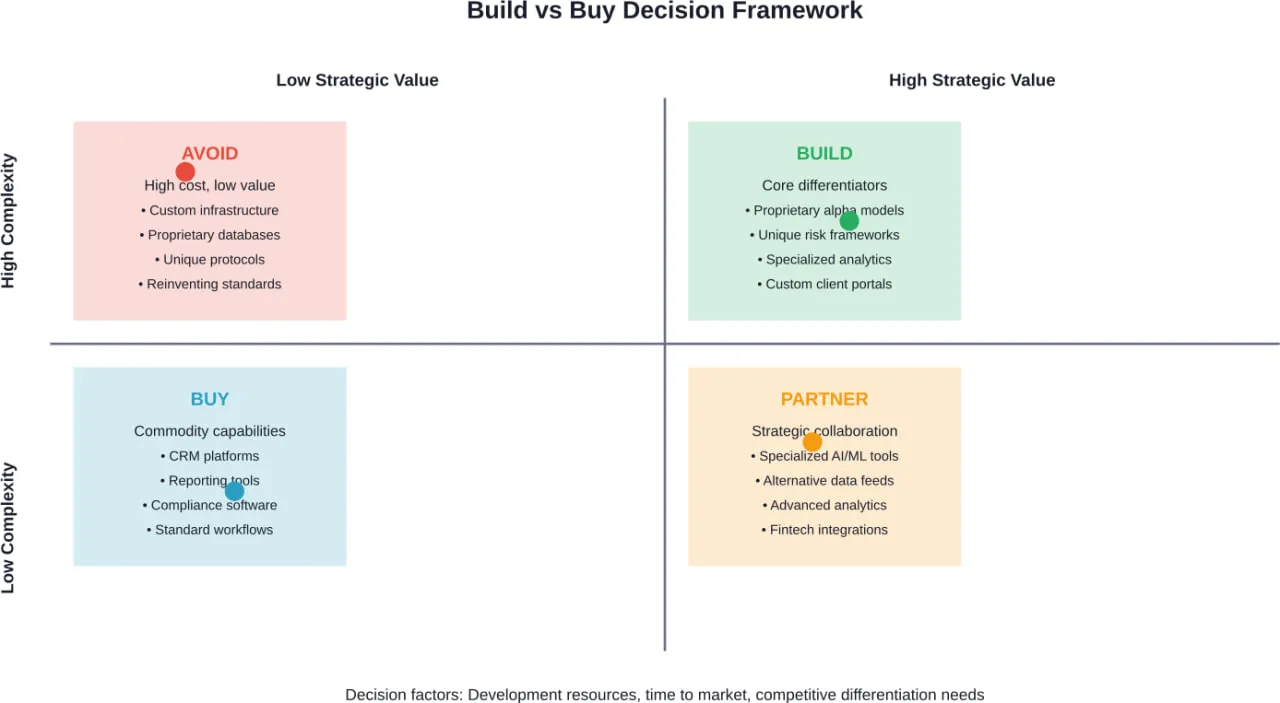
There’s no universal answer. Building custom solutions offers differentiation and control but requires substantial investment and technical expertise. Buying off-the-shelf platforms provides faster implementation and lower upfront costs but may limit customization.
Many firms adopt a hybrid approach. They build where competitive advantage demands uniqueness. They buy commodity capabilities that don’t differentiate. They partner for specialized expertise
Digital Investment Strategy Optimization
Technology investments themselves require strategic thinking. According to industry analysis, boards can help companies realize higher returns from digital transformation by addressing key areas such as the investment mix.
Too many firms spread resources thin across numerous initiatives. They lack clear prioritization frameworks. They don’t measure ROI effectively. They continue funding projects that aren’t delivering value.
Optimizing digital investment strategy means ruthlessly prioritizing based on business impact. It means creating stage-gate processes that kill underperforming initiatives early. It means shifting from project-based thinking to product-based thinking.
Mesurer le succès de la transformation
What does success look like? Different stakeholders have different answers. Executives want revenue growth and cost reduction. Advisors want improved productivity. Clients want better experiences. Regulators want stronger controls.
Effective measurement frameworks capture multiple dimensions. Financial metrics matter—total cost of ownership, revenue per advisor, client acquisition costs. Operational metrics matter too—time to onboard new clients, processing error rates, automation rates.
Don’t forget experience metrics. Client satisfaction scores, Net Promoter Scores, and advisor adoption rates indicate whether transformation efforts actually improve outcomes for the people they’re meant to serve.
Regulatory Compliance and Risk Management
Innovation can’t come at the expense of compliance. Investment firms operate in heavily regulated environments. Digital transformation initiatives must address regulatory requirements from the start, not as an afterthought.
AI models used for investment decisions need explainability. Client data requires robust security and privacy protections. Automated processes must maintain audit trails. Algorithmic trading demands oversight and controls.
RegTech solutions help manage these challenges. They automate compliance workflows, monitor for suspicious activities, and maintain detailed records. But technology alone isn’t enough—governance frameworks and human oversight remain essential.
Balancing Innovation and Control
How can firms move fast while maintaining appropriate controls? This tension defines much of digital transformation in investment management. Too much control stifles innovation. Too little creates unacceptable risks.
Leading firms establish clear guardrails that define what’s acceptable. They create sandboxes for experimentation. They implement continuous monitoring rather than annual audits. They foster cultures where people feel empowered to innovate within defined boundaries.
Establishing robust guardrails while removing speed bumps represents the key to sustainable transformation. It’s not about choosing between innovation and control—it’s about achieving both simultaneously.
Future Trends and Emerging Technologies
What’s coming next? The investment management industry continues to evolve rapidly. Several trends merit attention as firms plan their digital strategies.
Open banking and data portability will reshape how clients interact with financial institutions. Decentralized finance technologies may influence traditional investment structures. Quantum computing could revolutionize portfolio optimization and risk modeling.
But here’s the reality check: emerging markets and established markets both show that fundamental challenges remain consistent. Technology changes, but the core needs—trust, performance, service quality—stay the same.
The Role of Ecosystem Partnerships
No single firm can build every capability internally. Ecosystem thinking becomes increasingly important. Investment managers partner with fintechs for specialized tools. They collaborate with data providers for alternative datasets. They work with cloud platforms for infrastructure.
According to a 2026 study published in the California Management Review (UC Berkeley Haas School of Business), relationship-first digital transformation enables smaller financial institutions to compete through strategic partnerships. Scale doesn’t always win—smart collaboration can level the playing field.
This shift from vertical integration to ecosystem orchestration represents a fundamental change in industry structure. Success requires new skills in partnership management, platform thinking, and API strategy.
Key Takeaways for Investment Management Leaders
Digital transformation isn’t optional anymore. Firms that delay risk becoming irrelevant as client expectations evolve and competitive pressures intensify. But rushing into transformation without clear strategy creates different problems—wasted resources, failed initiatives, and organizational disruption without corresponding benefits.
Start with business outcomes, not technology features. Define what success looks like for clients, advisors, and the firm. Then identify the capabilities required to achieve those outcomes. Technology choices follow from strategy, not the other way around.
Invest in people as much as systems. The best technology can’t overcome organizational resistance or skill gaps. Training, communication, and change management deserve substantial attention and resources.
Think in platforms and ecosystems, not point solutions. Integration capabilities often matter more than individual feature sets. Build a tech stack that can evolve as needs change and new technologies emerge.
Remember that AI augments rather than replaces human judgment. According to CFA Institute findings, the most effective implementations combine algorithmic capabilities with human expertise. Define clear roles for both.
Measure rigorously and iterate constantly. Digital transformation isn’t a one-time project—it’s an ongoing capability. Establish feedback loops that enable continuous improvement based on real performance data.
Questions fréquemment posées
- What are the biggest challenges in digital transformation for investment management?
The primary challenges include legacy technology systems that resist integration, organizational resistance to change, data quality and governance issues, regulatory compliance requirements, and skill gaps within existing teams. According to industry reports, achieving end-to-end transformation requires addressing these interconnected challenges simultaneously rather than treating them as separate problems. Cultural factors often prove more difficult than technical obstacles.
- How is AI specifically changing investment management workflows?
According to CFA Institute research, AI is transforming workflows through augmentation rather than replacement. Specific applications include automated research data collection, pattern recognition in market analysis, scenario modeling for risk assessment, personalized client communication generation, and compliance monitoring. However, the research emphasizes that reliability gaps and oversight needs mean AI’s impact will be more measured than early hype suggested. Human judgment remains critical for strategic decisions.
- Should investment firms build custom technology or buy existing platforms?
The decision depends on strategic value and complexity. Build custom solutions for core differentiators that create competitive advantage—proprietary alpha generation models, unique risk frameworks, or specialized analytics. Buy commodity capabilities like CRM platforms, standard reporting tools, and compliance software. Consider partnerships for specialized areas like advanced AI/ML tools or alternative data feeds. Most successful firms adopt hybrid approaches that balance customization needs with implementation speed and resource constraints.
- How can smaller investment firms compete with larger institutions in digital transformation?
Recent academic research on relationship-first digital transformation demonstrates that scale doesn’t automatically determine success. Smaller firms can compete through strategic ecosystem partnerships, focused capability development in specific niches, and leveraging cloud-based platforms that democratize access to enterprise-grade technology. The key is identifying specific client segments or service areas where digital capabilities can create differentiated value rather than trying to match larger competitors across all dimensions.
- What role should advisors play in digitally transformed wealth management?
Advisors shift from administrative task execution to strategic relationship management and complex problem-solving. Technology handles routine processes like reporting, basic client communications, and data aggregation. This frees advisors to focus on understanding nuanced client goals, providing holistic financial planning, navigating complex situations, and delivering empathetic guidance during market volatility. Successful transformation empowers advisors with better data and tools while reinforcing rather than diminishing the human relationship element.
- How should firms measure digital transformation success?
Effective measurement frameworks include financial metrics like revenue growth, cost reductions, and client acquisition costs; operational metrics such as process automation rates, error reduction, and time-to-market for new services; and experience metrics including client satisfaction scores, advisor adoption rates, and Net Promoter Scores. The key is establishing baseline measurements before transformation initiatives begin and tracking progress across multiple dimensions rather than relying on single metrics that may not capture full impact.
- What are the most important compliance considerations for digital transformation?
Regulatory priorities include maintaining explainability for AI-driven investment decisions, ensuring robust data security and privacy protections, creating comprehensive audit trails for automated processes, implementing appropriate oversight for algorithmic trading, and documenting decision-making frameworks. Investment firms must integrate compliance requirements into technology design from the beginning rather than treating them as constraints to work around. RegTech solutions can automate many compliance workflows while governance frameworks and human oversight remain essential for managing risks effectively.
Conclusion
Digital transformation in investment management represents both tremendous opportunity and significant challenge. The technology exists to deliver better client experiences, more efficient operations, and enhanced investment insights. AI, automation, and advanced analytics are reshaping every aspect of the industry.
But technology alone doesn’t guarantee success. As CFA Institute research makes clear, the shift from exuberance to realism means recognizing that transformation requires careful implementation, robust governance, and ongoing human judgment. It demands organizational change that can prove even more difficult than technical integration.
The firms that will thrive are those that balance innovation with control, invest in people alongside systems, and maintain focus on business outcomes rather than technology for its own sake. They’ll build ecosystems rather than silos. They’ll augment human capabilities rather than attempting wholesale replacement.
The future of investment management is digital—but it’s also fundamentally human. Start planning your transformation journey today with clear strategy, realistic expectations, and commitment to both technological excellence and organizational change.


