Résumé rapide : Digital transformation for energy involves modernizing power infrastructure through smart grids, AI-driven analytics, IoT sensors, and cloud-based platforms to improve efficiency, integrate renewable sources, and meet decarbonization goals. According to the U.S. Department of Energy, America’s grid connects over 9,200 generating units to more than 600,000 miles of transmission lines—an ecosystem requiring digital upgrades to handle distributed energy resources and real-time demand management. ABI Research forecasts that energy companies will invest $713 billion in grid digitalization over the next six years, signaling a sector-wide shift from reactive maintenance to predictive, data-driven operations.
The energy sector stands at a crossroads. For more than a century, utilities have operated on a relatively simple model: generate power at centralized plants, push it through transmission lines, and bill customers for consumption. That model is collapsing under the weight of climate commitments, distributed generation, and consumer expectations shaped by the digital economy.
Digital transformation is no longer optional. It’s the only viable path to a resilient, low-carbon energy future.
But what does digital transformation actually mean when applied to power grids, renewable integration, and utility operations? And how can energy companies navigate the technical, financial, and regulatory hurdles that come with modernizing infrastructure built decades ago?
This guide breaks down the technologies driving change, the practical challenges slowing adoption, and the strategies that leading utilities are using to accelerate their digital journey.
What Digital Transformation Means for the Energy Industry
Digital transformation in energy isn’t about slapping software onto old infrastructure. It’s a fundamental shift in how power systems are designed, operated, and optimized.
Traditional energy systems were built around predictable, centralized generation. Coal plants, nuclear reactors, and large-scale hydroelectric dams produced steady baseload power. Demand followed known patterns. Grid operators could forecast loads with reasonable accuracy and dispatch generation accordingly.
That world is gone.
Today’s grids must integrate thousands of distributed energy resources—rooftop solar panels, residential battery storage, electric vehicle chargers, and wind farms scattered across remote regions. These assets introduce variability and bidirectional power flows that legacy control systems were never designed to handle.
Digital transformation addresses this complexity by replacing rule-based decision models with data-driven intelligence. Instead of reactive repairs when equipment fails, predictive maintenance algorithms analyze sensor data to forecast failures weeks in advance. Instead of isolated billing systems, platform ecosystems connect generation, transmission, distribution, and customer services into unified operational views.
According to NREL, solar costs had fallen 99%, while solar and wind have become the leading source of new electric generation capacity in the United States. These economics are forcing a rethink of grid architecture—and digital tools are the only way to manage the resulting complexity at scale.
Support Your Energy Infrastructure With Dedicated Development Teams
Modernizing energy grids and implementing smart monitoring systems requires specialized software engineering to manage massive data sets and ensure system security. Finding local developers with the right technical background for these complex integrations is often a slow and expensive process. A-Listware provides dedicated engineering teams and IT staff augmentation, allowing energy companies to upgrade their digital infrastructure and automate reporting without the delays of traditional recruitment.
- Specialized Engineering: Access developers skilled in IoT, big data analytics, and secure cloud systems.
- Flexible Capacity: Quickly scale your technical team to meet project-specific milestones or regulatory deadlines.
- Operational Savings: Reduce the high overhead costs of in-house hiring, training, and office infrastructure.
- Seamless Collaboration: Dedicated specialists work as an extension of your organization to maintain and modernize legacy software.
Commencez votre transformation numérique avec A-Listware.
The Core Technologies Driving Energy Digitalization
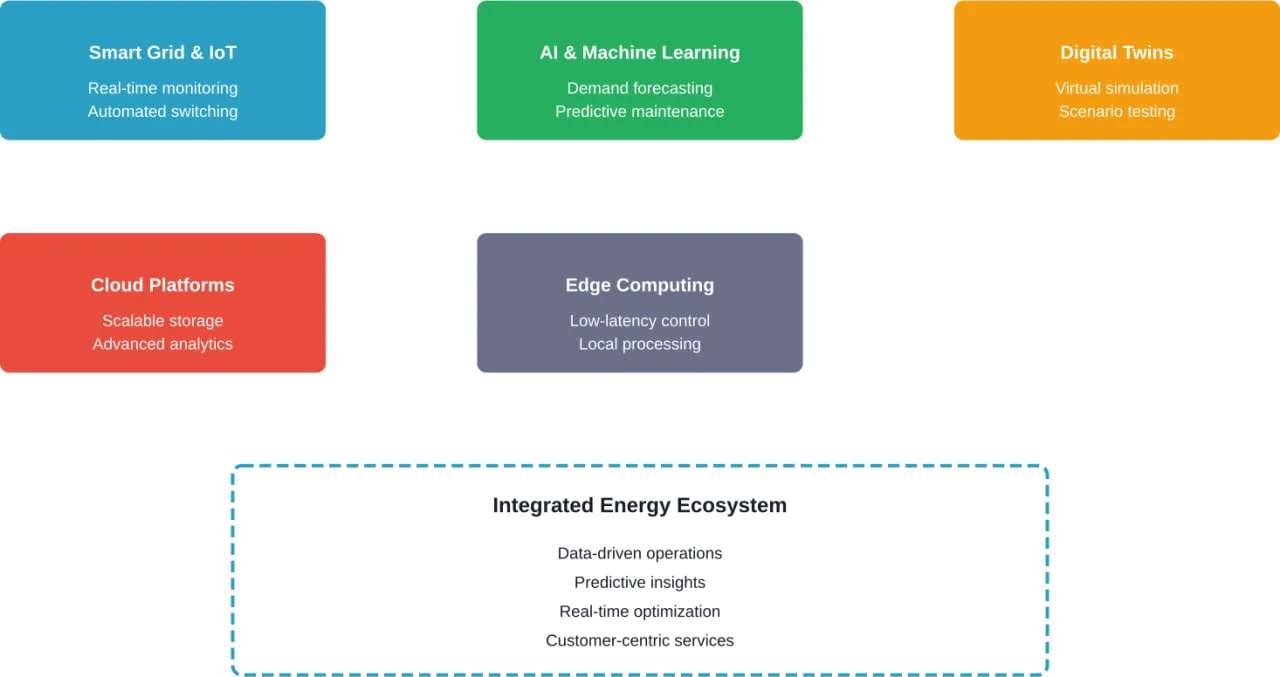
Several technology categories form the backbone of modern energy digitalization initiatives. Each addresses specific operational challenges while contributing to broader system resilience and efficiency.
Smart Grid Infrastructure and IoT Sensors
Smart grid technologies bring electricity delivery systems into the 21st century through networked sensors, automated switches, and real-time communication. At its core, the smart grid relies on networked sensors, automated switches, and real-time communication between grid components.
IoT sensors monitor voltage, frequency, temperature, and load at thousands of points across the grid. This telemetry enables operators to detect anomalies, reroute power around congestion, and isolate faults before they cascade into regional blackouts.
Smart meters sit at the grid edge, recording consumption patterns at 15-minute or sub-hour intervals. This granular data supports dynamic pricing, demand response programs, and accurate forecasting of distributed generation impacts.
IEEE technical standards, including IEEE 2030.5 (Smart Energy Profile 2.0), provide interoperability frameworks for distributed energy resources communicating with utility control systems. These standards ensure that devices from different manufacturers can exchange data reliably, reducing vendor lock-in and accelerating deployment.
Intelligence artificielle et apprentissage automatique
AI algorithms excel at pattern recognition in complex, high-dimensional datasets—exactly the challenge grid operators face when balancing supply and demand across thousands of generation sources and millions of consumption points.
Machine learning models forecast renewable generation by analyzing weather patterns, historical output, and real-time atmospheric conditions. They predict demand spikes by correlating temperature, time of day, day of week, and special events. They optimize battery dispatch to maximize value from energy arbitrage and grid services.
Generative AI is beginning to automate engineering workflows. Large language models can draft regulatory filings, summarize grid incident reports, and generate synthetic training data for edge cases that rarely occur but have catastrophic consequences when they do.
The key advantage? AI scales human expertise. A single algorithm can monitor thousands of assets simultaneously, identifying subtle degradation patterns that would escape manual inspection.
Digital Twins for Grid Simulation
A digital twin is a virtual replica of a physical system, continuously updated with real-world sensor data. For energy grids, digital twins model power flows, equipment behavior, and failure modes in software before implementing changes in hardware.
Grid planners use digital twins to test infrastructure upgrades, evaluate interconnection requests for new generation, and simulate extreme weather scenarios. Operators use them during outages to visualize restoration paths and prioritize crew deployment.
Digital twins compress decision timelines. Instead of waiting months for field tests, engineers can simulate outcomes in hours and iterate rapidly on design parameters.
Cloud Platforms and Edge Computing
Modern energy operations generate petabytes of data annually. Storing, processing, and analyzing this volume requires cloud-scale infrastructure that utilities historically haven’t built in-house.
Cloud platforms provide elastic compute resources, managed databases, and pre-built analytics services that reduce time-to-value for digital initiatives. They enable collaboration across geographically distributed teams and integrate with third-party data sources like weather APIs and commodity markets.
But not all processing can happen in centralized data centers. Edge computing deploys lightweight analytics at substations, smart meters, and renewable sites to reduce latency and bandwidth consumption. Local controllers make millisecond decisions about voltage regulation or fault isolation without waiting for round-trip communication to the cloud.
The hybrid architecture—cloud for strategic planning and historical analysis, edge for real-time control—balances performance with operational flexibility.
Practical Applications Transforming Energy Operations
Theory matters less than results. Here’s how digital technologies translate into operational improvements across the energy value chain.
Predictive Maintenance Replacing Reactive Repairs
Traditional maintenance follows fixed schedules or responds to failures. A transformer gets inspected every three years whether it needs attention or not. A turbine runs until it breaks, then waits for a repair crew.
Predictive maintenance flips this model. Sensors track vibration signatures, oil quality, thermal patterns, and electrical characteristics. Machine learning algorithms establish baseline behavior for each asset and flag deviations that correlate with impending failures.
Utilities schedule maintenance during planned outage windows, order parts before failures occur, and extend asset life by addressing minor issues before they cause cascading damage. The economic impact is substantial—reducing unplanned downtime, lowering inventory costs, and optimizing crew deployment.
Renewable Integration and Distributed Energy Resource Management
Integrating variable renewable generation requires second-by-second balancing of supply and demand. When cloud cover reduces solar output across a region, grid operators must ramp conventional generation or discharge storage within minutes to maintain frequency stability.
Digital platforms aggregate forecasts from thousands of distributed assets, coordinate battery dispatch, and trigger demand response programs that temporarily reduce consumption. Advanced inverters at renewable sites provide grid services like voltage support and frequency regulation, transforming what were once passive generators into active grid participants.
The U.S. Department of Energy’s Grid Modernization Initiative partners with national laboratories to develop advanced grid technologies that enable higher renewable penetration without compromising reliability.
Dynamic Pricing and Demand Response Programs
Smart meters enable time-variant pricing that reflects real-time grid conditions. During peak demand hours, prices rise to discourage discretionary consumption. During periods of excess renewable generation, prices drop to encourage charging electric vehicles or running industrial processes.
Demand response programs pay customers to reduce consumption during stress events. Commercial buildings pre-cool before hot afternoons, industrial facilities shift production schedules, and residential thermostats adjust setpoints automatically.
These programs reduce the need for peaker plants—expensive, rarely used generators that historically met peak demand but operate inefficiently and emit heavily. Shifting 5-10% of peak load can defer billions in generation capacity investments.
Virtual Power Plants Aggregating Distributed Assets
A virtual power plant treats distributed assets—rooftop solar, home batteries, EV chargers, smart thermostats—as a unified resource that can be dispatched like a conventional power plant.
Software platforms coordinate thousands of small assets to deliver grid services at scale. During a heat wave, the virtual power plant discharges residential batteries, reduces air conditioner setpoints by two degrees, and delays EV charging until evening. The aggregate capacity rivals a gas turbine, but with no fuel costs and faster response times.
Virtual power plants also create revenue opportunities for asset owners. Homeowners earn payments for allowing their batteries to participate in frequency regulation markets. Commercial fleets monetize EV batteries during idle hours.
The Business Case: Why Energy Companies Are Investing in Digitalization
Digital transformation requires substantial upfront investment. ABI Research forecasts $713 billion in grid digitalization spending over the next six years. That’s real money competing with traditional infrastructure needs like replacing aging transformers and hardening lines against extreme weather.
So why commit?
Efficacité opérationnelle et réduction des coûts
Digital tools reduce operating expenses across multiple categories. Predictive maintenance cuts unplanned outage costs. Automated meter reading eliminates truck rolls. Optimized power flow reduces transmission losses. AI-driven load forecasting improves fuel procurement and reduces need for expensive reserves.
These savings compound over decades. A utility that reduces annual operating costs by 3-5% through digitalization saves hundreds of millions over a 20-year planning horizon.
Regulatory Compliance and Decarbonization Mandates
Many jurisdictions have legislated emissions reductions—50% by 2030, net-zero by 2050. Achieving these targets requires massive renewable integration, electrification of transportation and heating, and demand-side flexibility.
Digital infrastructure is the enabling layer. Without real-time visibility, automated coordination, and predictive analytics, grids cannot reliably operate at 70-80% renewable penetration. DNV’s research highlights collective belief that achieving net-zero emissions by 2050 is only possible through digitalizing energy systems.
Utilities face penalties for missing emissions targets and reputational damage that affects credit ratings and regulatory relationships. Digital transformation mitigates these risks by providing the tools needed to meet commitments.
Customer Expectations and Competitive Pressure
Energy consumers increasingly expect digital interfaces, real-time usage data, and personalized service. Retail electricity markets are introducing new entrants offering sleek mobile apps, carbon tracking, and integrated home energy management.
Traditional utilities risk losing high-value customers if they maintain legacy billing systems and annual paper statements. Digital platforms enable self-service portals, proactive outage notifications, and personalized efficiency recommendations that match consumer expectations shaped by other industries.
Resilience and Grid Security
Extreme weather events and cyber threats are growing risks. Digital tools improve resilience through faster fault detection, automated restoration, and predictive modeling of storm impacts.
But digitalization also expands attack surfaces. IoT devices, cloud connections, and networked controls introduce vulnerabilities. Utilities must balance connectivity with security—segmenting networks, encrypting communications, and continuously monitoring for intrusions.
The Department of Energy’s Grid Modernization Lab Consortium works with utilities to develop secure-by-design architectures that protect critical infrastructure while enabling digital capabilities.
| Business Driver | Solution numérique | Impact typique |
|---|---|---|
| Operating Cost Reduction | Predictive maintenance, automated operations | 3-5% annual savings |
| Renewable Integration | Forecasting, DER management, storage optimization | 20-40% higher renewable penetration |
| Satisfaction des clients | Self-service portals, real-time data, personalized insights | 15-25% reduction in call center volume |
| Grid Reliability | Automated fault isolation, predictive outage analytics | 10-20% reduction in outage duration |
| Conformité réglementaire | Emissions tracking, renewable dispatch optimization | Avoidance of penalties and mandates |
Challenges Slowing Digital Transformation in Energy
Digital transformation sounds compelling in strategy documents. Implementation hits obstacles that delay timelines and inflate budgets.
Legacy Infrastructure and Technical Debt
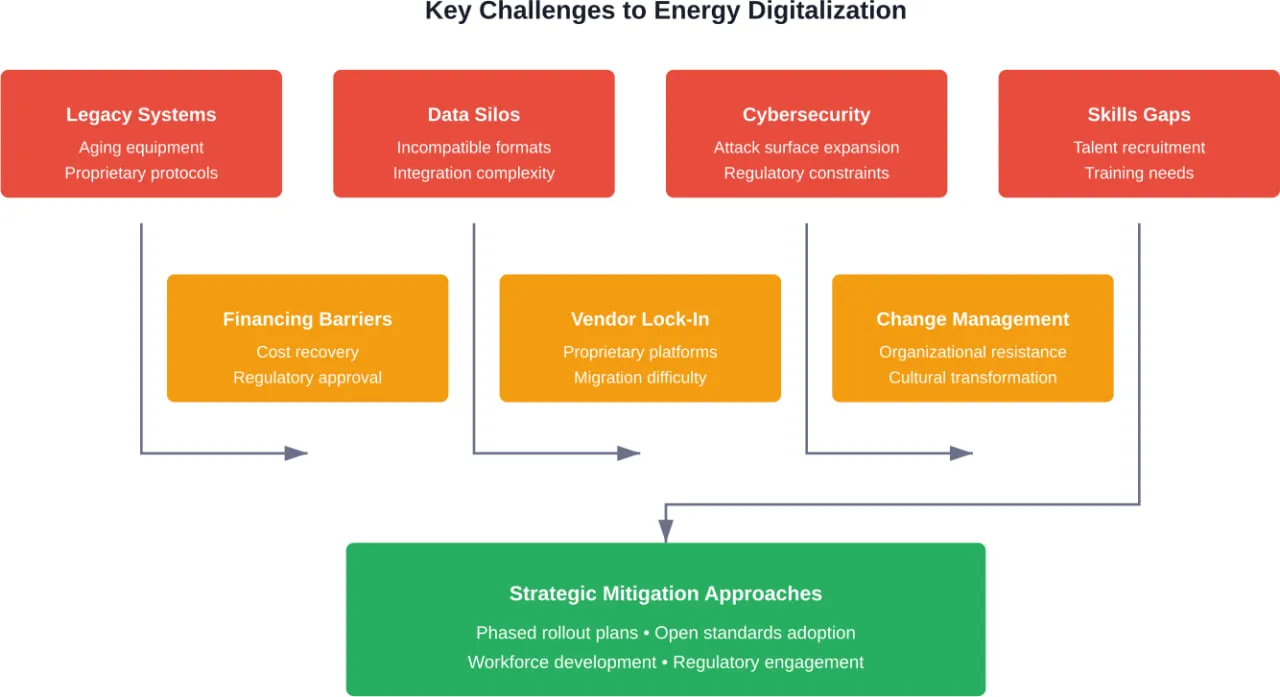
Energy grids include equipment installed decades ago—transformers from the 1970s, control systems running DOS, SCADA networks using proprietary protocols. This legacy infrastructure lacks digital interfaces and cannot communicate with modern platforms.
Retrofitting sensors onto analog equipment is expensive and sometimes impractical. Replacing assets before end-of-life strands capital and faces regulatory scrutiny. Utilities must balance incremental upgrades with long-term modernization roadmaps, often extending transformation timelines to 10-15 years.
Data Silos and Interoperability Gaps
Most utilities operate separate systems for generation, transmission, distribution, billing, customer service, and asset management. These systems store data in incompatible formats, use different identifiers for the same assets, and don’t communicate with each other.
Building unified data platforms requires extensive integration work—mapping schemas, resolving conflicts, establishing master data management practices. Many digital initiatives stall because promised data turns out to be incomplete, inconsistent, or locked in legacy systems.
Cybersecurity Risks and Regulatory Constraints
Energy infrastructure is critical national security assets. Cyber attacks can cause blackouts affecting millions. Regulatory frameworks impose strict security requirements—network segmentation, access controls, incident reporting, audit trails.
These requirements slow deployment. Every IoT device must be vetted, every cloud connection approved, every software update tested. Utilities face tension between agility and security, often erring toward caution that delays innovation.
Lacunes en matière de compétences de la main-d'œuvre
Traditional utility workforces include electrical engineers, lineworkers, and power plant operators. Digital transformation demands data scientists, software developers, cybersecurity specialists, and AI engineers.
Recruiting these skills into a regulated utility environment is challenging. Compensation may lag tech industry norms, locations are often non-urban, and career paths are unclear. Utilities must invest in training existing staff, partnering with universities, and competing for talent in tight labor markets.
Financing and Cost Recovery Uncertainty
Regulated utilities recover costs through rate cases approved by public utility commissions. Digital investments don’t fit neatly into traditional capital expenditure categories. Is a software subscription operating expense or capital? Can utilities earn returns on cloud infrastructure they don’t own?
Regulatory uncertainty around cost recovery creates risk. Utilities hesitate to commit billions to digital platforms without clear paths to recovering investments through rates. Progressive regulators are developing frameworks that recognize software and data as rate-base-eligible assets, but adoption varies by jurisdiction.
Strategic Roadmap: How to Accelerate Digital Transformation
Successful digital transformation requires clear strategy, not random technology adoption. Leading utilities follow structured approaches that balance ambition with practical constraints.
Start With High-Value Use Cases
Not all digital initiatives deliver equal returns. Prioritize use cases with clear business cases, measurable outcomes, and rapid payback periods.
Predictive maintenance for high-value assets—large transformers, critical transmission lines—often ranks high. Failures are expensive, data is available from existing sensors, and algorithms are mature. Quick wins build momentum and justify subsequent investments.
Avoid boiling-the-ocean approaches that try to digitize everything simultaneously. Complexity compounds, timelines stretch, and stakeholders lose confidence before value materializes.
Build on Open Standards and Interoperable Platforms
Vendor lock-in multiplies long-term costs and limits flexibility. Prioritize technologies based on open standards—IEEE 2030.5 for DER communication, IEC 61850 for substation automation, OpenADR for demand response.
Interoperable platforms integrate data from diverse sources without custom interfaces for every device. They enable competition among vendors, reduce switching costs, and future-proof investments as technology evolves.
The Department of Energy’s Grid Modernization Initiative emphasizes interoperability as a foundational principle for modern grid architecture.
Invest in Data Foundations Before Advanced Analytics
AI algorithms require clean, structured, comprehensive data. Many utilities discover too late that promised datasets are incomplete, inconsistent, or inaccessible.
Establish data governance practices—ownership, quality standards, access policies—before deploying analytics. Build data lakes that aggregate operational, customer, and external data into unified repositories. Implement master data management to resolve conflicts and establish single sources of truth.
These foundational investments lack glamour but determine whether advanced analytics succeed or fail.
Partner With Technology Providers and Research Institutions
Utilities don’t need to build every capability in-house. Strategic partnerships with cloud providers, software vendors, and research institutions accelerate timelines and reduce risk.
The Grid Modernization Lab Consortium connects utilities with national laboratories conducting cutting-edge research on grid technologies. Industry consortia share lessons learned and develop reference architectures that members can adopt.
But partnerships require clear governance. Define roles, intellectual property rights, data ownership, and exit terms upfront to avoid conflicts later.
Cultivate Digital Skills and Cultural Change
Technology alone doesn’t transform organizations. People must adopt new tools, workflows, and decision frameworks.
Invest in training programs that upskill existing staff. Engineers learn data analytics. Operators learn to interpret AI recommendations. Customer service representatives learn digital engagement platforms.
Leadership must model digital-first behaviors—using dashboards for decision-making, challenging assumptions with data, rewarding experimentation. Cultural transformation takes years and determines whether digital investments deliver lasting value or become shelfware.
Real-World Examples: Utilities Leading Digital Transformation
Several energy companies have made substantial progress on digitalization, offering lessons for peers navigating similar journeys.
Grid Operators Adopting AI for Demand Forecasting
Independent system operators use machine learning to predict hourly demand across multi-state regions. Models incorporate weather forecasts, historical patterns, economic indicators, and event calendars. Forecast accuracy improvements of 5-10% translate to millions in fuel cost savings and reduced reserve requirements.
Distribution Utilities Deploying Digital Twins
Several European utilities have built digital twins of distribution networks spanning hundreds of substations and thousands of circuit miles. Engineers test infrastructure upgrades, evaluate interconnection impacts, and optimize voltage profiles in simulation before field implementation. Planning cycles shorten from months to weeks.
Renewable Operators Using Predictive Maintenance
Wind farm operators analyze turbine sensor data to forecast gearbox failures, blade imbalances, and generator issues. Maintenance teams schedule interventions during low-wind periods, minimizing lost generation. Turbine availability improves by 2-3%, directly increasing revenue.
Virtual Power Plant Aggregators Coordinating Distributed Assets
Companies aggregate residential batteries, EV chargers, and smart thermostats into virtual power plants delivering grid services. These platforms bid into wholesale markets, providing frequency regulation and demand response at scale. Participants earn revenue while supporting grid stability.
These examples demonstrate that digital transformation isn’t theoretical. Practical implementations are delivering measurable operational and financial benefits today.
Future Trends Shaping Energy Digitalization Through 2030
Digital transformation is accelerating. Several emerging trends will define the next phase of grid modernization.
Generative AI Automating Engineering Workflows
Large language models will draft engineering documents, generate code for grid control algorithms, and synthesize insights from operational data. Engineers will spend less time on routine tasks and more on strategic problem-solving.
But generative AI introduces new risks—hallucinated recommendations, opaque decision logic, potential biases. Utilities will need governance frameworks that balance automation benefits with safety and reliability requirements.
Blockchain for Peer-to-Peer Energy Trading
Distributed ledger technologies enable direct energy transactions between prosumers—households that both generate and consume power. Solar panel owners sell excess generation to neighbors without utility intermediation, settling transactions automatically via smart contracts.
This model challenges traditional utility business models but offers efficiency gains by reducing intermediation costs and enabling hyper-local markets.
Quantum Computing for Optimization Problems
Grid operations involve complex optimization—balancing supply and demand across thousands of assets while respecting transmission constraints, equipment limits, and market rules. Classical computers struggle with large-scale multi-objective optimization.
Quantum computers promise exponential speedups for specific problem classes. Early applications may include unit commitment optimization, transmission planning, and real-time market clearing.
6G Networks Enabling Ultra-Low-Latency Control
Next-generation wireless networks will deliver sub-millisecond latency and massive device connectivity. This enables real-time coordination of millions of grid-edge devices—EVs, batteries, inverters—without wired infrastructure.
Distributed control schemes that today require dedicated fiber connections will operate over 6G networks, reducing deployment costs and accelerating renewable integration.
Autonomous Grid Operations
Advanced AI will shift grid operations from human-supervised automation to autonomous decision-making. Algorithms will detect disturbances, execute restoration sequences, and optimize resource dispatch without human intervention.
This raises profound governance questions. Who is accountable when autonomous systems make errors? How transparent must decision logic be? Regulatory frameworks will evolve slowly, but technology capabilities are advancing rapidly.
| Emerging Technology | Expected Timeline | Application primaire |
|---|---|---|
| IA générative | 2025-2027 | Engineering automation, documentation, code generation |
| Blockchain/DLT | 2026-2028 | Peer-to-peer trading, transaction settlement |
| Informatique quantique | 2028-2032 | Optimization, market clearing, planning |
| 6G Networks | 2029-2033 | Ultra-low-latency device coordination |
| Autonomous Operations | 2030+ | Self-healing grids, autonomous restoration |
Environmental Impact: Digitalization Enabling Decarbonization
Digital transformation isn’t just about efficiency and cost savings. It’s essential infrastructure for achieving climate commitments.
NREL’s research shows that comprehensive decarbonization of the U.S. energy system was considered futuristic as recently as 2013. Today, with solar costs down 99% and wind surpassing natural gas as the leading source of new capacity, decarbonization timelines have compressed dramatically.
But technical potential doesn’t equal operational feasibility. Grids must reliably operate with 70-80% renewable penetration—handling hourly, daily, and seasonal variability without compromising stability.
Digital technologies provide the coordination layer that makes high-renewable grids viable. Forecasting reduces uncertainty. Storage optimization smooths variability. Demand response provides flexibility. Virtual power plants aggregate distributed resources.
Without digitalization, renewable integration stalls at lower penetration levels, forcing continued reliance on fossil generation to maintain reliability. With digitalization, pathways to net-zero emissions become technically and economically achievable.
According to competitor source material, software alone may account for around 14% of the global CO₂ footprint by 2040. Energy digitalization must account for its own carbon footprint—optimizing data center efficiency, using renewable-powered cloud infrastructure, and designing algorithms that balance accuracy with computational intensity.
Cybersecurity and Resilience: Protecting Digital Energy Infrastructure
Increased connectivity creates vulnerabilities. Energy grids are high-value targets for nation-state actors, ransomware operators, and hacktivists.
Successful attacks can cause blackouts, damage equipment, and compromise sensitive operational data. The consequences extend beyond financial losses to national security and public safety.
Defense-in-Depth Architecture
Modern grid cybersecurity follows layered defense principles. Perimeter firewalls block unauthorized access. Network segmentation isolates critical systems. Intrusion detection monitors traffic patterns. Encryption protects data in transit and at rest.
But security is a process, not a product. Utilities conduct regular penetration testing, update systems promptly, and maintain incident response playbooks. Security operations centers monitor networks 24/7 for anomalies.
Gestion des risques de la chaîne d'approvisionnement
Hardware and software from compromised vendors can introduce backdoors, malware, or vulnerabilities. Utilities must vet suppliers, audit source code, and test equipment before deployment.
Geopolitical tensions complicate procurement. Some jurisdictions restrict equipment from specific countries due to national security concerns. Balancing security, cost, and availability requires careful vendor diversification strategies.
Workforce Training and Insider Threat Mitigation
Human error causes many security incidents. Phishing attacks compromise credentials. Misconfigured systems expose data. Negligent practices bypass controls.
Regular training reduces human-factor risks. Employees learn to recognize social engineering attempts, follow secure coding practices, and report suspicious activity. Background checks and access controls limit insider threats.
Regulatory and Policy Considerations
Digital transformation intersects with complex regulatory frameworks governing utility operations, rate recovery, and infrastructure investment.
Cost Recovery and Rate Base Treatment
Regulated utilities earn returns on capital investments included in rate base. Historically, rate base consisted of physical assets—power plants, transmission lines, substations.
Digital investments challenge traditional categories. Is cloud infrastructure rate-base-eligible if the utility doesn’t own servers? Can software subscriptions earn returns, or are they operating expenses? Should data itself be valued as an asset?
Progressive regulators are developing frameworks that recognize digital infrastructure as essential and recoverable through rates. But inconsistency across jurisdictions creates planning uncertainty.
Data Privacy and Customer Consent
Smart meters collect granular consumption data revealing occupancy patterns, appliance usage, and lifestyle habits. This raises privacy concerns and requires robust data governance.
Regulations increasingly require customer consent for data sharing, transparency about usage, and opt-out mechanisms for programs like demand response. Utilities must balance operational needs for data with privacy obligations.
Interoperability Mandates and Standards Development
Some jurisdictions mandate open standards for distributed energy resource communication, smart meter interfaces, and customer data access. These mandates prevent vendor lock-in and enable innovation.
Industry working groups develop technical standards through consensus processes involving utilities, vendors, regulators, and research institutions. Participation in standards development shapes future requirements and ensures technologies align with operational needs.
Choosing Technology Partners and Avoiding Vendor Lock-In
Selecting technology vendors is among the most consequential decisions utilities make during digital transformation. Poor choices create technical debt, inflate costs, and limit flexibility for decades.
Evaluation Criteria Beyond Feature Checklists
Vendor selection shouldn’t reduce to feature comparison spreadsheets. Consider:
- Financial stability and long-term viability
- Commitment to open standards and interoperability
- Quality of support and training programs
- Track record with similar utilities
- Roadmap alignment with strategic priorities
- Data ownership and portability terms
Reference checks with existing customers reveal operational realities that marketing materials obscure. Visit live deployments to see systems under production load.
Mitigating Lock-In Through Architecture Choices
Avoid monolithic platforms that bundle functionality with proprietary interfaces. Prefer modular architectures with well-defined APIs enabling component substitution.
Negotiate contract terms that preserve flexibility—data export rights, source code escrow, interoperability testing requirements. Build switching costs into total-cost-of-ownership models.
Multi-vendor strategies distribute risk but increase integration complexity. Balance standardization benefits against innovation opportunities from specialized best-of-breed solutions.
Workforce Development and Organizational Change Management
Technology investments fail without human capability to use them effectively. Organizational change management deserves equal attention to technology selection.
Upskilling Existing Staff
Many utilities focus on external hiring for digital skills, overlooking opportunities to train existing employees who understand operational contexts but lack technical depth.
Structured training programs can convert engineers into data analysts, operators into dashboard designers, and planners into modelers. These employees bring domain expertise that accelerates adoption and reduces resistance.
Recruiting Digital Talent
Some roles—data scientists, cybersecurity specialists, cloud architects—require external hiring. Utilities compete with tech companies offering higher compensation and more exciting work environments.
Differentiation comes from mission. Energy work impacts millions of lives, enables decarbonization, and solves genuinely complex problems. Marketing these aspects attracts talent motivated by purpose beyond paychecks.
Fostering Collaboration Between Operational and IT Functions
Digital transformation requires tight integration between operational technology (OT) managing physical systems and information technology (IT) managing data systems. These groups historically operate independently with different priorities, cultures, and governance.
Cross-functional teams, shared objectives, and executive sponsorship break down silos. OT brings reliability and safety disciplines. IT brings agility and innovation practices. Synthesis produces effective digital solutions.
Measuring Success: KPIs for Digital Transformation
Digital transformation initiatives need clear metrics to track progress and justify continued investment.
Mesures opérationnelles
- System average interruption duration index (SAIDI) reduction
- Peak demand reduction from demand response programs
- Renewable energy curtailment percentage
- Asset utilization rates
- Forecast accuracy improvement
Mesures financières
- Operating cost per megawatt-hour delivered
- Unplanned outage costs
- Fuel procurement savings from improved forecasting
- Return on digital infrastructure investments
- Customer acquisition cost reduction
Mesures de la clientèle
- Digital channel adoption rates
- Customer satisfaction scores
- Call center volume reduction
- Bill pay accuracy and dispute resolution time
- Program enrollment in demand response and time-of-use rates
Mesures de durabilité
- Carbon emissions per megawatt-hour
- Renewable energy penetration percentage
- Energy storage utilization
- Electric vehicle charging load management
- Progress toward net-zero commitments
Track metrics consistently, establish baselines before initiatives launch, and attribute changes carefully. Many factors influence grid performance—separating digital transformation impacts from weather, load growth, and economic conditions requires rigorous analysis.
Questions fréquemment posées
- What is digital transformation in the energy sector?
Digital transformation in energy involves replacing manual, rule-based operations with automated, data-driven systems. It includes deploying smart grid infrastructure, IoT sensors, AI analytics, cloud platforms, and digital customer interfaces to improve efficiency, integrate renewable generation, and deliver customer-centric services. Smart grid technologies bring electricity delivery into the 21st century through real-time monitoring, automated controls, and bidirectional communication.
- How much are energy companies investing in digitalization?
ABI Research forecasts that energy companies will spend $713 billion on grid digitalization over the next six years. This investment spans smart meters, distribution automation, advanced analytics platforms, cybersecurity infrastructure, and cloud migration. Spending varies by region based on grid age, regulatory support, and renewable penetration targets.
- What are the biggest challenges to energy digitalization?
Legacy infrastructure with limited digital interfaces, data silos preventing unified analytics, cybersecurity risks from expanded attack surfaces, workforce skills gaps, and regulatory uncertainty around cost recovery represent primary obstacles. Many utilities operate equipment installed decades ago that can’t communicate with modern platforms, requiring expensive retrofits or premature replacement. Integrating data across generation, transmission, distribution, and customer systems requires extensive work to resolve incompatible formats and establish interoperability.
- How does digitalization support renewable energy integration?
Digital technologies enable grid operators to manage renewable variability through improved forecasting, automated coordination of distributed resources, energy storage optimization, and demand response programs. AI algorithms predict solar and wind output using weather data, coordinate battery dispatch to smooth fluctuations, and trigger load reduction during supply shortages. NREL research shows these capabilities are essential for achieving high renewable penetration while maintaining reliability.
- What is a virtual power plant?
A virtual power plant aggregates distributed energy resources—rooftop solar, home batteries, EV chargers, smart thermostats—into a unified system that can be dispatched like a conventional generator. Software platforms coordinate thousands of small assets to provide grid services including frequency regulation, demand response, and energy arbitrage. Participants earn revenue by allowing their assets to be controlled during grid stress events while maintaining comfort and convenience.
- Are smart grids secure from cyber attacks?
Smart grids face substantial cybersecurity risks due to increased connectivity and networked controls. Leading utilities implement defense-in-depth strategies including perimeter firewalls, network segmentation, encryption, continuous monitoring, and regular penetration testing. The Department of Energy’s Grid Modernization Lab Consortium develops secure-by-design architectures to protect critical infrastructure. But security is an ongoing process requiring continuous investment, staff training, and adaptation to evolving threats.
- What skills do utilities need for digital transformation?
Digital transformation requires data scientists to build analytics models, software developers to create applications, cybersecurity specialists to protect systems, cloud architects to design scalable infrastructure, and change management professionals to drive adoption. Utilities must recruit externally for specialized roles while upskilling existing engineers, operators, and planners in data literacy, digital tools, and agile workflows. Cross-functional collaboration between operational technology and information technology teams is essential for success.
Conclusion: The Imperative of Energy Digitalization
Digital transformation is reshaping the energy sector as fundamentally as electrification did a century ago. The grid that powered 20th-century industrial economies cannot meet 21st-century demands for decarbonization, resilience, and customer choice.
Forward-looking utilities recognize that digitalization isn’t optional. It’s the enabling infrastructure for renewable integration, climate commitments, and competitive positioning. The $713 billion investment forecast by ABI Research reflects this reality—companies are committing capital because delays impose greater costs than action.
But successful transformation requires more than technology budgets. It demands strategic clarity about which capabilities deliver the highest value, rigorous data foundations before advanced analytics, open architectures that prevent vendor lock-in, and cultural change that empowers staff to embrace new ways of working.
The path is neither simple nor short. Legacy infrastructure, regulatory complexity, cybersecurity risks, and workforce constraints slow progress. Utilities will navigate these challenges over decades, not years.
Yet momentum is building. NREL’s work shows that decarbonization timelines once considered futuristic are now achievable with available technologies. The Department of Energy’s Grid Modernization Initiative demonstrates federal commitment to modernization. Industry consortia share lessons learned and accelerate adoption of proven approaches.
For energy companies, the strategic question isn’t whether to pursue digital transformation—it’s how quickly they can execute while managing operational risks and stakeholder expectations. Early movers will establish competitive advantages, meet regulatory mandates ahead of deadlines, and position themselves as leaders in the clean energy transition.
The digital energy future isn’t coming. It’s already here. Utilities must decide whether they’ll shape it or be disrupted by it.
Ready to begin your digital transformation journey? Start by identifying high-value use cases, assessing data readiness, and engaging stakeholders across operational and IT functions. The path to modernization begins with a single strategic initiative that builds momentum for broader change.


