Résumé rapide : Les cours sur les agents d'IA enseignent aux développeurs et aux professionnels comment construire des systèmes intelligents capables d'accomplir des tâches de manière autonome en utilisant de grands modèles de langage, des capacités de raisonnement et l'intégration d'outils. Les meilleurs programmes d'universités telles que UT Austin, Johns Hopkins et Temple University proposent une formation pratique aux cadres d'IA agentique, à l'ingénierie rapide et à l'orchestration multi-agents, avec des options allant de cours gratuits pour débutants à des certifications avancées.
Le passage de modèles d'IA statiques à des agents dynamiques et raisonnants représente l'une des évolutions les plus importantes de l'intelligence artificielle. Les agents d'intelligence artificielle ne se contentent pas de répondre à des invites : ils planifient, exécutent des flux de travail en plusieurs étapes, utilisent des outils et adaptent leur comportement sur la base d'observations.
Et la demande de professionnels capables de construire ces systèmes ? Elle a explosé.
Selon le guide pratique d'OpenAI (publié fin 2024), les grands modèles de langage ont débloqué une nouvelle catégorie de systèmes appelés agents grâce à des avancées en matière de raisonnement, de multimodalité et d'utilisation d'outils. Ce n'est plus de la théorie. Des organisations de tous secteurs déploient actuellement des solutions basées sur des agents.
Ce qui différencie les agents d'intelligence artificielle
Les modèles d'IA traditionnels génèrent des résultats sur la base des données d'entrée. C'est assez simple. Les agents d'IA vont plus loin en fonctionnant par cycles de pensée, d'action et d'observation.
Voici ce qui les distingue :
- Utilisation de l'outil : Les agents peuvent appeler des API externes, interroger des bases de données, exécuter du code et interagir avec des systèmes logiciels.
- Raisonnement en plusieurs étapes : Ils décomposent les tâches complexes en étapes gérables et adaptent leur approche en fonction des résultats.
- Mémoire et contexte : Les agents conservent leur état au fil des interactions, en tirant des enseignements des actions précédentes.
- Fonctionnement autonome : Une fois qu'ils ont reçu un objectif, les agents peuvent travailler de manière indépendante pour l'atteindre.
Le National Institute of Standards and Technology a annoncé son AI Agent Standards Initiative en février 2026, reconnaissant le besoin critique de systèmes agentiques interopérables et sécurisés. Ce soutien gouvernemental montre à quel point l'industrie prend cette technologie au sérieux.
Créez vos prototypes d'agents d'IA avec des développeurs dédiés
Apprendre à construire des agents d'IA est la première étape, mais passer d'un projet de cours à un système prêt pour la production nécessite une capacité d'ingénierie cohérente. De nombreuses entreprises estiment que le principal obstacle au déploiement d'agents autonomes est la difficulté d'embaucher des développeurs capables de gérer des intégrations et des infrastructures LLM complexes. A-Listware fournit des équipes de développement dédiées et une augmentation du personnel informatique, vous donnant le talent technique nécessaire pour transformer les concepts d'agents d'IA en logiciels fonctionnels sans les délais du recrutement traditionnel.
- Talents en matière d'intelligence artificielle : Accédez à des développeurs compétents en Python, en apprentissage automatique et en architecture API-first.
- Développement plus rapide : Oubliez le long cycle de recrutement et commencez à développer vos solutions d'IA immédiatement.
- Ingénierie évolutive : Augmentez ou réduisez la taille de votre équipe en fonction de votre phase de développement actuelle.
- Collaboration directe : Des spécialistes dédiés travaillent comme une extension de votre équipe pour maintenir et mettre à jour vos agents d'intelligence artificielle.
Commencez votre transformation numérique avec A-Listware.
Les meilleurs cours sur les agents d'IA pour 2026
Le paysage de la formation des agents d'intelligence artificielle a explosé au cours de l'année écoulée. Les universités, les entreprises technologiques et les plateformes en ligne s'efforcent de proposer une formation complète dans ce domaine.
Programmes soutenus par les universités
Les institutions académiques ont lancé des programmes spécialisés qui combinent les fondements théoriques et l'application pratique. Ces cours ont un poids important sur les CV et offrent des parcours d'apprentissage structurés.
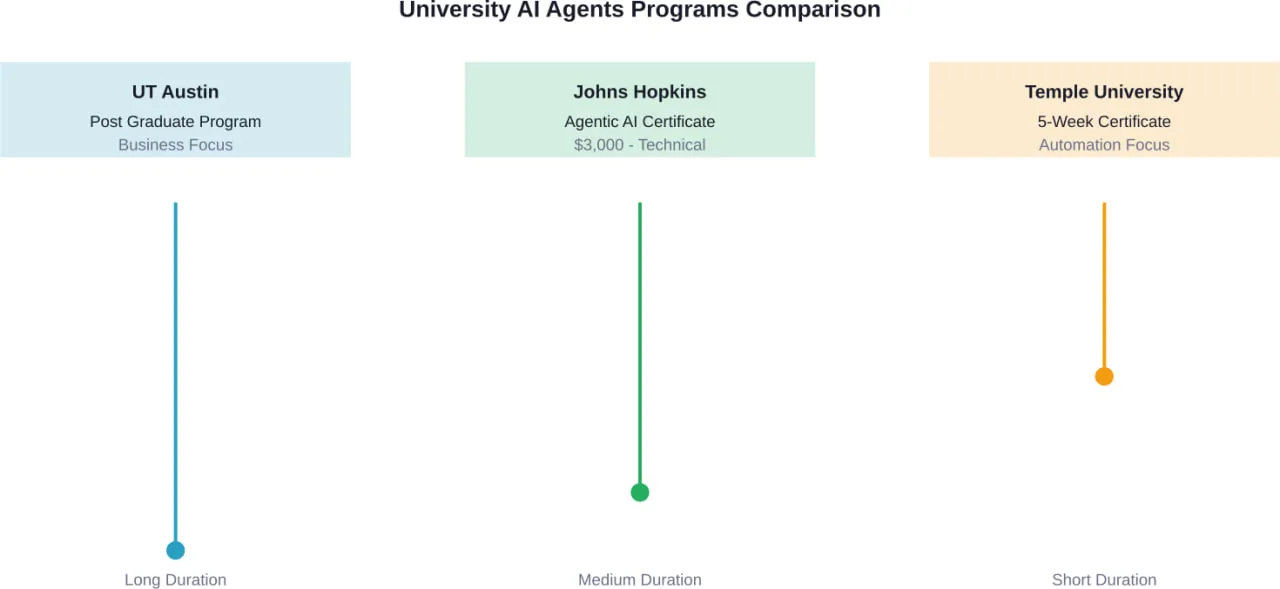
L'université du Texas à Austin propose un programme de troisième cycle sur les agents d'IA pour les applications commerciales par l'intermédiaire de sa McCombs School of Business. Ce programme en ligne de 12 semaines se concentre sur l'utilisation de l'IA agentique pour stimuler l'efficacité et l'innovation, avec des pistes flexibles pour les apprenants techniques et non techniques. Les étudiants apprennent à construire des agents d'IA alimentés par l'IA générative et les grands modèles de langage, en accordant une attention particulière aux applications commerciales réelles.
Le programme de certificat en IA agentique de l'université Johns Hopkins adopte une approche pratique. Le programme coûte $3 000, avec des options de financement disponibles par l'intermédiaire de partenaires tiers tels que Affirm ou Climb, y compris des plans de paiement jusqu'à 12 mensualités. Les étudiants construisent des agents d'IA par le biais de projets pratiques conçus pour développer des compétences dans le monde réel.
Temple University propose un cours de certificat de 5 semaines sur l'automatisation de l'IA et les bases de l'IA agentique (prix : $2,300, actuellement $1,700 avec 26% de réduction pour les sessions à venir en avril, mai et juin 2026) en collaboration avec Ziplines Education. Le programme comprend à la fois du contenu à la demande et des sessions en direct (sessions en ligne de deux heures une fois par semaine) avec des praticiens experts en IA qui aident les étudiants à affiner les flux de travail pour une application professionnelle immédiate. L'université délivre un certificat de fin d'études qui atteste d'une expérience pratique des concepts clés de l'automatisation de l'IA.
Parcours d'apprentissage gratuit
Tout le monde n'a pas besoin d'une certification payante pour commencer à créer des agents. Plusieurs cours gratuits de grande qualité offrent des bases solides.
Le cours de Microsoft AI Agents for Beginners propose 10 leçons qui amènent les apprenants du concept au code, avec du texte, des exemples de code et du contenu vidéo inclus. Le programme couvre les principes fondamentaux de la construction d'agents d'IA. Chaque leçon se construit progressivement, ce qui la rend accessible à ceux qui découvrent l'IA agentique.
Hugging Face propose un cours sur les agents d'intelligence artificielle qui couvre les outils, les pensées, les actions et les observations - les composants essentiels des architectures d'agents. Le cours met à la disposition des apprenants les outils et les plates-formes nécessaires, avec des exercices pratiques tout au long du cours.
Salesforce propose une formation gratuite sur les agents d'IA par le biais de Trailhead, qui enseigne comment créer, optimiser et déployer des flux de travail intelligents. Le cours se concentre sur la façon dont les agents d'IA automatisent les tâches, prennent des décisions et interagissent avec les données pour améliorer l'efficacité.
Formation spécialisée pour les développeurs
Pour ceux qui souhaitent développer des systèmes d'agents prêts à la production, des cours spécialisés pour développeurs offrent une formation technique avancée.
Coursera héberge la spécialisation AI Agent Developer enseignée par le Dr. Jules White (série de 6 cours, niveau débutant, environ 2 mois pour terminer), qui se concentre sur la conception, la construction et le perfectionnement d'agents logiciels intelligents en utilisant Python, l'IA générative et les architectures agentiques. Tout au long de la spécialisation, les apprenants réalisent des projets pratiques qui impliquent la construction d'agents d'IA fonctionnels pour résoudre des problèmes du monde réel dans diverses industries.
Coursera propose plusieurs cours sur l'IA, mais la spécialisation ‘Building AI Agents with OpenAI’ n'est pas un programme partenaire d'Edureka sur la plateforme. Il est recommandé d'avoir des connaissances de base en programmation Python et de se familiariser avec les API, mais aucune expérience préalable avec les frameworks d'agents n'est requise.
Compétences de base enseignées dans les cours sur les agents d'intelligence artificielle
Quel que soit le programme choisi, certaines compétences se retrouvent systématiquement dans les formations de qualité destinées aux agents d'intelligence artificielle.
| Catégorie de compétences | Ce qu'il couvre | Pourquoi c'est important |
|---|---|---|
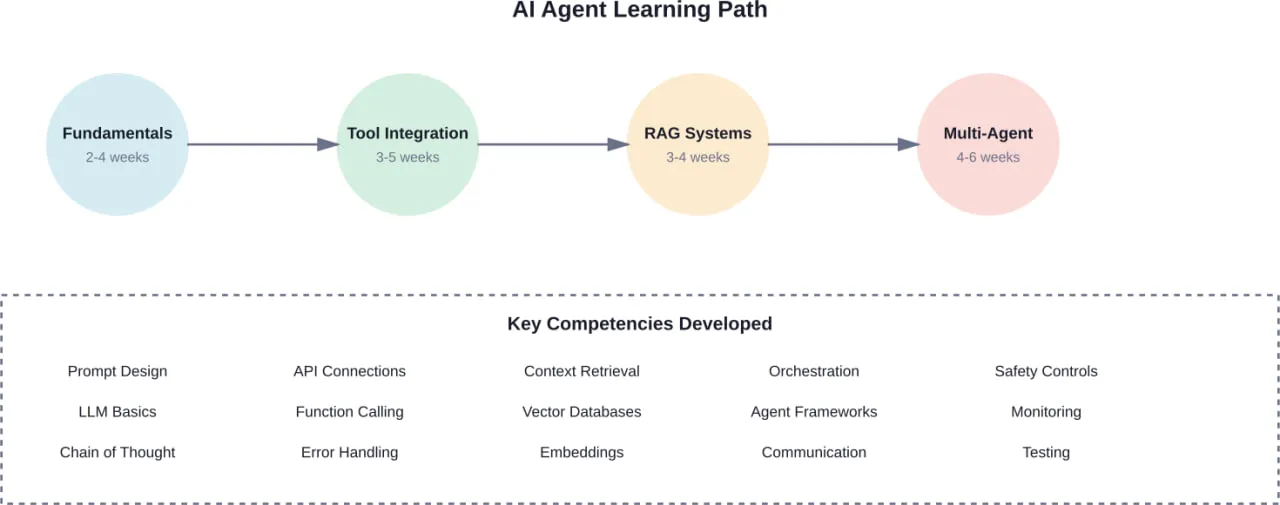
| Ingénierie rapide | Rédiger des instructions qui guident le comportement de l'agent, l'incitation à la réflexion en chaîne, l'apprentissage à court terme | Détermine l'efficacité avec laquelle les agents comprennent et exécutent les tâches |
| Intégration des outils | Connexion des agents aux API, aux bases de données, aux environnements d'exécution de code, aux systèmes externes | Permet aux agents de prendre des mesures réelles au-delà de la génération de texte |
| RAG Mise en œuvre | Génération assistée par récupération pour ancrer les réponses de l'agent dans des bases de connaissances spécifiques | Réduit les hallucinations et améliore la précision des tâches spécifiques à un domaine. |
| Orchestration multi-agents | Coordonner la collaboration de plusieurs agents spécialisés sur des flux de travail complexes | Les capacités des agents s'étendent au-delà de ce que des agents isolés peuvent accomplir. |
| Sécurité et garde-corps | Mise en œuvre de contraintes, de surveillance et de contrôles pour prévenir les comportements nuisibles des agents | Essentiel pour le déploiement de la production et la conformité réglementaire |
L'API de recherche profonde et le SDK d'agents de l'OpenAI fournissent des cadres pour la construction de flux de travail de recherche agentique, démontrant comment ces compétences se combinent dans la pratique. Le SDK permet aux développeurs d'orchestrer des pipelines mono et multi-agents à l'aide d'outils structurés.
Choisir le bon cours en fonction de vos objectifs
La meilleure formation d'agent d'intelligence artificielle dépend de votre point de départ et de votre objectif.
Pour les débutants complets n'ayant aucune expérience en matière de codage, des programmes tels que le cours de 5 semaines de l'université de Temple ou le Trailhead de Salesforce constituent des points d'entrée accessibles. Ils se concentrent sur les concepts et les outils non codés avant de plonger dans la mise en œuvre technique.
Les développeurs ayant une expérience de Python mais ne connaissant pas l'IA devraient envisager le cours gratuit de Microsoft ou le programme d'études de Hugging Face. Tous deux fournissent de solides bases techniques sans présupposer de connaissances préalables en matière d'IA.
Les professionnels de l'entreprise qui cherchent à mettre en œuvre des agents dans des contextes organisationnels tirent le meilleur parti du programme axé sur l'entreprise de l'UT Austin, qui fait le lien entre les concepts techniques et l'application stratégique.
Les praticiens avancés qui souhaitent acquérir une expertise spécialisée devraient explorer le programme de certificat de Johns Hopkins ou la spécialisation de développeur de Coursera. Ces programmes supposent des connaissances de base en matière d'IA et permettent de passer rapidement à des modèles de mise en œuvre sophistiqués.
Considérations de temps et de budget
Les cours gratuits fonctionnent bien pour l'exploration et l'apprentissage de base. Mais ils manquent généralement de soutien structuré, de services d'orientation professionnelle et de diplômes reconnus.
Les certificats universitaires coûtent de quelques centaines à plusieurs milliers de dollars. Consultez les sites web officiels pour connaître les prix actuels, car les tarifs et les options de financement changent fréquemment. Ces programmes offrent des cursus structurés, un enseignement spécialisé et des certificats qui ont du poids auprès des employeurs.
L'engagement en termes de temps varie considérablement. Les formations courtes durent de 5 à 10 semaines, à raison de quelques heures par semaine. Les spécialisations complètes peuvent nécessiter 3 à 6 mois d'efforts constants.
Ce que signifie l'initiative sur les normes applicables aux agents d'intelligence artificielle
L'initiative de normalisation des agents d'IA du NIST, annoncée en février 2026, vise à garantir que la prochaine génération d'IA puisse fonctionner en toute sécurité au nom des utilisateurs et interopérer sans heurts dans l'écosystème numérique.
Pour les apprenants, c'est important car les cours qui s'alignent sur les normes émergentes auront une valeur plus durable. L'initiative se concentre sur :
- Cadres de confiance et de sécurité pour les systèmes autonomes
- Protocoles d'interopérabilité permettant aux agents de différentes plates-formes de travailler ensemble
- Lignes directrices en matière de sécurité pour les systèmes d'agents déployés
- Protection de la vie privée dans le cadre d'interactions avec des agents
Les cours de qualité intègrent de plus en plus ces considérations dans leurs programmes, préparant les étudiants à un écosystème agentique normalisé.
Applications pratiques
Les meilleurs cours mettent l'accent sur des projets pratiques qui reflètent des cas d'utilisation du monde réel.
Les types de projets les plus courants sont les suivants
- Agents de recherche qui recueillent des informations à partir de sources multiples, synthétisent les résultats et produisent des rapports complets. Ils font preuve d'un raisonnement en plusieurs étapes et de l'utilisation d'outils.
- Agents de service à la clientèle qui traitent les demandes, accèdent aux bases de connaissances et font remonter les problèmes complexes de manière appropriée. Ils mettent en évidence l'IA conversationnelle et l'intégration des entreprises.
- Agents de génération de code qui analysent les besoins, écrivent le code, le testent et le répètent en fonction des résultats. Cela met en évidence les capacités autonomes de résolution de problèmes.
- Agents d'analyse des données qui interrogent les bases de données, effectuent des calculs, créent des visualisations et expliquent les idées. Ils combinent des compétences techniques et des capacités de communication.
L'élaboration de ces projets permet de constituer un portefeuille qui démontre les capacités à des employeurs ou des clients potentiels.
Questions fréquemment posées
- Ai-je besoin d'une expérience en codage pour suivre un cours sur les agents d'intelligence artificielle ?
Cela dépend du cours. Des programmes tels que le certificat de l'université de Temple et le Trailhead de Salesforce s'adressent aux apprenants non techniques avec des approches sans code. Toutefois, la plupart des cours complets exigent au moins des connaissances de base en Python. Pour les programmes axés sur les développeurs, comme ceux de Johns Hopkins ou les spécialisations de Coursera, une expérience de la programmation est indispensable.
- Combien de temps faut-il pour apprendre à développer un agent d'IA ?
Les connaissances de base peuvent être acquises en 5 à 10 semaines grâce à des cours structurés. L'acquisition de compétences prêtes pour la production nécessite généralement 3 à 6 mois d'apprentissage et de pratique réguliers. La maîtrise avancée de l'orchestration multi-agents et des cadres spécialisés peut prendre de 6 à 12 mois en fonction de l'expérience antérieure en matière d'IA.
- Quelle est la différence entre l'IA agentique et l'IA classique ?
Les modèles d'IA ordinaires génèrent des réponses basées sur des entrées, mais ne prennent pas d'autres mesures que la production de textes ou de prédictions. Les systèmes d'IA agentique peuvent planifier des flux de travail en plusieurs étapes, utiliser des outils externes, conserver une mémoire au fil des interactions et travailler de manière autonome à la réalisation d'objectifs. Pensez à la différence entre une calculatrice qui résout une équation et un système qui identifie les équations à résoudre et exécute l'analyse complète.
- Les cours d'agents d'intelligence artificielle gratuits sont-ils aussi bons que les cours d'agents rémunérés ?
Les cours gratuits de Microsoft, Hugging Face et Salesforce permettent d'acquérir de solides connaissances de base et sont excellents pour l'exploration. Les programmes universitaires payants offrent des cursus structurés, un enseignement spécialisé, une aide à la carrière et des diplômes reconnus. Les cours gratuits conviennent bien aux apprenants motivés qui se sentent à l'aise avec l'étude indépendante. Les programmes payants offrent davantage de soutien et de validation des compétences.
- Quels sont les outils et les cadres enseignés dans les cours sur les agents d'intelligence artificielle ?
La plupart des cours couvrent l'API d'OpenAI et AgentKit, LangChain pour l'orchestration d'agents, les bases de données vectorielles pour les implémentations RAG, et les frameworks Python pour la construction d'agents personnalisés. Les programmes universitaires incluent souvent plusieurs frameworks afin d'offrir une exposition plus large. Les outils spécifiques varient en fonction de l'objectif du cours et de sa récurrence.
- Puis-je obtenir une certification pour les agents d'intelligence artificielle ?
Oui, plusieurs universités proposent des certificats à l'issue de la formation, notamment Johns Hopkins, UT Austin et Temple University. Ces certificats attestent d'une expérience et de connaissances pratiques. Certaines plateformes comme Coursera proposent également des certificats, mais les diplômes délivrés par les universités ont généralement plus de poids auprès des employeurs.
- Quels sont les emplois auxquels je peux prétendre après avoir suivi une formation d'agent d'intelligence artificielle ?
Les rôles courants comprennent le développeur d'agents d'IA, l'ingénieur en apprentissage automatique spécialisé dans les systèmes agentiques, l'architecte de solutions d'IA, l'ingénieur en automatisation axé sur les flux de travail d'IA et le chercheur en IA appliquée. Les programmes axés sur les entreprises préparent les apprenants à des rôles dans la stratégie d'IA, la gestion de la mise en œuvre et la transformation numérique.
Commencer dès aujourd'hui
La révolution des agents n'est pas à venir, elle est déjà là. Les organisations déploient ces systèmes dès maintenant, et le manque de compétences est réel.
Commencez par un cours gratuit si vous explorez le domaine ou si vous n'êtes pas sûr de votre engagement. Le programme de 10 leçons de Microsoft ou le curriculum de Hugging Face fournissent des bases solides sans risque financier.
Si vous voulez vraiment progresser dans votre carrière ou mettre en place une organisation, investissez dans un programme de certificat reconnu. L'apprentissage structuré, l'enseignement d'experts et le titre de compétence accélèreront considérablement vos progrès.
Quoi qu'il en soit, l'essentiel est de commencer. Les architectures d'agents deviennent fondamentales pour les applications d'IA dans tous les secteurs. Les connaissances que vous acquérez aujourd'hui s'enrichiront au fur et à mesure que la technologie mûrira et que les normes se consolideront.
Consultez les sites web officiels des programmes pour connaître les tarifs en vigueur, les dates d'inscription et les conditions requises. De nombreuses universités proposent des séances d'information au cours desquelles les futurs étudiants peuvent poser des questions et évaluer leurs aptitudes avant de s'engager.
Les outils existent. Les cours sont disponibles. La demande augmente. La suite dépend de l'action.


