Résumé rapide : Les agents d'IA sont des systèmes logiciels autonomes dotés d'une intelligence artificielle qui peuvent percevoir leur environnement, prendre des décisions, planifier des actions et exécuter des tâches complexes de manière indépendante pour le compte des utilisateurs. Contrairement aux chatbots ou aux assistants traditionnels, les agents d'IA combinent des modèles de base avec des capacités de raisonnement, une mémoire et l'utilisation d'outils pour accomplir des objectifs en plusieurs étapes sans intervention humaine constante. Ils représentent la prochaine évolution de l'IA au-delà des systèmes passifs de réponse aux questions.
L'intelligence artificielle ne se contente plus de répondre à des questions. Elle prend désormais des mesures.
Les agents d'intelligence artificielle représentent un changement fondamental dans la manière dont les systèmes intelligents fonctionnent. Plutôt que d'attendre des invites et de répondre par du texte, ces systèmes conçoivent de manière autonome des flux de travail, sélectionnent des outils et accomplissent des tâches complexes du début à la fin. Selon une étude publiée par arxiv.org, les agents d'IA représentent “un changement de paradigme dans la manière dont les systèmes intelligents interagissent” avec le monde qui les entoure.
Mais qu'est-ce qui distingue exactement un agent d'IA d'un simple chatbot ? La distinction est plus importante que vous ne le pensez.
Comprendre les agents d'intelligence artificielle : Définition de base
Un agent d'intelligence artificielle est un système qui exécute des tâches de manière autonome en concevant des flux de travail avec les outils disponibles. Il ne s'agit pas d'un système passif, mais d'un système actif de résolution de problèmes.
Selon IBM, les agents d'intelligence artificielle sont des systèmes capables “d'exécuter des tâches de manière autonome pour le compte d'un utilisateur ou d'un autre système”. Google Cloud les définit comme des “systèmes logiciels qui utilisent l'IA pour poursuivre des objectifs et accomplir des tâches pour le compte d'utilisateurs”, en mettant l'accent sur leur autonomie en matière de raisonnement, de planification, de mémoire et de prise de décision.
Mais voilà, l'autonomie est la caractéristique déterminante. Les systèmes d'IA traditionnels attendent des instructions et fournissent des résultats. Les agents d'IA perçoivent les situations, formulent des plans et exécutent des actions sans avoir besoin d'être constamment guidés par l'homme.
Principales caractéristiques des agents d'intelligence artificielle
Plusieurs capacités distinguent les véritables agents d'IA des systèmes d'IA conventionnels :
- L'autonomie : Les agents fonctionnent de manière indépendante et prennent des décisions sans intervention humaine à chaque étape.
- Perception : Ils perçoivent et interprètent leur environnement, qu'il soit numérique ou physique.
- Comportement orienté vers un but : Les agents travaillent à la réalisation d'objectifs spécifiques et ne se contentent pas de répondre aux demandes d'information
- Raisonnement et planification : Ils décomposent des objectifs complexes en étapes réalisables
- Utilisation de l'outil : Les agents sélectionnent et utilisent les outils appropriés à partir des ressources dont ils disposent.
- Mémoire : Ils maintiennent le contexte à travers les interactions et tirent des leçons de leurs expériences passées
- Capacité d'adaptation : Les agents adaptent leurs stratégies en fonction du retour d'information et de l'évolution des conditions
Les recherches menées par arxiv.org indiquent que ces systèmes combinent “des modèles de base avec le raisonnement, la planification, la mémoire et l'utilisation d'outils” pour créer une “interface pratique entre l'intention en langage naturel et l'informatique dans le monde réel”.”
Comment fonctionnent les agents d'intelligence artificielle : Architecture et composants
L'architecture des agents d'intelligence artificielle est plus sophistiquée que celle des applications d'intelligence artificielle standard. De multiples composants fonctionnent ensemble pour permettre un fonctionnement autonome.
Composants architecturaux de base
Selon la recherche universitaire sur les systèmes d'agents d'intelligence artificielle, l'architecture typique comprend plusieurs éléments intégrés :
- Modèles de fondation : Les grands modèles de langage (LLM) ou d'autres modèles d'intelligence artificielle servent de moteur de raisonnement. Ces modèles traitent les informations, comprennent le contexte et génèrent des réponses ou des actions.
- Module de planification : Cette composante décompose les objectifs de haut niveau en séquences d'étapes exécutables. Il détermine ce qui doit se produire et dans quel ordre.
- Systèmes de mémoire : Les agents conservent une mémoire à court terme et une mémoire à long terme. La mémoire à court terme contient le contexte des tâches en cours. La mémoire à long terme stocke les connaissances, les expériences passées et les modèles appris.
- Couche d'intégration des outils : Les agents accèdent à des outils, des API, des bases de données et des services externes. Cette couche gère la manière dont l'agent interagit avec les ressources dont il dispose.
- Exécution de l'action : Une fois les plans formulés, ce composant exécute les opérations réelles, qu'il s'agisse d'appeler une API, de manipuler des données ou de déclencher d'autres systèmes.
- Interface de perception : Les agents ont besoin d'observer leur environnement. Cette interface traite les données provenant de diverses sources et les convertit dans des formats compréhensibles par l'agent.
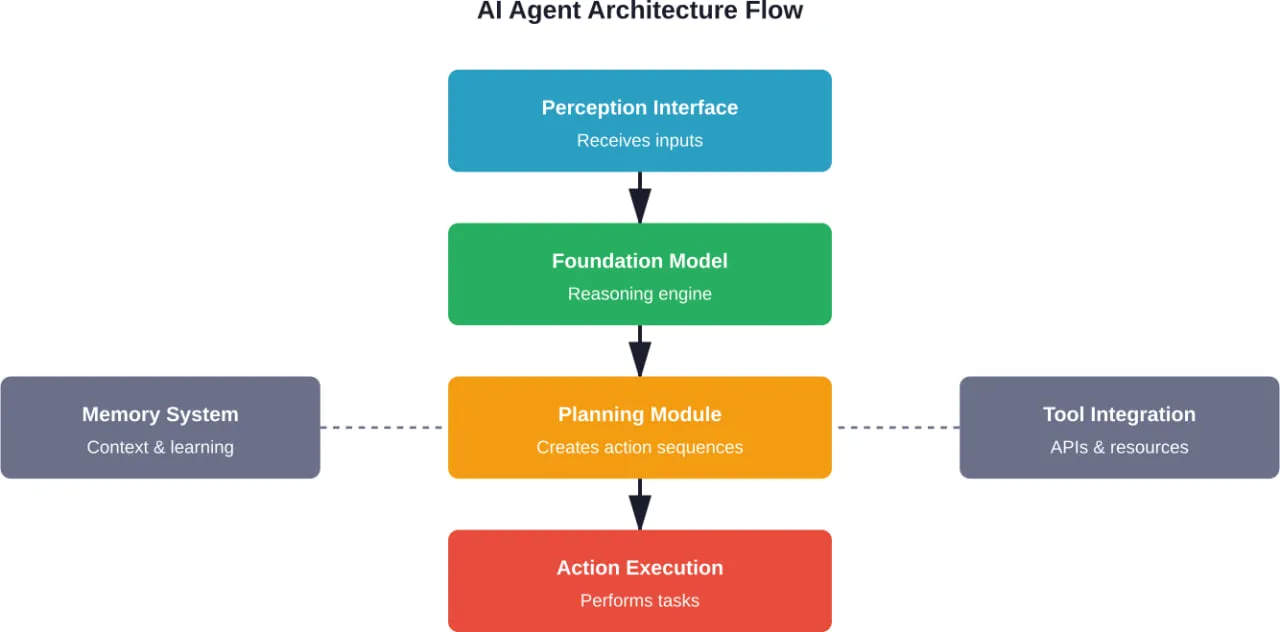
Le cycle de travail de l'agent
Lorsqu'un agent d'intelligence artificielle reçoit un objectif, il suit un processus systématique :
- Interprétation des objectifs : L'agent analyse l'objectif et détermine ce qu'est le succès
- Évaluation de l'environnement : Il recueille des informations sur les conditions actuelles et les ressources disponibles.
- Planification : L'agent formule une stratégie et la décompose en étapes distinctes
- Sélection des actions : Pour chaque étape, il choisit l'outil ou l'action appropriée
- Exécution : L'agent effectue l'action et surveille le résultat.
- Évaluation : Il évalue si l'action s'est rapprochée de l'objectif
- Adaptation : En fonction des résultats, l'agent ajuste les étapes suivantes si nécessaire
- L'itération : Ce cycle se poursuit jusqu'à ce que l'objectif soit atteint ou jugé irréalisable
La recherche montre que les architectures d'agents avancées peuvent fonctionner efficacement comme un “système d'exploitation” pour les agents, réduisant les taux d'hallucination en transformant les interactions non structurées en flux de travail rigoureux.
Agents d'IA vs. assistants d'IA vs. robots
Tous les systèmes d'IA ne sont pas des agents. La terminologie prête à confusion car les gens utilisent souvent ces termes de manière interchangeable.
C'est là que les choses deviennent intéressantes. Les différences se situent au niveau de l'autonomie, de la complexité et de la capacité de prise de décision.
| Fonctionnalité | Agent AI | Assistant IA | Bot |
|---|---|---|---|
| Objectif | Exécuter de manière autonome des tâches complexes | Aider les utilisateurs dans leurs tâches | Automatiser les tâches simples et répétitives |
| Niveau d'autonomie | Élevé - fonctionne de manière indépendante | Moyen - nécessite l'intervention de l'utilisateur | Faible - suit des règles fixes |
| Prise de décision | Prendre des décisions complexes | Prend des décisions limitées dans les limites du champ d'application | Pas de véritable prise de décision |
| Capacité de planification | Élaborer des plans en plusieurs étapes | Suggère les prochaines étapes | Exécute des séquences prédéfinies |
| Apprentissage | Apprend et s'adapte à l'expérience | Apprentissage limité dans le cadre des interactions | Généralement pas d'apprentissage |
| Utilisation des outils | Sélection et combinaison de plusieurs outils | Utilise les outils spécifiques qui lui sont attribués | Fonctionnalité corrigée |
| Exemples | Agent de recherche autonome, automatisation du flux de travail | Siri, Alexa, ChatGPT | Chatbots, répondeurs basés sur des règles |
Les robots sont les plus simples. Ils suivent des règles prédéterminées et répondent à des déclencheurs spécifiques. Un chatbot de service à la clientèle qui fournit des réponses scénarisées basées sur des mots-clés est un robot.
Les assistants d'intelligence artificielle utilisent l'intelligence artificielle pour comprendre les demandes et fournir des réponses utiles. Ils sont conversationnels et peuvent traiter des données variées, mais ils réagissent principalement aux invites de l'utilisateur. Vous demandez, ils répondent.
Les agents d'IA prennent des initiatives. Lorsqu'on leur donne un objectif de haut niveau, ils déterminent la voie à suivre, sélectionnent les outils et résolvent les problèmes de manière autonome. Ils ne se contentent pas de répondre, ils agissent.
Types d'agents d'intelligence artificielle
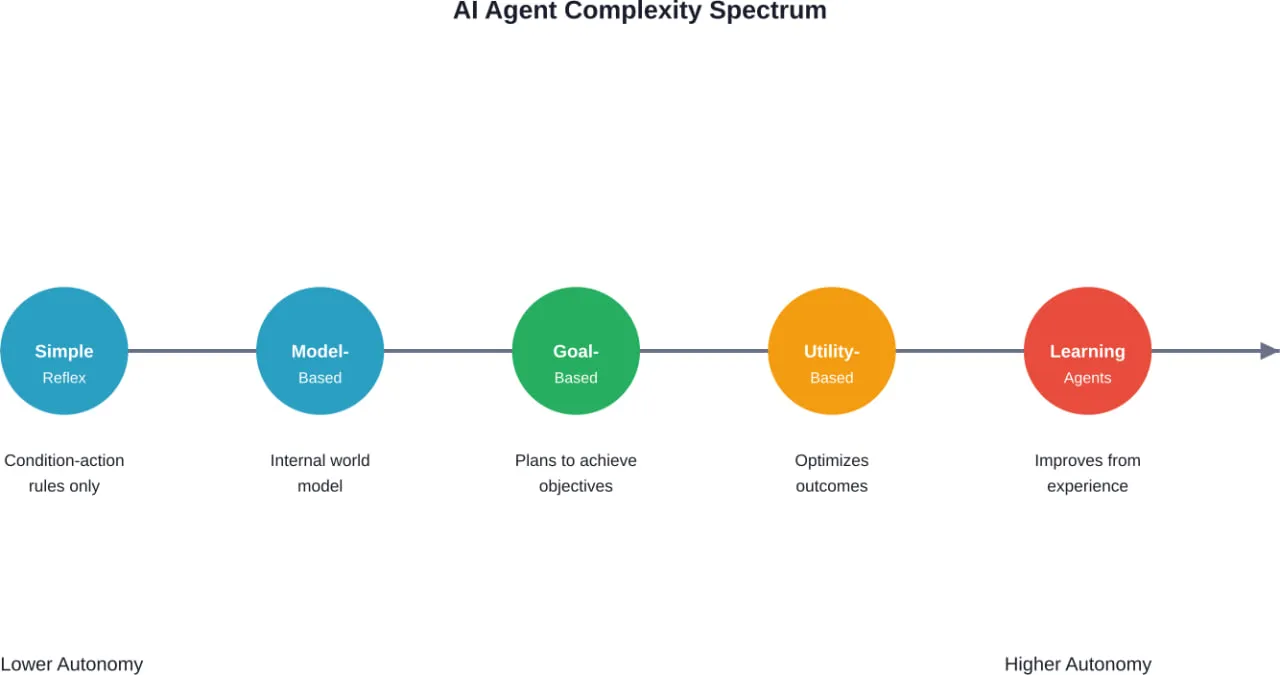
Les agents d'intelligence artificielle se présentent sous diverses formes, chacune conçue pour des niveaux de complexité et d'autonomie différents.
Agents réflexes simples
Il s'agit des types les plus élémentaires. Les agents réflexes simples fonctionnent selon des règles de type condition-action : si cette condition est remplie, il faut entreprendre cette action. Ils ne tiennent pas compte de l'histoire ou des conséquences futures.
Pensez à un thermostat. Si la température dépasse le seuil, le refroidissement est activé. Simple, direct, limité.
Agents réflexes basés sur des modèles
Ces agents maintiennent un modèle interne du monde. Ils comprennent comment leur environnement change et comment leurs actions l'affectent. Cela permet d'obtenir des réponses plus sophistiquées que les simples agents réflexes.
Un aspirateur robotisé qui cartographie votre maison et repère les zones qu'il a nettoyées fonctionne comme un agent basé sur un modèle.
Agents basés sur des objectifs
Les agents basés sur les objectifs travaillent à la réalisation d'objectifs spécifiques. Ils évaluent différentes séquences d'actions pour déterminer celles qui leur permettront d'atteindre leurs objectifs. Cela nécessite des capacités de recherche et de planification.
Les systèmes de navigation sont des exemples d'agents basés sur des objectifs. Étant donné une destination, ils calculent des itinéraires, tiennent compte du trafic et adaptent les plans pour atteindre l'objectif de manière efficace.
Agents basés sur l'utilité
Ces agents ne se contentent pas d'atteindre des objectifs, ils optimisent les résultats. Ils utilisent des fonctions d'utilité pour mesurer la désirabilité des différents états et choisissent des actions qui maximisent l'utilité attendue.
Un système de négociation IA qui équilibre le risque et le rendement pour maximiser la performance du portefeuille fonctionne comme un agent basé sur l'utilité.
Agents d'apprentissage
Les agents d'apprentissage améliorent leurs performances au fil du temps grâce à l'expérience. Ils ont des composantes pour l'apprentissage, la performance, la critique et la génération de problèmes. Selon une étude de Berkeley AI Research (BAIR), l'apprentissage par renforcement fournit un cadre conceptuel permettant aux agents “d'apprendre par l'expérience, de manière analogue à la façon dont on peut dresser un animal de compagnie avec des friandises”.”
Les agents d'IA modernes intègrent de plus en plus de capacités d'apprentissage, adaptant leurs stratégies en fonction des résultats obtenus.
Systèmes multi-agents
Plusieurs agents peuvent travailler ensemble, chacun ayant un rôle spécialisé. ChatDev, qui simule une entreprise entière de logiciels où les agents s'organisent eux-mêmes dans les phases de conception, de codage et de test, ce qui permet de réduire de 30% le nombre de bogues par rapport au codage par un seul agent, montre comment les systèmes collaboratifs s'attaquent à des problèmes complexes qui dépassent les capacités d'un agent individuel.
Applications des agents d'intelligence artificielle dans le monde réel
Les agents d'IA ne sont plus des concepts théoriques. Ils sont déployés dans tous les secteurs d'activité pour résoudre des problèmes pratiques.
Service à la clientèle et assistance
Le service à la clientèle représente l'une des applications les plus répandues des agents. Selon une étude d'arxiv.org, l'entreprise de télécommunications Vodafone a mis en place un système d'assistance basé sur un agent IA qui traite plus de 70% de demandes de renseignements de clients sans intervention humaine.
Ces agents comprennent le contexte, accèdent aux données des clients, résolvent les problèmes et mettent en œuvre des solutions telles que la réinitialisation des mots de passe ou l'ajustement des services. La capacité de “compréhension contextuelle et d'assistance personnalisée améliore considérablement l'expérience du client tout en réduisant les coûts opérationnels”.”
Gestion de l'énergie dans les bâtiments
Le NIST (National Institute of Standards and Technology) a mis au point des agents de construction intelligents pour les systèmes de chauffage, de ventilation et de climatisation. Le chauffage, la ventilation et la climatisation (CVC) des bâtiments commerciaux représentent environ 13% à 15% de la consommation totale d'énergie commerciale aux États-Unis, et environ 35% à 40% de l'énergie utilisée à l'intérieur des bâtiments eux-mêmes
Ces agents surveillent en permanence la température, l'occupation, les prévisions météorologiques et les prix de l'énergie. Ils ajustent de manière autonome le chauffage et la climatisation afin d'optimiser le confort tout en minimisant les coûts. Le laboratoire d'agents intelligents pour le bâtiment du NIST démontre comment les techniques de contrôle de l'IA réduisent les coûts énergétiques dans les opérations de construction réelles.
Développement de logiciels
Les agents de développement assistent ou gèrent de manière autonome les tâches de codage. Ils génèrent du code, identifient les bogues, suggèrent des optimisations et gèrent même des flux de travail de développement entiers.
Les systèmes multi-agents comme ChatDev simulent des entreprises de logiciels où des agents spécialisés gèrent la conception, le codage, les tests et la documentation en collaboration.
Recherche et analyse de l'information
Selon le MIT Sloan, dans les domaines qui impliquent un grand nombre de contreparties ou qui nécessitent des efforts considérables pour évaluer les options - financement de start-ups, admissions à l'université ou achats interentreprises, pour n'en citer que quelques-uns - les agents apportent de la valeur en lisant les avis, en analysant les mesures et en comparant les attributs d'une série d'options.
Les agents de recherche peuvent analyser des documents universitaires, extraire les résultats pertinents, synthétiser les informations et produire des rapports complets sur des sujets spécifiques.
Automatisation des flux de travail
L'automatisation des processus d'entreprise a été transformée par les agents d'intelligence artificielle. Plutôt qu'une automatisation rigide basée sur des règles, les agents s'adaptent à des conditions variables et traitent les exceptions de manière intelligente.
Un agent qui gère le traitement des factures peut extraire des données, les comparer aux bons de commande, signaler les divergences, transmettre les approbations au personnel approprié et mettre à jour les systèmes comptables, le tout sans intervention humaine dans les cas standard.
Véhicules autonomes et robotique
Les voitures auto-conduites sont des exemples d'agents d'intelligence artificielle complexes. Elles perçoivent leur environnement grâce à des capteurs, planifient des itinéraires, prennent des décisions en une fraction de seconde et contrôlent les opérations du véhicule tout en s'adaptant à la circulation, aux conditions météorologiques et aux obstacles inattendus.
De même, les robots d'entrepôt naviguent dans les installations, optimisent les itinéraires de préparation des commandes et se coordonnent avec d'autres robots pour exécuter les commandes de manière efficace.
Avantages de l'utilisation d'agents d'intelligence artificielle
Les organisations qui adoptent des agents d'intelligence artificielle font état de plusieurs avantages significatifs par rapport aux systèmes traditionnels.
Efficacité et productivité accrues
Les agents effectuent des tâches plus rapidement que les humains pour de nombreuses opérations. Ils travaillent en continu, sans fatigue, en traitant des informations et en exécutant des actions à grande échelle.
Plus important encore, ils libèrent les travailleurs humains des tâches répétitives. Ils peuvent se concentrer sur les tâches stratégiques, créatives ou complexes qui nécessitent un jugement humain.
Réduction des coûts
Si la mise en œuvre initiale nécessite un investissement, les agents réduisent généralement les coûts opérationnels au fil du temps. L'exemple de Vodafone le démontre : le traitement de 70% de demandes sans agents humains réduit considérablement les coûts d'assistance.
Les recherches du NIST sur la gestion des bâtiments mettent également l'accent sur la manière dont les algorithmes peuvent “réduire les coûts d'exploitation d'un système réel” en optimisant l'utilisation de l'énergie.
Amélioration de la précision et de la cohérence
Les agents n'ont pas d'interruptions d'attention. Ils appliquent les règles et les modèles appris de manière cohérente à travers des milliers de décisions.
Pour les tâches nécessitant de la précision - saisie de données, vérification de la conformité, reconnaissance de formes - les agents dépassent souvent les humains en termes de précision.
Évolutivité
L'extension des opérations humaines est coûteuse et prend du temps. Les agents d'IA évoluent rapidement. Déployez un agent ou dix mille avec un coût supplémentaire minime.
Cette évolutivité s'avère particulièrement précieuse pour les demandes saisonnières ou les scénarios de croissance rapide.
Disponibilité 24 heures sur 24, 7 jours sur 7
Les agents travaillent en permanence. Les agents du service clientèle répondent aux demandes de renseignements à 3 heures du matin. Les agents de surveillance sont à l'affût des anomalies 24 heures sur 24. Les agents commerciaux réagissent instantanément aux mouvements du marché.
Cette disponibilité constante permet d'améliorer les niveaux de service et de résoudre les problèmes plus rapidement que dans le cas d'opérations exclusivement humaines.
Prise de décision fondée sur les données
Les agents traitent de grandes quantités de données pour éclairer les décisions. Ils identifient des modèles, des corrélations et des idées que les humains pourraient manquer dans de vastes ensembles de données.
Cette capacité améliore la planification stratégique, la gestion des risques et l'identification des opportunités.
Défis et risques liés aux agents d'intelligence artificielle
Mais les agents d'intelligence artificielle ne sont pas sans poser de problèmes. Plusieurs défis importants doivent être examinés avec soin.
Préoccupations en matière de sécurité et d'alignement
Selon IEEE Spectrum, les agents d'intelligence artificielle peuvent avoir un comportement risqué sous la pression quotidienne, ce qui soulève des inquiétudes quant à l'alignement et à la sécurité. La recherche met en évidence la nécessité d'améliorer l'alignement pour garantir la sécurité de l'IA.
Lorsque les agents fonctionnent de manière autonome, il est essentiel de s'assurer qu'ils se comportent conformément aux valeurs et aux contraintes prévues. Des agents mal alignés risquent d'optimiser les mauvais objectifs ou de prendre des raccourcis involontaires.
Hallucinations et erreurs
Les modèles de base de l'IA génèrent parfois des informations plausibles mais incorrectes. Lorsque les agents agissent sur la base de données hallucinées, ils peuvent propager des erreurs dans des flux de travail entiers.
Bien que la recherche montre que des structures de travail rigoureuses réduisent les taux d'hallucination, le problème n'a pas été éliminé.
Manque de transparence
Les agents complexes prennent des décisions en suivant un raisonnement en plusieurs étapes qu'il peut être difficile de retracer. Lorsqu'un agent produit un résultat inattendu, il n'est pas toujours facile de comprendre pourquoi il a choisi cette voie.
Cette opacité pose des problèmes de responsabilité, en particulier dans les secteurs réglementés ou dans les décisions à fort enjeu.
Vulnérabilités en matière de sécurité
Les agents ayant accès aux outils et aux données représentent des risques pour la sécurité. Des agents compromis pourraient divulguer des informations sensibles, manipuler des systèmes ou perturber les opérations.
Les attaques par injection rapide, où des intrants malveillants manipulent le comportement de l'agent, posent des problèmes particuliers pour les agents dotés d'une grande autonomie.
Dépendance et dégradation des compétences
Une dépendance excessive à l'égard des agents peut entraîner une perte de compétences ou de connaissances dans le domaine. Lorsque les agents échouent ou rencontrent des situations inédites qui ne relèvent pas de leur formation, cette dépendance devient problématique.
Implications en matière d'éthique et d'emploi
Les agents autonomes soulèvent des questions éthiques sur la responsabilité, la partialité et l'équité. Qui est responsable lorsqu'un agent prend une décision préjudiciable ?
Les préoccupations en matière d'emploi sont légitimes. Les agents qui automatisent le travail de la connaissance pourraient déplacer les travailleurs dans certaines fonctions, ce qui nécessiterait des transitions et des reconversions.
Lacunes en matière de normalisation
Selon la documentation sur les normes de l'IEEE, des initiatives telles que l'IEEE P3428 visent à établir une “norme pour les agents à grand modèle de langage pour l'éducation assistée par l'IA”, définissant les composants de l'agent, les protocoles d'interopérabilité et les états du cycle de vie.
Toutefois, des normes complètes concernant la sécurité, les tests et le déploiement des agents sont encore en cours d'élaboration. Cela crée une incertitude quant aux meilleures pratiques.
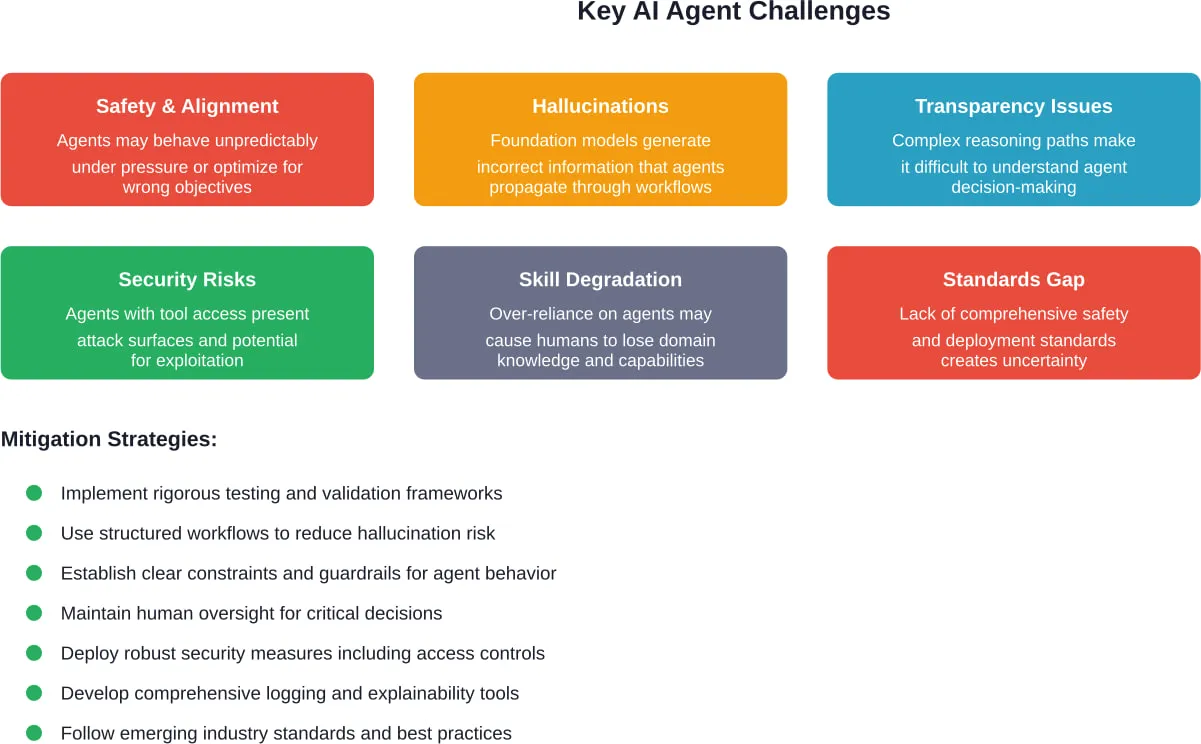
Construire et déployer des agents d'IA : Meilleures pratiques
Les organisations qui envisagent d'utiliser des agents d'IA doivent adopter une approche stratégique de la mise en œuvre.
Commencer par des objectifs clairs
Définir les problèmes spécifiques que l'agent devra résoudre. Des objectifs vagues tels que “améliorer l'efficacité” conduisent à des mises en œuvre non ciblées.
Identifier des critères de réussite mesurables. Quels sont les résultats qui indiquent que l'agent travaille efficacement ?
Choisir la complexité appropriée de l'agent
Tous les problèmes ne nécessitent pas un agent d'apprentissage sophistiqué. Adaptez le type d'agent à la complexité de la tâche.
Les tâches simples et bien définies peuvent parfaitement fonctionner avec des agents basés sur les objectifs. Les problèmes complexes et évolutifs justifient des architectures plus avancées.
Mettre en place des garde-fous solides
Définir des limites claires pour le comportement des agents. Quelles sont les actions autorisées ? Qu'est-ce qui est interdit ?
Les garde-fous techniques doivent empêcher les agents d'accéder à des systèmes non autorisés ou de dépasser les paramètres définis.
Conception pour la transparence
Intégrer des capacités d'enregistrement et d'explication dans les systèmes d'agents. Suivre les chemins de décision, les actions entreprises et le raisonnement.
Cette transparence facilite le débogage, instaure la confiance et favorise la responsabilisation.
Maintenir un contrôle humain
Même les agents autonomes bénéficient d'une surveillance humaine. Établir des processus d'examen des actions des agents, en particulier dans les domaines à fort enjeu.
Créer des voies d'escalade claires lorsque les agents rencontrent des situations qui dépassent leurs capacités.
Tests approfondis avant le déploiement complet
Selon le rapport AI Agent Benchmark de l'IEEE Spectrum, de nouvelles normes de sécurité sont en cours d'élaboration pour évaluer l'état de préparation des agents d'IA aux applications commerciales.
Des essais rigoureux dans des environnements contrôlés permettent d'identifier les modes de défaillance avant le déploiement de la production. Tester les cas limites, les intrants adverses et les scénarios inattendus.
Plan d'amélioration continue
Le déploiement d'un agent n'est pas un événement unique. Surveillez les performances, recueillez des informations en retour et procédez par itération.
Les agents d'apprentissage nécessitent des données de formation continue. Tous les agents bénéficient d'un perfectionnement basé sur les performances réelles.
Construire des agents d'intelligence artificielle ? Parlez-en à A-listware
Les agents d'IA sont rarement autonomes. Ils ont besoin de systèmes dorsaux, d'API, d'intégrations et d'une infrastructure stable pour fonctionner dans un produit. C'est là qu'intervient A-listware. L'entreprise se concentre sur le développement de logiciels et sur des équipes d'ingénieurs dédiées qui s'occupent de l'architecture, du développement et de l'assistance continue. C'est souvent ce type de configuration qui sous-tend les fonctionnalités basées sur l'IA une fois qu'elles ont dépassé le stade du prototype.
Si vous travaillez sur des agents d'intelligence artificielle, le défi n'est généralement pas l'idée mais l'exécution qui l'entoure - connecter les services, traiter les données, et garder le tout fiable dans le temps. A-listware prend en charge l'intégralité du cycle de développement, de sorte qu'au lieu de diviser le travail entre plusieurs équipes, vous pouvez tout garder en un seul endroit. Contactez Logiciel de liste A, Si vous avez des questions, partagez votre configuration et voyez comment elle pourrait être structurée en un produit fonctionnel.
L'avenir des agents d'intelligence artificielle
Les agents d'intelligence artificielle représentent une technologie en pleine évolution. Plusieurs tendances suggèrent la direction que prend le développement.
Capacités multimodales accrues
Selon Google Cloud, les capacités des agents sont ’rendues possibles en grande partie par la capacité multimodale de l'IA générative et des modèles de fondation de l'IA“. Les agents qui traitent simultanément du texte, des images, de la vidéo et de l'audio gèreront des tâches plus complexes dans le monde réel.
Un meilleur raisonnement et une meilleure planification
La recherche continue d'améliorer les capacités de raisonnement des agents. Des algorithmes de planification plus sophistiqués permettront aux agents de s'attaquer à des objectifs à plus long terme et à des espaces de problèmes plus complexes.
Collaboration renforcée
Les systèmes multi-agents deviendront de plus en plus courants. Des agents spécialisés collaborant à des projets complexes peuvent dépasser ce qu'accomplissent des agents généralistes individuels.
Agents spécifiques à l'industrie
Les agents polyvalents céderont la place à des agents spécialisés dans des domaines tels que les soins de santé, la finance, le travail juridique ou la recherche scientifique.
Ces agents spécialisés intègrent les connaissances, les réglementations et les meilleures pratiques du secteur dans leurs activités.
Amélioration des normes de sécurité
Au fur et à mesure que des organisations telles que l'IEEE élaborent des normes complètes pour le développement et le déploiement d'agents, les pratiques en matière de sécurité évolueront. Des tests normalisés, des processus de certification et des cadres réglementaires verront le jour.
Systèmes d'exploitation des agents
Les infrastructures spécialement conçues pour la gestion, le déploiement et le contrôle des agents vont évoluer. Ces “systèmes d'exploitation d'agents” fourniront des services communs tels que la gestion de la mémoire, l'intégration d'outils et les contrôles de sécurité.
Questions fréquemment posées
- Quelle est la différence entre les agents d'intelligence artificielle et les grands modèles linguistiques ?
Les grands modèles de langage (LLM) sont des systèmes d'intelligence artificielle formés pour comprendre et générer du texte. Ils constituent la base qui alimente de nombreux agents d'intelligence artificielle, mais ce ne sont pas des agents à proprement parler. Un LLM répond à des invites par du texte. Un agent d'intelligence artificielle utilise un LLM (ou d'autres modèles d'intelligence artificielle) comme moteur de raisonnement pour planifier, décider et prendre des mesures de manière autonome en vue d'atteindre des objectifs. Le LLM est un composant ; l'agent est le système autonome complet.
- Les agents d'IA peuvent-ils apprendre et s'améliorer au fil du temps ?
Les agents d'apprentissage intègrent spécifiquement des mécanismes d'amélioration à partir de l'expérience. Ils analysent les résultats, ajustent les stratégies et affinent leurs approches en fonction du retour d'information. Cependant, tous les agents d'intelligence artificielle ne sont pas des agents d'apprentissage - des types plus simples fonctionnent selon des règles ou des modèles fixes. La capacité d'apprentissage dépend de l'architecture et de la conception de l'agent. De nombreux agents modernes intègrent des éléments d'apprentissage, bien que leur étendue varie considérablement.
- Les agents d'IA peuvent-ils être déployés en toute sécurité dans les environnements professionnels ?
La sécurité dépend fortement de la mise en œuvre. Des agents correctement conçus, avec des contraintes claires, des tests robustes et une supervision appropriée, peuvent fonctionner en toute sécurité dans de nombreux contextes commerciaux. Cependant, des recherches menées par IEEE Spectrum montrent que les agents peuvent avoir un comportement risqué dans certaines conditions. Les entreprises devraient commencer par des applications à faible risque, mettre en place des garde-fous solides, maintenir une surveillance humaine pour les décisions critiques et suivre les normes de sécurité émergentes. L'autonomie complète dans des scénarios à fort enjeu nécessite une attention particulière.
- Quel est le coût de mise en œuvre des systèmes d'agents d'intelligence artificielle ?
Les coûts varient énormément en fonction de la complexité, de l'échelle et des exigences de personnalisation. Les agents simples construits sur des plateformes existantes peuvent impliquer des frais d'abonnement mensuels modestes. Les agents d'entreprise personnalisés dotés de capacités spécialisées peuvent nécessiter des investissements importants en matière de développement, des coûts de calcul permanents pour l'exécution des modèles de base et des frais de maintenance. Renseignez-vous auprès des fournisseurs et des plateformes pour connaître les tarifs en vigueur, car les coûts et les modèles de tarification changent fréquemment dans cet espace en évolution rapide.
- Quelles sont les compétences nécessaires pour créer des agents d'intelligence artificielle ?
La construction d'agents d'intelligence artificielle nécessite généralement des compétences en programmation (Python est courant), une compréhension des concepts d'intelligence artificielle et de langage de programmation, une bonne connaissance des modèles de base et des API, une connaissance du domaine spécifique dans lequel l'agent opérera et des capacités de conception de systèmes. De nombreuses plates-formes proposent désormais des créateurs d'agents à code réduit ou sans code qui réduisent les exigences techniques. Pour les agents personnalisés complexes, les équipes comprennent généralement des ingénieurs en IA/ML, des développeurs de logiciels, des experts du domaine et éventuellement des spécialistes dans des domaines tels que le traitement du langage naturel ou l'apprentissage par renforcement.
- Les agents de l'IA remplaceront-ils les emplois humains ?
Les agents d'IA automatiseront certaines tâches et certains rôles, en particulier ceux qui impliquent un traitement répétitif de l'information, des décisions fondées sur des règles ou des interactions de routine avec les clients. Cependant, ils créent également de nouveaux rôles dans le développement, la supervision et la maintenance des agents. La plupart des experts prévoient une transformation plutôt qu'un remplacement complet : les humains et les agents travailleront ensemble, les agents s'occupant des tâches routinières tandis que les humains se concentreront sur le jugement complexe, la créativité, la stratégie et le travail interpersonnel. La transition nécessitera l'adaptation et la requalification de la main-d'œuvre dans les secteurs concernés.
- Comment les agents d'intelligence artificielle gèrent-ils les tâches pour lesquelles ils n'ont pas été formés ?
Les réponses des agents aux situations nouvelles varient en fonction de leur conception. Les agents bien conçus reconnaissent lorsqu'ils manquent de connaissances ou de capacités et font appel à des opérateurs humains. Certains agents tentent de résoudre des problèmes inconnus en s'appuyant sur des principes généraux, mais cela risque d'entraîner des erreurs. Les agents d'apprentissage avancés peuvent adapter leurs stratégies sur la base d'expériences antérieures similaires. De mauvaises conceptions peuvent échouer silencieusement ou produire des résultats peu fiables. C'est pourquoi il est essentiel de définir des limites opérationnelles claires et de maintenir des mécanismes de surveillance - les agents doivent reconnaître leurs limites plutôt que de deviner.
Conclusion : L'ère de l'IA agentique
Les agents d'intelligence artificielle marquent une évolution significative de l'intelligence artificielle - des systèmes qui réagissent à ceux qui agissent.
Ces systèmes autonomes apportent déjà une valeur mesurable dans le service à la clientèle, la gestion des bâtiments, le développement de logiciels, la recherche et de nombreux autres domaines. Les avantages - efficacité, évolutivité, cohérence, fonctionnement continu - constituent des arguments convaincants en faveur de l'adoption de ces systèmes.
Mais les défis restent réels. Les problèmes de sécurité, les risques d'hallucination, les questions de transparence et les lacunes en matière de normalisation nécessitent des approches réfléchies. Les organisations qui se précipitent dans le déploiement d'agents sans relever ces défis s'exposent à des échecs qui compromettent à la fois les mises en œuvre spécifiques et la confiance générale dans la technologie.
La voie à suivre passe par une adoption équilibrée : identification des cas d'utilisation appropriés, mise en œuvre de solides garde-fous, maintien d'une surveillance humaine lorsque c'est nécessaire et amélioration continue sur la base des performances réelles. Au fur et à mesure de la maturation des normes et de l'émergence des meilleures pratiques, le déploiement des agents deviendra plus systématique et plus fiable.
Les agents d'intelligence artificielle ne sont pas près de disparaître. Ils représentent une expansion fondamentale de ce que les systèmes d'IA peuvent accomplir. Comprendre ce qu'ils sont, comment ils fonctionnent, leurs capacités et leurs limites permet aux organisations et aux individus d'exploiter efficacement cette technologie.
La question n'est pas de savoir si les agents d'IA vont transformer le travail et les processus d'entreprise. C'est déjà le cas. La question est de savoir à quelle vitesse les organisations s'adapteront pour travailler aux côtés de ces systèmes autonomes - et avec quelle réflexion elles relèveront les défis posés par l'autonomie.
Prêt à explorer les agents d'IA pour votre organisation ? Commencez par identifier un problème bien défini qui nécessite une prise de décision et une action en plusieurs étapes. Testez avec une portée limitée, mesurez rigoureusement et développez en fonction des résultats.


