Quick Summary: Digital transformation for science integrates AI, cloud computing, and advanced data infrastructure to accelerate research, improve reproducibility, and enable data-driven discoveries. Federal agencies like NSF are investing heavily in AI research institutes and national infrastructure, while organizations modernize data management systems to support collaborative, open science initiatives.
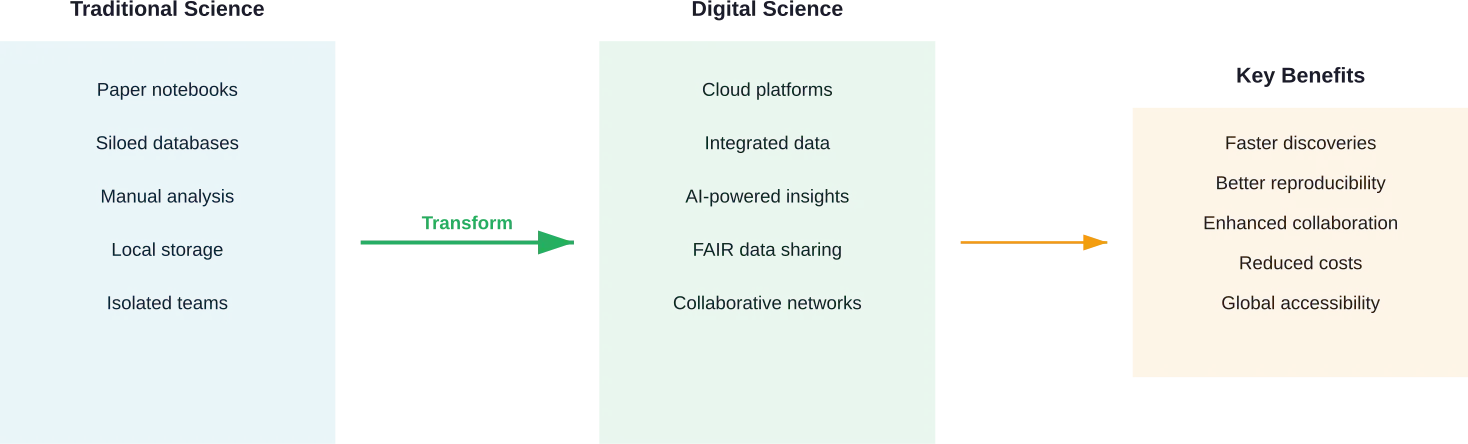
Scientific research stands at a crossroads. Traditional lab notebooks and siloed databases can’t keep pace with the data volumes modern instruments generate. Digital transformation addresses this challenge head-on.
The U.S. National Science Foundation announced a $100 million investment in five new National AI Research Institutes and a central community hub in 2025. This commitment reflects how federal agencies recognize digital technologies as fundamental to scientific competitiveness.
Core Technologies Reshaping Research
Cloud computing enables researchers to process massive datasets without building expensive on-premise infrastructure. NASA defines digital transformation as employing technologies to change processes so dramatically they become unrecognizable compared to traditional forms.
But here’s the thing—technology alone won’t cut it. Organizations must address data management fundamentals. Research data management toolkits for life sciences emphasize FAIR principles: Findable, Accessible, Interoperable, and Reusable.
Implementation Challenges and Solutions
Research from German neuroscience communities identified key barriers: lack of metadata standards, insufficient provenance tracking, and inadequate infrastructure for sensitive data. Sound familiar?
| Challenge | Solution Strategy | Expected Outcome |
|---|---|---|
| Siloed databases | Implement integrated data platforms | Cross-dataset insights |
| Skills gaps | Invest in training programs | Enhanced team capabilities |
| Data security | Deploy privacy-preserving infrastructure | Compliant sensitive data handling |
| Lack of standards | Adopt common data elements | Improved interoperability |
Climate scientists demonstrated success using IoT sensors and cloud computing for real-time environmental data collection. This approach improved climate model accuracy through continuous data streams rather than periodic manual collection.
The AI Revolution in Scientific Research
NSF’s investments focus on quantum computing, AI research institutes, and the National Artificial Intelligence Research Resource (NAIRR). The agency initiated efforts to establish a NAIRR Operations Center, transitioning the pilot into a coordinated national program.
AI-driven discoveries promise practical solutions to global challenges—from food production and supply chains to healthcare and education. Smart Health and Biomedical Research programs combine computing, engineering, and data science to tackle public health challenges.
Practical Strategies for Research Teams
Start with pilot projects rather than wholesale transformation. Materials engineering researchers adopted virtual labs for simulation experiments, validating feasibility before scaling.
Real talk: investment in training programs matters more than technology purchases. Teams without digital literacy can’t leverage advanced tools effectively.
| Do | Don’t |
|---|---|
| Invest in training programs | Ignore skill development needs |
| Start with pilot projects | Implement large-scale changes immediately |
| Establish data standards early | Leave metadata as an afterthought |
| Plan for interoperability | Build isolated systems |
| Prioritize security from day one | Add security as a later patch |
Make Research Workflows Easier to Manage and Scale
In many scientific teams, the issue is not a lack of tools but a lack of consistency – different systems, formats, and processes that do not quite fit together as work evolves.
A-listware approaches this by stepping into the existing setup and making sense of it first. They identify where coordination breaks down, where data becomes harder to track, and where teams lose time on routine tasks. From there, they adjust and connect systems so work becomes easier to follow, not harder to control, while staying involved during implementation to keep things stable.
For science-focused organisations, this often results in more predictable workflows, better visibility across projects, and fewer manual workarounds. If your current setup feels harder to manage as your work grows, contact A-listware and get a clear, practical view of what needs to change next.
Future Outlook
Digital transformation continues accelerating. For 75 years, the U.S. National Science Foundation has helped secure the nation’s leadership in science and engineering, demonstrating sustained commitment to technological advancement. The transition of NAIRR from pilot to national program signals infrastructure investments will grow.
Organizations that embrace digital transformation position themselves for collaborative, reproducible, and impactful research. Those clinging to traditional methods risk falling behind.
Frequently Asked Questions
- What is digital transformation for science?
Digital transformation for science integrates advanced technologies like AI, cloud computing, and data management platforms to fundamentally change how research is conducted, enabling faster discoveries, better reproducibility, and enhanced collaboration across distributed teams.
- How much is NSF investing in AI research?
According to data from 2025, The U.S. National Science Foundation announced a $100 million investment in five new National AI Research Institutes and a central community hub.
- What are FAIR data principles?
FAIR principles ensure research data is Findable, Accessible, Interoperable, and Reusable. These standards improve data sharing and enable other researchers to validate findings and build upon existing work.
- What challenges do scientists face during digital transformation?
Key barriers include lack of metadata standards, insufficient provenance tracking methods, inadequate infrastructure for sensitive data, skills gaps in digital literacy, and resistance to changing established workflows.
- How do cloud platforms benefit scientific research?
Cloud platforms eliminate expensive on-premise infrastructure requirements, provide scalable computing power for large datasets, enable real-time collaboration across global teams, and reduce time-to-insight for data-intensive research projects.
- What role does AI play in scientific research transformation?
AI accelerates data analysis, identifies patterns humans might miss, automates routine tasks, improves prediction accuracy in models, and enables new research methodologies in fields from healthcare to climate science.
- Should organizations implement digital transformation all at once?
No. Starting with pilot projects allows teams to test feasibility, identify challenges, build skills gradually, and demonstrate value before committing to large-scale implementation across entire organizations.
Conclusion
Digital transformation represents the future of scientific research. Federal investments, advancing technologies, and proven implementation strategies provide a clear roadmap forward.
Organizations must act now—investing in training, establishing data standards, and adopting cloud infrastructure. The competitive advantage goes to teams embracing these changes today. Check current NSF funding opportunities to access transformation resources.


