Quick Summary: Digital transformation for professional services involves integrating advanced technologies, data-driven processes, and cultural change to improve operational efficiency, client delivery, and competitive positioning. According to recent industry surveys, business leaders have made digital transformation and AI exploration top priorities for 2025, though implementation faces significant obstacles including time-consuming compliance tasks, misaligned organizational structures, and employee anxiety about AI adoption.
The professional services industry has always adapted to change. Legal firms, consulting practices, accounting agencies, and engineering companies have weathered regulatory shifts and market disruptions for decades. But something fundamental has shifted.
It’s not just about adopting new tools anymore. Digital transformation has become the baseline expectation for survival, let alone growth. Clients demand faster turnarounds. Talent follows firms with modern infrastructure. And competitors who move quickly are capturing market share at an unprecedented pace.
According to the 2025 C-Suite Survey published by the Thomson Reuters Institute, business leaders have made digital transformation, improving operational efficiency, and exploring the potential of AI their top priorities for 2025. Almost two-thirds of these leaders (62%) identified time-consuming compliance and reporting tasks as a primary challenge.
Here’s the thing though—knowing digital transformation matters and actually executing it are two entirely different challenges.
What Digital Transformation Actually Means for Professional Services
Digital transformation isn’t a single technology deployment. It’s not just implementing cloud storage or buying new software licenses.
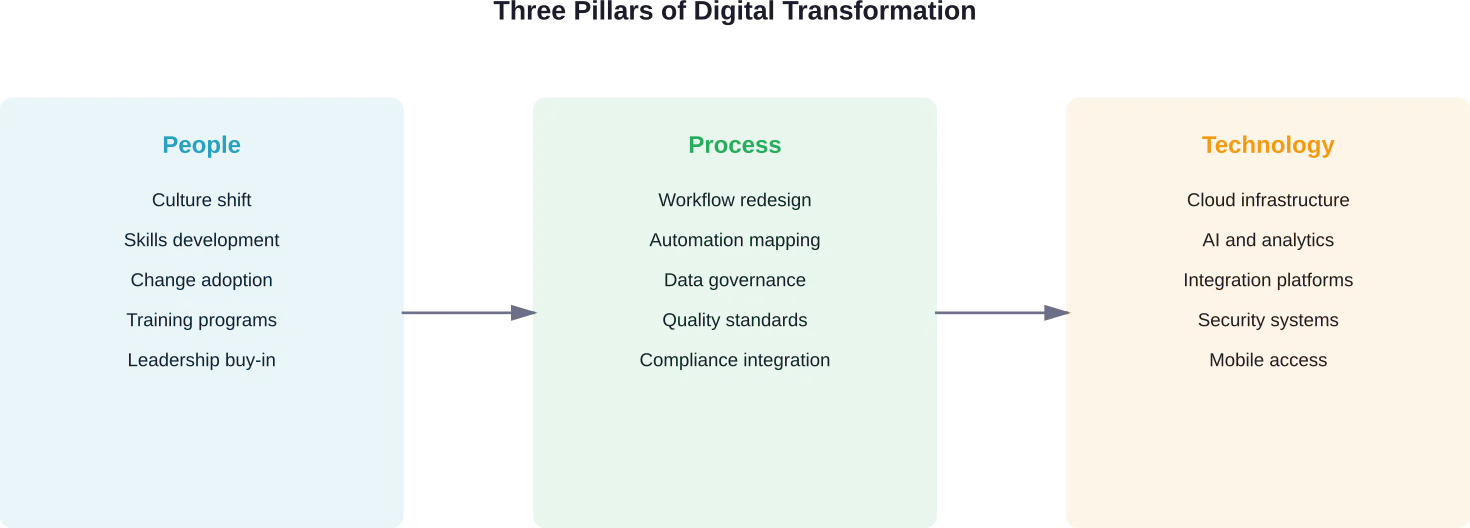
Real transformation touches three interconnected dimensions: people, process, and technology. Strategy must align with operational systems, and those systems need people who understand how to use them effectively.
For professional services specifically, this means rethinking how work gets delivered from intake through billing. How does a law firm reduce contract review time from days to hours? How does a consultancy scale its insights without proportionally scaling headcount? How does an accounting practice handle increasing compliance complexity without drowning in administrative overhead?
These aren’t hypothetical questions. They’re the daily reality firms face.
Why Corporate Functions Struggle With Implementation
Despite widespread recognition that digital transformation matters, implementation consistently stalls. Corporate departments face specific obstacles that prevent meaningful progress.
Time-consuming compliance and reporting tasks leave little room for value-add work. According to the 2025 C-Suite Survey, 68% of C-Suite leaders surveyed identified this as a primary challenge. When teams spend most of their energy on mandatory reporting, strategic initiatives get deprioritized.
But that’s just one piece. Siloed organizational structures create information bottlenecks. Data flows poorly across departments. Different teams use incompatible systems. And nobody has clear ownership of cross-functional digital initiatives.
There’s also a general perception that enabling functions aren’t as effective as they could be, nor able to contribute significantly to overall organizational objectives. This creates a vicious cycle—limited resources lead to limited impact, which reinforces the perception that these functions don’t deserve additional investment.
The Psychology of AI Adoption
According to a Harvard Business Review article published February 17, 2026, while 88% of companies report regular AI use, many leaders express familiar frustrations about disappointing returns on AI investments.
The problem isn’t technical execution. It’s psychological resistance and organizational change management.
According to Harvard Business Review research, AI adoption stalls because employees experiment with new tools but don’t integrate them deeply into how work actually gets done, leaving executives increasingly concerned about ROI.
Leaders who treat AI adoption as a psychological and contextual challenge—not just a technical rollout—see significantly better results. That means addressing concerns directly, creating safe experimentation spaces, and demonstrating how AI augments rather than replaces human expertise.
Measuring Success Beyond Traditional ROI
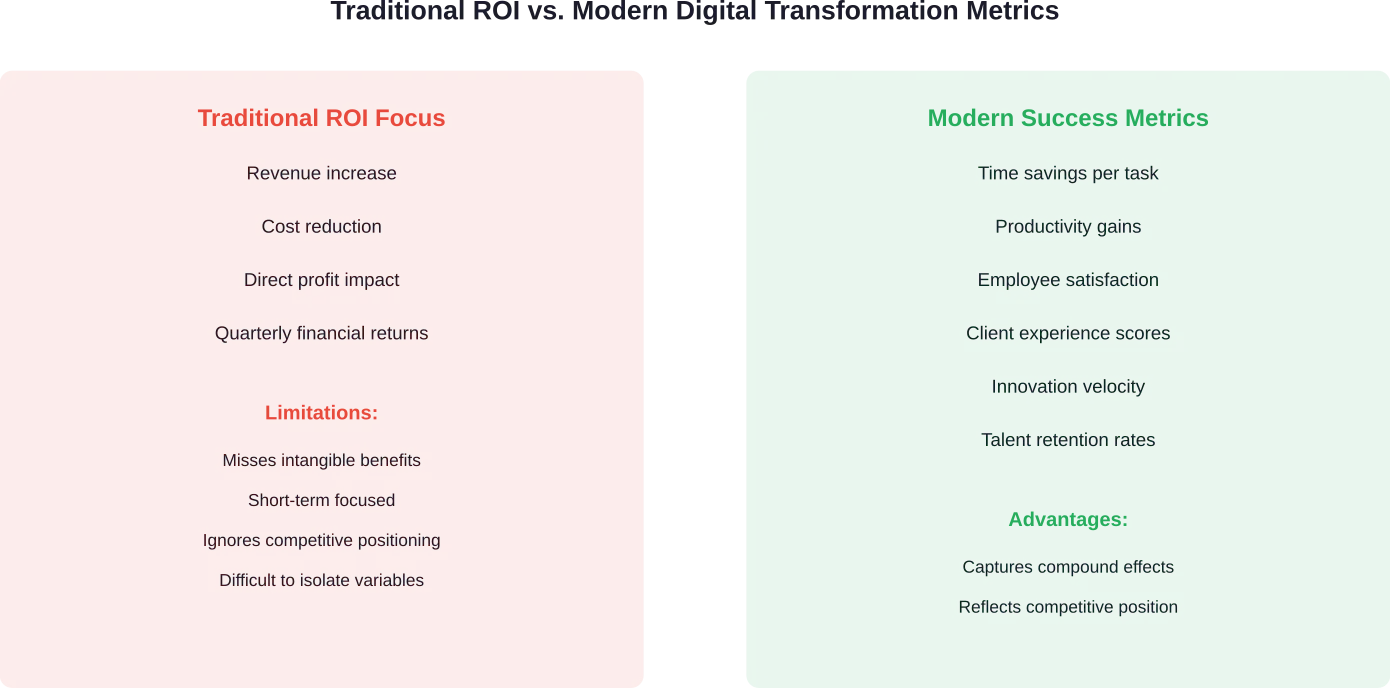
Here’s where most digital transformation initiatives go wrong from the start. They anchor success metrics to traditional return on investment calculations that don’t capture the full picture.
According to research from UC Berkeley’s Executive Education program (published September 17, 2025), MIT’s recent report “The GenAI Divide: State of AI in Business 2025” claimed that 95% of generative AI projects fail to deliver measurable return on investment. The study found that despite $30-40 billion in enterprise investment, 95% of organizations studied are seeing zero return on their AI initiatives.
But are organizations measuring the wrong things?
Berkeley’s response suggested focusing on alternative metrics that actually matter. Instead of only tracking revenue increases, firms should measure Return on Efficiency (ROE)—time savings and productivity gains that compound over time.
When a marketing team reduces content creation time from hours to minutes, or when legal teams accelerate contract review by 60%, the immediate dollar value might seem modest. But the cumulative effect over quarters and years creates significant competitive advantage.
The Data-Driven Decision Making Imperative
Marketing professionals increasingly face a harsh reality. Creating strong campaigns, writing compelling copy, or designing standout visuals no longer guarantees career advancement.
According to research from Villanova University’s College of Professional Studies, the difference between those who advance and those who plateau isn’t just creativity—it’s the ability to interpret and act on digital marketing analytics. Data-driven decision-making has become the new standard across professional services.
This shift extends beyond marketing. Legal teams need data to forecast case outcomes. Consultancies require analytics to identify client patterns. Accounting firms depend on data visualization to communicate complex financial insights.
The skill gap is real. Many professionals trained before widespread digital adoption lack formal analytics training. They understand their domain expertise but struggle to translate that knowledge into data-informed strategies.
Building Data Literacy Across Organizations
Closing this gap requires systematic investment in upskilling. But throwing people into generic data science courses doesn’t work.
Professional services firms need targeted training that connects analytics directly to domain-specific applications. How does a lawyer use predictive analytics for case strategy? How does a consultant build client dashboards that drive action rather than just present information?
Data storytelling has emerged as a critical capability. Raw numbers mean nothing without context and narrative. Professionals who can extract insights from data and communicate those insights effectively become invaluable.
Practical Transformation Pathways
So what does implementation actually look like? Several common pathways have emerged across successful professional services transformations.
| Pathway | Best For | Key Focus Areas | Timeline |
|---|---|---|---|
| Operational Excellence | Established firms with legacy processes | Process automation, workflow optimization, cost efficiency | 12-18 months |
| Client Experience | Firms facing retention challenges | Digital portals, communication platforms, self-service tools | 6-12 months |
| Data Modernization | Organizations with siloed information | Integration platforms, analytics infrastructure, reporting systems | 18-24 months |
| Innovation-Led | Growth-focused firms in competitive markets | AI experimentation, new service models, technology partnerships | Ongoing |
Most firms don’t pick just one pathway. They sequence initiatives based on immediate pain points and long-term strategic goals.
Starting with operational excellence often makes sense because it frees up resources for other initiatives. When teams spend less time on administrative tasks, they have bandwidth for innovation projects.
The Role of Professional Services Automation
Professional Services Automation (PSA) platforms have become central to many transformation initiatives. These integrated systems handle project management, resource allocation, time tracking, and billing in unified environments.
The value proposition is straightforward. Instead of juggling multiple disconnected tools, teams work within a single system that maintains data consistency and enables real-time visibility.
But PSA implementation isn’t plug-and-play. Firms need clear processes before automation. Technology amplifies whatever processes exist—efficient ones become more efficient, but chaotic ones become systematically chaotic.
Successful PSA deployments start with process mapping. Document current workflows, identify bottlenecks, redesign for efficiency, then configure the platform to support those optimized processes.
Make Your Systems Support the Work, Not Get in the Way
In professional services, small inefficiencies across tools, data, and reporting tend to build up quickly, especially when teams rely on multiple systems that do not fully connect. A-listware approaches digital transformation by first understanding how work actually moves through a firm, then restructuring systems around that flow instead of forcing teams to adapt to rigid setups. This usually involves improving how information is shared, reducing duplicated work, and making core processes easier to manage across departments.
For professional services firms, the result is more consistent delivery, better visibility into performance, and fewer operational gaps between teams. A-listware stays involved from early planning through implementation and support, so changes remain practical and usable over time. If your systems are slowing down your team or creating unnecessary friction, contact A-listware and get a clear view of what can be improved and how to move forward.
Creating a Culture of Continuous Change
Here’s what separates firms that successfully transform from those that flounder: cultural readiness.
Digital transformation isn’t a project with a defined endpoint. It’s an ongoing posture of adaptability. New technologies emerge constantly. Client expectations evolve. Competitive dynamics shift.
Firms need cultures that embrace experimentation, tolerate calculated failures, and continuously learn. That doesn’t mean chaos—it means structured flexibility.
Leadership plays a critical role. When executives visibly use new tools, participate in training, and acknowledge their own learning curves, it signals that change is everyone’s responsibility. When they delegate digital initiatives to mid-level managers without engagement, transformation stalls.
Frequently Asked Questions
- What’s the typical timeline for digital transformation in professional services?
Most comprehensive digital transformations take 18-36 months for initial implementation, but transformation is fundamentally ongoing rather than a fixed project. Early operational improvements often appear within 6-12 months, while cultural shifts and advanced capabilities like AI integration typically require longer horizons.
- How much should firms budget for digital transformation initiatives?
Investment levels vary significantly based on firm size, starting point, and ambition level. Industry data shows enterprise AI spending alone reached $30-40 billion in recent years. For mid-sized professional services firms, annual digital transformation budgets typically range from 3-8% of revenue, though this varies by practice area and competitive positioning needs.
- What’s the biggest mistake firms make during digital transformation?
The most common failure is treating transformation as purely a technology problem. Firms purchase expensive platforms but neglect process redesign and cultural change. According to Harvard Business Review research, employee anxiety about AI adoption creates surface-level tool usage without genuine integration into core workflows. Successful transformations address psychological barriers alongside technical implementation.
- Can small professional services firms compete digitally with larger organizations?
Size creates both advantages and disadvantages. Smaller firms often move more quickly, have less legacy infrastructure to migrate, and can build digital-first cultures more easily. Larger firms have more resources but face coordination challenges and entrenched processes. The key for smaller firms is focusing on high-impact use cases rather than attempting comprehensive transformation all at once.
- How do you measure digital transformation success?
Traditional ROI metrics often miss the full picture. UC Berkeley research suggests focusing on Return on Efficiency—time savings and productivity gains—rather than just revenue increases. Other valuable metrics include client satisfaction scores, employee retention rates, innovation velocity, and competitive positioning indicators. Successful firms track a balanced scorecard of financial and operational metrics.
- What role does cybersecurity play in digital transformation?
Security must be foundational, not an afterthought. As professional services firms digitize client data, implement cloud systems, and enable remote access, they expand their attack surface. Organizations should reference frameworks from NIST for cybersecurity and privacy standards that meet evolving digital needs while maintaining client trust and regulatory compliance.
- Should professional services firms build custom solutions or buy existing platforms?
Most firms benefit from a hybrid approach. Core operational systems—PSA platforms, document management, financial systems—typically make sense as purchased solutions with customization. Highly differentiated capabilities that create competitive advantage may warrant custom development. The decision depends on available technical resources, budget constraints, and time-to-market requirements. Generally speaking, buying accelerates implementation but may require process adaptation to fit platform constraints.
Moving Forward With Digital Transformation
Digital transformation for professional services isn’t optional anymore. Client expectations have shifted permanently. Talent increasingly chooses firms with modern infrastructure and flexible work capabilities. And competitors who move decisively are capturing market position that becomes harder to reclaim over time.
But successful transformation doesn’t require massive budgets or wholesale disruption. It requires clear strategic thinking about where digital capabilities create the most value, systematic investment in both technology and people, and leadership commitment to sustained cultural evolution.
The firms that thrive won’t necessarily be the ones with the most advanced technology. They’ll be the ones that most effectively align technology with strategy, empower their people to adopt new ways of working, and maintain the flexibility to adapt as both client needs and technological capabilities continue evolving.
Start by assessing current digital maturity honestly. Identify the highest-impact improvement opportunities. Build cross-functional teams with clear ownership. And remember that transformation is a journey requiring patience, persistence, and willingness to learn continuously.
The professional services landscape is being reshaped right now. The question isn’t whether to participate in that transformation—it’s whether to lead it or follow.


