Quick Summary: Digital transformation for the NHS represents a comprehensive shift from analogue to digital healthcare delivery, driven by the government’s 10 Year Health Plan. With over 28 million NHS App users, £150 million invested in social care digitisation, and a mandate for 2% annual productivity improvements, the NHS is modernising through electronic patient records, connected systems, and AI-powered tools to deliver better patient outcomes and value for taxpayers.
The NHS is undergoing its most significant technological overhaul in decades. From outdated paper-based systems to connected digital infrastructure, this transformation isn’t just about technology—it’s about fundamentally reimagining how healthcare is delivered across England.
According to NHS England, over 40 million people now have an NHS login, and most NHS trusts have implemented electronic patient record systems. This represents a massive shift in how patients access care and how clinicians make critical decisions.
But here’s the challenge: the track record for digital transformation in the NHS has been poor. The National Audit Office reported that previous major national programmes closed early without achieving their objectives. Currently, £4.7 billion of national funding is delivering some national digital services and improving digital maturity across the system.
Understanding NHS Digital Transformation Strategy
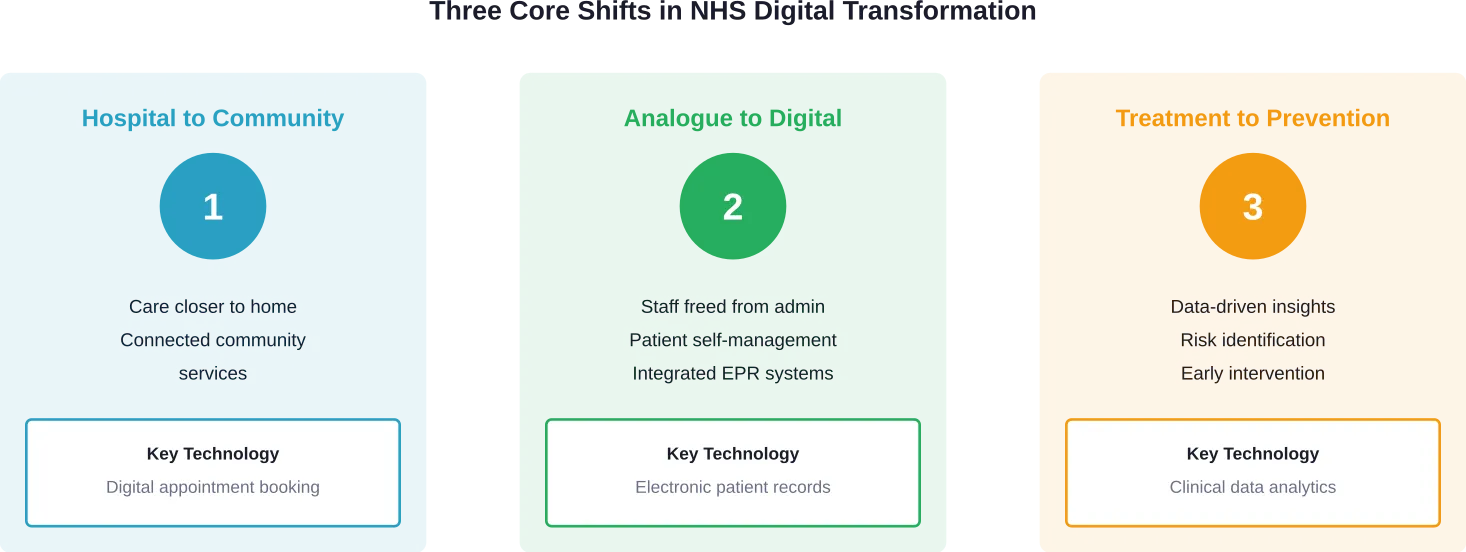
The 10 Year Health Plan for England, published on 3 July 2025, sets out three fundamental shifts that define the NHS’s digital future. These aren’t incremental changes—they’re structural transformations designed to address decades of underinvestment and fragmentation.
The first shift moves care from hospital to community, with more services available on people’s doorsteps and in their homes. Digital tools enable this by connecting community health services with hospital systems, allowing seamless coordination across care settings.
The second shift—from analogue to digital—liberates staff from administrative burden and allows people to manage their care as easily as online banking. This means integrated electronic patient records, digital appointment booking, and real-time access to test results.
The third shift focuses on prevention rather than treatment, using data and analytics to identify health risks before they become crises. Digital transformation makes this possible by collecting, storing, and analysing clinical data across multiple touchpoints.
Electronic Patient Records: The Foundation
Electronic patient record (EPR) systems form the backbone of NHS digital transformation. These aren’t just digitised paper files—they’re comprehensive platforms that integrate clinical history, test results, medications, and care plans into a single accessible system.
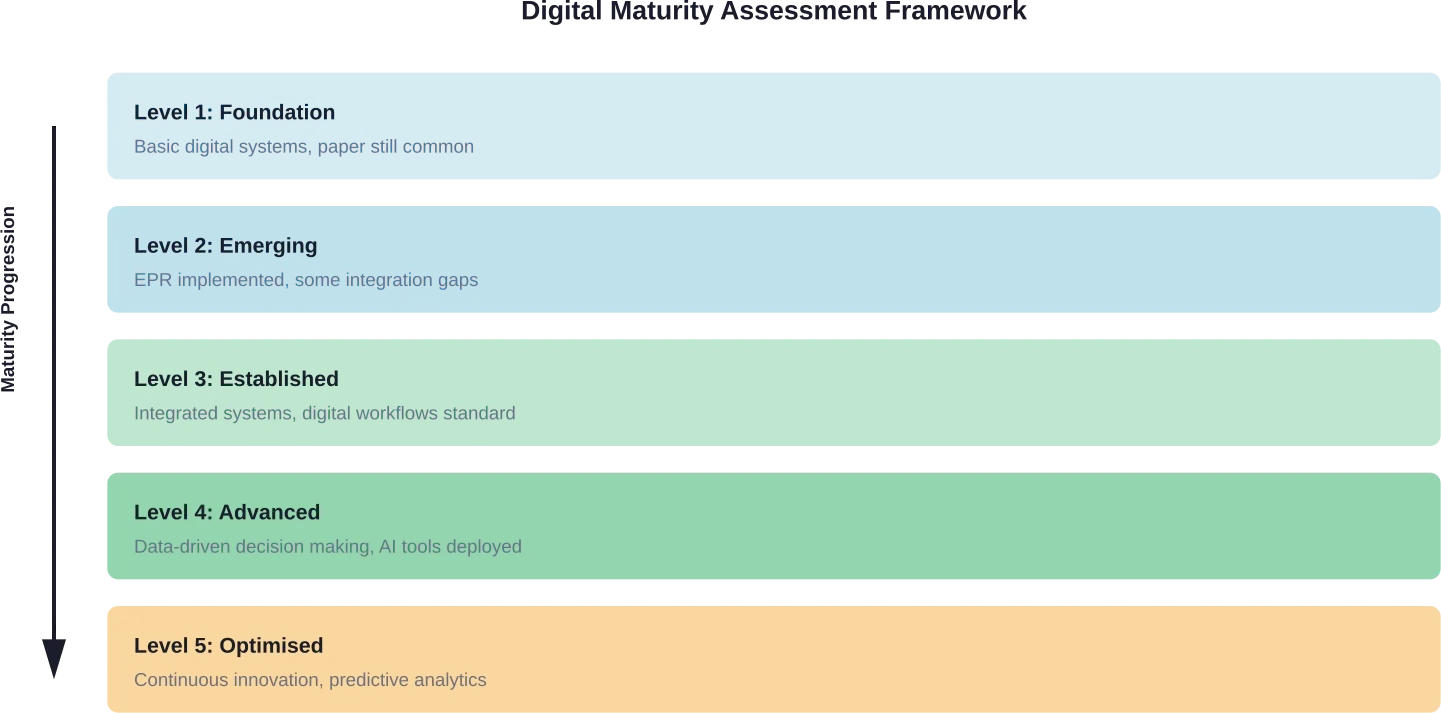
Most NHS trusts now have EPR systems in place, but implementation quality varies significantly. Digital maturity refers to an organisation’s ability to respond to changes and trends in technology, and it can be viewed as a ‘state of readiness’ to adapt and integrate with new systems.
A digitally mature organisation demonstrates a clear link between digital strategies and core business objectives. This isn’t just about having the technology—it’s about using it effectively to improve patient outcomes and operational efficiency.
Proact IT UK Limited offers EPR and Digital Capability Delivery and Transformation Services designed to guide organisations from initial recognition of need through successful implementation and go-live. Their approach includes change readiness assessment, programme leadership, and ongoing support services.
The NHS App and Patient Access Revolution
The NHS App represents perhaps the most visible aspect of digital transformation for patients. With over 28 million users, it’s become a primary access point for healthcare services across England.
Through the app, patients can book appointments, order repeat prescriptions, view test results, and access their medical records. This shift towards patient self-management reduces administrative burden on staff while giving people control over their healthcare journey.
But the app is more than convenience—it’s about enabling people to access care quickly and easily, whenever it suits them. From websites and apps that make care easy to access wherever people are, to connected computer systems that give staff the information they need, the NHS is working smarter to provide better care than ever before.
Productivity Demands and Digital Efficiency
The 2025 Spending Review settlement for the NHS requires annual productivity improvements of 2% for the next three years. This is the minimum productivity improvement required to deliver necessary levels of activity and achieve the government’s performance goals.
Digital transformation is central to meeting these targets. The NHS’s productivity plan aims to close the productivity gap back to 2019/20 levels in the short term, leveling up the worst performers with operational and clinical productivity improvements.
Longer term, the plan seeks to drive productivity improvement beyond the current ‘productivity frontier’—setting new standards for healthcare efficiency through technology adoption and process optimisation.
| Productivity Target | Timeframe | Digital Enablers |
|---|---|---|
| 2% annual improvement | 2025-2028 | EPR systems, automation, AI tools |
| Close gap to 2019/20 baseline | Short-term (1-2 years) | Operational efficiency, digital workflows |
| Exceed productivity frontier | Long-term (3+ years) | Advanced analytics, predictive care |
Community Health Services Data Transformation
Community health services (CHS) are key to the NHS’s mission to deliver high-quality, safe, and coordinated care closer to home for patients. However, the health and care system cannot consistently draw reliable insights from CHS data at national, system, or local level.
The NHS Community Health Services Data Plan, dated 8 April 2024 and last updated 27 May 2025, addresses this critical gap. It aims to optimize and improve services, patient care, and outcomes across care settings by establishing robust data collection and analysis frameworks.
This matters because community services are where the shift from hospital to community actually happens. Without proper data infrastructure, coordinating care across settings becomes guesswork rather than evidence-based decision-making.
Digital Maturity Assessment and Implementation
Digital maturity assessment provides a structured approach to evaluating an organisation’s readiness for digital transformation. NHS England published guidance on digital maturity on 28 July 2023, updated through 30 April 2025.
The assessment covers multiple dimensions including technological factors, system usability, performance, adaptability, flexibility, dependability, data availability, integrity, and confidentiality. It also examines data accuracy and how effectively organisations leverage digital tools to support clinical decision-making.
For general practice settings, digital maturity is part of the Good Practice Guidelines for GP electronic patient records. This ensures that primary care—the front door to the NHS—maintains consistent digital standards across the system.
Make NHS Systems Easier to Work With
Digital transformation in the NHS often runs into practical issues – legacy systems that don’t connect well, data spread across platforms, and processes that still rely on manual steps. These gaps don’t just affect efficiency, they impact how teams collaborate and how quickly decisions can be made. A-listware works with organizations to review how existing systems operate, identify where friction builds up, and adjust processes so information moves more reliably across teams.
Their work focuses on improving how systems interact rather than replacing everything at once. That includes restructuring workflows, supporting system integration, and gradually modernizing outdated infrastructure without disrupting day-to-day operations. If transformation initiatives feel slow or fragmented, it’s worth taking a closer look at what’s happening behind the scenes and discussing with A-listware how to move forward more clearly.
Challenges and Barriers to Implementation
Digital transformation in the NHS faces significant challenges that go beyond technology. The National Audit Office noted that previous major programmes closed early without achieving objectives—a sobering reminder that good intentions don’t guarantee success. Here is why:
- Legacy systems represent a major obstacle: Some NHS IT infrastructure is outdated and inefficient, making integration with modern platforms difficult and expensive. The cost of replacement competes with immediate clinical priorities.
- Workforce readiness varies widely: Digital transformation requires staff at all levels to adopt new ways of working, but training, support, and change management resources are often insufficient. Resistance to change is natural, particularly in high-pressure clinical environments.
- Data quality and interoperability remain persistent issues: Even when systems are in place, data standards vary, making it difficult to share information seamlessly across organisational boundaries. The NHS Federated Data Platform aims to address this by creating a unified data infrastructure, but implementation is complex.
- Public trust and inclusion present another dimension: Digital services must be accessible to all populations, including those with limited digital literacy or access. Excluding vulnerable groups would undermine the fundamental principle of universal healthcare.
Investment and Funding Landscape
The government has committed unprecedented investment in NHS digitisation. Beyond the £150 million dedicated to adult social care digitisation, the £4.7 billion national funding programme supports digital services and maturity improvements across the system.
This investment isn’t distributed evenly. Some trusts receive targeted funding as part of national programmes, while others must compete for resources or self-fund digital initiatives. This creates variation in digital capabilities across England.
The 2025 Spending Review ties funding to productivity improvements, creating direct accountability for digital transformation outcomes. Organisations must demonstrate that technology investments translate into measurable efficiency gains and better patient outcomes.
The Role of AI and Advanced Technologies
Artificial intelligence is becoming central to NHS digital transformation ambitions. AI tools can analyse clinical data at scale, identify patterns humans might miss, and support clinical decision-making with evidence-based recommendations.
However, AI implementation in healthcare raises unique challenges. Clinical safety, algorithmic bias, data privacy, and accountability for AI-assisted decisions all require careful governance frameworks. The NHS must balance innovation with patient safety and ethical considerations.
The 10 Year Health Plan emphasises seizing opportunities provided by new technologies, medicines, and innovations to deliver better care for all patients—wherever they live and whatever they earn—and better value for taxpayers. AI is explicitly part of this vision.
Frequently Asked Questions
- What is digital transformation in the NHS?
Digital transformation in the NHS is the comprehensive shift from analogue, paper-based healthcare systems to integrated digital platforms that connect patients, clinicians, and care settings. It encompasses electronic patient records, digital appointment booking, the NHS App, data analytics, and AI tools designed to improve patient outcomes and operational efficiency.
- How many people use the NHS App?
Over 28 million people now have the NHS App, with over 40 million people having an NHS login. These figures represent significant adoption of digital healthcare services across England, making the app one of the most widely used government digital platforms.
- What are electronic patient records (EPR)?
Electronic patient records are comprehensive digital systems that integrate a patient’s complete clinical history, including test results, medications, care plans, allergies, and treatment history. Most NHS trusts now have EPR systems in place, though implementation quality and digital maturity vary across organisations.
- What productivity targets must the NHS meet?
The 2025 Spending Review settlement requires the NHS to achieve annual productivity improvements of 2% for three years. This is the minimum improvement needed to deliver necessary activity levels and achieve government performance goals. Digital transformation is central to meeting these targets through automation, better data use, and streamlined workflows.
- What challenges does NHS digital transformation face?
Key challenges include outdated legacy IT systems, variable workforce digital readiness, data quality and interoperability issues, public trust and digital inclusion concerns, and inconsistent funding across trusts. Previous major digital programmes closed early without achieving objectives, highlighting the complexity of large-scale healthcare technology implementation.
- How is digital transformation funded?
The NHS receives £4.7 billion in national funding for digital services and maturity improvements, including £150 million specifically for adult social care digitisation. Funding is tied to productivity improvements under the 2025 Spending Review, creating accountability for measurable outcomes from technology investments.
- What is digital maturity assessment?
Digital maturity assessment evaluates an organisation’s readiness to respond to technological changes and integrate new systems. NHS England’s guidance covers system usability, performance, data availability, security, and how effectively organisations use digital tools for clinical decision-making. Assessments help identify gaps and prioritise improvement areas.
Conclusion: The Path Forward
Digital transformation for the NHS represents both enormous opportunity and significant challenge. The infrastructure is taking shape—28 million NHS App users, electronic patient records in most trusts, and billions in funding committed. The strategic direction is clear through the 10 Year Health Plan’s three core shifts.
But technology alone won’t deliver transformation. Success depends on addressing workforce readiness, ensuring data quality and interoperability, maintaining public trust, and learning from past failures. The 2% productivity target creates urgency, but sustainable change requires patience and persistence.
For healthcare professionals, managers, and policymakers, the question isn’t whether digital transformation will happen—it’s already underway. The question is whether it will be implemented thoughtfully, inclusively, and effectively enough to deliver on its promise of better care for all patients and better value for taxpayers.
The track record may be mixed, but the stakes have never been higher. An NHS that successfully navigates digital transformation can set global standards for healthcare delivery in the 21st century.


