Quick Summary: Digital transformation for workplace culture goes beyond technology adoption—it requires reshaping organizational values, behaviors, and mindsets to support innovation and change. MIT research shows that 67% of employees are significantly impacted by digital initiatives, making cultural alignment critical for transformation success. Organizations that balance continuity with change while fostering digital dexterity across their workforce achieve better outcomes than those focusing solely on technology implementation.
Digital transformation isn’t just about implementing new tools and systems. The technology part? That’s actually the easy bit.
What derails most initiatives is something far more human: workplace culture. When organizational culture doesn’t align with digital ambitions, even the most robust technology investments fall flat. Employees resist adoption, innovation stalls, and transformation initiatives become expensive failures.
According to MIT Sloan research published in 2024, digital transformation transcends technology and business models—organizational culture plays a critical role in successfully leading an organization into the digital era. The disconnect between corporate culture and technology represents one of the most significant barriers organizations face today.
But here’s where it gets interesting. Companies that successfully transform their workplace culture don’t just survive digital change—they thrive in it.
Why Workplace Culture Determines Digital Success
Research from MIT’s Center for Information Systems Research reveals that on average, digital transformation significantly impacts 67% of employees. That’s not a small change management project. That’s a fundamental shift in how people work, collaborate, and deliver value.
Organizations often focus first on technology—selecting platforms, migrating data, training users on new systems. The cultural piece gets treated as an afterthought or a soft issue that’ll work itself out.
It won’t.
According to MIT Sloan research on cracking the culture code, leaders who successfully execute digital transformation achieve cultural balance between continuity and change. They don’t blow up everything that came before. They don’t preserve outdated practices either. They find the sweet spot.
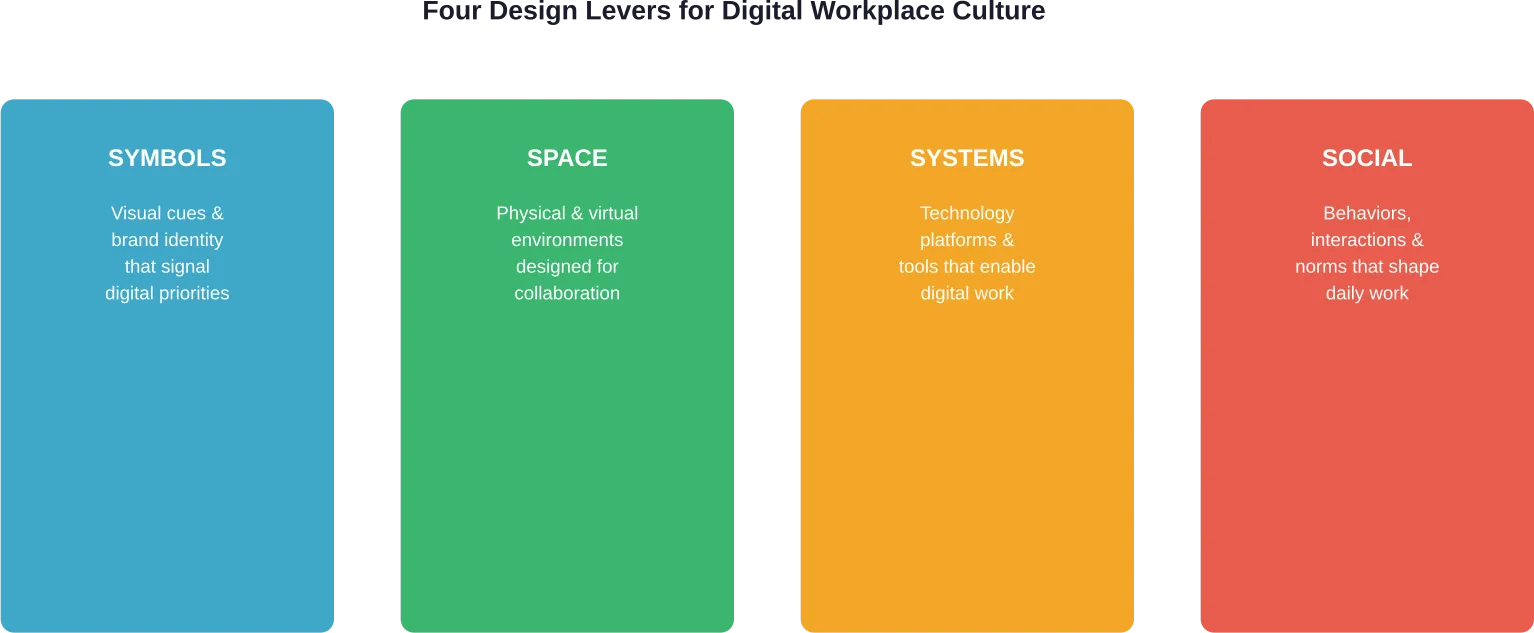
Deloitte Australia provides a compelling case study. When the firm embarked on transforming an A$330 million business that was “going south with its reputation in the gutter,” they recognized that digital workplace transformation required more than new systems. They used four design levers—symbols, space, systems, and social—to fundamentally reshape the workplace for the digital economy.
The Digital Dexterity Imperative
MIT research spanning surveys of over 8,300 leaders across 109 countries and 11 sectors identifies a critical success factor: digital dexterity. Leaders who frame transformation as developing a digitally capable workforce make significantly more progress than those who don’t.
Digital dexterity goes beyond basic tech skills. It’s about building a workforce that’s comfortable experimenting with new tools, adapting to changing workflows, and continuously learning. Organizations with high digital dexterity don’t wait for perfect solutions—they test, iterate, and improve.
The research shows that companies that focus first on the operational backbone—technology matched with employee skills—create better experiences for their employees. On average, digital transformation significantly impacts 67% of employees, and reducing complexity in employee-facing systems matters more than adding features.
Think about it: how many organizations roll out sophisticated platforms that employees find frustrating and abandon for workarounds? The technology works. The culture doesn’t support it.
Core Elements of Transformation-Ready Culture
What does a workplace culture that supports digital transformation actually look like? Based on analysis of successful initiatives, several core elements emerge consistently.
Risk Tolerance and Openness to Change
Organizations stuck in “this is how we’ve always done it” mode struggle with transformation. Successful digital cultures embrace calculated risk-taking and view failure as learning.
That doesn’t mean reckless experimentation. It means creating safe spaces for testing new approaches, collecting data, and making informed decisions about what works.
Cross-Functional Collaboration
Digital transformation breaks down silos whether teams like it or not. The technology integrates functions. The culture needs to follow.
Organizations that succeed build collaboration into their operating model. They create cross-functional teams, establish shared metrics, and reward collaborative behaviors. Information flows horizontally, not just up and down hierarchies.
Leadership Buy-In at Every Level
Transformation doesn’t work as a top-down mandate. Middle managers often become the critical success factor—or the bottleneck.
When leaders at every level model digital behaviors, use new tools visibly, and champion change, adoption accelerates. When they pay lip service while sticking to old habits, employees notice and follow suit.
| Cultural Trait | Traditional Workplace | Digital-Ready Workplace |
|---|---|---|
| Decision Making | Hierarchical approval chains | Distributed authority with guardrails |
| Learning Approach | Formal training programs | Continuous learning and peer sharing |
| Failure Response | Blame and risk avoidance | Analysis and rapid iteration |
| Communication Flow | Vertical and departmental | Horizontal and cross-functional |
| Change Pace | Periodic reorganizations | Continuous incremental evolution |
Common Cultural Barriers Organizations Face
Real talk: most organizations encounter significant cultural resistance during digital transformation. Understanding common barriers helps leaders address them proactively.
The Comfort Zone Problem
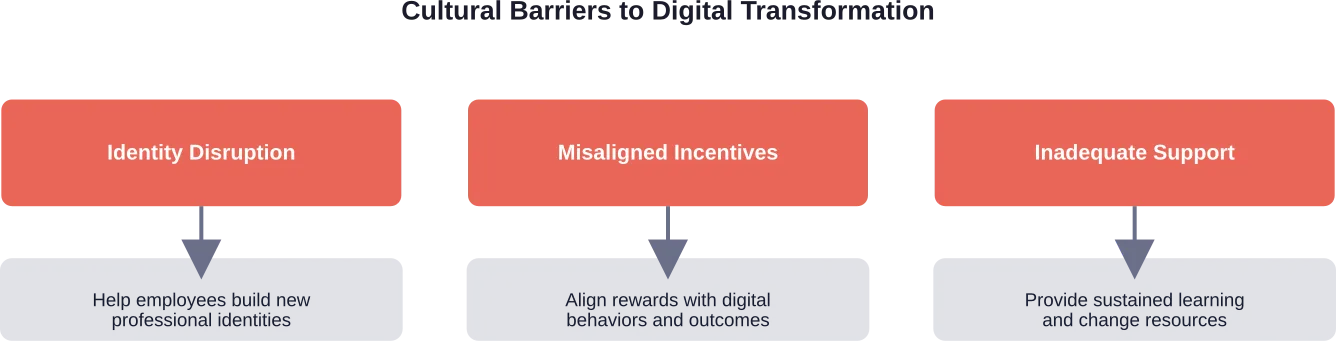
Employees resist new technologies not because they can’t learn them, but because disruption feels threatening. According to MIT research on organizational change, large-scale transformation disrupts employees’ sense of self, not just their tasks.
People derive identity from their work. When transformation changes how they contribute value, it triggers deeper psychological responses than simple process changes. Leaders who recognize this and help employees adapt to new identities—not just new tasks—achieve better outcomes.
Misaligned Incentives
Organizations say they want innovation while rewarding efficiency and error-free execution. They promote digital adoption while measuring productivity on old metrics. The disconnect creates confusion and cynicism.
If transformation success isn’t reflected in performance reviews, promotions, and recognition systems, employees rationally prioritize what actually gets rewarded.
Inadequate Change Support
Throwing employees into new systems with minimal training and expecting smooth adoption doesn’t work. Neither does one-time training sessions weeks before go-live.
Effective digital culture change requires sustained support: accessible help resources, peer champions, ongoing learning opportunities, and leadership visibility throughout the transition.
Practical Strategies for Cultural Alignment
So how do organizations actually align workplace culture with digital transformation goals? Several strategies consistently appear in successful initiatives.
Start With Leadership Modeling
Leaders can’t delegate digital adoption while maintaining analog habits. When executives visibly use new collaboration tools, share information transparently, and demonstrate continuous learning, it sends powerful cultural signals.
Leadership modeling includes admitting when technology creates challenges, asking for help, and working through problems publicly. Perfectionism kills digital culture. Visible learning builds it.
Build Digital Champions Networks
Peer influence drives adoption more effectively than top-down mandates. Identifying enthusiastic early adopters across different teams and empowering them as champions creates organic spread.
These champions don’t need formal titles. They need support, resources, and recognition. They become the go-to people for questions, the ones who demonstrate new possibilities, and the bridge between technology teams and end users.
Embed Digital Behaviors in Daily Work
Cultural change happens through repeated behaviors, not inspiration. Organizations that successfully transform workplace culture build digital behaviors into routine work.
That might mean requiring certain communications happen in new collaboration platforms, conducting meetings with digital tools visible and active, or creating templates and workflows that guide people toward desired behaviors.
Measure and Celebrate Progress
What gets measured gets done. Organizations should track cultural indicators alongside technology adoption metrics: collaboration patterns, learning activity, cross-functional project participation, and innovation submissions.
But measurement alone doesn’t change culture. Recognition does. Celebrating teams that embrace new ways of working, sharing success stories, and making cultural progress visible reinforces desired behaviors.
Align Workplace Culture with How Your Systems Work
Workplace culture in a digital environment is shaped by how tools, processes, and data come together in everyday work. When systems don’t support how teams actually collaborate, it creates friction that no policy can fix. A-listware works with companies to understand how their current setup affects team dynamics and to redesign processes so collaboration, communication, and decision-making feel more natural.
They support the full transformation cycle – from assessing the current state to implementing changes and maintaining them over time. That includes improving how systems connect, reducing manual steps, and making information easier to access across teams. If workplace culture is part of your digital transformation goals, it makes sense to review the systems behind it and talk to A-listware about what can be improved.
The Role of Communication and Transparency
Transformation initiatives often stumble on communication. Leaders announce changes, provide rationale, and expect understanding. Then they’re surprised by the resistance.
Effective communication for cultural change isn’t one-way broadcasting. It’s an ongoing dialogue. Organizations that handle cultural transformation well create feedback loops, address concerns transparently, and adjust approaches based on employee input.
Transparency about challenges matters too. When leaders acknowledge that transformation is hard, that some aspects aren’t working as planned, and that adjustments are being made, trust increases. Pretending everything’s perfect erodes credibility.
Measuring Cultural Transformation Success
How do organizations know if workplace culture is actually shifting to support digital transformation? Traditional engagement surveys often miss the nuances.
More useful indicators include:
- Adoption rates for new tools across different employee segments
- Time-to-productivity for new employees in digital workflows
- Cross-functional collaboration metrics from platform analytics
- Innovation activity like ideas submitted or experiments launched
- Employee sentiment about change readiness and support
- Leadership visibility in using digital tools and channels
These metrics provide leading indicators of cultural health rather than lagging measures of satisfaction. They show whether behaviors are changing, not just whether people feel good about it.
| Success Indicator | What to Measure | Why It Matters |
|---|---|---|
| Digital Adoption | Active users and feature utilization | Shows actual behavior change, not intent |
| Collaboration Patterns | Cross-team projects and communications | Indicates silo breakdown and integration |
| Learning Velocity | Training completion and peer knowledge sharing | Reflects continuous improvement mindset |
| Innovation Activity | Ideas submitted and experiments launched | Demonstrates risk tolerance and creativity |
| Change Readiness | Employee confidence with new tools | Predicts future transformation capacity |
Long-Term Cultural Sustainability
Here’s the thing about workplace culture: it doesn’t stay transformed without ongoing attention. Initial enthusiasm fades. Old habits creep back. New employees arrive without context.
Organizations that maintain digital culture treat it as an ongoing practice, not a project with an end date. They build cultural reinforcement into onboarding, integrate digital behaviors into leadership development, and continuously evolve practices as technology changes.
According to MIT research, sustaining leadership and systemic learning serve as management levers that shift organizations from an analog workplace with digital attributes to a truly reshaped digital workplace. This dynamic fine-tuning requires dedicated management focus.
The goal isn’t reaching a final state. Digital transformation for workplace culture is continuous adaptation—building organizational capacity to evolve as technology, markets, and workforce expectations shift.
Frequently Asked Questions
- How long does it take to transform workplace culture for digital initiatives?
Cultural transformation typically spans 18-36 months for meaningful change, though early indicators emerge within 6-12 months. The timeline depends on organization size, existing culture, leadership commitment, and transformation scope. Cultural change requires sustained effort rather than quick fixes.
- What’s the biggest mistake organizations make with digital culture change?
Treating culture as secondary to technology represents the most common failure. Organizations invest heavily in platforms and systems while giving culture minimal attention. When technology meets resistant culture, technology loses. Successful transformations address culture and technology as interconnected elements from the start.
- Do all employees need to become tech experts for digital transformation?
No. Digital dexterity differs from technical expertise. Employees need comfort with learning new tools, willingness to adapt workflows, and openness to experimentation. Basic digital literacy matters, but transformation doesn’t require everyone to become developers or IT specialists.
- How can middle managers support digital culture change?
Middle managers bridge executive vision and frontline execution. They support digital culture by modeling new behaviors, providing team members with learning time, addressing concerns empathetically, and translating transformation goals into daily work practices. Their visible commitment accelerates or blocks cultural change.
- What role does remote work play in digital workplace culture?
Remote and hybrid work models often accelerate digital culture adoption by necessitating digital-first communication and collaboration. Physical distance removes analog fallback options, forcing organizations to make digital tools work effectively. However, remote work also requires intentional culture-building to maintain connection and shared purpose.
- How do you measure ROI on workplace culture transformation?
Culture transformation ROI appears in technology adoption rates, productivity improvements, innovation output, employee retention, and faster execution of future changes. While harder to quantify than technology ROI, organizations with strong digital cultures demonstrate measurably better transformation outcomes and business performance.
- Can small organizations transform workplace culture as effectively as large enterprises?
Small organizations often transform culture more easily than large enterprises due to fewer layers, faster communication, and simpler change management. However, they may lack dedicated transformation resources. Size matters less than leadership commitment, clear communication, and consistent reinforcement of desired behaviors.
Moving Forward With Cultural Transformation
Digital transformation for workplace culture isn’t optional anymore. Organizations that treat it as technology implementation with a culture side dish will continue struggling with adoption, productivity, and competitive positioning.
The ones that get it right—balancing continuity with change, developing digital dexterity across the workforce, and treating culture as equal to technology—don’t just implement new systems. They build adaptive organizations capable of evolving continuously.
Start by assessing current cultural strengths and gaps honestly. Identify leaders at every level who can model digital behaviors. Create support systems that help employees build new capabilities and identities. Measure both adoption and cultural indicators. Adjust based on feedback.
Most importantly, commit to the long game. Cultural transformation isn’t a sprint project. It’s building organizational capacity for perpetual evolution in an increasingly digital world.


