Quick Summary: Digital transformation for local businesses means adopting modern technology to streamline operations, improve customer experiences, and compete more effectively. According to SBA-backed research and the 2024-2025 ‘Small Business Digital Equity’ reports, businesses that fully embrace digital tools see 25% higher revenue growth and are twice as likely to be profitable than their less digital peers. This isn’t about expensive overhauls—it’s about strategic, cost-effective changes that solve real problems and deliver measurable results.
Digital transformation sounds expensive. It sounds complicated. And for many local business owners, it sounds like something only major corporations with massive IT budgets can afford.
But here’s the thing—that’s not what digital transformation actually means anymore.
The U.S. Small Business Administration has been actively working since 2016 to help America’s small businesses, with recent statements referencing more than 34 million small businesses adopt technology through partnerships with leading tech companies. In January 2025, the SBA announced its new MySBA digital platform, which achieved a 50% reduction in application processing times through modern, mobile-friendly design.
That’s the real story. Digital transformation isn’t about replacing everything with cutting-edge software. It’s about solving specific problems with the right tools, improving how customers interact with a business, and making operations more efficient without draining resources.
What Digital Transformation Actually Means for Local Businesses
When tech companies talk about digital transformation, they often describe massive enterprise systems and AI-powered everything. For local businesses, the definition needs to be more practical.
Digital transformation means rethinking how a business operates by integrating technology that solves real problems. It’s the coffee shop that stops losing paper order slips by using a tablet-based POS system. It’s the plumbing company that automates appointment reminders so customers actually show up. It’s the local retailer who finally gets inventory counts accurate because everything’s tracked digitally.
According to research on small and medium enterprises, SMEs are responsible for 90% of all businesses and 50% of employment globally. When these businesses transform digitally, the economic impact extends far beyond the individual companies—it affects entire communities.
The SBA’s Small Business Digital Alliance, launched in January 2022 through a partnership with Business Forward, provides free digital tools from national members and Fortune 500 companies specifically designed to help small businesses expand their customer base and manage operations more effectively.
Why Local Businesses Can’t Ignore This Anymore
Look, nobody wants another expense or another system to learn. But the businesses that are thriving right now aren’t the ones with the biggest budgets—they’re the ones that adapted.
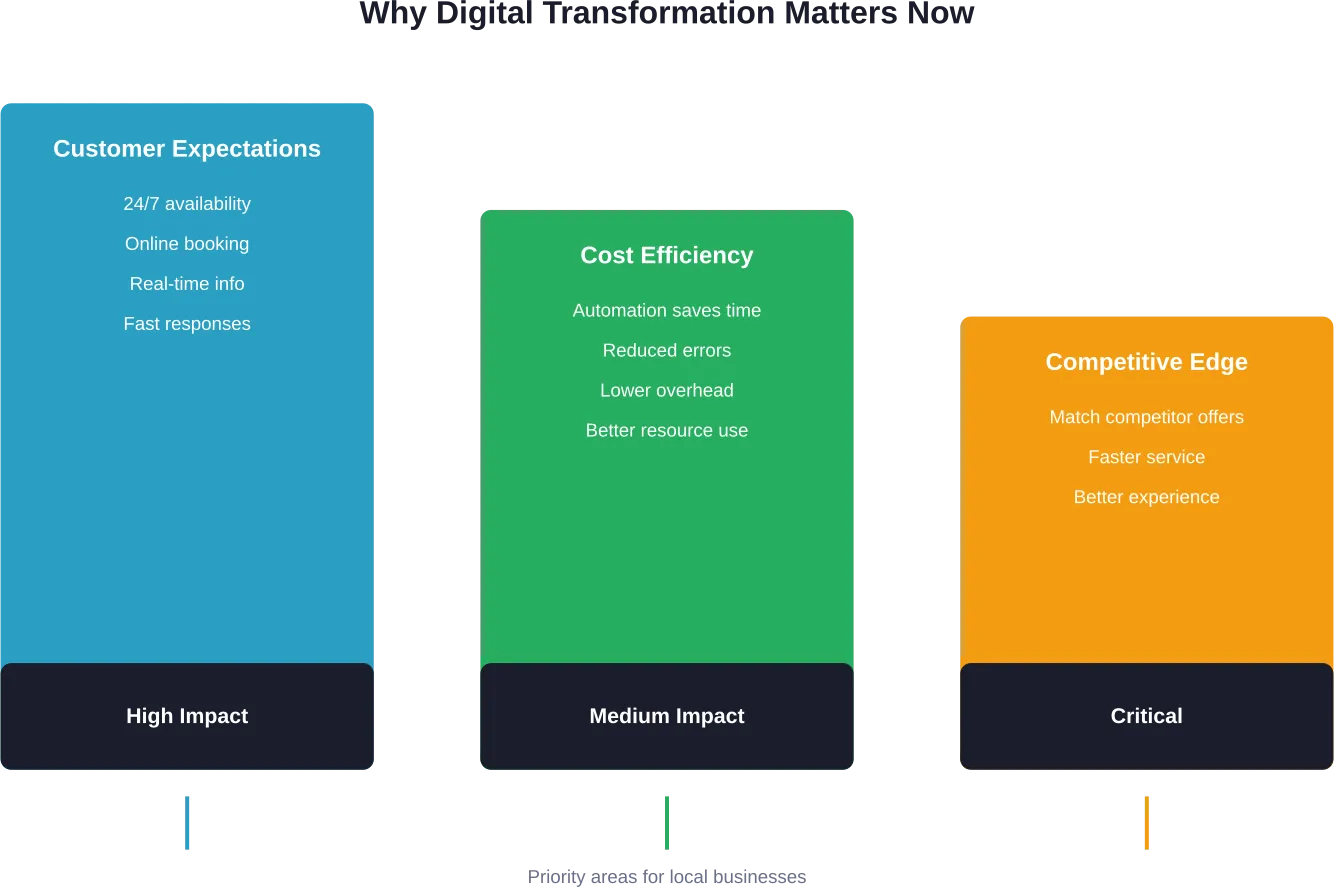
Customer expectations changed. People expect to book appointments online, not during business hours only. They expect to see current inventory before driving to a store. They want responses to questions within hours, not days.
The competitive landscape shifted too. When a competitor offers online ordering and a business doesn’t, customers simply go elsewhere. It’s not personal. It’s convenient.
Operational costs keep climbing. Labor shortages make it harder to handle routine tasks manually. Digital tools can automate repetitive work so staff focuses on what actually requires human judgment.
Technology became affordable. Cloud-based services mean businesses don’t need to buy servers or hire IT departments. Monthly subscriptions replaced massive upfront investments. Free tools handle tasks that used to require custom software.
Digital Transformation for Local Businesses
Modern digital systems help local businesses improve efficiency, manage operations, and better serve customers. A-listware provides teams that can implement and maintain custom solutions tailored to your business.
Focus areas include:
- point-of-sale and inventory systems
- customer management tools
- workflow automation
- secure cloud adoption
The team can work within your existing systems or handle entire digital projects. Contact A-listware now to begin your local business transformation with expert support.
Core Areas Where Local Businesses Need Digital Tools
Not every business needs to digitize everything. But certain areas deliver immediate, measurable benefits when technology gets applied correctly.
Customer Communication and Engagement
Email autoresponders help companies deliver regular, consistent messaging to keep customers informed without manual effort. Social media, SMS, and chatbots give customers contact options at any time, making them feel appreciated and welcomed.
The SBA’s MySBA platform includes modern features like mobile-friendly design specifically because customers interact with businesses on their phones, not just desktops. Businesses that don’t meet customers where they are lose those customers to competitors who do.
Review management matters too. Automated systems can request reviews after positive interactions, respond to feedback quickly, and monitor reputation across multiple platforms without someone checking five different sites daily.
Operations and Process Automation
Before investing in tools, the critical question is always: what problem needs solving? Once the true issue becomes clear, the best solution follows naturally.
Appointment scheduling software eliminates phone tag. Inventory management systems prevent stockouts and overstock situations. Automated invoicing reduces billing errors and speeds up payment collection. Employee scheduling tools prevent overstaffing and understaffing.
These aren’t flashy innovations. But they solve expensive problems—wasted time, lost revenue, frustrated customers, and stressed employees.
Online Presence and E-Commerce
A functional website isn’t optional anymore. But it doesn’t need to be elaborate. It needs accurate hours, contact information, service descriptions, and ideally some way to take action—book an appointment, place an order, request a quote.
E-commerce capabilities matter even for traditionally in-person businesses. The restaurant that adds online ordering captures additional revenue from customers who won’t call. The hardware store with “buy online, pick up in store” serves customers who want to confirm availability before driving across town.
Local search optimization helps customers find businesses when they search “near me.” Google Business Profile management, consistent NAP (name, address, phone) information across directories, and location-based keywords make local businesses visible when intent to purchase is highest.
Data Management and Decision-Making
Spreadsheets work until they don’t. When customer lists, inventory counts, and sales records live in disconnected files, making informed decisions becomes guesswork.
Cloud-based systems centralize data so it’s accessible anywhere, backed up automatically, and updated in real-time. Basic analytics show which products sell best, which marketing drives traffic, which customers generate the most revenue, and which processes waste the most time.
The SBA emphasizes that AI can help small businesses do more with less. Simple AI tools can analyze sales patterns, predict inventory needs, or identify customers likely to churn—insights that used to require dedicated analysts.
Building a Practical Digital Transformation Strategy
Strategy sounds formal. But for local businesses, it just means approaching this systematically instead of randomly buying software and hoping it helps.
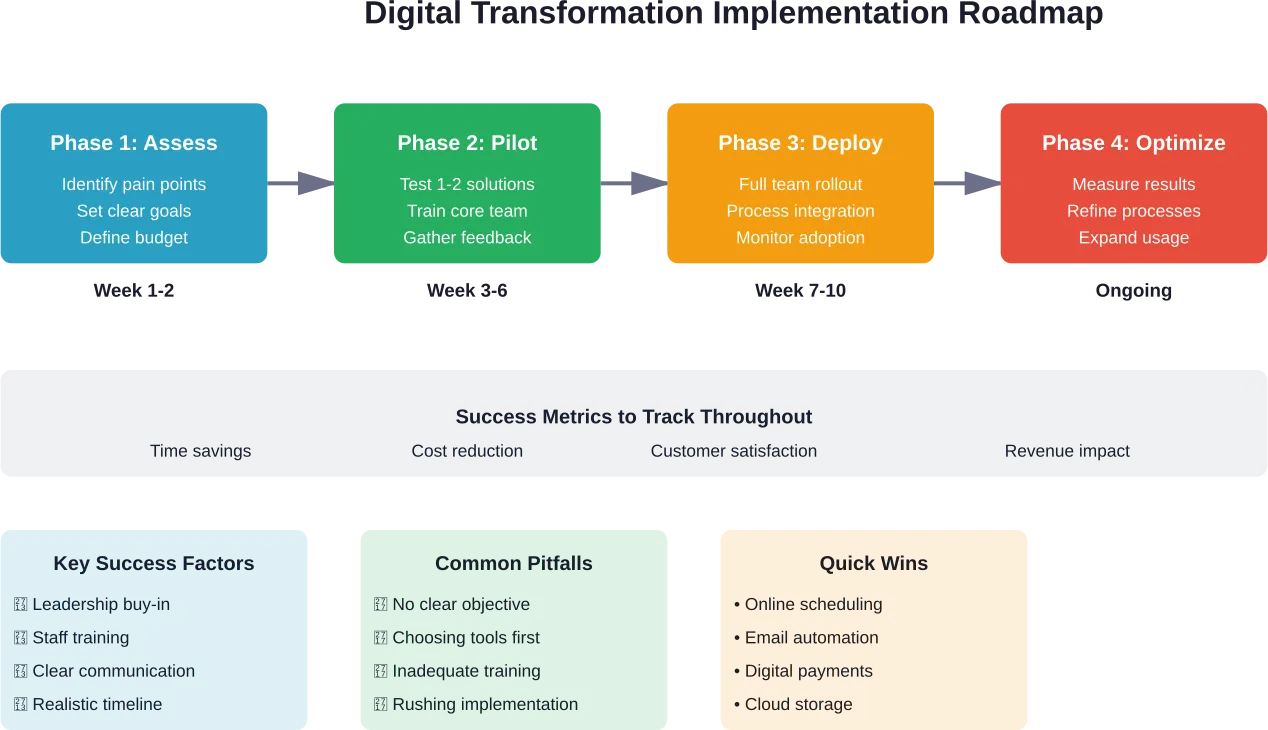
Start With Problems, Not Solutions
The biggest mistake is choosing technology first and then trying to apply it. That’s how businesses end up with expensive software nobody uses.
Start by identifying actual pain points. Where does money leak? Where do customers complain? Where do employees waste time on repetitive tasks? Where do errors happen frequently?
Write down the top three problems costing the most money or causing the most frustration. Then look for technology that specifically addresses those issues.
Set Measurable Goals
Vague goals like “improve efficiency” don’t work. Specific goals like “reduce appointment no-shows by 30%” or “cut invoice processing time from three days to one day” provide clear targets.
Measurable goals also determine whether an investment succeeded. If appointment reminder software cost $50 monthly and reduced no-shows enough to generate $500 in additional revenue, the ROI is obvious.
Prioritize Cloud-Based Solutions
Cloud services deliver several advantages for local businesses. Lower upfront costs—subscription pricing instead of large purchases. Automatic updates—no manual software installations. Remote access—manage the business from anywhere. Scalability—add users or features as needed.
According to digital transformation strategy resources, cloud migration strategies can achieve 40-60% reduction in IT costs with implementation timeframes of 2-4 weeks.
| Strategy Area | Key Benefit | Typical Cost | Implementation Time |
|---|---|---|---|
| Cloud Migration | 40-60% reduction in IT costs | $50-200/month | 2-4 weeks |
| Process Automation | 30-50% time savings on routine tasks | $30-150/month | 1-3 weeks |
| Customer Experience Tools | Increased retention and satisfaction | $20-100/month | 1-2 weeks |
| Data Analytics | Better decision-making capability | $0-80/month | 2-4 weeks |
Train Staff and Manage Change
New technology fails when employees resist it or don’t understand it. Change management matters as much as the technology itself.
Involve staff early. Explain why changes are happening and how they’ll benefit employees, not just the business. Provide adequate training—not just a quick demo, but hands-on practice with support available. Start with enthusiastic adopters who can help train and encourage others.
Digital transformation is an ongoing process, not a one-time project. Expect adjustment periods. Collect feedback. Make refinements. Some tools won’t work as expected and need replacement.
Cost-Effective Technologies That Deliver Results
Budget constraints are real. But many effective tools cost less than most business owners expect.
Free and Low-Cost Essential Tools
The Small Business Digital Alliance publishes comprehensive suites of free resources from national members and Fortune 500 companies. These aren’t limited trial versions—they’re functional tools designed specifically for small businesses.
Google Workspace provides email, document collaboration, cloud storage, and video conferencing. Many businesses operate entirely on the free tier. Social media management platforms offer free plans that handle multiple accounts. Basic website builders include hosting and templates at minimal cost.
Accounting software often costs less than $30 monthly and eliminates the need for expensive bookkeepers for routine transactions. Customer relationship management (CRM) systems have free tiers suitable for businesses with smaller customer bases.
Automation Tools That Pay for Themselves
Automation delivers ROI quickly because it directly replaces labor hours. Email marketing automation costs $10-50 monthly but can send targeted campaigns to thousands of customers without manual effort.
Appointment scheduling tools integrate with calendars, send confirmations and reminders, and allow customer self-service booking. This eliminates phone calls, reduces no-shows, and frees staff for other work.
Inventory management automation prevents costly stockouts and reduces overstock situations. The software often costs less than the money saved from better inventory control.
Payment and Financial Systems
Modern payment processors accept cards, contactless payments, and digital wallets with rates competitive to traditional merchant accounts but without long-term contracts or expensive hardware.
Integrated payment systems connect to accounting software, automatically recording transactions and eliminating manual entry errors. Some also provide instant access to funds instead of multi-day delays.
Digital invoicing systems send automated reminders for overdue payments, accept online payment methods, and track which invoices remain outstanding—capabilities that measurably improve cash flow.
Government Support and Resources Available
Local businesses don’t have to figure this out alone. Federal resources provide guidance, tools, and sometimes funding specifically for small business technology adoption.
The U.S. Small Business Administration offers multiple programs. The MySBA platform provides modern digital tools for loan applications, lender matching, and loan management. The Small Business Digital Alliance maintains a library of free digital tools from major technology companies.
Since 2016, the SBA has partnered with leading tech companies through initiatives like the Small Business Technology Coalition to provide streamlined access to innovative platforms, digital education, and enterprise training.
These aren’t token gestures. Studies show that businesses leveraging modern technology grow 15% faster than those that do not and serve customers better—which is why federal support exists to help small businesses compete more effectively.
Measuring Success and ROI
Technology investments need justification. ROI demonstrates whether spending delivered value or just created new expenses.
Defining Relevant Metrics
Different businesses measure success differently, but certain metrics matter universally. Time savings translate directly to labor cost reductions. Error reductions prevent costly mistakes. Customer acquisition and retention rates show whether improved experiences drive business results.
Revenue metrics include average transaction value, conversion rates, and customer lifetime value. Operational metrics track task completion time, resource utilization, and process efficiency. Customer metrics measure satisfaction scores, review ratings, and repeat purchase rates.
Tracking and Adjustment
Establish baseline measurements before implementing new technology. Otherwise, there’s no comparison point to determine improvement.
Monitor regularly—weekly or monthly depending on the metric. Look for trends, not just snapshots. One slow week doesn’t indicate failure, but a consistent downward trend requires investigation.
Be willing to abandon tools that don’t deliver results after a fair trial period. Sunk cost fallacy keeps businesses paying for software nobody uses. If something doesn’t work after adequate training and adjustment, move on.
Real Challenges Local Businesses Face
This all sounds straightforward in theory. In practice, obstacles exist.
Limited Technical Expertise
Most local business owners aren’t IT professionals. Learning new systems takes time they don’t have. Technology jargon is deliberately confusing.
Solutions include starting with user-friendly tools designed for non-technical users, working with consultants for initial setup and training, and participating in local small business associations where peers share experiences and recommendations.
Budget Constraints
Technology costs money, and margins are tight. Many businesses operate month-to-month without resources for major investments.
That’s why prioritization matters. Focus on tools that solve expensive problems first. A $30 monthly expense that prevents $500 in lost revenue is affordable. A $200 monthly tool that provides marginal convenience isn’t.
Many providers offer nonprofit pricing, startup discounts, or extended free trials for small businesses. Government programs sometimes provide grants or subsidized access to technology services.
Resistance to Change
Employees comfortable with existing processes resist new systems. Owners who built businesses without technology question whether it’s necessary.
Change management requires clear communication about why changes are happening, how they benefit everyone involved, and what support will be available. Small pilots prove value before company-wide rollouts. Early wins build momentum and reduce resistance.
Looking Forward: Staying Current Without Chasing Trends
Technology evolves constantly. New tools emerge monthly. Trying to adopt everything is exhausting and expensive.
Digital transformation is an ongoing process. It doesn’t end when the first few tools get implemented. But that doesn’t mean chasing every trend or replacing working systems with newer versions just because they exist.
The approach that works: solve current problems with current tools, then reassess periodically. When a tool stops meeting needs or significantly better options emerge, consider upgrades. Otherwise, stable systems that work effectively shouldn’t be replaced just for novelty.
Stay informed about technology developments relevant to the industry. Join trade associations. Follow respected business publications. Talk to other business owners about what works for them. But filter everything through the lens of actual business needs, not vendor marketing.
AI continues advancing rapidly. The SBA specifically highlights AI as helping small businesses do more with less. But AI adoption should follow the same principle—identify specific problems it solves, test carefully, measure results, and scale what works.
Taking the First Step
Digital transformation feels overwhelming when viewed as a complete overhaul. It’s not. It’s a series of small improvements that compound over time.
Start by identifying one expensive problem. Not three. Not five. One.
Research solutions specifically designed to address that problem. Look for providers with strong reviews from businesses similar in size and industry. Take advantage of free trials. Test thoroughly before committing.
Implement carefully with adequate training and support. Measure results against the specific goals set initially. Adjust or abandon based on actual performance, not hopes or assumptions.
Then move to the next problem.
That’s digital transformation for local businesses. Not a dramatic revolution. Just steady progress solving real problems with appropriate tools, one improvement at a time.
Frequently Asked Questions
- How much should a small business budget for digital transformation?
Budget depends entirely on business size and specific needs. Many businesses start with $50-200 monthly for essential cloud services and gradually add tools as they prove ROI. Prioritize solutions that directly address expensive problems—those pay for themselves quickly. Free tools from programs like the SBA’s Small Business Digital Alliance can handle many needs initially without any budget.
- Do local businesses really need to invest in technology to compete?
Customer expectations changed fundamentally. People expect online booking, digital payments, fast responses, and current information available 24/7. Businesses that don’t meet these expectations lose customers to competitors who do. Technology also reduces operational costs through automation and improved efficiency, making businesses more profitable regardless of competition.
- What’s the biggest mistake small businesses make with digital transformation?
Choosing technology before identifying the actual problem. Businesses see impressive software demos and purchase tools without clear use cases. Then the software sits unused because it doesn’t address real needs. Always start with specific pain points costing money or frustrating customers, then find technology that solves those exact problems.
- How long does digital transformation take for a small business?
Digital transformation is ongoing, not a project with an end date. But implementing initial tools typically takes 2-4 weeks for cloud services, 1-3 weeks for automation tools, and 1-2 weeks for customer experience platforms. The SBA’s MySBA platform achieved 50% reductions in processing times specifically through modern, mobile-friendly designs that were implemented systematically over time.
- Can businesses with limited technical knowledge successfully implement digital tools?
Absolutely. Modern business software is designed for non-technical users with intuitive interfaces and guided setup processes. Many providers offer free training, implementation support, and responsive customer service. Starting with user-friendly tools builds confidence and skills. Local business associations and SBA resources provide additional guidance specifically for business owners without IT backgrounds.
- What happens if employees resist new technology?
Resistance usually stems from fear of change or inadequate training. Involve employees early in the selection process so they have input. Clearly explain how new tools benefit them personally, not just the business. Provide thorough hands-on training with ongoing support available. Start with enthusiastic early adopters who can help train and encourage others. Most resistance disappears once employees see tools genuinely making their work easier.
- Should small businesses try to implement AI and advanced technologies?
AI tools are becoming increasingly accessible and affordable for small businesses. The SBA specifically notes that AI can help small businesses do more with less. But the same principle applies—identify specific problems AI might solve, test carefully with clear success metrics, and scale what delivers measurable results. Don’t adopt advanced technology just because it’s trendy. Adopt it because it addresses real business needs effectively.


