Короткий виклад: Digital transformation for entrepreneurs involves integrating digital technologies into all business operations to fundamentally change how value is delivered to customers. According to research published by the Small Business & Entrepreneurship Council (SBE Council), 75% of small business owners have adopted digital tools like CRM systems and cloud platforms, with 86% believing these tools contribute to their success. Success requires not just technology adoption, but cultural change, strategic planning, and a willingness to experiment and adapt quickly in today’s fast-paced economy.
Technology allows small businesses to be more competitive in today’s fast-paced economy. The federal government has adopted artificial intelligence as a way to help them better serve the public, and entrepreneurs are following suit.
But here’s the thing—digital transformation isn’t just about buying new software or setting up a website.
It’s about fundamentally changing how businesses operate and deliver value to customers. It’s also a cultural change that requires organizations to continually challenge the status quo, experiment, and get comfortable with failure.
What Is Digital Transformation for Entrepreneurs?
Digital transformation is the integration of digital technology into all areas of a business. It fundamentally changes how entrepreneurs operate and deliver value to customers.
The U.S. Small Business Administration has been leading by example. In January 2025, Administrator Isabel Casillas Guzman announced the new MySBA digital platform, transforming how America’s more than 34 million small businesses interact with the agency.
Key highlights from the MySBA platform include features allowing business owners to apply for disaster loans, get matched with SBA-approved lenders via Lender Match, and manage existing SBA loans with modern features like mobile-friendly design and recurring payments. The platform achieved a 50% reduction in processing times.
That’s the kind of impact real digital transformation delivers.
For entrepreneurs, this means rethinking business processes from the ground up. Not just digitizing what already exists, but reimagining how work gets done.
Основні компоненти
Digital transformation touches every part of a business. Technology is the enabler, but strategy drives the change.
Most successful transformations involve three layers:
- Customer-facing systems that improve how value is delivered
- Internal operations that increase efficiency and reduce costs
- Data analytics that enable better decision-making
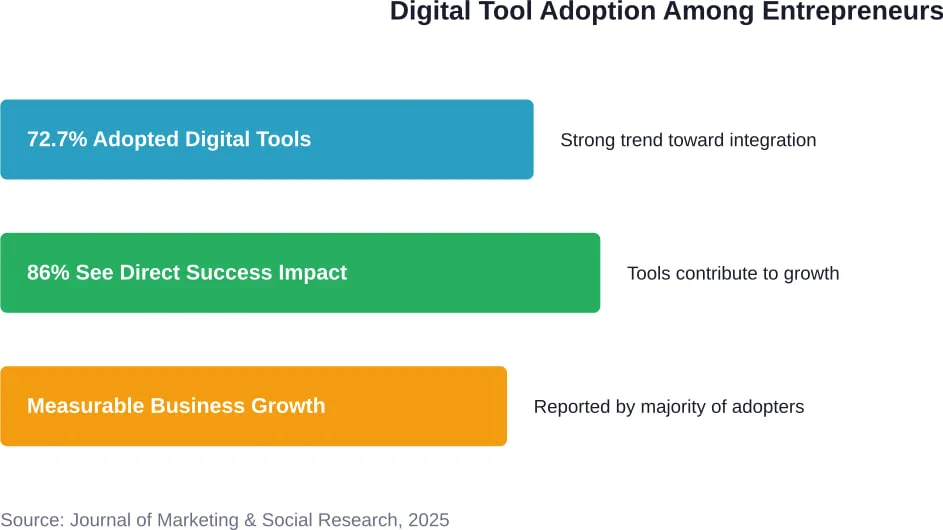
According to research published in the Journal of Marketing & Social Research, 72.7% of entrepreneurs have adopted digital tools in their business operations, indicating a strong trend toward digital integration.
And the results? 86% of respondents believe that access to digital tools directly contributes to their entrepreneurial success.
Чому цифрова трансформація важлива зараз
The most disruptive startups today aren’t necessarily the flashiest. They aren’t chasing every trend or burning through capital on unproven technology.
True digital transformation is about using technology to remove friction and complexity, allowing the human experience to become effortless.
Look at the numbers. Research shows that businesses investing in digital transformation experience measurable growth across multiple metrics—revenue, customer satisfaction, operational efficiency, and market share.
The Legacy Technology Trap
Here’s where many entrepreneurs get stuck.
As Beth Devin, Managing Director and Head of Innovation Network & Emerging Technology at Citi Ventures, has explained, legacy tech can become a costly barrier to transformation. “If you’re spending 70 to 80 percent of the IT budget operating and maintaining legacy systems, there’s not much left to seize new opportunities.”
That’s the challenge. And it’s not just about money.
Old systems create technical debt that slows down innovation. They make it harder to integrate new tools, respond to customer needs, or scale operations efficiently.
Speed Without Breaking Everything
Entrepreneurs want to move fast. But speed without strategy leads to chaos.
The key is building systems that can evolve. Not just for today’s needs, but for challenges that don’t exist yet.
The U.S. Small Business Administration’s digital strategy demonstrates this approach. In 2012, the federal Chief Information Officer released a directive entitled “Digital Government: Building a 21st Century Platform to Better Serve the American People.”
The goal? Enable more efficient and coordinated delivery of digital information across the federal space.
Entrepreneurs can apply the same principles—build platforms, not just products. Create systems that support continuous improvement, not one-time upgrades.
Scale Your Product Development with Dedicated Engineering Teams
Launching and scaling a digital product requires consistent technical talent that many entrepreneurs struggle to find through traditional local hiring. The time and cost associated with recruitment can often delay a product’s market entry. A-Listware addresses this by providing dedicated development teams and IT staff augmentation, allowing founders to scale their engineering capacity quickly and focus on their core business strategy.
- Перевірений технічний талант: Access developers skilled in AI, cloud architecture, and mobile platforms.
- Capital Efficiency: Reduce the high overhead costs of internal HR, benefits, and office space.
- Agile Resource Scaling: Adjust your team size dynamically based on funding rounds or project phases.
- Пряма інтеграція: Dedicated specialists work as an extension of your company to build and maintain your software.
Почніть свою цифрову трансформацію з Програмне забезпечення A-List.
Key Components of Entrepreneurial Digital Transformation
Digital transformation isn’t a single project. It’s an ongoing process that touches every aspect of how businesses operate.
Let’s break down what actually matters.
Технологічна інфраструктура
The foundation starts with the right technical infrastructure. Cloud computing, mobile capabilities, and data systems form the backbone.
Small businesses can use AI tools and applications to find solutions for all kinds of issues. As a small business owner, AI can help businesses do more with less.
The SBA is dedicated to informing small businesses about both the risks and benefits of AI adoption. This balanced approach matters—technology should solve problems, not create new ones.
| Технологічна сфера | Основна вигода | Common Applications |
|---|---|---|
| Хмарні обчислення | Scalability and flexibility | Data storage, collaboration tools, SaaS platforms |
| Штучний інтелект | Automation and insights | Customer service, data analysis, predictive modeling |
| CRM Systems | Управління відносинами з клієнтами | Sales tracking, marketing automation, support tickets |
| Мобільні платформи | Accessibility and convenience | Mobile apps, responsive design, mobile payments |
| Аналітика даних | Informed decision-making | Business intelligence, reporting, trend analysis |
Культурна трансформація
Technology alone doesn’t create transformation. Culture does.
Organizations need to challenge the status quo continually. Experiment with new approaches. Get comfortable with failure.
This cultural shift separates successful digital transformations from expensive technology implementations that deliver no real value.
What does this look like in practice? Teams that question assumptions. Leaders who encourage calculated risks. Systems that capture lessons from both successes and failures.
Customer Experience Focus
Digital transformation must deliver value to customers. Otherwise, what’s the point?
The MySBA platform reduced disaster loan application processing times by 50%. That’s real value—entrepreneurs can access capital faster when they need it most.
Customer-centric transformation means understanding pain points in the current experience and using technology to eliminate them. Not just making things digital, but making them better.
Digital Transformation Frameworks for Entrepreneurs
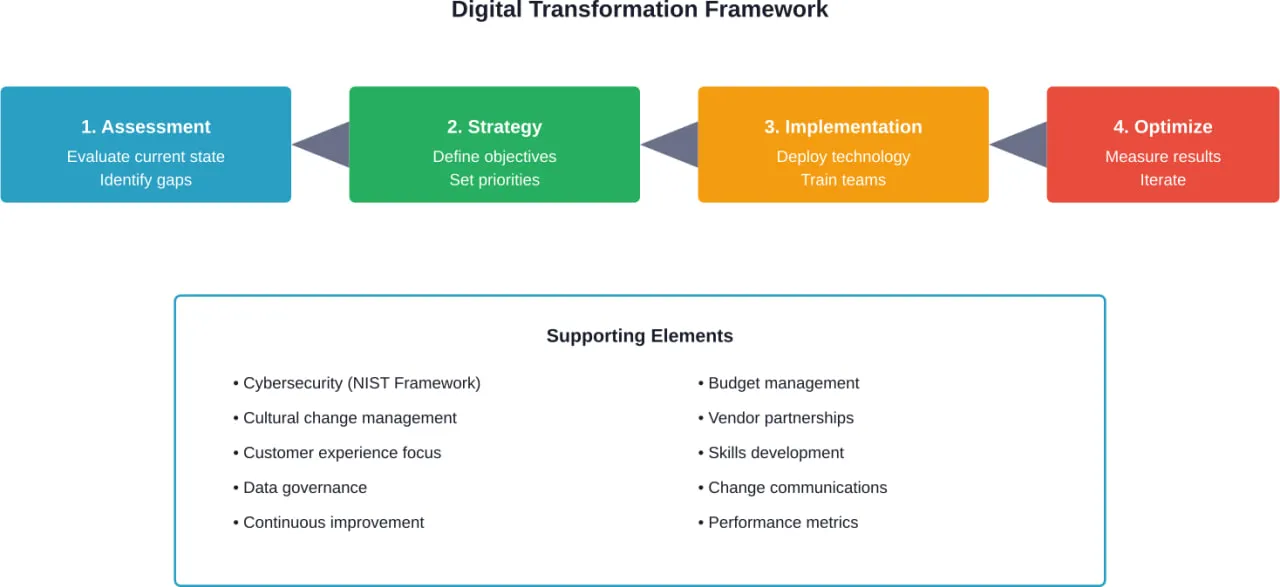
Frameworks provide structure. They help entrepreneurs move from abstract concepts to concrete actions.
The National Institute of Standards and Technology has been helping organizations better understand and improve their management of cybersecurity risk since 2013. Their Cybersecurity Framework supports digital transformation efforts by ensuring security doesn’t become an afterthought.
Because here’s the thing—transformation initiatives that ignore security create vulnerabilities that can destroy businesses.
Building a Digital Strategy
The U.S. Small Business Administration publishes a Digital Strategy Report that provides a breakdown of their digital strategy approach.
Key components include:
- IT policy development and governance
- Data center optimization initiatives
- Strategic planning with measurable milestones
- Cost savings identification and tracking
Entrepreneurs can adapt this government framework for their own needs. Start with clear objectives. Define measurable outcomes. Track progress systematically.
Supporting Legacy Systems During Transformation
Michael Pease from the National Institute of Standards and Technology has more than 25 years of experience supporting information technology, cybersecurity, and maintaining cybersecurity programs for IT and operational technology environments.
His work focuses on cybersecurity for industrial control systems and their operating environments.
Digital transformation doesn’t mean abandoning everything that works. It means strategically updating systems while maintaining business continuity.
Legacy components can coexist with modern systems during transformation. The trick is building bridges—APIs, data integrations, and middleware that connect old and new.
Practical Steps for Entrepreneurial Digital Transformation
Theory is great. But what do entrepreneurs actually do on Monday morning?
Start With Customer Pain Points
The best digital transformation initiatives solve real problems. Not hypothetical ones.
Map out the customer journey. Where do people struggle? What takes too long? What causes frustration?
Those pain points are transformation opportunities.
Prioritize Quick Wins
Big transformations start with small victories. Quick wins build momentum and prove value.
Look for processes that are:
- High-impact for customers or operations
- Relatively simple to digitize
- Measurable in terms of improvement
Automate repetitive tasks first. Implement cloud-based collaboration tools. Deploy CRM systems to track customer interactions better.
These changes deliver value fast while building organizational confidence in digital approaches.
Інвестуйте в розвиток навичок
Technology is only as good as the people using it.
Entrepreneurs need to invest in skills development—for themselves and their teams. This includes technical skills like data analysis and cloud platform management, but also soft skills like adaptability and digital literacy.
The good news? Resources abound. The SBA provides information and support for small businesses exploring AI and other digital technologies.
Build Data Capabilities
Data drives modern business decisions. But raw data isn’t enough—businesses need analytics capabilities to extract insights.
Start by identifying what data matters most. Customer behavior? Operational efficiency? Financial performance?
Then build systems to collect, store, and analyze that data. Cloud platforms make this more accessible than ever for small businesses.
Загальні виклики цифрової трансформації
Not every transformation succeeds. Understanding common pitfalls helps entrepreneurs avoid them.
Бюджетні обмеження
Digital transformation costs money. Entrepreneurs often face tight budgets and competing priorities.
The solution isn’t necessarily spending more—it’s spending smarter. Focus on high-ROI initiatives. Leverage cloud services that reduce upfront capital expenses. Take advantage of free or low-cost tools for early-stage businesses.
Government data shows strategic approaches to IT spending can dramatically reduce costs. The SBA’s own initiatives included contract re-scoping, IT infrastructure optimization, and data center consolidation.
Опір змінам
People resist change. It’s human nature.
Successful transformation requires managing this resistance through communication, training, and involvement. Teams that participate in designing new processes are more likely to embrace them.
Cultural transformation takes time. Leaders need patience and persistence.
Security and Privacy Concerns
Digital systems create new vulnerabilities. Cybersecurity must be part of transformation planning from day one.
The NIST Cybersecurity Framework provides guidance for organizations of all sizes. It helps businesses understand and improve their management of cybersecurity risk.
Entrepreneurs should implement security best practices: regular software updates, employee training, data encryption, access controls, and incident response plans.
| Виклик | Вплив | Підхід до вирішення проблеми |
|---|---|---|
| Бюджетні обмеження | Limits technology options and implementation speed | Prioritize high-ROI projects, leverage cloud services, phase implementations |
| Опір змінам | Slows adoption and reduces effectiveness | Communicate benefits, involve teams in planning, provide training |
| Застарілі системи | Creates technical debt and integration challenges | Build bridges with APIs, modernize incrementally, plan migration paths |
| Прогалини у навичках | Limits ability to implement and optimize technology | Invest in training, hire strategically, partner with experts |
| Security Risks | Exposes business to cyber threats and data breaches | Implement NIST framework, regular updates, employee training |
Вимірювання успіху цифрової трансформації
What gets measured gets managed. Entrepreneurs need clear metrics to track transformation progress.
Ключові показники ефективності
The right metrics depend on business objectives. But some common KPIs include:
- Customer satisfaction scores and Net Promoter Score
- Process efficiency metrics like cycle time and error rates
- Revenue growth and customer acquisition costs
- Employee productivity and engagement
- Technology adoption rates across the organization
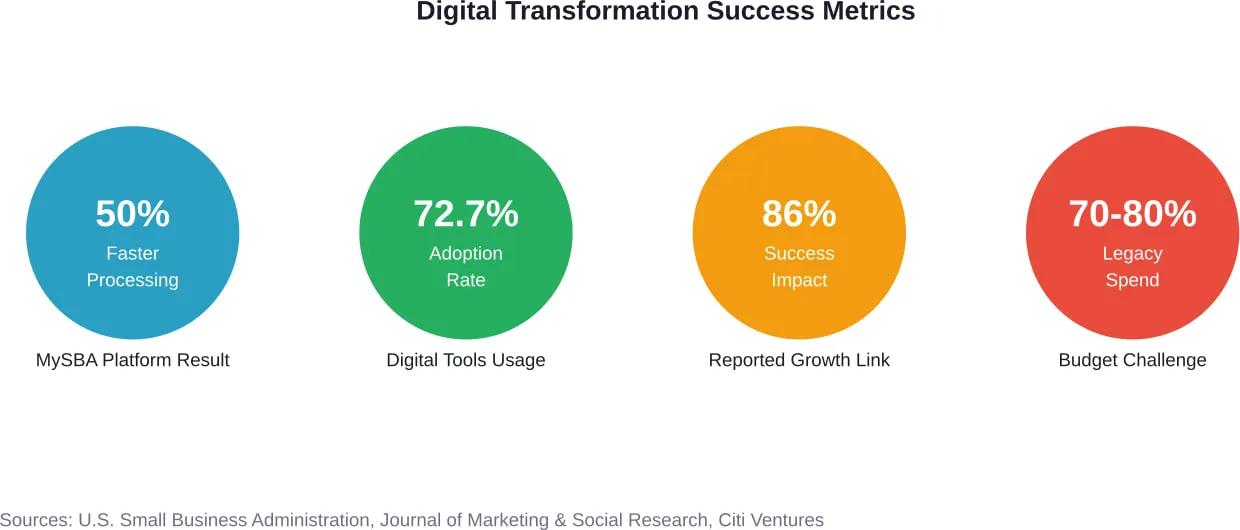
The MySBA platform demonstrated clear success with its 50% reduction in loan processing times. That’s a concrete, measurable outcome.
Return on Investment
Digital transformation requires investment. Entrepreneurs need to understand the return.
ROI calculations should include both tangible benefits like cost savings and efficiency gains, and intangible benefits like improved customer satisfaction and competitive advantage.
Research shows that 72.7% of entrepreneurs who adopted digital tools experienced measurable business growth. That’s a strong indicator of positive ROI across the board.
Постійне вдосконалення
Transformation isn’t a one-time event. It’s an ongoing process.
Successful entrepreneurs build systems for continuous improvement. Regular reviews of technology performance. Feedback loops from customers and employees. Experimentation with new tools and approaches.
This mindset separates businesses that stay competitive from those that fall behind.
Digital Transformation Trends for 2026
The digital landscape evolves constantly. Staying current matters.
ШІ та машинне навчання
Artificial intelligence is no longer just for large corporations. Small businesses can use AI tools and applications to find solutions for all kinds of issues.
AI applications for entrepreneurs include customer service chatbots, predictive analytics for inventory management, personalized marketing automation, and financial forecasting.
The SBA provides guidance on both the risks and benefits of AI adoption, helping entrepreneurs make informed decisions.
Mobile-First Experiences
Mobile isn’t the future—it’s the present. Customers expect seamless mobile experiences.
The MySBA platform emphasized mobile-friendly design as a core feature. This reflects broader trends toward mobile-first digital transformation.
Entrepreneurs need to ensure their digital tools, websites, and customer interfaces work flawlessly on mobile devices.
Хмарна архітектура
Cloud computing continues to transform how businesses operate. The advantages—scalability, flexibility, reduced capital expenses—make cloud platforms essential for modern entrepreneurs.
Cloud-native architecture means building systems designed for cloud environments from the start, rather than migrating legacy systems.
Cybersecurity as a Core Function
Security can’t be an afterthought. As businesses become more digital, cyber threats increase.
The NIST Cybersecurity Framework, initially published in 2014, continues to evolve. Entrepreneurs need to implement comprehensive security programs that protect customer data, business operations, and intellectual property.
Реальні приклади цифрової трансформації
Looking at successful transformations helps entrepreneurs understand what works.
Government Leadership
The U.S. Small Business Administration’s transformation demonstrates what’s possible. Starting with the 2012 federal directive on digital government, the SBA has systematically improved its online capabilities.
The MySBA platform launched in January 2025 represents years of strategic planning and execution. It includes modern features like disaster loan applications, lender matching services, and loan management with recurring payment options.
The 50% reduction in processing times shows real impact—not just digital for digital’s sake, but meaningful improvements in service delivery.
Private Sector Innovation
Research published in academic journals reveals patterns in successful digital entrepreneurship. Key characteristics include:
- Focus on customer value rather than technology for its own sake
- Willingness to experiment and learn from failures
- Investment in both technology and organizational capabilities
- Strategic rather than opportunistic technology adoption
These patterns appear consistently across industries and business sizes.
Getting Started With Digital Transformation
The journey begins with a single step. But which step?
Оцініть поточний стан
Before transforming, understand where things stand now. Audit existing technology, processes, and capabilities.
Questions to ask: What works well? What causes problems? Where do bottlenecks occur? What do customers complain about?
This assessment provides the baseline for measuring progress.
Визначте чіткі цілі
Vague goals lead to vague results. Digital transformation needs specific, measurable objectives.
Not “improve customer experience” but “reduce customer service response time by 40%.” Not “modernize technology” but “migrate 75% of applications to cloud platforms within 18 months.”
Clear objectives drive action and enable accountability.
Start Small, Think Big
The best transformations combine ambitious vision with practical execution. Think big about where the business is heading. Start small with concrete projects that deliver value quickly.
This approach builds momentum while managing risk. Quick wins fund larger initiatives. Early successes convince skeptics.
Partner Strategically
Entrepreneurs don’t need to figure everything out alone. Strategic partnerships extend capabilities without requiring full-time hires.
Technology vendors, consultants, and service providers can accelerate transformation. The key is choosing partners who understand entrepreneurial constraints and opportunities.
Поширені запитання
- What is digital transformation for entrepreneurs?
Digital transformation for entrepreneurs is the integration of digital technology into all areas of a business, fundamentally changing how operations work and how value is delivered to customers. It involves not just adopting new tools, but rethinking business processes and culture. According to the U.S. Small Business Administration, successful transformation requires continuous experimentation and willingness to challenge existing approaches.
- How much does digital transformation cost for small businesses?
Costs vary widely based on business size, industry, and scope of transformation. Research from Citi Ventures indicates that many businesses spend 70-80% of IT budgets maintaining legacy systems, leaving limited resources for transformation. Cloud-based solutions reduce upfront costs by shifting from capital expenses to operational expenses. Entrepreneurs should focus on high-ROI initiatives first and phase implementations to manage costs effectively.
- What percentage of entrepreneurs have adopted digital tools?
According to research published in the Journal of Marketing & Social Research, 72.7% of entrepreneurs have adopted digital tools such as CRM systems, cloud platforms, and digital marketing solutions in their business operations. Furthermore, 86% of respondents believe that access to digital tools directly contributes to their entrepreneurial success, with the majority reporting measurable business growth after adoption.
- Скільки часу займає цифрова трансформація?
Digital transformation isn’t a one-time project with a fixed endpoint—it’s an ongoing process. The U.S. Small Business Administration’s digital initiatives began with a 2012 federal directive and continue evolving today, with major milestones like the MySBA platform launching in January 2025. For entrepreneurs, initial implementations might take 6-18 months, but continuous improvement should be built into business operations indefinitely.
- What are the biggest challenges in digital transformation?
The most common challenges include budget constraints, resistance to organizational change, legacy system limitations, skills gaps, and cybersecurity concerns. Research from Citi Ventures shows that spending 70-80% of IT budgets on legacy system maintenance leaves little for innovation. Cultural resistance also matters—digital transformation requires not just new technology but new mindsets and willingness to experiment and accept failure as part of learning.
- Do I need to replace all existing systems for digital transformation?
No. Digital transformation doesn’t require abandoning everything at once. According to NIST research on supporting digital transformation with legacy components, businesses can maintain existing systems while gradually modernizing. The key is building bridges between old and new systems through APIs, data integrations, and middleware. This approach maintains business continuity while enabling innovation.
- What cybersecurity considerations matter for digital transformation?
Cybersecurity must be integrated into transformation planning from the beginning. The National Institute of Standards and Technology provides a Cybersecurity Framework to help organizations understand and improve their management of cybersecurity risk. Essential practices include regular software updates, employee training, data encryption, access controls, and incident response plans. Protecting information and operational technology environments is critical for successful digital transformation.
Висновок
Digital transformation isn’t optional for entrepreneurs who want to compete in today’s economy. Technology allows small businesses to be more competitive in the fast-paced market.
The data tells a compelling story. Over 72% of entrepreneurs have already adopted digital tools. Among those who have, 86% see direct links between technology and business success. The U.S. Small Business Administration achieved 50% faster processing times through strategic digital transformation.
But success requires more than just buying software.
True transformation involves integrating technology across all business operations, building cultures that embrace change and experimentation, focusing relentlessly on customer value, and continuously improving based on data and feedback.
The frameworks exist. Government agencies like the SBA and NIST provide guidance, templates, and best practices. Cloud platforms make enterprise-level technology accessible to small businesses. AI tools help entrepreneurs do more with less.
The question isn’t whether to pursue digital transformation. It’s how to do it strategically—moving fast without breaking everything, building for the future while maintaining current operations, and delivering real value rather than just implementing technology for its own sake.
Start with customer pain points. Prioritize quick wins that demonstrate value. Invest in both technology and the people who use it. Measure results rigorously. Iterate continuously.
Ready to transform your business? The U.S. Small Business Administration offers resources, guidance, and support for entrepreneurs exploring digital transformation. Visit their website to learn about digital tools, AI applications, and strategies that work for small businesses.
The future belongs to entrepreneurs who embrace digital transformation strategically. The tools are available. The roadmap is clear. The time to start is now.


