DDoS Protection Cost: Real Pricing Factors and How to Plan for Them
Оновлено 20 лютого 2026 року
Отримайте безкоштовну оцінку послуг
Розкажіть нам про свій проєкт - ми відповімо вам з індивідуальною пропозицією
DDoS protection isn’t something you notice – until it fails. When sites go dark or services freeze up, the losses aren’t just technical. Contracts can get terminated, reputations take a hit, and SEO rankings slide faster than you’d expect. But the cost of protecting against DDoS attacks? That part isn’t one-size-fits-all.
Some businesses overpay for coverage they barely use, while others cut corners and leave critical assets exposed. The real challenge is figuring out what your business actually needs, where the cost comes from, and how to keep protection scalable without making it fragile. Let’s break that down.
Understanding DDoS Protection in Practical Terms
DDoS protection is one of those things most teams don’t talk about – until they’re suddenly under pressure to explain why a key system is offline. At its core, it’s about keeping your services available even when someone is deliberately trying to overwhelm them. Not all attacks are massive. Some are short and targeted. Others hit in waves, using botnets or app-layer exploits to knock out specific endpoints. Either way, downtime is rarely just a technical hiccup. It spills over into customer churn, lost revenue, SEO fallout, and internal fire drills.
The job of DDoS protection isn’t to make systems invincible. It’s to make sure your business can keep moving when things get noisy. That means filtering traffic at the right layers (not just the network), reacting fast, and knowing which systems need protection first. It also means designing infrastructure with this in mind – because overpaying for blanket coverage or underestimating real risks can both be expensive in the long run.
What Really Drives DDoS Protection Costs
DDoS protection pricing depends on a few very practical things. How your infrastructure is set up, how much traffic you handle, and what’s actually at risk if a service goes down all play a role. Some teams overspend by protecting everything by default. Others save upfront and end up exposed where it hurts most. Understanding the cost drivers early makes planning a lot calmer later on. Here’s what usually shapes the final price:
Number of protected IPs: More public-facing endpoints mean more surface area to defend and higher costs.
Protection layers covered: Basic network-layer filtering costs less, while application-layer protection adds complexity and price.
Traffic volume and behavior: High or irregular traffic patterns often push protection into higher pricing tiers.
Mitigation speed and automation: Faster, automated responses typically cost more but reduce downtime risk.
Monitoring and visibility tools: Some providers include analytics by default, others charge separately.
Infrastructure design choices: Using CDNs, load balancers, or private networking can significantly reduce what needs protection.
Cost stays manageable when protection matches real exposure, not assumptions.
How A‑listware Designs Practical, Scalable DDoS Protection
За адресою Програмне забезпечення списку А, we approach DDoS protection the same way we approach software delivery: deliberately, flexibly, and always with real-world risks in mind. It’s never about just throwing filters on everything. The work starts with understanding where real exposure sits, which systems are truly critical to uptime, and how protection should scale with actual traffic patterns rather than assumptions.
We treat protection as part of the architecture, not something bolted on later. That means looking at traffic flows, attack surface, and fallback plans together, not in isolation. Whether we’re supporting lean startups or high‑load enterprise platforms, the focus stays on transparent costs and coverage that matches real business needs, not hypothetical scenarios.
We also share lessons and approaches with our community through regular posts on LinkedIn і Facebook. It’s where we talk openly about what works, what’s evolving in the threat landscape, and how teams can avoid overengineering without cutting corners where it matters.
How Much Does DDoS Protection Cost in 2026?
There’s no single price tag for DDoS protection – it depends on how critical your systems are, how your infrastructure is built, and how often you’re a target. That said, the market in 2026 is a lot more structured than it used to be. Providers now tend to follow two main pricing models, and actual cost ranges are clearer across business sizes.
Common Pricing Models in 2026
Most DDoS protection tools follow one of two models. Some offer per-resource pricing, where you only pay to protect specific public IPs or services. Others bundle protection across your entire infrastructure, usually with a flat monthly fee based on volume or resource count.
Per-IP / Targeted Protection: Ideal if you have a small number of public-facing endpoints. You only pay for what you explicitly protect, which helps avoid over-coverage.
Flat-Rate or Network-Based Protection: Best suited for businesses with lots of exposed services or complex architecture. Monthly fees are stable but typically higher, covering multiple IPs and automatic onboarding of new resources.
Both approaches can work – it depends on whether you’re looking for control and precision, or simplicity and predictability.
DDoS Protection Price Ranges by Business Type
Pricing varies widely depending on the size of the business, the layers of protection required (network vs application), and the level of support and automation. Here’s what most teams are paying in 2026:
Small Businesses or Startups
$20-$500+/month
Basic protection from L3/L4 attacks
Often bundled with hosting, CDN, or WAF
Limited customization or analytics
Середні компанії
$500-$5,000+/month
Mix of L3-L7 protection
Real-time monitoring, bot detection, and basic dashboards
Typically includes traffic-based scaling or flexible IP coverage
Enterprises and High-Risk Sectors (e.g. finance, e‑commerce)
$3,000-$20,000+/month
Full-stack DDoS mitigation, including application-layer defenses
24/7 SOC support, custom SLAs, and threat intelligence
Often integrated with WAF, anti-bot, TLS inspection, and CDN layers
Add-Ons and Hidden Costs to Watch
Some pricing looks flat until you hit real-world scenarios. Things that can raise the bill:
Overage fees during high-volume attacks
Premium support or faster response SLAs
L7 (application layer) protection not always included by default
Geo-distributed filtering across multiple regions
Being clear about what’s included and what’s extra – matters more than just picking a plan with the right number.
Making the Right Call on DDoS Budgeting
By 2026, DDoS protection has become more structured and easier to compare – but it’s still not plug-and-play. The smartest spenders aren’t the ones who pay the least. They’re the ones who align their protection model with how their infrastructure is actually used.
If you’re running mostly internal systems or have just a few exposed endpoints, selective protection can keep your budget tight without adding risk. But if you’re public-facing, deal with sensitive data, or see repeated attack attempts, you’ll need something more layered and hands-on. Trying to cut corners there usually backfires.
How to Choose the Right DDoS Protection Strategy for Your Business
There’s no universal setup that works for everyone. The right protection depends on what you’re running, what’s exposed, and how much downtime you can actually afford.
1. Start With What’s Actually at Risk
Not every system needs the same level of protection. The first step is identifying which services customers or partners rely on most. If a login page, checkout process, or public API goes down, what’s the actual impact – annoyance, lost revenue, missed contracts? That’s the zone that deserves priority.
The goal isn’t to protect everything equally, but to understand what can’t afford to break. When traffic spikes or malicious requests slip through, it’s these systems that will feel it first. A clear map of exposure turns DDoS planning from guesswork into something grounded and actionable.
2. Match the Protection Model to Your Architecture
If you only have a few public IPs or customer-facing endpoints, targeted protection will get the job done. You’ll keep costs down and avoid over-engineering. But if you’ve got dozens of services exposed across cloud environments, a network-wide model with automated onboarding is usually the smarter path.
It’s not about complexity for its own sake. It’s about not leaving gaps. The biggest risk in hybrid and fast-moving setups isn’t overpaying – it’s forgetting to protect something important after an update, a migration, or a new deployment.
3. Involve the Right People Early
Security teams shouldn’t be the only ones making decisions. Ops knows where the fire drills happen. Finance knows what downtime actually costs. Bringing those people into the conversation early helps avoid two common problems: under-protection caused by budget panic, and over-protection caused by fear.
Good DDoS strategy is a balance. It’s not just a checkbox or a security blanket. It’s something you design to scale with your infrastructure, your risk profile, and your roadmap. If those pieces don’t line up, the cracks will show when you least expect it.
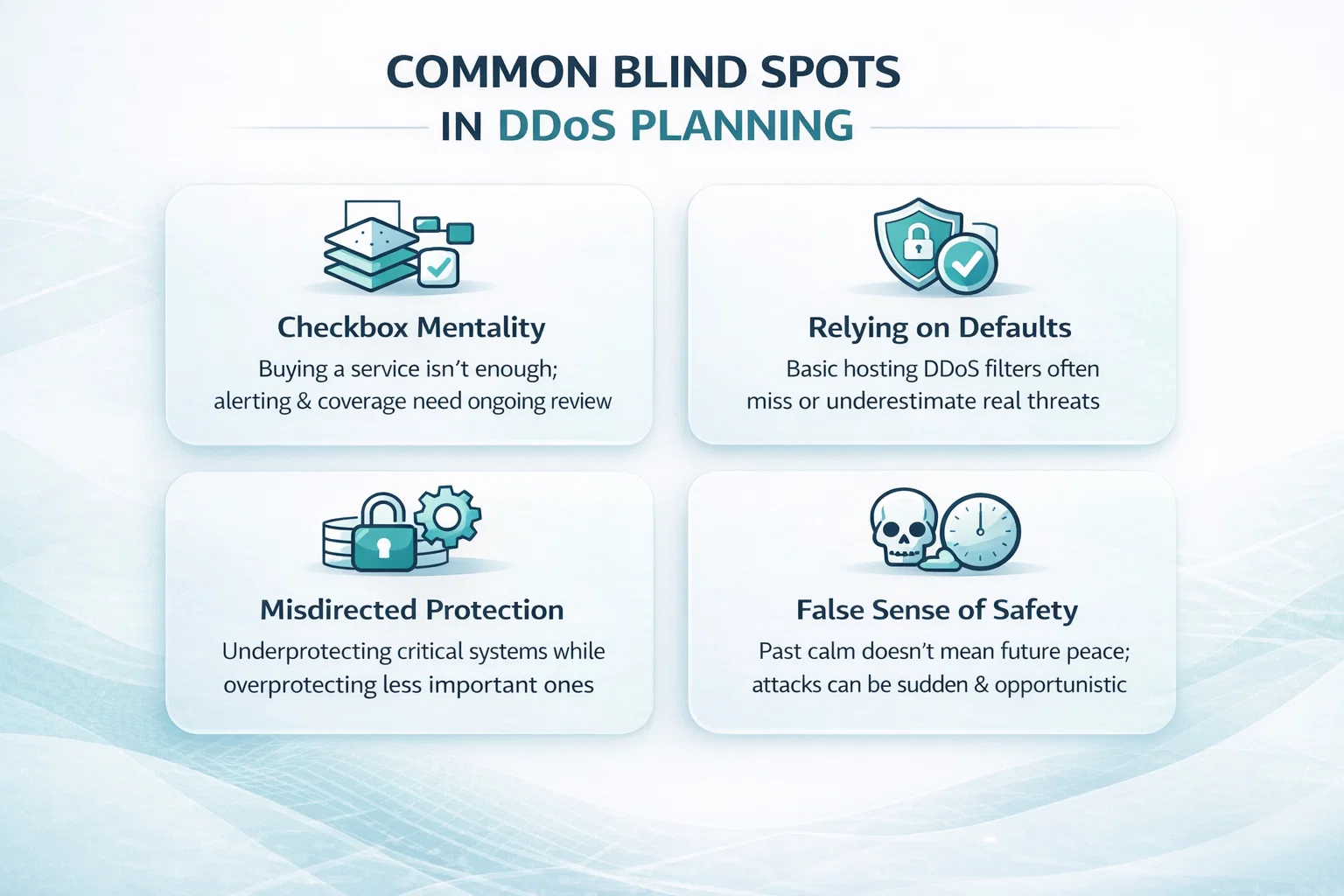
Common Blind Spots in DDoS Planning
Even solid teams with strong infrastructure make avoidable mistakes when it comes to DDoS protection. Some are budget-driven, others come from assuming the threat looks the same for everyone. Here’s where things usually go sideways:
Treating DDoS as a checkbox, not a workflow: Buying a service isn’t the same as being protected. If alerts go ignored or coverage isn’t reviewed after infrastructure changes, the gaps will show up when it’s already too late.
Relying only on default hosting protection: Some think the bundled “basic DDoS filter” from their provider is enough. It often isn’t – especially when application-layer (L7) attacks are involved.
Overprotecting low-risk systems, underprotecting what matters: It’s easy to sink budget into visible assets and forget backend APIs or third-party endpoints that are far more critical during an attack window.
Assuming past peace means future peace: Just because you haven’t been hit doesn’t mean you’re invisible. Attackers don’t send warnings, and many hits are opportunistic or automated.
Good protection starts with knowing your own weak spots – not just buying someone else’s idea of a strong setup.
Before You Commit: What to Double‑Check in a DDoS Protection Deal
Not all DDoS protection contracts are created equal – and once you’re locked in, the wrong setup can get expensive fast. Before signing anything, take a step back and look at how the service actually fits your infrastructure. Does it protect what really matters? Is the pricing clear once your traffic spikes? Can you scale up without chasing support? These things matter more than slick dashboards or bundled extras.
It’s also worth pressing for specifics. Ask what’s included in the base tier and what quietly falls into “premium.” Clarify whether application-layer (L7) protection is covered or optional. Look into how fast mitigation kicks in, and whether human response is part of the SLA or just automated filtering. And don’t forget to ask what happens when you hit volume thresholds – some providers start charging more the moment an attack gets serious.
Getting clear answers upfront saves you from scrambling later. A good contract doesn’t just protect your systems – it protects your ability to stay in control when things get noisy.
Висновок
DDoS protection isn’t just a line item in a security budget – it’s what keeps services running when things get messy. Costs vary widely, and that’s not necessarily a drawback. Flexibility allows protection to match how systems are built, what customers depend on, and how much downtime is truly acceptable.
Whether the setup is lean or built for high availability, the key is staying ahead of the risk. Waiting for an outage to rethink priorities usually costs more. It makes more sense to start with real exposure, align coverage accordingly, and build something that holds up under pressure.
ПОШИРЕНІ ЗАПИТАННЯ
How much does DDoS protection cost for small businesses?
Most small teams pay between $50 and $300 per month. That usually covers basic network-layer filtering (L3/L4) and might be bundled with your hosting or CDN. But if you rely on uptime for sales or client access, you’ll likely need something more advanced.
Is L7 protection always necessary?
Not in every case. But if your services involve user logins, forms, dynamic content, or public APIs, L7 protection isn’t optional – it’s where most targeted attacks hit. Network filtering alone won’t stop them.
Is free hosting-level protection enough?
It can help with basic traffic floods, but it’s rarely enough for anything more complex. These default tools often lack visibility, alerting, or fast response. If uptime matters or attacks could affect clients, you’ll want something more reliable.
Do I need protection if I’ve never been attacked?
Yes because many attacks are automated and opportunistic. Just because you haven’t seen one yet doesn’t mean you’re immune. Planning ahead costs less than cleaning up after an outage.
Маєте проект для нас?
Давайте створимо ваш наступний продукт! Поділіться своєю ідеєю або зверніться до нас за безкоштовною консультацією.
As organizations grow and adopt multiple platforms, the ability to bring data together efficiently becomes a critical challenge. That’s where data integration services companies step in – offering tools and expertise to unify data from various sources, eliminate silos, and ensure information flows smoothly across departments. From cloud-native startups to enterprise-grade providers, these companies specialize […]
As businesses increasingly rely on distributed workforces and cloud-based systems, the need for dependable technical support from afar has never been more critical. That’s where remote IT support companies come in – offering professional, on-demand assistance to resolve issues, monitor systems, and provide ongoing maintenance without the need for on-site presence. In this article, we […]
Outsourcing IT consulting allows businesses to access specialized knowledge without the overhead of expanding internal teams. From software architecture and cloud integration to cybersecurity and digital transformation, external consulting partners can support critical technology initiatives with precision and efficiency. In this guide, we explore some of the most reliable IT consulting outsourcing companies, focusing on […]
Використовуючи цей сайт, ви даєте згоду на отримання та використання персональних даних та обробку файлів cookie. Більше інформації про файли cookie.
Функціональний
Завжди активні
Технічне зберігання або доступ є суворо необхідним для законної мети уможливлення використання конкретної послуги, прямо запитуваної абонентом або користувачем, або з єдиною метою здійснення передачі повідомлення через мережу електронних комунікацій.
Уподобання
Технічне зберігання або доступ необхідні для законної мети зберігання налаштувань, які не запитуються абонентом або користувачем.
Статистика
Технічне зберігання або доступ, який використовується виключно для статистичних цілей.Технічне зберігання або доступ, який використовується виключно для анонімних статистичних цілей. Без повістки до суду, добровільного виконання вимог вашого інтернет-провайдера або додаткових записів від третьої сторони інформація, збережена або отримана лише з цією метою, зазвичай не може бути використана для вашої ідентифікації.
Маркетинг
Технічне зберігання або доступ необхідні для створення профілів користувачів для надсилання реклами або для відстеження користувача на веб-сайті або на декількох веб-сайтах з аналогічними маркетинговими цілями.