Короткий виклад: Digital transformation for charities involves integrating technology, data, and digital culture to enhance mission delivery, fundraising, and operational efficiency. While 74% of nonprofit leaders recognize its importance, only 12% have achieved digital maturity, and recent data shows that just 44% of charities have a digital strategy in place—down from 50% in 2024. Success doesn’t require massive budgets; even small strategic steps can yield significant impact.
The charity sector stands at a critical juncture. Technology has reshaped how donors engage, how services reach beneficiaries, and how organizations measure impact. Yet most charities struggle to keep pace.
According to the 2022 Nonprofit Trends Report sponsored by Salesforce, 74% of nonprofit leaders agree that digital transformation is important. But here’s the problem: only 12% have achieved digital maturity. That gap reveals systemic barriers—limited funding, resource constraints, and organizational resistance.
The situation has worsened recently. The Charity Digital Skills Report shows that 44% of charities now have a digital strategy in place, down from 50% in 2024. This backward slide is concerning, especially when digital fundraising grew by 86% during the COVID-19 pandemic, proving the sector’s capacity for rapid digital adoption when necessity demands it.
What Digital Transformation Actually Means for Charities
Digital transformation isn’t about buying new software or launching a social media account. It’s the strategic integration of technology, data, and digital culture to improve mission delivery, fundraising capabilities, and operational efficiency.
Think of a behavioral health therapist in suburban Maryland who logs into a dashboard before meeting clients. The screen displays real-time caseloads, treatment plans, and risk alerts. One name flashes yellow—a client whose recent history suggests heightened hospitalization risk. Rather than waiting for a crisis, the therapist addresses this proactively.
That’s digital transformation in action. Not flashy, but fundamentally powerful.
Yale Insights research highlights that only 11% of nonprofits view their approaches to digital as highly effective. The challenge isn’t technological—it’s organizational. Digital transformation requires rethinking processes, training staff, and committing leadership resources to sustain change.
The Current State of Charity Digital Adoption
Understanding where the sector stands helps charities benchmark their progress and identify realistic next steps.

The data reveals a troubling pattern. While awareness is high, execution lags significantly. But there’s encouraging news too: the Charity Excellence AI Benchmarking Survey found that 60% of individuals in charities are now using AI, showing rapid adoption of emerging technologies despite broader strategic gaps.
Digital Fundraising Performance
Digital fundraising has become essential, yet performance varies wildly across organizations. According to the 2024 UK & Ireland Charity Digital Benchmarks Study, online revenue growth has stabilized after pandemic-era explosions. During COVID-19, online revenue grew by an astonishing 86% versus 2019. The following years saw smaller growth rates of 5% each year.
Donor behavior has shifted too. Nearly half (47%) of donors give to multiple charities, with younger age groups being particularly generous—53% of 18-44 year olds have given to multiple causes compared to 42% of those aged 45 and over, according to Donor Pulse 2025.
But digital fundraising growth in 2024 wasn’t universal: 49% of organizations reported growth while others stagnated or declined. The difference? Strategic digital integration versus ad-hoc technology adoption.
Key Challenges Blocking Digital Progress
Understanding barriers helps charities address them systematically rather than blame themselves for falling behind.
Limited Funding and Resources
Most charities operate on tight budgets with every pound scrutinized. Digital transformation competes with direct mission delivery for scarce resources. Leadership often struggles to justify technology investments when immediate needs seem more pressing.
The perception that digital change requires massive budgets creates paralysis. In reality, many high-impact changes cost little financially but demand time and commitment.
Skills Gaps and Capacity Constraints
According to the Charity Digital Skills Report, 76% of organizations say the survey helped them reflect on their digital progress, strengths, and weaknesses. This reflection is valuable, but identifying gaps doesn’t solve them.
Staff turnover, limited training budgets, and competing priorities mean digital skills develop slowly. Small charities often lack dedicated technology roles, expecting program staff to manage digital tools alongside their primary responsibilities.
Organizational Culture and Resistance
Digital transformation isn’t primarily a technology challenge—it’s a change management challenge. Long-standing processes, risk-averse cultures, and fear of disruption create resistance.
Leadership vision matters enormously. Without board and executive commitment, digital initiatives stall when obstacles arise or competing priorities emerge.
Building a Practical Digital Strategy
Charities don’t need complex roadmaps. They need clarity, focus, and realistic next steps.
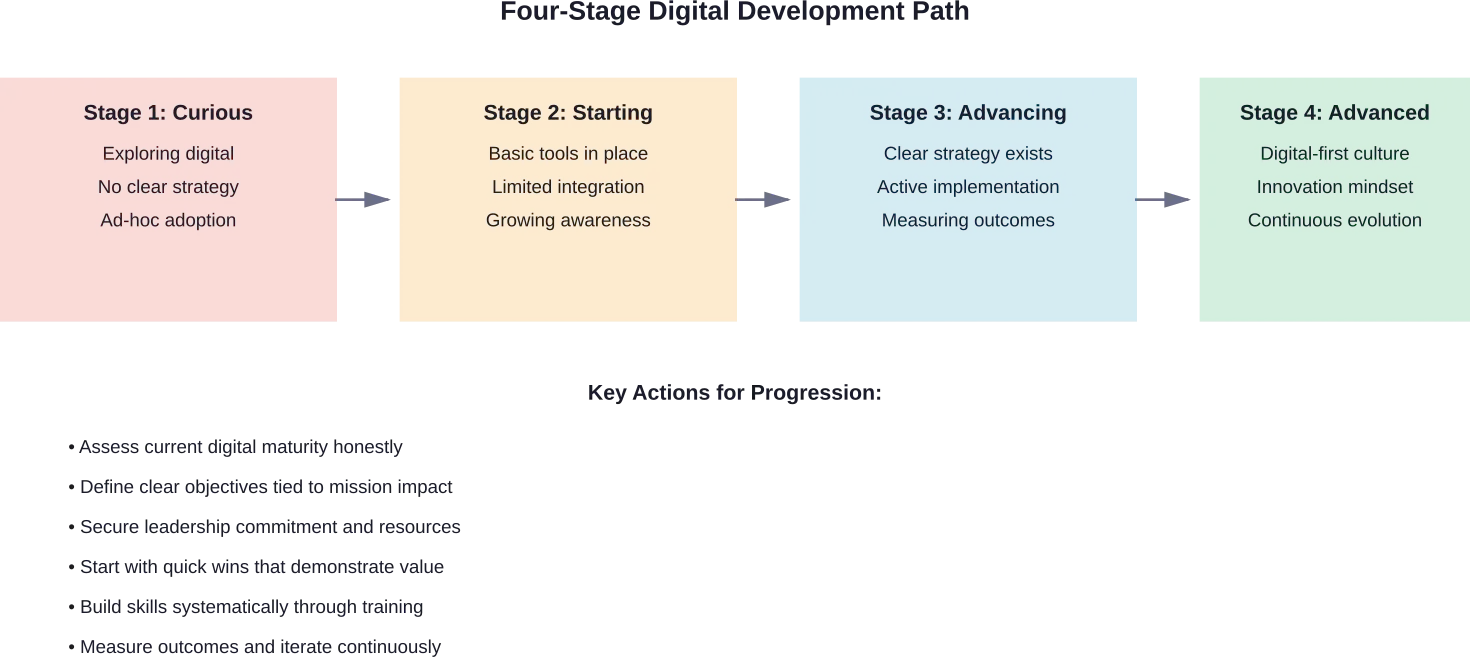
Start With Assessment, Not Tools
Before adopting new technology, charities need clarity on current capabilities and gaps. Self-assessment frameworks help identify strengths, weaknesses, and priority areas.
Questions to consider: How effectively does technology support mission delivery? Where do manual processes create bottlenecks? What data exists but remains underutilized? Which staff have digital skills and which need support?
Focus on Quick Wins
Large-scale transformation overwhelms resource-constrained organizations. Quick wins build momentum, demonstrate value, and secure ongoing support.
One charity used the Alice platform to improve donation services for an appeal to raise £50,000 to help lift 15 people out of long-term rough sleeping by delivering intense personalised support. The platform froze donations at specific milestones, creating urgency and transparency that boosted donor confidence.
Small changes—automating routine communications, digitizing paper processes, or implementing simple donor management systems—yield immediate benefits and prove digital transformation’s value.
Emerging Technologies Reshaping the Sector
Charities don’t need to chase every trend, but understanding key technologies helps prioritize investments.
Штучний інтелект та автоматизація
AI adoption has surged, with 60% of individuals in charities now using AI according to the Charity Excellence AI Benchmarking Survey. However, there’s little evidence of charitable grant makers investing in AI yet, creating a potential resource gap.
Practical AI applications include automated donor communication, predictive analytics for fundraising campaigns, chatbots for beneficiary support, and data analysis to identify service gaps.
Stanford research on PayPal users showed that small tweaks to charitable asks can boost giving significantly. AI helps optimize these prompts at scale, testing variations and personalizing appeals based on donor behavior.
Управління даними та аналітика
Data represents one of charity’s most underutilized assets. Most organizations collect extensive information but struggle to extract actionable insights.
Effective data management enables better decision-making, demonstrates impact to funders, personalizes donor engagement, and identifies emerging beneficiary needs.
Практичні кроки впровадження
Moving from strategy to action requires clear steps and realistic expectations.
| Фаза | Хронологія | Основні напрямки діяльності | Індикатори успіху |
|---|---|---|---|
| Foundation | Months 1-3 | Assess current state, define vision, secure leadership buy-in | Strategy document completed, budget allocated |
| Quick Wins | Months 3-6 | Implement 2-3 high-impact, low-complexity changes | Measurable efficiency gains, staff enthusiasm |
| Building Capacity | Months 6-12 | Train staff, implement core systems, establish processes | Skills development, system adoption rates |
| Scaling Impact | Months 12-24 | Expand successful initiatives, integrate advanced technologies | Mission impact metrics, cost efficiency improvements |
Building Digital Skills
Technology only delivers value when people can use it effectively. Skills development should be continuous, not a one-time training event.
Approaches include peer learning networks, online courses and certifications, external mentoring or consultancy, and learning by doing through pilot projects.
Choosing Between Open Source and Proprietary Solutions
Technology selection decisions have long-term implications for costs, flexibility, and capabilities.
| Аспект | Відкритий вихідний код | Proprietary |
|---|---|---|
| Initial Cost | Low or free | Often high |
| Ongoing Licensing | Ні. | Annual fees |
| Налаштування | High flexibility | May be limited |
| Підтримка | Community-based | Vendor-provided |
| Technical Skills Required | Higher | Нижній |
| Long-term Lock-in Risk | Нижній | Higher |
Neither approach is universally better. The right choice depends on technical capacity, budget constraints, customization needs, and long-term strategic goals.
Make Digital Change Work for Your Charity, Not Against It
Digital transformation in charities should solve real operational issues, not introduce new ones. A-listware works with organisations that need to move away from outdated systems, scattered data, or manual processes. They usually start by reviewing what is already in place, then shape a transformation plan around real workflows. That includes improving how systems connect, making data easier to use, and reducing the amount of manual effort teams deal with every day.
For charities, this often means clearer reporting, more reliable internal tools, and simpler ways to manage operations without adding extra layers of complexity. A-listware supports the full cycle, from initial assessment to implementation and ongoing support, so teams are not left figuring things out on their own. If your current setup is slowing you down or making everyday work harder than it should be, it is worth having a direct conversation with Програмне забезпечення списку А about what can be improved and how to move forward.
Measuring Success and Impact
Digital transformation initiatives need clear metrics to justify ongoing investment and guide refinement.
Effectiveness metrics should connect digital activities to mission outcomes. For fundraising, track donor acquisition costs, retention rates, online conversion rates, and average gift sizes. For service delivery, measure beneficiary reach, service quality indicators, and efficiency gains.
Operational metrics matter too: system uptime and reliability, staff productivity improvements, process cycle times, and cost per transaction.
Overcoming Common Pitfalls
Understanding where others stumble helps charities avoid similar mistakes.
Technology-first thinking leads to expensive tools that don’t address actual needs. Start with problems and desired outcomes, then identify appropriate solutions.
Underestimating change management creates technically sound implementations that staff resist or ignore. Invest in communication, training, and addressing concerns proactively.
Neglecting data governance and security exposes charities to breaches, compliance violations, and donor trust erosion. Build security and privacy considerations into every digital initiative from the start.
Looking Ahead: The Future of Charity Digital Transformation
Several trends will shape the sector’s digital evolution over coming years.
Digital inclusion remains critical. Government data shows that 1.6 million people in the UK are living offline and around 23% of the UK population lack essential digital skills. Charities serving vulnerable populations must ensure digital transformation doesn’t exclude those already marginalized.
According to Yale Insights research, someone inspired by a story on social media could soon donate by simply telling their phone or smart speaker to give £10. Voice-activated giving, cryptocurrency donations, and embedded giving at checkout will reshape fundraising landscapes.
Sustainable technology practices will gain importance as environmental concerns intensify. Charities will scrutinize energy consumption of digital infrastructure, e-waste from hardware refreshes, and carbon footprints of cloud services.
Поширені запитання
- How much does digital transformation cost for charities?
Costs vary enormously based on organization size, current digital maturity, and ambition level. Many high-impact changes cost little financially but require staff time and commitment. Quick wins might require only hundreds of pounds, while comprehensive transformations for larger charities could reach tens of thousands. Prioritize based on impact potential rather than starting with a fixed budget.
- Do we need dedicated technology staff to undertake digital transformation?
Not necessarily, especially for smaller organizations. Many charities successfully advance digital maturity through upskilling existing staff, using external consultants for specific projects, or participating in sector-wide support programs. However, as digital capabilities become more central to mission delivery, dedicated technology roles become increasingly valuable.
- How long does charity digital transformation take?
Digital transformation isn’t a project with a fixed endpoint—it’s an ongoing process of adaptation and improvement. Initial quick wins can emerge within 3-6 months. Meaningful organizational change typically requires 12-24 months. Building an advanced, digitally mature culture takes years of sustained commitment.
- What’s the first step charities should take?
Start with an honest assessment of current digital capabilities, challenges, and opportunities. The Charity Digital Skills Report notes that 76% of organizations found the survey helpful for reflecting on digital progress. Understanding the starting point enables realistic goal-setting and prioritization.
- Can small charities with limited budgets still pursue digital transformation?
Absolutely. Digital transformation doesn’t require massive budgets or technical expertise to start. Focus on high-impact, low-cost improvements: automating manual processes, improving online donor experience, or better utilizing existing data. Many open source tools and sector-specific support programs help resource-constrained organizations advance digitally.
- How do we measure if digital transformation is working?
Connect digital metrics to mission outcomes. Track efficiency gains from automated processes, fundraising improvements from better donor engagement, service reach expansion through digital channels, and staff productivity increases. Both quantitative metrics and qualitative feedback from staff and beneficiaries provide valuable insight.
- What role should trustees play in digital transformation?
Trustees should provide strategic oversight, ensure adequate resources, hold leadership accountable for progress, and champion digital culture throughout the organization. Without board-level commitment, digital initiatives often stall when competing priorities emerge or implementation challenges arise.
Taking Action on Digital Transformation
The charity sector faces a persistent gap between recognizing digital transformation’s importance and achieving meaningful progress. But this gap represents opportunity, not failure.
Organizations that take deliberate, strategic steps—however small initially—position themselves to better serve beneficiaries, engage donors more effectively, and maximize mission impact in an increasingly digital world.
Success doesn’t require technical expertise, massive budgets, or perfect execution. It requires honesty about current capabilities, clarity about desired outcomes, commitment from leadership, and willingness to learn and adapt.
The data shows troubling trends: digital strategy adoption declining from 50% to 44% of charities, while only 12% achieve digital maturity despite 74% recognizing its importance. Yet the same data reveals possibilities: 60% already using AI, digital fundraising capabilities proven during COVID-19, and younger donors increasingly engaging through digital channels.
Start where it makes sense for the organization. Assess the current state honestly. Identify one or two quick wins that demonstrate value. Build from there, learning and adjusting along the way.
Digital transformation isn’t optional for charities that want to maximize impact, reach new supporters, and remain relevant to digitally native generations. The question isn’t whether to pursue it, but how to begin—and that answer is simpler than most organizations think.


