Короткий виклад: Digital transformation for tour operators means modernizing operations through technology—from mobile booking platforms and AI personalization to cloud-based management systems. Success requires focusing on customer experience, operational efficiency, and data-driven decisions rather than just adopting the latest tech. Tour operators who prioritize integration, staff training, and scalable solutions see measurable improvements in bookings, customer satisfaction, and competitive positioning.
Tour operators face unprecedented pressure to modernize. Travelers expect seamless digital experiences, real-time updates, and personalized recommendations. Meanwhile, operational costs climb and competition intensifies from both traditional players and tech-first disruptors.
But here’s the thing—digital transformation isn’t about throwing money at the latest apps or rebuilding everything from scratch. It’s about strategic evolution. The tour operators thriving right now? They’ve figured out how to blend technology with their core strengths while keeping the human element intact.
According to Booking.com research, 80% of travelers use mobile apps when researching trips. That’s not a future trend. That’s today’s baseline expectation.
What Digital Transformation Actually Means for Tour Operators
Digital transformation gets thrown around as buzzword territory. Let’s cut through that.
For tour operators, it means fundamentally rethinking how business operates—from initial customer contact through post-trip follow-up. It’s not just digitizing paper forms or adding a booking widget to a website. Real transformation touches every aspect of the operation.
The travel industry has seen robust recovery post-pandemic. According to UN Tourism data, between 2019 and 2023, the tourism sector attracted 1,983 announced foreign direct investment (FDI) greenfield projects with US$106.7 billion in capital investments, creating nearly 260,000 potential jobs worldwide. That growth creates opportunity. But it also raises customer expectations exponentially.
Modern travelers compare every experience to their best digital interaction—whether that’s ordering food, streaming entertainment, or banking. Tour operators compete against that standard, not just against other tour companies.
Основні компоненти
Successful digital transformation for tour operators typically includes these elements:
- Mobile-first booking platforms that work flawlessly across devices
- Cloud-based management systems that centralize operations
- Customer relationship management tools that track preferences and history
- Data analytics capabilities that inform business decisions
- Payment processing integration that handles multiple currencies and methods
- Communication automation for confirmations, updates, and follow-ups
- Dynamic pricing engines that optimize revenue
None of these exist in isolation. The magic happens when they connect seamlessly.
Why Tour Operators Can’t Ignore This Shift
Look, some operators still manage to run profitable businesses with minimal tech. That’s getting harder by the quarter.
Consumer behavior has shifted permanently. According to travel industry surveys, 72% of travelers in 2022 said traveling would be worth it in 2023 despite economic uncertainty. They’re ready to spend. But they expect frictionless experiences.
Here’s what happens when tour operators delay transformation:
- Customer acquisition costs increase: Without efficient digital channels, operators rely on more expensive traditional marketing and distribution. Online travel agencies take larger commissions. Direct booking opportunities evaporate.
- Operational inefficiency compounds: Manual processes create bottlenecks. Staff spend time on repetitive tasks instead of customer service. Errors multiply. Scaling becomes nearly impossible.
- Data insights remain invisible: Without proper systems, operators fly blind—guessing at customer preferences, seasonal patterns, and pricing optimization instead of knowing.
The World Travel & Tourism Council data reveals tourism’s expanding economic impact globally. That growth disproportionately benefits operators who’ve embraced digital capabilities.
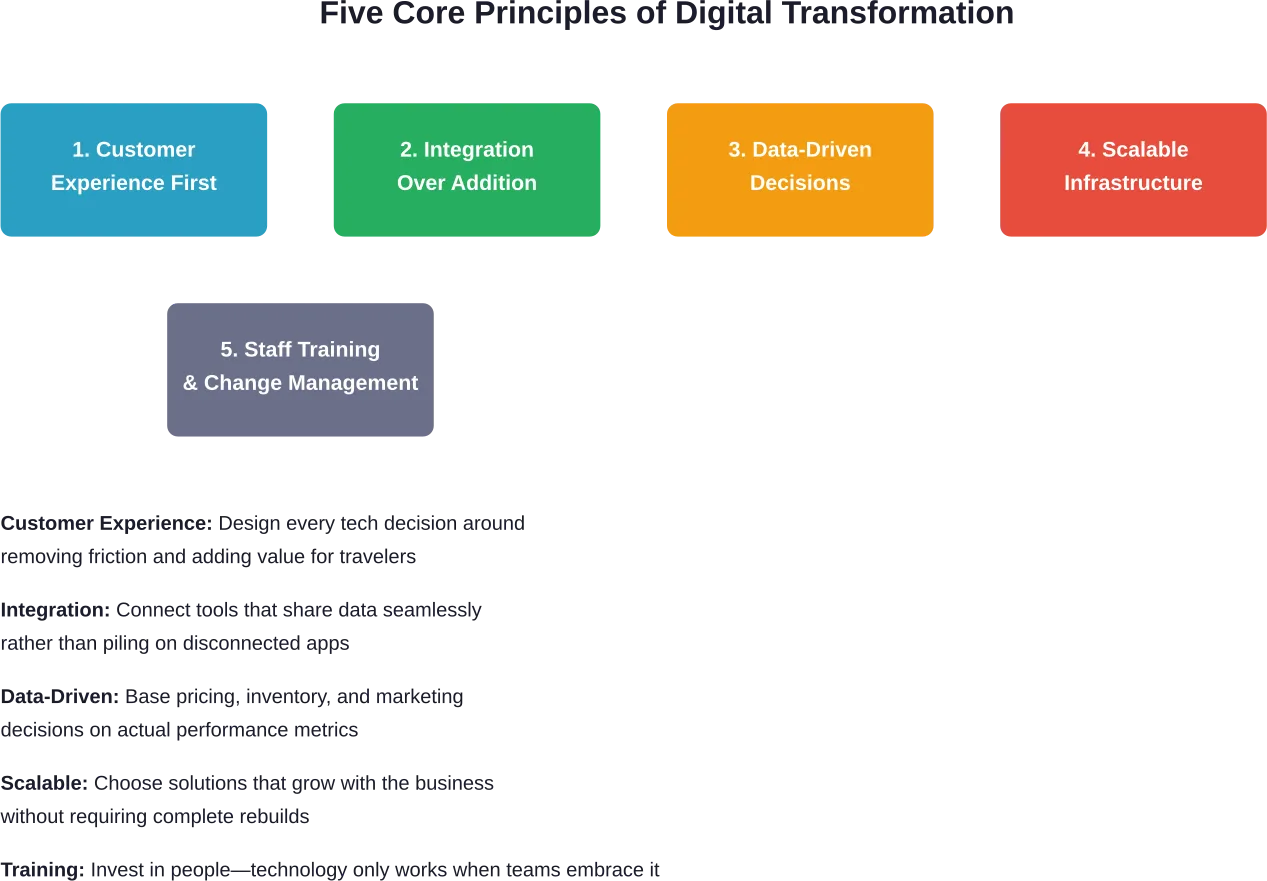
Five Core Principles That Actually Work
Many tour operators approach digital transformation backwards—choosing technology first, then figuring out how to use it. That’s expensive and frustrating.
The operators seeing real results follow these principles instead:
Start With Customer Pain Points
What frustrates customers most? Long booking processes? Lack of real-time availability? Confusing payment options? Poor mobile experience?
Identify the biggest friction points first. Then choose technology that eliminates those specific problems. This approach delivers measurable ROI quickly and builds momentum for larger changes.
Build for Integration, Not Collection
The graveyard of failed digital transformation projects is full of disconnected tools. A booking system that doesn’t talk to the CRM. A payment processor that requires manual reconciliation. A communication platform that can’t access customer data.
Real talk: fewer integrated tools beat a dozen disconnected ones every time.
Let Data Guide Decisions
Gut instinct built many successful tour operations. But it can’t optimize pricing across 50 departure dates, identify which marketing channels convert best, or predict seasonal demand patterns.
Digital transformation enables data-driven decision making at scale. The operators leveraging analytics consistently outperform those flying blind.
Implementation Timeline and Investment
How long does digital transformation take? That depends entirely on starting position and ambition.
Industry analysis suggests these general timelines:
| Розмір бізнесу | Typical Launch Timeline | Key Considerations |
|---|---|---|
| Small operators (up to $3M revenue) | Within three months | Focus on core booking and payment systems first |
| Mid-sized operators (up to $10M) | Three to six months | Prioritize integration between existing systems |
| Large operators (over $10M) | Three-month iterations | Phase implementation by department or product line |
But here’s what matters more than timeline—the approach. Operators attempting big-bang transformations face higher failure rates than those taking iterative steps.
Launch with minimum viable technology that solves one clear problem. Validate the approach. Then expand systematically.
Investment Considerations
Technology costs vary widely based on chosen solutions, customization needs, and business complexity. Check official websites for current pricing since plans and features change frequently.
Most operators should budget for:
- Software subscriptions (booking platforms, CRM, analytics)
- Implementation and integration services
- Staff training and change management
- Постійне обслуговування та оновлення
- Potential customization for unique workflows
The operators seeing strongest returns treat technology as operational investment, not capital expense. Monthly subscription models aligned with revenue make more sense than large upfront purchases for most.
Technology Areas Driving Results Right Now
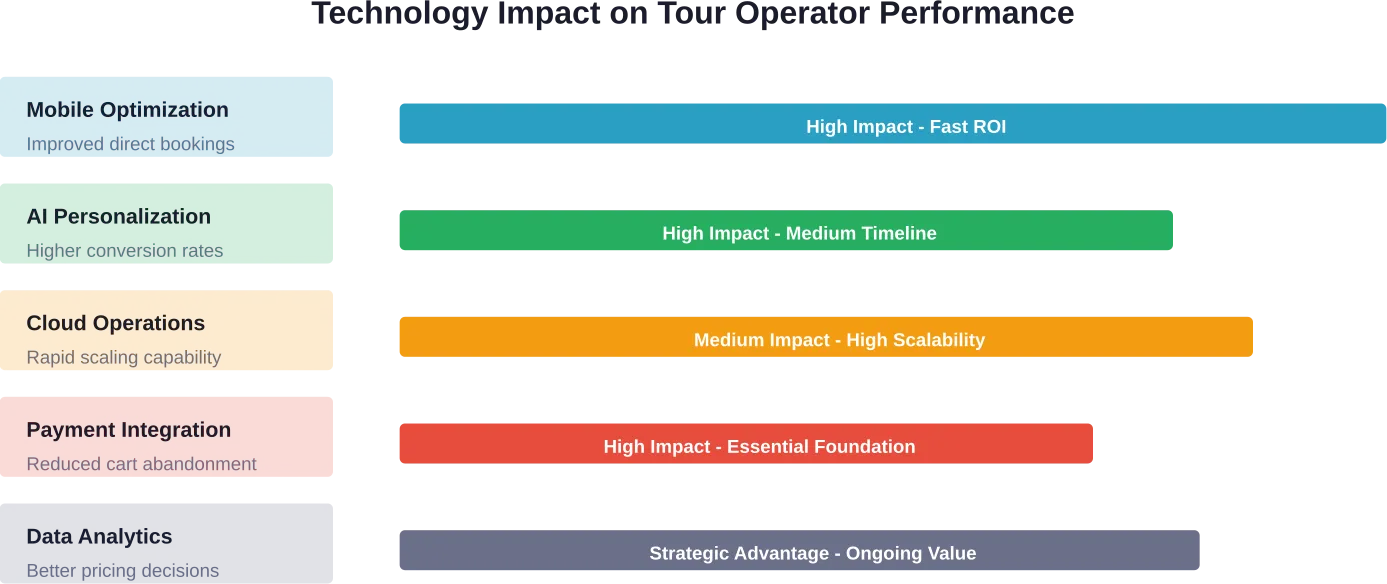
Not all technology delivers equal impact. These areas consistently show measurable results for tour operators currently implementing them:
Mobile-First Booking Experiences
Mobile isn’t optional anymore. Travelers research, compare, and book increasingly from smartphones and tablets.
Effective mobile experiences load fast, simplify complex information, and streamline checkout. Tour operators with optimized mobile experiences report improved direct booking rates.
Artificial Intelligence and Personalization
AI sounds futuristic but delivers practical benefits today. Smart tour operators use AI for:
- Personalized tour recommendations based on browsing history
- Dynamic pricing that optimizes for demand and competition
- Chatbots handling common customer questions 24/7
- Predictive analytics for inventory management
- Automated email sequences tailored to customer behavior
Cornell University offers an AI in Hospitality certificate program (SHAC67, $3,900, 3 months with 3-5 hours weekly study) noting that generative AI is transforming hospitality by enhancing efficiency and streamlining operations. Operators leveraging AI effectively gain significant competitive advantages.
Cloud-Based Operations Management
Cloud platforms centralize operations, enabling staff to access critical information anywhere. This matters increasingly as remote and hybrid work becomes standard.
Cloud systems also enable rapid scaling without infrastructure investment. Peak season capacity? Available instantly. New market expansion? Supported without opening physical offices.
Віртуальна та доповнена реальність
Virtual reality lets potential customers experience tours before booking. While still emerging, virtual reality experiences in travel may enhance conversion rates and reduce cancellations, though adoption remains in early stages.
Augmented reality enhances actual tours—overlaying historical information, translation services, or interactive elements on real-world environments through smartphone cameras.
Integrated Payment Solutions
Modern travelers expect to pay how they want—credit cards, digital wallets, buy-now-pay-later options, cryptocurrency in some markets, and multiple currencies.
Integrated payment platforms handle complexity behind the scenes while presenting simple checkout experiences. They also reduce payment failures, chargebacks, and reconciliation headaches.
Common Pitfalls That Sink Transformation Projects
Digital transformation fails more often than it succeeds. Understanding why helps operators avoid expensive mistakes.
The Technology-First Trap
Choosing impressive technology without clear business objectives wastes resources. Shiny features matter less than solving actual problems.
Start with business goals. Revenue growth? Operational efficiency? Customer satisfaction? Market expansion? Then identify technology that advances those specific objectives.
Neglecting Change Management
New systems fail when staff resist or can’t use them effectively. The critical human factor determines whether technology delivers value or gathers digital dust.
Successful operators invest heavily in training, create internal champions, and involve staff in selection processes. They also accept that adoption takes time and provide ongoing support.
Underestimating Integration Complexity
That booking platform looks perfect in demos. But how does it connect to the existing CRM? The accounting system? The email marketing platform?
Integration challenges sink more projects than any other technical issue. Operators should verify integration capabilities and ideally see working examples before committing.
Ignoring Mobile Performance
Websites that work beautifully on desktop but frustrate mobile users lose bookings constantly. Testing on actual devices—not just desktop browsers resized—reveals problems before they cost revenue.
Lacking Clear Metrics
How will success be measured? Increased bookings? Higher average order value? Reduced customer service calls? Better review scores?
Without defined metrics, operators can’t evaluate whether investments deliver returns or need adjustment.
The Role of Data in Modern Tour Operations
Data transforms how tour operators make decisions. But it’s not about collecting everything—it’s about tracking what matters and acting on insights.
Effective operators focus data collection on:
- Customer behavior patterns: Which tours attract which demographics? How do people find the website? What prompts booking versus abandonment? Where do customers drop out of the booking process?
- Operational efficiency: Which processes consume disproportionate time? Where do errors occur most frequently? How do different staff members perform on key tasks?
- Financial performance: Which tours deliver the highest margins? How do marketing channels compare in cost-per-acquisition? What pricing strategies optimize revenue?
- Market trends: Which destinations gain popularity? How do seasonality patterns shift? What do competitors offer and charge?
UN Tourism research emphasizes that tourism measurement within global economic systems requires sophisticated data capabilities. Operators building these capabilities position themselves for sustainable growth.
Building Digital Capabilities Incrementally
The tour operators succeeding with digital transformation rarely attempt everything simultaneously. They build capabilities incrementally, validating each step before advancing.
A practical sequence looks like this:
- Phase 1 – Foundation (Months 1-3): Implement core booking and payment systems. Ensure mobile functionality. Establish basic analytics tracking.
- Phase 2 – Enhancement (Months 4-6): Add CRM capabilities. Implement automated communications. Integrate systems to reduce manual work.
- Phase 3 – Optimization (Months 7-9): Deploy dynamic pricing. Add personalization features. Expand analytics for deeper insights.
- Phase 4 – Innovation (Months 10-12): Test emerging technologies like VR or AR. Explore AI-powered recommendations. Consider custom development for unique competitive advantages.
Each phase builds on previous work while delivering independent value. This approach maintains momentum, demonstrates ROI, and allows course correction without catastrophic failures.
Вимірювання успіху трансформації
Digital transformation without measurement is just expensive experimentation. Operators need clear metrics to evaluate progress and adjust strategies.
| Метрична категорія | Ключові показники | Покращення цільових показників |
|---|---|---|
| Revenue Performance | Direct booking percentage, average order value, conversion rate | Measurable increase in direct bookings within 12 months of implementation |
| Операційна ефективність | Time per booking, manual task hours, error rates | Significant reduction in administrative time through process optimization |
| Задоволеність клієнтів | Net promoter score, review ratings, repeat booking rate | 15-25% improvement in customer satisfaction scores |
| Market Position | Search visibility, competitive pricing position, brand awareness | Top 3 organic rankings for primary tour categories |
Track these metrics consistently. Monthly reviews identify what’s working and what needs adjustment. Quarterly analysis reveals longer-term trends and informs strategic decisions.
The Competitive Landscape in 2026
Tour operators compete in an increasingly complex environment. Traditional competitors have upped their digital game. Online travel agencies dominate search results. Tech-first startups enter markets with innovative approaches.
Staying competitive requires continuous adaptation. The digital capabilities that differentiate today become baseline expectations tomorrow.
Community discussions in travel industry forums reveal operators struggle most with balancing investment in new technology against maintaining existing systems. That tension is real. But the operators winning make continuous improvement part of their operating model rather than treating transformation as a one-time project.
Emerging Trends Worth Watching
Several emerging trends will shape tour operations over the next few years:
- Sustainable tourism technology: Travelers increasingly prioritize environmental impact. Technology that measures, reports, and reduces carbon footprints creates competitive advantages.
- Voice-activated booking: Smart speakers and voice assistants expand into travel planning. Early adopters position themselves in these new channels.
- Blockchain for verification: Blockchain technology enables transparent verification of sustainability claims, authentic local experiences, and secure payment processing.
- Hyper-personalization: AI advances enable individualized experiences at scale—different recommendations, pricing, and communication for each customer based on detailed preference profiles.
- Contactless everything: The pandemic accelerated demand for contactless experiences. That preference persists, driving adoption of digital check-ins, mobile tickets, and app-based tour guidance.
Not every trend deserves immediate investment. But awareness helps operators anticipate shifts and position strategically.
Choosing Technology Partners Wisely
Tour operators rarely build technology in-house. Choosing the right partners determines transformation success.
Evaluate potential partners on:
- Travel industry expertise: Generic business software rarely addresses tour operations’ unique requirements. Partners with proven travel experience understand the nuances.
- Integration capabilities: How easily do their solutions connect with other systems? Do they provide APIs? What existing integrations do they support?
- Scalability: Will the solution grow with the business or require replacement as operations expand?
- Support quality: What happens when things break? Response times, support channels, and resolution rates matter enormously.
- Total cost of ownership: Look beyond initial pricing. Implementation, training, customization, ongoing fees, and eventual migration costs all factor into true cost.
Check references thoroughly. Speak with operators of similar size and business model using the solutions being considered. Their experiences reveal what demos won’t show.
Practical Next Steps for Getting Started
Ready to begin? These practical steps create momentum:
- Audit current state: Document existing technology, processes, and pain points. Identify gaps between current capabilities and business objectives.
- Prioritize ruthlessly: List everything that could be improved. Then rank by impact and feasibility. Focus resources on the top three priorities.
- Assemble the team: Include representatives from operations, sales, marketing, and finance. Technology decisions affect everyone—involve them early.
- Research solutions: Investigate options thoroughly. Request demos. Check references. Verify integration capabilities. Compare pricing transparently.
- Почніть з малого: Launch with minimum viable scope that solves one clear problem. Validate the approach before expanding.
- Measure everything: Establish baseline metrics before implementation. Track consistently afterward. Let data guide decisions.
- Invest in people: Allocate significant resources to training and change management. Technology only works when people embrace it.
- Iterate continuously: Digital transformation never finishes. Build a culture of continuous improvement and adaptation.
Bring Your Tour Operations into One Working System
For many tour operators, digital transformation starts with customer-facing tools but quickly runs into issues behind the scenes. Booking data, supplier details, itineraries, and pricing often live in separate systems, which makes updates slower and coordination harder than it should be. A-listware helps companies step back and rethink how these parts connect, so operations feel more predictable and easier to manage day to day.
Instead of layering new tools on top, they focus on restructuring how systems interact and how information moves across teams. That can mean simplifying booking workflows, improving visibility across platforms, and reducing the number of manual checks needed to keep things running. If your operations depend on too many workarounds to stay in sync, it’s worth discussing with Програмне забезпечення списку А how to bring everything into a setup that actually works together.
Поширені запитання
- How much should tour operators budget for digital transformation?
Investment varies widely based on business size and starting point. Small operators might begin with $10,000-30,000 for basic systems, while larger operations could invest $100,000+ for comprehensive transformation. Focus on ROI rather than absolute spend—technology that increases revenue 20% justifies higher investment. Subscription-based solutions spread costs over time rather than requiring large capital outlays.
- Can small tour operators compete digitally with larger companies?
Absolutely. Small operators often move faster and focus more sharply than larger competitors. Cloud-based solutions provide enterprise-grade capabilities at accessible prices. The key is choosing technology that solves real problems rather than trying to match large competitors feature-for-feature. Many successful small operators excel by specializing deeply and delivering exceptional customer experiences in narrow niches.
- What’s the biggest mistake tour operators make with digital transformation?
Choosing technology before defining clear business objectives. Impressive features mean nothing if they don’t solve actual problems or advance strategic goals. The second biggest mistake is neglecting change management—new systems fail when staff can’t or won’t use them effectively. Always start with business goals, then select technology that advances those goals, then invest heavily in training and adoption.
- How long before digital transformation shows measurable results?
Well-executed transformations typically show early wins within 3-6 months—improved conversion rates, reduced administrative time, or better customer satisfaction scores. Substantial financial impact usually takes 9-12 months as new capabilities mature and compound. Operators should expect 12-18 months for comprehensive transformation to deliver full potential. Incremental approaches show results faster than big-bang implementations.
- Should tour operators build custom software or use existing platforms?
Most operators benefit from existing platforms rather than custom development. Modern SaaS solutions offer extensive capabilities at reasonable costs without development risk or ongoing maintenance burden. Custom development makes sense only when unique competitive advantages require proprietary functionality or when business scale justifies the investment. Even then, building on platforms through APIs and extensions beats building from scratch.
- How important is mobile optimization for tour operators really?
Critical. Research shows 80% of travelers use mobile apps when researching trips, and mobile bookings continue growing as percentage of total revenue. Tour operators with poor mobile experiences lose bookings to competitors with better mobile functionality. Mobile optimization isn’t just about responsive design—it requires rethinking information architecture, simplifying complex booking flows, and optimizing load speeds for cellular connections.
- What role does AI play in tour operations currently?
AI delivers practical value today through personalized recommendations, dynamic pricing optimization, chatbot customer service, predictive analytics for demand forecasting, and automated email marketing. The technology has matured beyond experimental to proven ROI. Tour operators don’t need AI expertise in-house—many platforms embed AI capabilities that work automatically. Focus on business outcomes rather than technical complexity.
Впевнено рухаємося вперед
Digital transformation for tour operators isn’t optional anymore. Customer expectations, competitive pressure, and operational efficiency demands all require continuous technological evolution.
But success doesn’t require unlimited budgets or technical expertise. It requires strategic thinking, clear priorities, and willingness to adapt based on results.
The tour operators thriving right now started where everyone starts—identifying problems, researching solutions, taking calculated risks, and learning from results. They made mistakes along the way. They adjusted course when necessary. But they kept moving forward.
Your transformation journey starts with a single step. Audit current capabilities. Identify the biggest opportunity for improvement. Research potential solutions. Start small, measure results, and build from there.
The competitive landscape rewards action and adaptation. The perfect plan matters less than getting started and iterating based on real results. Tour operators who embrace digital transformation thoughtfully and persistently position themselves for sustainable success regardless of how technology evolves.
Ready to take the next step? Begin with that audit. Document where the operation stands today, define where it needs to go, and identify the technology gaps standing in the way. That clarity makes everything else possible.


