Цифрова трансформація для управління інвестиціями 2026

Короткий виклад: Цифрова трансформація в управлінні інвестиціями передбачає модернізацію операцій, клієнтського досвіду та процесу прийняття рішень за допомогою штучного інтелекту, автоматизації та аналізу даних. Згідно з дослідженням Інституту CFA, ШІ переходить від надмірного використання до зваженого впровадження з акцентом на доповнення, а не на заміну. Успіх вимагає балансу між інноваціями та дотриманням нормативних вимог, інвестуванням у розвиток талантів та збереженням людського фактору при прийнятті стратегічних рішень.

Інвестиційний менеджмент - це вже не та індустрія, якою вона була п'ять років тому. Технології проникли в усі сфери, від формування портфеля до комунікацій з клієнтами. Але ось у чому річ - цифрова трансформація полягає не лише у впровадженні нових інструментів.

Йдеться про фундаментальне переосмислення того, як інвестиційні компанії працюють, обслуговують клієнтів та приймають рішення. Тиск, який чиниться на інвестиційні компанії з метою забезпечення індивідуального підходу до клієнтів при одночасному управлінні витратами та дотриманні регуляторних вимог, ще ніколи не був таким високим.

Згідно з дослідженням Інституту CFA щодо штучного інтелекту в управлінні інвестиціями, ця сфера переходить від надмірної активності до реалізму, з акцентом на виваженому впровадженні та розширенні, а не на заміні. Це реальність, з якою стикаються інвестиційні менеджери сьогодні.

Сучасний стан цифрової трансформації в управлінні інвестиціями

Сектор управління капіталом стикається зі зростаючим тиском. Клієнти очікують такого ж безпроблемного цифрового досвіду, який вони отримують від компаній, що спеціалізуються на споживчих технологіях. Консультантам потрібні кращі інструменти для роботи з даними. Операційні команди борються із застарілими системами, які не можуть йти в ногу з часом.

Галузеві звіти показують, що для досягнення наскрізної цифрової трансформації потрібно більше, ніж оновлення програмного забезпечення. Вона вимагає організаційних змін, нових навичок і готовності кинути виклик процесам, що існували десятиліттями.

Реальна розмова: більшість фірм знаходяться десь посередині цього шляху. Вони оцифрували деякі процеси, але не трансформували свої бізнес-моделі по-справжньому. Розрив між цифровими лідерами та відстаючими продовжує збільшуватися.

Чотири етапи цифрової зрілості в управлінні інвестиціями: від застарілих систем до повної трансформації

Виміряний вплив штучного інтелекту на інвестиційні процеси

Дослідження Інституту CFA щодо штучного інтелекту в інвестиційному менеджменті свідчить про перехід від надмірності до реалізму. GenAI трансформує інвестиційні робочі процеси, але при цьому піднімає критичні питання про людські судження, постановку завдань і майбутнє професії.

Ось що насправді відбувається на місцях. Інструменти штучного інтелекту розширюють можливості аналітиків, а не замінюють їх. Портфельні менеджери використовують моделі машинного навчання для виявлення закономірностей у ринкових даних. Ризик-менеджери впроваджують ШІ для аналізу сценаріїв і стрес-тестування.

Але зачекайте. Прогалини в надійності зберігаються. ШІ-моделі можуть викликати галюцинації або давати незрозумілі результати. Це створює проблеми з наглядом, які інвестиційні компанії не можуть ігнорувати.

П'ять уроків від впровадження штучного інтелекту

Згідно з дослідженням Інституту CFA, ШІ переходить від надмірної активності до зваженого впровадження з акцентом на доповнення, а не на заміну людського судження.

Успішні впровадження ставлять на перше місце стратегічне розуміння, а не автоматизацію заради автоматизації. Вони вимагають зрозумілості. Інвестори та регулятори не сприймають прийняття рішень у "чорному ящику", незалежно від того, наскільки точними є прогнози.

Найважливіший урок? Розвиток компетенцій інвесторів має більше значення, ніж вибір технології. Командам потрібні нові навички, щоб ефективно працювати разом із системами штучного інтелекту.

Сфера застосування ШІПоточне усиновленняОсновний викликФактор успіху
Побудова портфоліоПомірнийПояснюваність моделіГібридний підхід людина-штучний інтелект
Аналіз ризиківВисокийЯкість данихНадійна система управління
Комунікації з клієнтамиЗростанняТочність персоналізаціїПротоколи нагляду за дотриманням прав людини
Автоматизація дослідженьВисокийРозуміння контекстуПроцеси перевірки аналітиків
Виконання угодЗрілістьВплив на ринокСистеми безперервного моніторингу
Моніторинг відповідностіПомірнийХибні спрацьовуванняРобочі процеси обробки винятків


Масштабуйте свою інвестиційну платформу за допомогою спеціалізованих технічних талантів

Модернізація систем управління портфелями та порталів для інвесторів вимагає спеціалізованих технічних талантів, які розуміють високі ставки на безпеку фінансових даних та їх обробку в режимі реального часу. Створення внутрішнього ІТ-відділу з нуля часто призводить до значних затримок з підбором персоналу та високих операційних витрат. A-Listware вирішує цю проблему, надаючи спеціалізовані команди розробників та розширюючи штат ІТ-спеціалістів, що дозволяє інвестиційним компаніям впроваджувати власні фінтех-рішення та автоматизувати робочі процеси без традиційного найму персоналу.

  • Нішева технічна експертиза: Доступ до перевірених розробників, які мають досвід роботи зі штучним інтелектом, великими даними та безпечною хмарною інфраструктурою.
  • Швидке розгортання ресурсів: Швидко масштабуйте свої інженерні потужності, щоб відповідати мінливим вимогам ринку або регуляторним змінам.
  • Оперативна ефективність: Скоротіть довгострокові накладні витрати, використовуючи гнучку, високопродуктивну модель доставки.
  • Пряма інтеграція: Виділені фахівці працюють як органічне продовження вашої існуючої команди для модернізації застарілих систем.

Почніть свою цифрову трансформацію з Програмне забезпечення A-List.

Створення технологічної основи для управління активами

Застарілі технологічні стеки не були розроблені для сучасних вимог. Вони не можуть обробляти дані в режимі реального часу. Вони не інтегруються з сучасними аналітичними платформами. Вони створюють операційні вузькі місця, які розчаровують як консультантів, так і клієнтів.

Створення технологічної основи вимагає стратегічних інвестицій у хмарну інфраструктуру, архітектуру даних та платформи з підтримкою API. Йдеться не про те, щоб все вирвати і почати з чистого аркуша - це рідко буває практично можливо.

Коротка відповідь? Більшість успішних перетворень здійснюються за модульним підходом. Вони визначають найцінніші сфери використання та модернізують їх у першу чергу. Потім вони систематично розширюються.

Основні технологічні компоненти

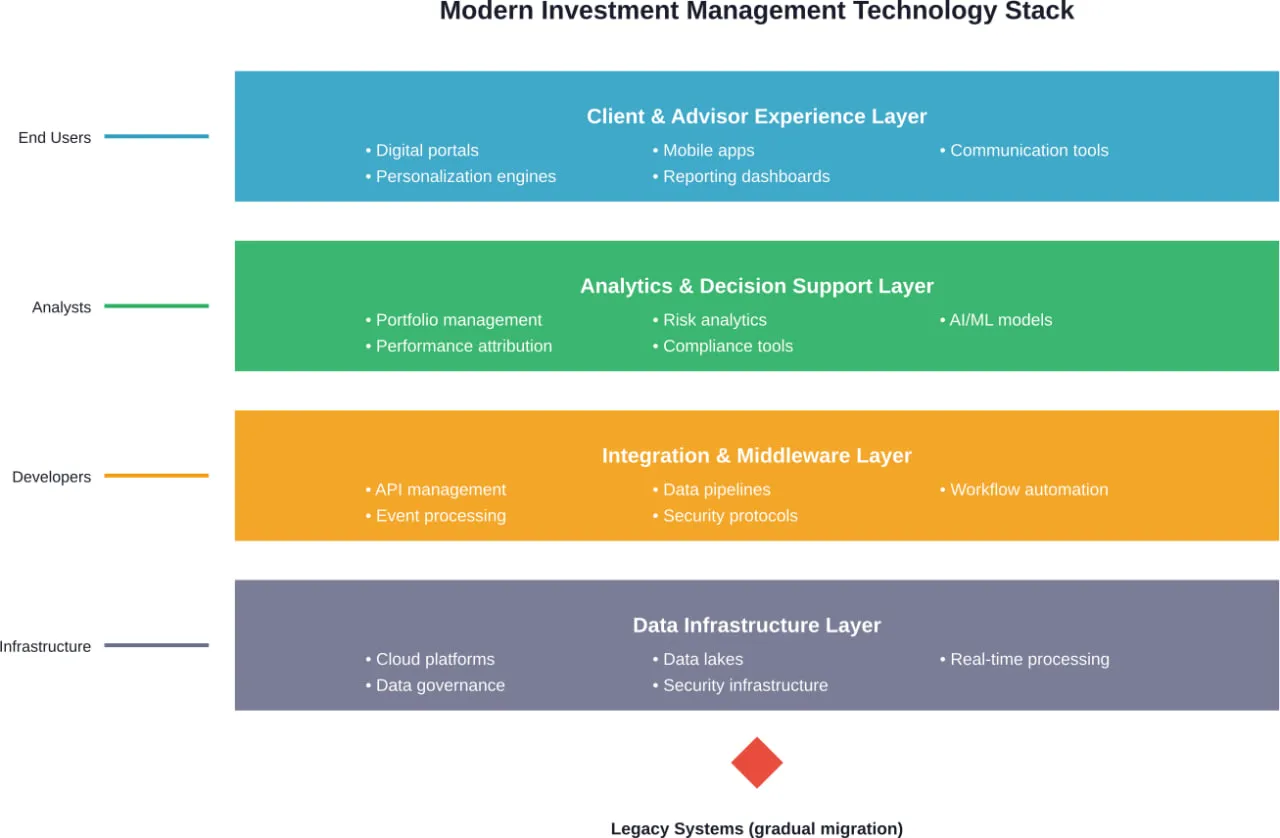
Сучасний стек технологій управління інвестиціями складається з декількох рівнів. В основі лежить інфраструктура даних - хмарні сховища, озера даних і можливості обробки в режимі реального часу.

Середній рівень складається з аналітики та інструментів підтримки прийняття рішень. Сюди входять системи управління портфелем, ризик-платформи та фреймворки AI/ML. Інтеграційне проміжне програмне забезпечення з'єднує ці системи та забезпечує потік даних.

Верхній рівень фокусується на досвіді клієнтів та консультантів. Тут живуть цифрові портали, мобільні додатки та інструменти комунікації. Кожен рівень повинен безперешкодно працювати з іншими.

Багаторівнева архітектура сучасної технологічної інфраструктури управління інвестиціями

Трансформація досвіду клієнтів та консультантів

Клієнти з управління капіталом очікують більше, ніж щоквартальні звіти. Вони хочуть бачити портфель в режимі реального часу, отримувати персоналізовану інформацію та безперешкодну комунікацію через різні канали. Щоб відповідати цим очікуванням, потрібно переосмислити весь клієнтський досвід.

Радники теж потребують трансформації. Вони потопають в адміністративних завданнях, з якими могли б впоратися технології. Дані знаходяться у розрізнених системах. Створення комплексного уявлення про клієнта вимагає ручної роботи.

Галузеві дискусії підкреслюють, що розширення можливостей радників з управління капіталом за допомогою даних є критично важливим фактором успіху. Коли радники мають потрібну інформацію в потрібний час, вони можуть зосередитися на тому, що вміють робити найкраще - будувати відносини та надавати стратегічні рекомендації.

Персоналізація в масштабі

Надати індивідуальний досвід тисячам клієнтів здається неможливим. Але це саме те, що дозволяють зробити цифрові інструменти. Механізми персоналізації аналізують вподобання, поведінку та цілі клієнта, щоб адаптувати комунікацію та рекомендації.

Йдеться не про масову кастомізацію з поверхневими налаштуваннями. Йдеться про справжнє розуміння індивідуальних потреб клієнта та надання відповідної цінності. Технологія існує - її впровадження вимагає ретельної стратегії та управління змінами.

Перешкоди? Проблеми з якістю даних, організаційна розрізненість та опір новим робочим процесам. Подолання цих викликів вимагає відданості керівництва та міжфункціональної співпраці.

Вирішення проблем організаційних змін та культури

Трансформація технологій зазнає невдачі, коли організації ігнорують людський фактор. Інвестиційні компанії мають глибоко вкорінену культуру, яка формувалася десятиліттями. Щоб змінити те, як люди працюють, потрібно більше, ніж нові ліцензії на програмне забезпечення.

Перехід від застарілих систем до сучасних платформ означає перенавчання персоналу, перепроектування процесів, а іноді й реструктуризацію команд. Це незручно. Деякі працівники чинять опір. Іншим не вистачає навичок для нових ролей.

Найуспішніші трансформації встановлюють надійні бар'єри, усуваючи "лежачих поліцейських". Вони створюють чіткі рамки управління для використання технологій. Вони інвестують значні кошти в навчання та підтримку. Вони постійно інформують про те, чому зміни мають значення.

Еволюція ролі в інвестиційному менеджменті

Робочі ролі швидко змінюються. Традиційні посади аналітиків тепер вимагають навичок роботи з даними. Радники повинні вільно володіти технологіями. Операційні команди повинні розумітися на автоматизації та проектуванні робочих процесів.

Згідно з дослідженням Інституту CFA щодо ШІ в інвестиційному менеджменті, виникають питання щодо постановки завдань і професійного розвитку. Яку роботу повинні виконувати люди? Де ШІ додає найбільшу цінність? Як реструктурувати команди, щоб ефективно використовувати обидві можливості?

Це не теоретичні питання. Це практичні виклики, з якими компанії стикаються щодня. Від того, наскільки правильні відповіді на них, залежить, чи будуть ініціативи з трансформації успішними, чи зайдуть у глухий кут.

Традиційна рольМожливості, що розвиваютьсяВплив технологій
Інвестиційний аналітикНаука про дані, валідація моделей штучного інтелекту, альтернативний аналіз данихРозширені дослідження, автоматизований збір даних
Портфельний менеджерАлгоритмічний нагляд за стратегією, моделювання сценаріїв, технологічна генерація альфа-версійІнсайти на основі штучного інтелекту, моніторинг ризиків у реальному часі
Фінансовий радникЦифрова взаємодія, вільне володіння технологічними платформами, інтерпретація данихАвтоматизовані завдання адміністратора, інструменти персоналізації
Операційний спеціалістАвтоматизація робочого процесу, обробка виключень, оптимізація процесівРоботизована автоматизація процесів, інтелектуальні робочі процеси
Відповідальний за комплаєнсВикористання RegTech, нагляд за штучним інтелектом, цифрові аудиторські слідиАвтоматизований моніторинг, предиктивне виявлення ризиків

Стратегічні підходи до реалізації

З чого варто починати? Відповідь залежить від поточних можливостей, конкурентного тиску та стратегічних пріоритетів. Але деякі закономірності випливають з успішних трансформацій.

По-перше, визначте можливості з високим впливом і низькою складністю. Швидкі перемоги створюють імпульс і демонструють цінність. Вони створюють прихильників для ширших ініціатив змін.

По-друге, інвестуйте в інфраструктуру даних, перш ніж переходити до аналітики. Погані дані дають погані висновки, незалежно від того, наскільки досконалою є модель штучного інтелекту. Управління даними, їхня якість і доступність повинні бути на першому місці.

По-третє, думайте про екосистеми, а не про точкові рішення. Сучасний інвестиційний менеджмент передбачає партнерство з фінтехами, постачальниками даних і постачальниками платформ. Інтеграційні можливості мають не менше значення, ніж окремі функції інструментів.

Будівництво проти купівлі

Чи повинні виробники створювати власні рішення для побудови портфеля? Чи повинні фірми розробляти власні моделі ШІ або ліцензувати існуючі платформи?

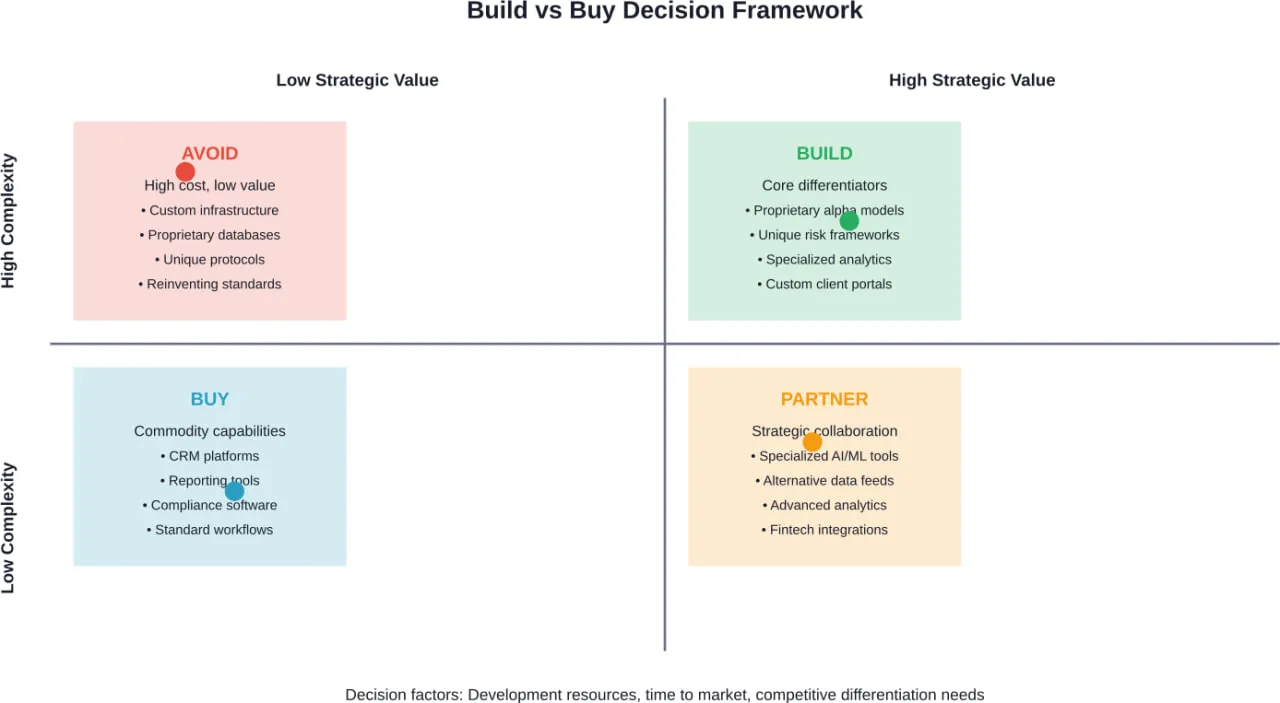
Універсальної відповіді не існує. Створення індивідуальних рішень пропонує диференціацію та контроль, але вимагає значних інвестицій і технічної експертизи. Купівля готових платформ забезпечує швидше впровадження та менші початкові витрати, але може обмежити можливості кастомізації.

Багато фірм застосовують гібридний підхід. Вони будують там, де конкурентна перевага вимагає унікальності. Вони купують товарні можливості, які не диференціюються. Вони співпрацюють з партнерами для отримання спеціалізованої експертизи

Стратегічні рамки для прийняття рішень "будувати чи купувати" в інвестиційних технологіях

Оптимізація цифрової інвестиційної стратегії

Інвестиції в технології самі по собі вимагають стратегічного мислення. Згідно з галузевим аналізом, ради директорів можуть допомогти компаніям отримати вищу віддачу від цифрової трансформації, звернувшись до таких ключових сфер, як інвестиційний мікс.

Занадто багато компаній розпорошують ресурси на численні ініціативи. Їм бракує чіткої системи пріоритетів. Вони неефективно вимірюють рентабельність інвестицій. Вони продовжують фінансувати проекти, які не приносять користі.

Оптимізація стратегії цифрових інвестицій означає безжальне визначення пріоритетів на основі впливу на бізнес. Це означає створення процесів, які вбивають неефективні ініціативи на ранніх стадіях. Це означає перехід від мислення, орієнтованого на проект, до мислення, орієнтованого на продукт.

Вимірювання успіху трансформації

Як виглядає успіх? Різні зацікавлені сторони мають різні відповіді. Керівники хочуть зростання доходів і скорочення витрат. Консультанти хочуть підвищити продуктивність. Клієнти хочуть кращого досвіду. Регулятори хочуть посилення контролю.

Ефективні системи вимірювання охоплюють багато аспектів. Фінансові показники мають значення - загальна вартість володіння, дохід на одного консультанта, витрати на залучення клієнтів. Операційні показники теж мають значення - час на залучення нових клієнтів, рівень помилок при обробці, рівень автоматизації.

Не забувайте про показники досвіду. Показники задоволеності клієнтів, індекси Net Promoter Score та рівень залучення консультантів вказують на те, чи дійсно зусилля з трансформації покращують результати для людей, яким вони покликані служити.

Регуляторна відповідність та управління ризиками

Інновації не можуть відбуватися за рахунок комплаєнсу. Інвестиційні компанії працюють в умовах жорсткого регулювання. Ініціативи з цифрової трансформації повинні враховувати регуляторні вимоги з самого початку, а не в останню чергу.

Моделі штучного інтелекту, що використовуються для прийняття інвестиційних рішень, потребують пояснення. Клієнтські дані потребують надійного захисту та конфіденційності. Автоматизовані процеси повинні зберігати аудиторські сліди. Алгоритмічна торгівля вимагає нагляду і контролю.

Рішення RegTech допомагають впоратися з цими викликами. Вони автоматизують робочі процеси, відстежують підозрілі дії та ведуть детальний облік. Але одних технологій недостатньо - важливими залишаються система управління та людський нагляд.

Баланс між інноваціями та контролем

Як компанії можуть рухатися швидко, зберігаючи при цьому належний контроль? Це протиріччя значною мірою визначає цифрову трансформацію в управлінні інвестиціями. Надмірний контроль стримує інновації. Недостатній - створює неприйнятні ризики.

Провідні фірми встановлюють чіткі межі, які визначають, що є прийнятним. Вони створюють пісочниці для експериментів. Вони впроваджують постійний моніторинг, а не щорічні аудити. Вони розвивають культуру, в якій люди відчувають себе уповноваженими впроваджувати інновації у визначених межах.

Встановлення надійних огороджень та усунення "лежачих поліцейських" є ключем до стійкої трансформації. Йдеться не про вибір між інноваціями та контролем, а про досягнення обох цілей одночасно.

Майбутні тенденції та нові технології

Що буде далі? Індустрія управління інвестиціями продовжує стрімко розвиватися. Кілька тенденцій заслуговують на увагу, коли компанії планують свої цифрові стратегії.

Відкритий банкінг та мобільність даних змінять спосіб взаємодії клієнтів з фінансовими установами. Децентралізовані фінансові технології можуть вплинути на традиційні інвестиційні структури. Квантові обчислення можуть зробити революцію в оптимізації портфелів і моделюванні ризиків.

Але ось перевірка реальності: і ринки, що розвиваються, і розвинені ринки показують, що фундаментальні проблеми залишаються незмінними. Технології змінюються, але основні потреби - довіра, продуктивність, якість послуг - залишаються незмінними.

Роль екосистемних партнерств

Жодна компанія не може створити всі можливості власними силами. Екосистемне мислення стає все більш важливим. Інвестиційні менеджери співпрацюють з фінтех-компаніями для створення спеціалізованих інструментів. Вони співпрацюють з постачальниками даних для отримання альтернативних наборів даних. Вони працюють з хмарними платформами для створення інфраструктури.

Згідно з дослідженням 2026 року, опублікованим у виданні California Management Review (UC Berkeley Haas School of Business), цифрова трансформація, орієнтована на взаємовідносини, дає змогу меншим фінансовим установам конкурувати завдяки стратегічним партнерствам. Масштаб не завжди виграє - розумна співпраця може вирівняти ігрове поле.

Цей перехід від вертикальної інтеграції до оркестрування екосистеми є фундаментальною зміною в структурі індустрії. Успіх вимагає нових навичок в управлінні партнерствами, мисленні платформи та стратегії API.

Основні висновки для лідерів інвестиційного менеджменту

Цифрова трансформація більше не є необов'язковою. Фірми, які зволікають, ризикують втратити свою актуальність у міру того, як змінюються очікування клієнтів та посилюється конкурентний тиск. Але поспішна трансформація без чіткої стратегії створює різні проблеми - даремно витрачені ресурси, провалені ініціативи та організаційні збої без відповідних переваг.

Почніть з бізнес-результатів, а не з технологічних особливостей. Визначте, як виглядає успіх для клієнтів, консультантів та фірми. Потім визначте можливості, необхідні для досягнення цих результатів. Вибір технології випливає зі стратегії, а не навпаки.

Інвестуйте в людей так само, як і в системи. Найкращі технології не можуть подолати організаційний опір або прогалини в навичках. Навчання, комунікація та управління змінами заслуговують на значну увагу та ресурси.

Думайте про платформи та екосистеми, а не про точкові рішення. Можливості інтеграції часто мають більше значення, ніж окремі набори функцій. Створіть технологічний стек, який може розвиватися зі зміною потреб і появою нових технологій.

Пам'ятайте, що ШІ доповнює, а не замінює людські судження. Згідно з висновками CFA Institute, найефективніші впровадження поєднують алгоритмічні можливості з людським досвідом. Визначте чіткі ролі для обох.

Ретельно вимірюйте та постійно повторюйте. Цифрова трансформація - це не одноразовий проєкт, а постійний процес. Створіть цикл зворотного зв'язку, який уможливить постійне вдосконалення на основі реальних даних про ефективність.

Поширені запитання

  1. Які найбільші виклики цифрової трансформації для інвестиційного менеджменту?

Серед основних викликів - застарілі технологічні системи, які не піддаються інтеграції, організаційний опір змінам, проблеми з якістю даних та управлінням, вимоги дотримання нормативних норм, а також прогалини у навичках існуючих команд. Згідно з галузевими звітами, досягнення наскрізної трансформації вимагає одночасного вирішення цих взаємопов'язаних викликів, а не розглядати їх як окремі проблеми. Культурні фактори часто виявляються складнішими, ніж технічні перешкоди.

  1. Як саме штучний інтелект змінює робочі процеси в управлінні інвестиціями?

Згідно з дослідженням Інституту CFA, штучний інтелект трансформує робочі процеси, доповнюючи їх, а не замінюючи. Серед конкретних застосувань - автоматизований збір дослідницьких даних, розпізнавання шаблонів в аналізі ринку, моделювання сценаріїв для оцінки ризиків, персоналізоване спілкування з клієнтами та моніторинг дотримання вимог законодавства. Однак у дослідженні підкреслюється, що прогалини в надійності та потреби в нагляді означають, що вплив штучного інтелекту буде більш вимірюваним, ніж передбачалося на початку ажіотажу. Людські судження залишаються критично важливими для прийняття стратегічних рішень.

  1. Чи повинні інвестиційні компанії створювати власні технології або купувати існуючі платформи?

Рішення залежить від стратегічної цінності та складності. Створюйте індивідуальні рішення для ключових диференціаторів, які створюють конкурентні переваги - запатентовані моделі альфа-генерації, унікальні системи управління ризиками або спеціалізовану аналітику. Купуйте товарні можливості, такі як CRM-платформи, стандартні інструменти звітності та програмне забезпечення для дотримання нормативних вимог. Розгляньте можливість партнерства у спеціалізованих сферах, таких як передові інструменти AI/ML або альтернативні канали передачі даних. Більшість успішних фірм застосовують гібридні підходи, які забезпечують баланс між потребами в кастомізації, швидкістю впровадження та ресурсними обмеженнями.

  1. Як менші інвестиційні компанії можуть конкурувати з великими установами у сфері цифрової трансформації?

Нещодавні наукові дослідження щодо цифрової трансформації, орієнтованої на взаємовідносини, демонструють, що масштаб автоматично не визначає успіх. Невеликі фірми можуть конкурувати завдяки стратегічним екосистемним партнерствам, цілеспрямованому розвитку потенціалу в конкретних нішах і використанню хмарних платформ, які демократизують доступ до технологій корпоративного рівня. Ключовим моментом є визначення конкретних клієнтських сегментів або сфер послуг, де цифрові можливості можуть створити диференційовану цінність, а не намагання зрівнятися з великими конкурентами за всіма параметрами.

  1. Яку роль повинні відігравати консультанти в управлінні капіталом в умовах цифрової трансформації?

Радники переходять від виконання адміністративних завдань до стратегічного управління відносинами та комплексного вирішення проблем. Технології беруть на себе рутинні процеси, такі як звітність, базові комунікації з клієнтами та агрегування даних. Це дозволяє консультантам зосередитися на розумінні нюансів клієнтських цілей, забезпеченні цілісного фінансового планування, орієнтуванні в складних ситуаціях та наданні емпатичних порад під час ринкової волатильності. Успішна трансформація надає консультантам кращі дані та інструменти, водночас посилюючи, а не зменшуючи елемент людських стосунків.

  1. Як компаніям вимірювати успіх цифрової трансформації?

Ефективні системи вимірювання включають фінансові показники, такі як зростання доходів, скорочення витрат і витрат на залучення клієнтів; операційні показники, такі як рівень автоматизації процесів, скорочення помилок і час виведення на ринок нових послуг; а також показники досвіду, включаючи показники задоволеності клієнтів, рівень залучення консультантів і індекс незадоволених клієнтів (Net Promoter Scores). Ключовим моментом є встановлення базових вимірювань до початку ініціатив трансформації та відстеження прогресу за багатьма вимірами, а не покладання на окремі показники, які можуть не відображати повного впливу.

  1. Які найважливіші аспекти комплаєнсу для цифрової трансформації?

Серед регуляторних пріоритетів - забезпечення зрозумілості інвестиційних рішень на основі ШІ, надійна безпека даних і захист конфіденційності, створення комплексних аудиторських звітів для автоматизованих процесів, впровадження належного нагляду за алгоритмічною торгівлею та документування механізмів ухвалення рішень. Інвестиційні компанії повинні з самого початку інтегрувати комплаєнс-вимоги в технологічний дизайн, а не ставитися до них як до обмежень, які потрібно обійти. Рішення RegTech можуть автоматизувати багато робочих процесів, пов'язаних з комплаєнсом, тоді як системи управління та людський нагляд залишаються важливими для ефективного управління ризиками.

Висновок

Цифрова трансформація в управлінні інвестиціями представляє як величезні можливості, так і значні виклики. Технологія існує для того, щоб забезпечити кращий клієнтський досвід, більш ефективні операції та покращити інвестиційну аналітику. Штучний інтелект, автоматизація та передова аналітика змінюють кожен аспект галузі.

Але самі по собі технології не гарантують успіху. Як показують дослідження Інституту CFA, перехід від надмірної активності до реалізму означає визнання того, що трансформація вимагає ретельного впровадження, надійного управління та постійного людського судження. Це вимагає організаційних змін, які можуть виявитися навіть складнішими, ніж технічна інтеграція.

Процвітатимуть ті фірми, які збалансують інновації з контролем, інвестуватимуть у людей, а не в системи, і зосереджуватимуться на бізнес-результатах, а не на технологіях заради них самих. Вони будуватимуть екосистеми, а не ізоляцію. Вони розширюватимуть людські можливості, а не намагатимуться масово їх замінити.

Майбутнє інвестиційного менеджменту - цифрове, але в основі його лежить людський фактор. Почніть планувати свій шлях до трансформації вже сьогодні, маючи чітку стратегію, реалістичні очікування та прихильність як до технологічної досконалості, так і до організаційних змін.

Digital Transformation for Dealerships: 2026 Guide

Короткий виклад: Digital transformation for dealerships means modernizing sales, service, and customer interactions through smart technology adoption. Success requires leadership buy-in, the right tools (DMS, CRM, AI), measurable goals, and team training. Dealerships that embrace digital strategies see higher lead conversion, faster service times, and better customer retention.

The automotive retail industry faces unprecedented pressure to modernize. Customer expectations have shifted dramatically, profit margins continue tightening, and traditional dealership models struggle to keep pace.

Digital transformation isn’t just about adding technology. It’s about fundamentally rethinking how dealerships operate, sell vehicles, and serve customers. The stakes are high—dealerships that fail to adapt risk losing ground to more agile competitors.

But here’s the thing: transformation done right creates measurable advantages. According to industry data, Renault automated video creation across its used inventory, generating over 34,000 views and 212 hours of watch time in one month and achieving a 20.5 percent increase in used vehicle enquiries and a 29.5 percent jump in engagement.

So what does successful digital transformation actually look like for dealerships?

Understanding What Digital Transformation Really Means

Digital transformation goes beyond installing new software. It’s a complete reimagining of dealership operations through technology.

For car dealerships, this means integrating systems that connect every customer touchpoint—from initial online research through purchase and ongoing service. Today’s customers navigate over 400 digital touchpoints during the car buying journey, moving rapidly between OEM websites, dealer platforms, and used car listings.

The shift requires dealerships to move from disconnected systems to unified digital ecosystems. This integration enables real-time data sharing, automated workflows, and seamless customer experiences across channels.

Accelerate Dealership Innovation with Dedicated Engineering Teams

Modernizing the car-buying experience requires seamless integration between inventory management systems, CRM platforms, and customer-facing digital showrooms. Finding the right technical talent to build and maintain these systems is often the primary bottleneck for automotive groups. A-Listware solves this by providing dedicated development teams and IT staff augmentation, allowing dealerships to deploy custom software solutions without the delays of traditional hiring.

  • Перевірений технічний талант: Access developers experienced in cloud architecture, mobile apps, and AI-driven analytics.
  • Оперативна ефективність: Reduce the high overhead and recruitment costs associated with in-house IT departments.
  • Flexible Scaling: Quickly expand your technical capacity for specific digital projects or long-term maintenance.
  • Seamless Integration: Dedicated specialists work as a direct extension of your business to modernize legacy software.

Почніть свою цифрову трансформацію з Програмне забезпечення A-List.

Essential Tools That Drive Transformation

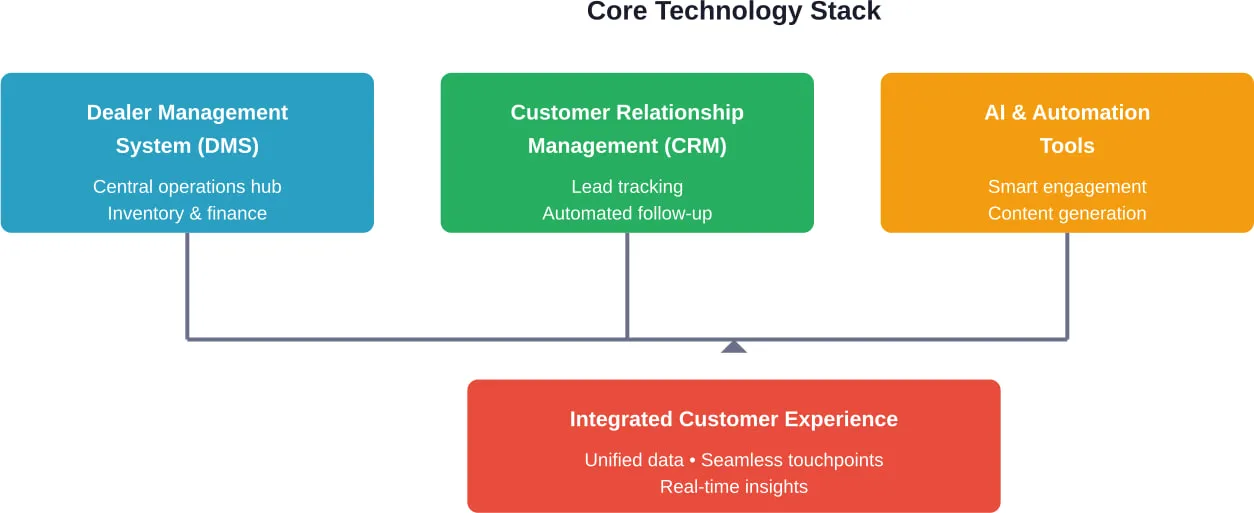
Successful digital transformation relies on selecting the right technology stack. Here are the core tools reshaping dealership operations:

Dealer Management Systems (DMS)

Modern DMS platforms serve as the central nervous system for dealership operations. These systems manage inventory, sales processes, service scheduling, and financial reporting in one unified platform.

The best DMS solutions integrate with other tools to eliminate data silos and manual entry errors. This connectivity allows information to flow seamlessly between departments.

Управління взаємовідносинами з клієнтами (CRM)

CRM systems track every customer interaction, from initial inquiry through repeat purchases. They enable personalized follow-up, automated communication, and data-driven sales strategies.

Advanced CRM platforms now incorporate AI to predict customer needs, optimize outreach timing, and prioritize high-value leads.

No-Code and Low-Code Development Tools

No-code applications revolutionize how automotive professionals conduct daily operations by making it simple to digitize previously manual processes. These tools allow dealerships to create custom digital workflows without extensive programming knowledge.

Website generators, form builders, and automation platforms empower staff to build solutions tailored to specific operational needs.

Essential technology components for dealership digital transformation

Creating a Roadmap for Implementation

Digital transformation requires strategic planning. Random tool adoption without clear direction leads to wasted resources and frustrated teams.

Securing Leadership Buy-In

Transformation initiatives fail without executive support. Leadership must champion the vision, allocate budget, and communicate why change matters.

Present the business case clearly: reduced operational costs, higher customer satisfaction scores, improved staff productivity, and competitive positioning. Frame digital transformation as essential for survival, not optional enhancement.

Setting Measurable Goals

Avoid digitizing for the sake of it. Establish concrete targets that tie technology adoption to business outcomes:

  • Reduce average service check-in time by 30%
  • Increase lead conversion by 15% in 6 months
  • Eliminate 90% of manual invoicing errors
  • Automate 100% of service follow-ups

Track performance regularly and adjust based on what actually delivers results. Data-driven decision making separates successful transformations from expensive failures.

Mapping the Customer Journey

Understanding how customers interact with the dealership reveals where digital tools create the most value. Map every touchpoint from awareness through purchase and service.

Identify friction points where customers experience delays, confusion, or frustration. These pain points represent prime opportunities for digital solutions to make immediate impact.

Journey StageTraditional Pain PointsDigital Solutions
ResearchLimited inventory visibilityReal-time online inventory with AI-generated videos
InquirySlow response timesAI chatbots for instant engagement
VisitManual paperworkDigital forms and eSignatures
PurchaseComplex financingOnline calculators and digital F&I
СервісUnclear schedulingOnline booking and status updates

Compliance and Data Security Requirements

Digital transformation comes with significant regulatory obligations. Dealerships handle sensitive customer information, making compliance non-negotiable.

The Gramm-Leach-Bliley Act requires financial institutions—including dealerships offering financing—to explain information-sharing practices and safeguard sensitive data. The FTC’s Safeguards Rule was amended in 2021 and further amended in 2023 to require covered entities to report certain data breaches and security incidents, with breach notification requirements taking effect on May 13, 2024.

According to the Federal Trade Commission, automobile dealers must implement comprehensive security programs including encryption, access controls, and regular security assessments. Non-compliance risks substantial penalties and reputational damage.

When selecting digital tools, verify that vendors meet current security standards and provide clear documentation of their compliance measures. Data breaches cost far more than investing in proper security upfront.

Preparing Teams for Change

Technology alone doesn’t transform dealerships—people do. Staff resistance represents one of the biggest obstacles to successful digital adoption.

Start preparing teams early. Communicate why changes are happening, how new tools will make their jobs easier, and what support will be available during transition.

Provide comprehensive training before rolling out new systems. Identify tech-savvy staff members who can serve as internal champions and peer support resources.

Real talk: some resistance is inevitable. Address concerns openly and demonstrate quick wins that prove the value of new approaches.

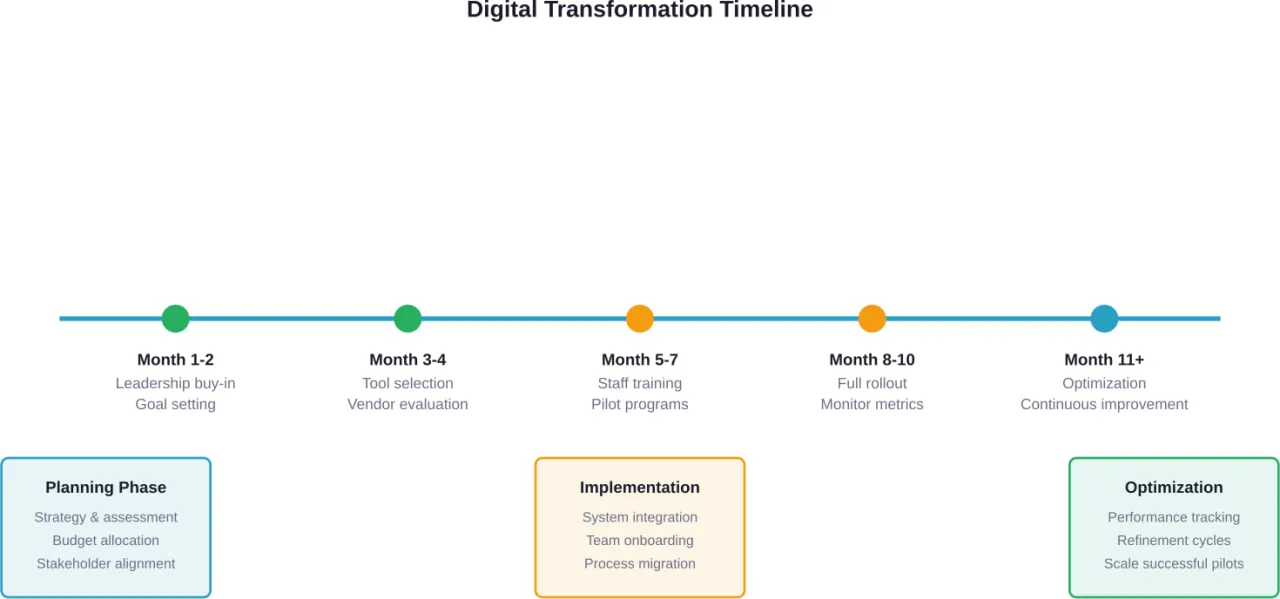
Typical implementation timeline for dealership digital transformation

Working With the Right Partners

No dealership can manage complex digital transformation alone. The right technology partners make the difference between success and costly failure.

Look for vendors with deep automotive industry experience. Generic business software rarely addresses the unique workflows and compliance requirements dealerships face.

Evaluate partners based on implementation support, training resources, integration capabilities, and long-term commitment to the automotive sector. Check references from other dealerships of similar size.

Поширені запитання

  1. How long does digital transformation take for dealerships?

Most dealerships require 6-12 months for initial implementation of core systems, with ongoing optimization continuing indefinitely. The timeline depends on dealership size, existing technology infrastructure, and scope of transformation.

  1. What’s the typical cost of digital transformation?

Investment varies widely based on dealership size and chosen solutions. Check with specific vendors for current pricing, as costs depend on user counts, feature requirements, and integration complexity.

  1. Do we need to replace all systems at once?

No. Phased implementation works better for most dealerships. Start with highest-impact areas like CRM or DMS, then expand to additional tools as teams adapt and demonstrate ROI.

  1. How do we handle staff resistance to new technology?

Involve staff early in the selection process, provide comprehensive training, identify internal champions, and demonstrate quick wins that make daily work easier. Communication about why changes matter reduces resistance.

  1. What compliance requirements apply to dealership digital tools?

Dealerships must comply with the Gramm-Leach-Bliley Act and FTC Safeguards Rule when handling customer financial information. This includes implementing encryption, access controls, and regular security assessments. Verify that technology vendors meet these requirements.

  1. Can small dealerships afford digital transformation?

Many digital tools now offer scalable pricing models suitable for dealerships of all sizes. No-code platforms and cloud-based solutions reduce upfront costs. Focus on high-impact areas first rather than attempting comprehensive transformation immediately.

  1. How do we measure ROI from digital transformation?

Track the specific metrics tied to your initial goals: lead conversion rates, service appointment efficiency, customer satisfaction scores, operational cost reductions, and revenue per employee. Compare performance before and after implementation.

Впевнено рухаємося вперед

Digital transformation represents both challenge and opportunity for automotive dealerships. The competitive landscape demands modernization, but success requires strategic planning rather than random technology adoption.

Start with clear goals tied to business outcomes. Secure leadership support and budget. Choose tools that integrate seamlessly and address real pain points in the customer journey.

Most importantly, invest in preparing teams for change. Technology amplifies human capability—it doesn’t replace it.

The dealerships that thrive through 2026 and beyond will be those that embrace digital transformation strategically, measure results rigorously, and adapt continuously based on data.

Ready to modernize operations and deliver better customer experiences? Start by assessing current processes, identifying the biggest friction points, and selecting one high-impact area for initial digital investment.

Digital Transformation for Municipalities: 2026 Guide

Короткий виклад: Digital transformation for municipalities involves the strategic integration of digital technologies into all areas of local government operations to improve service delivery, operational efficiency, and citizen engagement. This comprehensive shift goes beyond simple digitization of paper records to fundamentally reimagining how municipalities operate, make decisions, and serve their communities through tools like cloud computing, IoT sensors, AI-driven analytics, and automated workflows.

Municipal governments face unprecedented pressure to do more with less. Citizens expect seamless digital experiences that mirror what they get from private sector companies. Budget constraints tighten year after year. Meanwhile, infrastructure ages, workforces shrink, and urban challenges grow more complex.

Digital transformation offers municipalities a path forward. But what does that actually mean for local government?

Unlike private companies chasing competitive advantage, municipalities must balance efficiency gains with public trust, transparency, and equitable access. The stakes are different. The constraints are tighter. And the playbook needs serious adaptation.

This guide explores how municipalities can successfully navigate digital transformation—from foundational technologies to implementation strategies that work within the unique constraints of local government.

Understanding Digital Transformation in Municipal Context

Digital transformation in municipalities means fundamentally rethinking how local governments operate, deliver services, and interact with citizens using digital technologies. It’s not about buying software or scanning documents.

The distinction matters. Three related but different concepts often get confused:

Digitization vs. Digitalization vs. Digital Transformation

  • Digitization converts analog information into digital format. Scanning paper permits into PDFs? That’s digitization. It creates digital copies but doesn’t change how work gets done.
  • Digitalization uses digital technologies to change business processes. Online permit applications that route automatically to the right department? That’s digitalization. Processes become more efficient, but the fundamental operating model remains similar.
  • Цифрова трансформація leverages technology to fundamentally reimagine how an organization creates and delivers value. A municipality that uses real-time sensor data, predictive analytics, and automated workflows to shift from reactive to preventive infrastructure maintenance? That’s transformation. The entire approach to service delivery changes.

According to research from municipalities in the Eastern Cape, many local governments struggle because they lack standardized digital transformation principles. They jump to solutions without understanding this foundational distinction.

Why Municipalities Need a Different Approach

Private sector digital transformation frameworks don’t translate directly to municipal government. Several factors make local government transformation unique:

  • Public accountability requirements: Every decision faces scrutiny. Transparency isn’t optional. Technology choices must withstand public records requests and open meeting laws.
  • Equity imperatives: Municipal services must remain accessible to all residents regardless of digital literacy, internet access, or technical capabilities. Digital solutions can’t leave vulnerable populations behind.
  • Legacy system constraints: Decades-old systems often run critical functions. Replacement carries enormous risk. Integration becomes more important than wholesale replacement.
  • Budget cycles: Multi-year transformation initiatives must navigate annual budget processes. Funding certainty remains elusive even for obviously beneficial projects.
  • Workforce realities: According to ICMA workforce research, 46% of HR managers in the public sector anticipate the largest wave of retirements in coming years. Knowledge walks out the door while specialized digital skills remain scarce.

Accelerate Municipal Innovation with Expert Development Teams

Transitioning to a digital-first municipality requires more than just new software; it requires the right technical talent to integrate legacy systems with modern citizen-facing platforms. Many local governments struggle with recruitment delays and high overhead when trying to build internal IT departments. A-Listware solves this by providing specialized development teams and staff augmentation that scale with your specific digital transformation goals.

  • Expert Talent: Access to vetted developers experienced in AI, cloud infrastructure, and data analytics.
  • Cost Efficiency: Significant savings compared to traditional in-house hiring and long-term overhead.
  • Legacy Modernization: Specialized support for migrating outdated systems to secure, scalable architectures.
  • Flexible Scaling: Quickly expand or reduce your team based on project phases and budget availability.

Почніть свою цифрову трансформацію з Програмне забезпечення A-List.

The Strategic Drivers Behind Municipal Digital Transformation

What’s actually pushing municipalities toward digital transformation right now?

Rising Citizen Expectations

Residents increasingly expect friction-free, self-service interactions with their local government. In the private sector, people access websites or download apps for basic transactions, check service status, and get real-time updates. That expectation now extends to government services.

The gap between private sector digital experiences and government services has grown too wide. Citizens notice. They voice frustration. And they judge their local government accordingly.

Operational Efficiency Pressures

Local governments operate complex organizations delivering multiple services to residents. But inefficient processes waste staff time on manual tasks, paper shuffling, and redundant data entry.

Digital transformation offers municipalities ways to streamline operations, reduce administrative overhead, and reallocate staff to higher-value activities. When budgets stay flat or shrink, efficiency gains become essential for maintaining service levels.

Transparency and Accountability Demands

Citizens increasingly demand visibility into how their local government operates. Where do tax dollars go? How are decisions made? What’s the status of that pothole repair request?

Technology enables unprecedented transparency. Digital systems can automatically publish data, track performance metrics, and give residents real-time windows into government operations. This transparency helps citizens hold leaders accountable and reduces potential for corruption.

Cybersecurity Imperatives

Municipal governments store enormous amounts of sensitive citizen data and operate essential services. That makes them attractive targets for cybercrime—especially when they’re running outdated systems with inadequate security.

Modern digital infrastructure includes security as a foundational element rather than an afterthought. Cloud platforms, zero-trust architectures, and automated security monitoring significantly improve municipal cybersecurity postures.

Smart City Ambitions

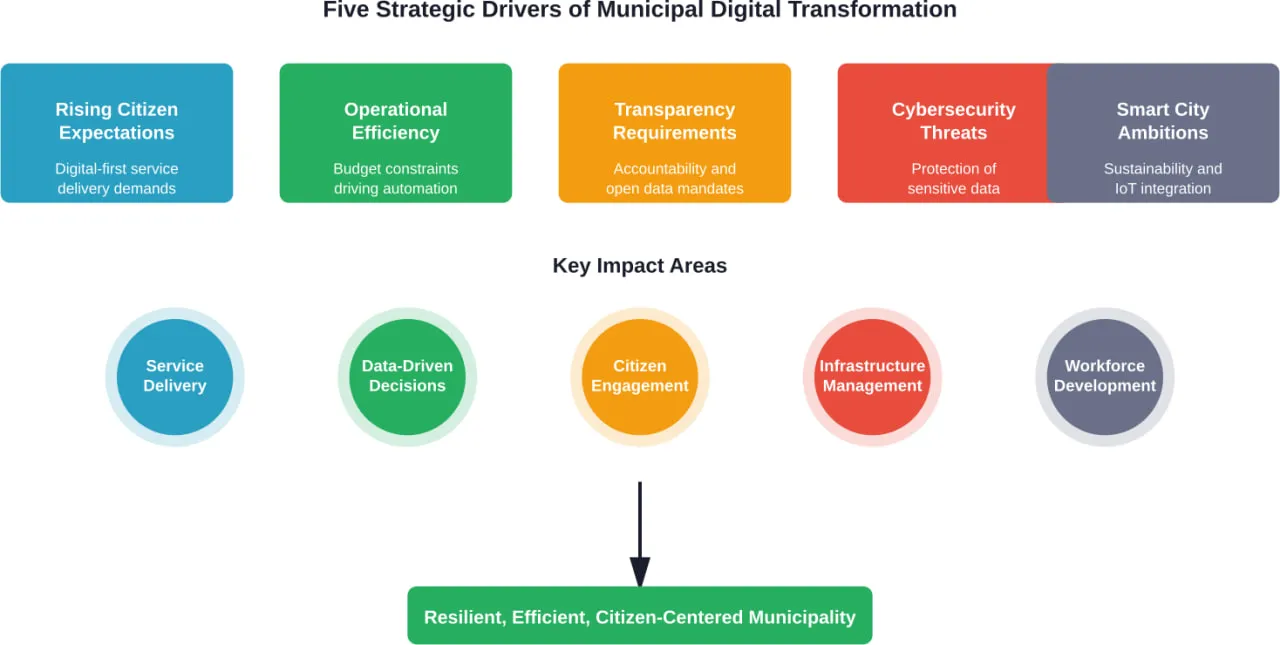
According to Sustainable Development Goal 11, smart cities strive to make urban areas more inclusive, safe, resilient, and sustainable. Digital technologies address urbanization concerns like rising energy use, pollution, waste disposal, and social inequities.

The Internet of Things and data-driven technologies have become essential drivers for smart municipalities. Sensors monitor everything from air quality to parking availability. Data analytics optimize service delivery. Integrated systems coordinate responses across departments.

As NIST research emphasizes, the measurement science and standards-based foundations for interoperable, replicable, scalable, and trustworthy cyber-physical systems enable cities and communities of all sizes to improve their efficiency and trustworthiness cost-effectively.

The five strategic drivers converge to transform service delivery, decision-making, engagement, infrastructure, and workforce capabilities in modern municipalities.

Core Technologies Enabling Municipal Digital Transformation

Several technology categories form the foundation for municipal digital transformation. Understanding each helps municipalities make informed investment decisions.

Cloud Computing Infrastructure

Cloud platforms provide scalable, secure infrastructure without requiring municipalities to build and maintain their own data centers. This shift from capital expenditure to operational expenditure makes technology more accessible for smaller municipalities with limited IT budgets.

Cloud infrastructure also enhances disaster recovery capabilities, improves system reliability, and enables remote work—a capability that proved essential during recent years.

Internet of Things (IoT) Sensors and Networks

IoT sensors collect real-time data from physical infrastructure. Smart streetlights adjust brightness based on activity. Water sensors detect leaks before they become expensive problems. Traffic monitors optimize signal timing to reduce congestion.

NIST research emphasizes that cyber-physical systems enabled by IoT require interoperable, replicable, scalable, and trustworthy foundations. Standards become critical as municipalities deploy thousands of connected devices across their infrastructure.

Аналітика даних та бізнес-аналітика

Municipalities generate enormous amounts of data. But raw data sitting in siloed systems creates no value. Analytics platforms transform that data into actionable insights.

Dashboards visualize trends. Predictive models forecast service demand. Pattern recognition identifies inefficiencies. This data-driven approach enables municipalities to shift from reactive to proactive management.

Workflow Automation Platforms

Workflow automation moves requests, documents, and approvals through processes without manual intervention. A building permit application routes automatically to the right reviewers, tracks completion, triggers notifications, and generates approvals—all without staff manually managing each step.

Beyond basic digitization, workflow automation fundamentally changes how municipalities deliver services. Staff focus on complex cases requiring judgment rather than shepherding routine requests through manual processes.

Штучний інтелект і машинне навчання

AI applications in municipal government continue expanding. Chatbots handle routine citizen inquiries. Machine learning models predict maintenance needs. Computer vision analyzes infrastructure conditions from drone footage.

However, according to research from the RAND Corporation, state and local governments are experimenting with AI but lack systematic approaches to scale these efforts effectively. Instead, efforts remain piecemeal and slow, leaving many practitioners struggling to keep up.

As RAND researchers note, the opportunity exists now to set standards for AI-enabled governance, but it requires proactive steps in policy development, funding, procurement, workforce development, and safeguards.

Citizen Engagement Platforms

Modern engagement platforms give residents convenient ways to interact with their local government. Mobile apps let citizens report issues, request services, and receive updates. Online portals provide self-service access to permits, payments, and records.

These platforms create two-way communication channels rather than one-way information broadcasts. Municipalities gather feedback, measure satisfaction, and respond to community needs more effectively.

Cybersecurity and Identity Management

As municipalities digitize operations and connect systems, cybersecurity becomes foundational rather than peripheral. Zero-trust architectures verify every access request. Multi-factor authentication protects sensitive systems. Automated monitoring detects threats in real time.

Identity management ensures the right people access the right systems with the right permissions—and provides audit trails demonstrating compliance with regulations.

Key Dimensions of Smart Municipality Transformation

Research on smart municipalities identifies four key dimensions where digital transformation creates the most impact:

Smart Governance

Digital technologies enable more transparent, participatory, and efficient governance. Online portals publish budget data, meeting minutes, and performance metrics. Digital platforms facilitate citizen input on policy decisions. Automated systems ensure consistent application of rules and regulations.

Smart governance also means better internal coordination. Integrated systems let departments share information seamlessly. Workflow automation eliminates redundant approvals. Data analytics inform strategic planning.

Smart Environment

Environmental monitoring and management benefit significantly from digital technologies. Sensor networks track air and water quality. Smart grids optimize energy distribution. Waste management systems use IoT to optimize collection routes and reduce fuel consumption.

According to research on smart cities and energy, municipalities can contribute substantially to addressing global energy challenges through digital transformation of infrastructure management.

Smart Living

Quality of life improvements stem from digital transformation across multiple municipal services. Smart transportation reduces congestion and improves mobility. Digital health services expand access to care. Connected emergency services respond faster and more effectively.

Public safety applications use predictive analytics to allocate resources more efficiently. Recreation departments offer online registration and facility booking. Libraries provide digital resources accessible from anywhere.

Smart Technology Integration

The technology dimension focuses on infrastructure that enables other smart capabilities. High-speed broadband reaches all residents. Secure networks connect municipal facilities. Data platforms integrate information from diverse sources.

Research from Stockholm’s broadband initiative shows that availability and adoption represent different challenges. While Stockholm’s broadband network reaches 100 percent of businesses and 90 percent of residences, significant gaps remain between who can access broadband and who actually does. Municipalities must address both infrastructure and adoption barriers.

Smart DimensionОсновний фокусКлючові технологіїCitizen Impact 
Smart GovernanceTransparent, efficient administrationCloud platforms, workflow automation, open data portalsBetter accountability, easier access to services
Smart EnvironmentSustainability and resource managementIoT sensors, smart grids, environmental monitoringCleaner air, efficient utilities, reduced waste
Smart LivingQuality of life improvementsMobile apps, connected services, digital health platformsImproved mobility, safety, and access to services
Smart TechnologyDigital infrastructure foundationBroadband networks, data integration, cybersecurity systemsUniversal access, secure services, integrated experience

Practical Benefits Municipalities Achieve Through Digital Transformation

What tangible outcomes can municipalities expect from successful digital transformation? Real-world implementations demonstrate several consistent benefit categories:

Operational Cost Reduction

Automated workflows eliminate manual processing time. Cloud infrastructure reduces IT maintenance costs. Digital communications replace printing and mailing expenses. Predictive maintenance prevents costly emergency repairs.

These savings accumulate across departments and compound over time. Staff hours freed from routine tasks get reallocated to higher-value activities.

Improved Service Speed and Quality

Digital transformation dramatically reduces processing times for common municipal services. Permit applications that once took weeks now complete in days. Service requests get routed instantly to appropriate departments. Citizens track their request status in real time rather than making phone calls.

Speed improvements also enhance quality. Automated systems apply rules consistently. Digital checklists reduce errors. Integration eliminates redundant data entry that introduces mistakes.

Enhanced Transparency and Trust

Open data portals and digital dashboards give citizens unprecedented visibility into municipal operations. Budget visualizations show where money goes. Performance metrics demonstrate service levels. Meeting recordings and transcripts remain permanently accessible.

This transparency builds trust. When citizens can see how decisions get made and verify that services meet standards, confidence in local government increases.

Better Resource Allocation

Data analytics reveal where municipalities over-invest or under-serve. Usage patterns inform facility planning. Demand forecasts improve staffing decisions. Performance metrics identify underperforming processes that need attention.

This evidence-based approach to resource allocation ensures municipalities maximize the impact of constrained budgets.

Increased Accessibility and Equity

Digital services can expand access when designed thoughtfully. Online portals let residents interact with their government outside traditional office hours. Mobile apps eliminate transportation barriers. Multilingual interfaces serve diverse populations.

However, digital transformation must address rather than widen the digital divide. Municipalities need parallel strategies for residents without internet access or digital literacy.

Environmental Sustainability Gains

Going paperless reduces environmental impact directly. But digital transformation enables broader sustainability improvements. Smart lighting reduces energy consumption. Optimized routes cut fleet fuel usage. Building automation lowers heating and cooling costs.

Sensor data helps municipalities track and achieve environmental goals through better measurement and management.

Workforce Development and Retention

Modern digital tools make municipal jobs more attractive to younger workers expecting technology-enabled workplaces. Automation of tedious tasks reduces burnout. Remote work capabilities improve work-life balance. Training on new technologies develops valuable skills.

Given that 46% of HR managers in the public sector anticipate significant retirement waves, municipalities that embrace digital transformation position themselves better to attract and retain talent.

Common Challenges Municipalities Face During Digital Transformation

Understanding obstacles helps municipalities plan realistic transformation strategies. Research across multiple municipalities identifies recurring challenges:

Інтеграція застарілих систем

Decades-old systems run critical functions but weren’t designed to integrate with modern platforms. Data exists in incompatible formats. APIs don’t exist. Vendors no longer support the software.

Wholesale replacement carries enormous risk and cost. Gradual migration requires careful planning and significant technical expertise that many municipalities lack in-house.

Budget Constraints and Funding Uncertainty

Digital transformation requires multi-year investment, but municipal budgets operate on annual cycles. Initial costs often exceed ongoing savings, creating challenging budget dynamics. Grant funding helps but introduces uncertainty and reporting burdens.

Federal programs like the State and Local Cybersecurity Grant Program offer potential, though current authorization expires September 30, 2026. State initiatives like Massachusetts’ FutureTech Act exemplifies direct state investment, with authorization mentioned for IT capital projects including AI.

Прогалини у навичках робочої сили

Municipal workforces often lack the technical skills needed to implement and manage digital transformation initiatives. Specialized skills remain scarce in public sector labor markets. Training existing staff takes time and resources.

The traditional model of recruiting externally and hiring full-time for long-term tenure faces strain. Retirements accelerate while specialized digital skills become harder to attract at government salary scales.

Організаційний опір змінам

Long-established processes and work cultures don’t change easily. Staff comfortable with existing systems resist new approaches. Department silos impede cross-functional integration. Leadership turnover disrupts transformation momentum.

Change management becomes as important as technology selection. Without addressing the human side of transformation, even well-designed technical solutions fail to achieve expected benefits.

Питання якості та інтеграції даних

Digital transformation depends on quality data, but municipal data often exists in siloed systems with inconsistent formats, definitions, and quality standards. Cleaning and integrating this data requires significant effort before analytics and automation can deliver value.

Ризики кібербезпеки

Digital transformation expands attack surfaces. More connected systems create more vulnerabilities. Cloud migration raises data sovereignty questions. IoT devices introduce new security challenges.

Municipalities must invest in cybersecurity alongside digital transformation rather than treating it as an afterthought. The sensitive data municipalities hold and the essential services they provide make them attractive targets.

Regulatory and Compliance Complexity

Municipal governments operate under complex regulatory requirements that complicate digital transformation. Data retention rules, public records laws, accessibility standards, and procurement regulations all constrain technology choices.

Solutions that work in the private sector may not comply with public sector requirements. Municipalities need careful legal review of digital initiatives.

Vendor Lock-In Concerns

Committing to proprietary platforms creates dependency on specific vendors. If that vendor raises prices, discontinues products, or fails to innovate, municipalities have limited recourse. Migration to alternative solutions becomes prohibitively expensive.

Open standards and interoperability principles help mitigate this risk but may limit feature availability or increase complexity.

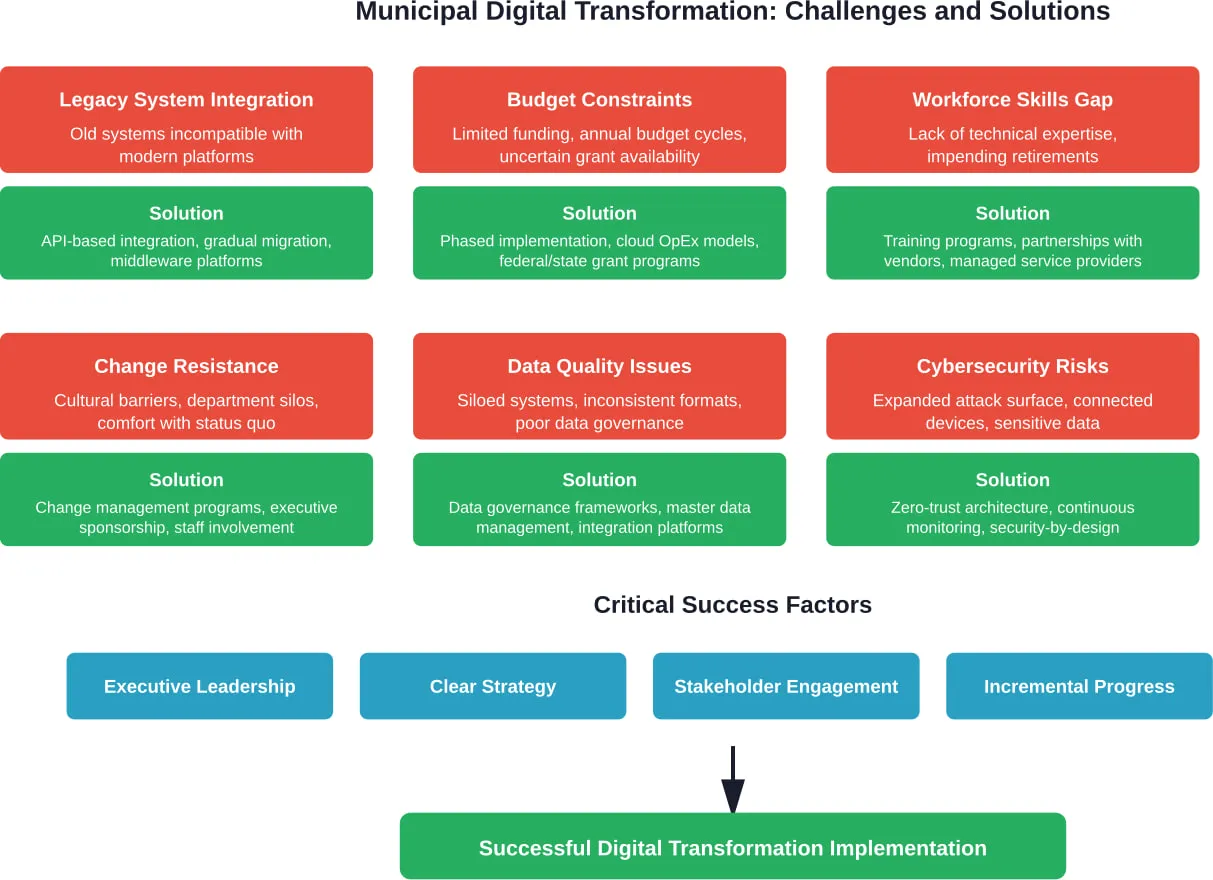
Common challenges in municipal digital transformation require specific solutions and depend on critical success factors including executive leadership, clear strategy, stakeholder engagement, and incremental progress.

Strategic Approaches to Municipal Digital Transformation

How should municipalities actually approach digital transformation? Research and practitioner experience point to several effective strategic frameworks:

The Micro-Transformation Framework

According to research presented at ICEGOV 2025, existing digital government models often assume levels of capacity, stability, and institutional readiness that many public administrations lack. The Micro-Transformation Framework responds to this gap by emphasizing sequenced, incremental changes.

Rather than attempting comprehensive transformation all at once, municipalities implement small, manageable changes that build capacity over time. Each micro-transformation delivers tangible value while developing organizational capabilities needed for more ambitious initiatives.

This approach proves particularly valuable for smaller municipalities or those with limited technical capacity. Success builds momentum and develops internal champions who drive further transformation.

Citizen-Centered Design Principles

Digital transformation should start from citizen needs rather than internal processes. What problems do residents actually face when interacting with their municipality? Where does friction occur? What outcomes matter most?

A growing number of scholars and practitioners recognize that value gets defined and co-created by citizens. Citizens must be involved in the service delivery process to improve the quality and efficacy of public services.

This service-oriented logic flips traditional government thinking. Instead of digitizing existing processes, municipalities redesign services around citizen journeys and desired outcomes.

Platform-Based Architecture

Rather than implementing disconnected point solutions, successful municipalities build on integrated platforms that share common infrastructure, data, and capabilities.

Platform approaches reduce redundancy, improve interoperability, and accelerate implementation of new services. Citizen identity management, payment processing, document management, and workflow orchestration become shared services that multiple departments leverage.

Agile, Iterative Implementation

Traditional waterfall project management—spending years planning before implementation begins—doesn’t work well for digital transformation. Requirements change. Technologies evolve. Organizational priorities shift.

Agile approaches deliver working functionality quickly, gather feedback, and iterate. Minimum viable products get deployed to real users who provide input shaping subsequent development. This reduces risk and ensures solutions actually meet needs.

Public-Private Partnerships

Many municipalities lack the internal capacity to drive digital transformation alone. Strategic partnerships with private sector technology providers, academic institutions, and non-profit organizations can accelerate progress.

These partnerships work best when they build municipal capacity rather than creating permanent dependency. Municipalities should retain control of core systems and data while leveraging external expertise for implementation and specialized capabilities.

Regional Collaboration and Shared Services

Smaller municipalities can achieve digital transformation more cost-effectively through regional cooperation. Shared platforms serve multiple jurisdictions. Common procurement reduces costs. Pooled technical staff provide expertise no single municipality could afford.

Regional approaches work particularly well for specialized capabilities like cybersecurity monitoring, advanced analytics, or emerging technologies like AI where single municipalities lack scale to justify investment.

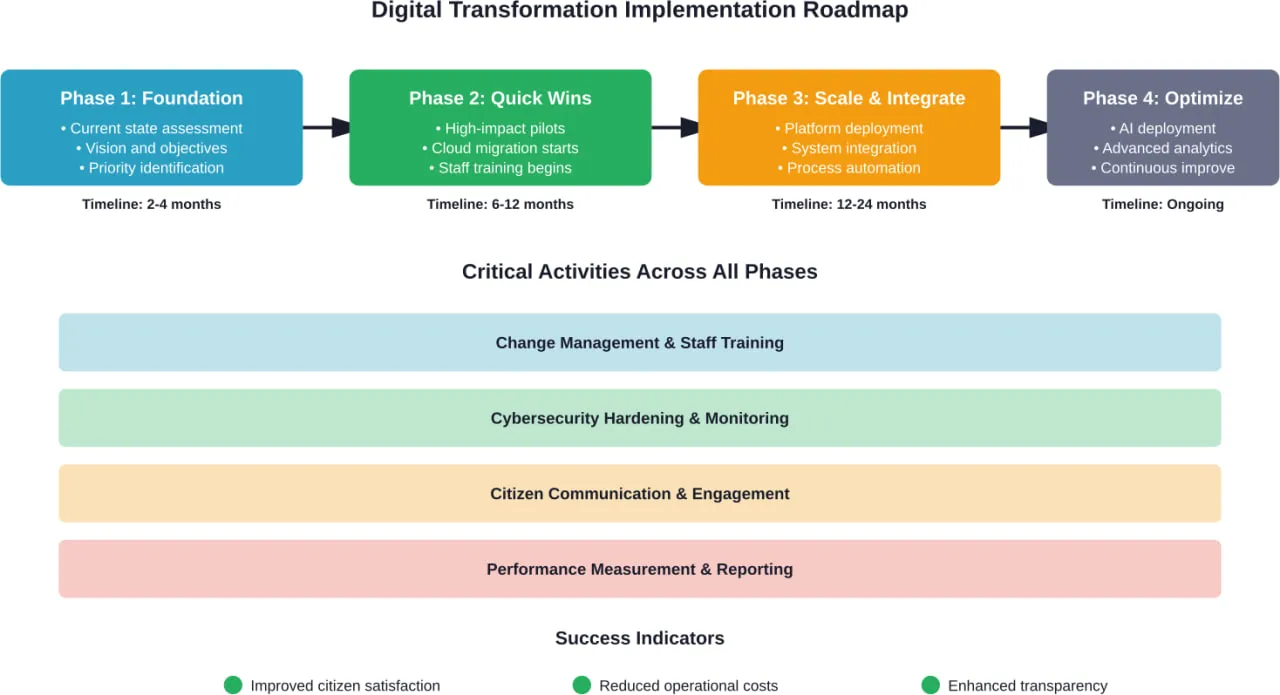
Building a Digital Transformation Roadmap

Successful digital transformation requires systematic planning. A well-designed roadmap provides direction while maintaining flexibility as circumstances change.

Крок 1: Оцініть поточний стан

Where does the municipality currently stand in its digital maturity? What systems exist? What capabilities do they provide? Where are the gaps?

This assessment should cover technology infrastructure, workforce skills, organizational culture, budget availability, and citizen expectations. Honest evaluation of current state grounds realistic planning.

Step 2: Define Vision and Objectives

What should digital transformation achieve for this specific municipality? Goals need to be concrete and measurable rather than generic aspirations.

Objectives might include: reduce permit processing time by 50%, achieve 80% citizen satisfaction with online services, decrease operational costs by 20%, or eliminate paper from three high-volume processes.

Vision should connect to broader municipal strategic priorities rather than treating digital transformation as purely a technology initiative.

Step 3: Identify Priority Use Cases

Which specific services or processes should transform first? Prioritization criteria typically include:

  • Citizen impact—high-volume services affecting many residents
  • Feasibility—achievable within available resources and constraints
  • Value—significant benefit relative to effort required
  • Strategic alignment—supports broader organizational objectives
  • Learning value—builds capabilities needed for subsequent initiatives

Early wins build momentum and demonstrate value to skeptics. But priorities should also include foundational investments that enable future capabilities even if they lack immediate visibility.

Step 4: Develop Implementation Plan

The roadmap should sequence initiatives across a multi-year timeline. Dependencies matter—some projects must complete before others can begin. Resource constraints limit how many initiatives can proceed simultaneously.

Plans should identify required funding, staffing, vendor support, training needs, and change management activities for each initiative. Realistic timelines account for procurement processes, budget cycles, and learning curves.

Step 5: Establish Governance Structure

Who makes decisions about digital transformation? How are priorities set and adjusted? How do departments coordinate? What approval processes apply?

Effective governance balances central coordination with departmental autonomy. Executive leadership provides strategic direction and resolves conflicts. Cross-functional teams manage implementation. Clear decision rights prevent paralysis.

Step 6: Implement, Measure, and Adapt

Execute the roadmap with regular progress reviews. Track metrics demonstrating whether initiatives achieve intended outcomes. Gather feedback from staff and citizens.

The roadmap isn’t a static document. As municipalities learn what works, as technology evolves, and as priorities shift, the plan should adapt. Flexibility matters more than rigid adherence to initial plans.

Change Management: The Human Side of Digital Transformation

Technology implementation represents only half the digital transformation challenge. The human dimension often determines success or failure.

Securing Executive Leadership Support

Digital transformation needs visible, active support from municipal leadership—city managers, mayors, department heads. Without executive sponsorship, initiatives stall when they encounter resistance or resource competition.

Leaders must communicate why transformation matters, what the municipality hopes to achieve, and how it aligns with community priorities. They need to model adoption of new technologies and processes.

Engaging Employees Early and Often

Staff who will use new systems daily should participate in design and implementation decisions. Their process knowledge proves invaluable. Their buy-in determines adoption success.

Change imposed from above without staff input generates resistance. Collaborative approaches that involve employees create advocates who help drive transformation forward.

Addressing Concerns Transparently

Digital transformation raises legitimate concerns about job security, skill requirements, and work changes. Acknowledging and addressing these concerns builds trust.

Will automation eliminate jobs? How will roles change? What training will be provided? What happens if someone can’t learn new systems? Clear, honest answers matter more than unrealistic reassurances.

Providing Adequate Training and Support

New technologies require new skills. Training can’t be an afterthought. Comprehensive onboarding, ongoing support, and opportunities to practice before go-live increase confidence and capability.

Different people learn differently. Some prefer hands-on practice. Others want reference documentation. Video tutorials help visual learners. Multiple training modalities reach more staff effectively.

Celebrating Wins and Learning from Setbacks

Recognition of successful implementations motivates continued effort. Highlighting staff who effectively adopt new approaches creates role models. Sharing positive citizen feedback demonstrates impact.

Setbacks inevitably occur. How the organization responds determines whether teams take appropriate risks or become paralyzed by fear of failure. Treating problems as learning opportunities rather than occasions for blame maintains momentum.

Specific Application Areas Delivering High Impact

While comprehensive transformation affects all municipal operations, certain application areas consistently deliver significant value:

Permitting and Licensing

Permit processes involve multiple reviews, complex rules, and coordination across departments. Digital transformation of permitting typically includes:

  • Online application portals replacing paper forms
  • Automated routing to appropriate reviewers
  • Digital plan review replacing physical document markup
  • Real-time status tracking visible to applicants
  • Electronic payments and fee calculation
  • Automated notifications at key process milestones

These improvements dramatically reduce processing times, improve applicant experience, and free staff from routine administrative tasks to focus on complex reviews requiring judgment.

Citizen Service Requests

Mobile apps and web portals let residents report potholes, request services, and track resolution. Digital service request systems provide:

  • GPS-tagged submissions with photos
  • Automatic routing to responsible departments
  • Work order generation and assignment
  • Status updates to requestors
  • Analytics identifying problem patterns and response performance

Beyond improving individual request handling, aggregated data reveals systemic issues and helps prioritize preventive maintenance.

Financial Management and Transparency

Cloud-based financial systems integrate budgeting, accounting, procurement, and reporting. Open data portals publish budget information and spending in accessible formats. Citizens can see where tax dollars go and how spending compares to plans.

Digital procurement platforms increase competition, reduce processing time, and create audit trails that enhance accountability.

Infrastructure Asset Management

IoT sensors monitor infrastructure condition continuously. Predictive analytics forecast maintenance needs before failures occur. Digital twins—virtual replicas of physical assets—enable scenario modeling.

Asset management systems track maintenance history, calculate lifecycle costs, and optimize replacement timing. This data-driven approach prevents expensive emergency repairs and extends infrastructure lifespan.

Emergency Services and Public Safety

Computer-aided dispatch systems optimize emergency response. Mobile data terminals give first responders real-time information. Integrated systems coordinate across police, fire, and emergency medical services.

Predictive analytics help allocate resources based on anticipated demand patterns. Community alert systems rapidly disseminate critical information during emergencies.

Parks and Recreation

Online registration replaces paper forms and in-person signups. Digital facility booking shows real-time availability. Mobile apps provide trail maps and park information. Automated payment processing eliminates manual fee collection.

These improvements expand access—residents can register outside office hours—while reducing administrative workload.

Code Enforcement

Mobile apps let inspectors access property histories, file reports, and upload photos from the field. Workflow systems track cases from initial complaint through resolution. Analytics identify chronic violators and problem properties.

Digital systems ensure consistent application of codes and create comprehensive records supporting enforcement actions.

Application AreaKey Digital CapabilitiesPrimary BenefitsСкладність реалізації 
Permitting & LicensingOnline portals, automated workflows, digital plan reviewFaster processing, improved applicant experienceHigh (complex integrations)
Service RequestsMobile apps, GPS tagging, automated routingBetter response tracking, data-driven improvementsMedium (requires mobile development)
Фінансовий менеджментCloud ERP, open data portals, e-procurementEnhanced transparency, streamlined processesHigh (mission-critical systems)
Управління активамиIoT sensors, predictive analytics, digital twinsPreventive maintenance, extended asset lifeHigh (sensor deployment, data integration)
Emergency ServicesCAD systems, mobile terminals, predictive deploymentFaster response, better coordinationVery High (24/7 reliability requirement)
Parks & RecreationOnline registration, facility booking, mobile appsExpanded access, reduced admin burdenLow to Medium (well-defined processes)

Вимірювання успіху цифрової трансформації

How do municipalities know if digital transformation initiatives are working? Clear metrics matter:

Service Delivery Metrics

  • Processing time for common transactions
  • First-contact resolution rates
  • Service completion rates
  • Channel shift (online vs. in-person transactions)
  • Service availability (uptime/reliability)

Citizen Experience Metrics

  • Satisfaction scores for digital services
  • Net Promoter Score
  • Digital service adoption rates
  • Complaint volume and resolution
  • Citizen engagement levels

Показники операційної ефективності

  • Staff time per transaction
  • Cost per service delivered
  • Process automation percentage
  • Error/rework rates
  • Paper consumption reduction

Financial Metrics

  • Return on investment for initiatives
  • Operating cost trends
  • Revenue collection improvements
  • Avoided costs from preventive maintenance

Workforce Metrics

  • Employee satisfaction with digital tools
  • Digital skill development
  • Staff retention rates
  • Time spent on high-value vs. routine tasks

Baseline measurements before transformation enable comparison showing actual impact. Regular tracking reveals whether initiatives deliver expected benefits and where adjustments are needed.

The Role of AI in Municipal Digital Transformation

Artificial intelligence represents both significant opportunity and considerable challenge for municipalities. Understanding realistic applications helps set appropriate expectations.

Current AI Applications in Local Government

Several AI applications have matured enough for municipal deployment:

  • Chatbots and virtual assistants handle routine citizen inquiries, provide service information, and direct complex questions to appropriate staff. These systems operate 24/7 and respond instantly.
  • Predictive maintenance models analyze sensor data and historical patterns to forecast when infrastructure components will likely fail, enabling proactive intervention.
  • Computer vision applications analyze images for code enforcement, infrastructure inspection, and traffic monitoring. Automated review identifies issues requiring human attention.
  • Natural language processing extracts information from unstructured documents, categorizes service requests, and analyzes citizen feedback for sentiment and themes.
  • Optimization algorithms improve routing for municipal fleets, facility scheduling, and resource allocation based on complex constraints and objectives.

AI Implementation Challenges

Despite promise, municipalities face significant obstacles scaling AI adoption:

As RAND research notes, state and local governments are experimenting with AI but lack systematic approaches to scale these efforts effectively. Current efforts remain piecemeal and slow.

Key challenges include:

  • Data quality and availability requirements
  • Explainability and transparency needs for public sector decisions
  • Bias and fairness concerns in algorithmic systems
  • Staff skills gaps in AI development and management
  • Vendor evaluation and procurement complexity
  • Policy and governance framework gaps

According to ICMA research, artificial intelligence is advancing across agencies faster than policies can be written. This creates tension between innovation and appropriate safeguards.

Responsible AI Principles for Municipalities

Municipalities deploying AI need clear principles ensuring responsible use:

  • Transparency: Citizens should know when AI systems inform decisions affecting them and understand how those systems work.
  • Fairness: AI systems must not discriminate based on protected characteristics. Regular audits should test for bias.
  • Accountability: Human decision-makers remain responsible for outcomes even when AI systems provide recommendations.
  • Privacy: AI training and deployment must protect personal information and comply with data protection regulations.
  • Security: AI systems require robust protection against manipulation and adversarial attacks.

Regional Considerations: Digital Transformation in Smaller Municipalities

Digital transformation strategies must account for significant variations in municipal capacity, resources, and contexts.

Challenges Facing Smaller Municipalities

Communities under 50,000 population—the vast majority of US municipalities—face distinct challenges:

  • Limited IT staff or no dedicated technology personnel
  • Smaller budgets making major platform investments difficult
  • Less vendor attention and fewer reference implementations
  • Difficulty attracting specialized technical talent
  • Lower digital literacy among some resident populations

Research on digital transformation in developing nations’ municipalities shows that lack of standardized principles presents particular problems for transitioning municipalities into data-driven organizations.

Strategies for Resource-Constrained Municipalities

Smaller municipalities can pursue digital transformation through adapted strategies:

  • Regional shared services: Multiple municipalities jointly procure and operate common platforms, sharing costs and technical expertise.
  • State-provided platforms: Some states offer digital government platforms that municipalities can adopt rather than building their own.
  • Cloud-first approaches: Software-as-a-service eliminates infrastructure investment and shifts costs from capital to operating budgets.
  • Incremental implementation: The micro-transformation framework particularly suits smaller municipalities, delivering value through manageable steps.
  • Managed service providers: Outsourcing technical operations lets municipalities access expertise they can’t afford to employ directly.
  • Peer learning networks: Organizations like ICMA facilitate knowledge sharing, helping municipalities learn from each other’s experiences.

Cybersecurity Considerations in Municipal Digital Transformation

Digital transformation expands cybersecurity exposure. Municipalities must address security proactively rather than reactively.

Common Threat Vectors

Municipalities face several cybersecurity threats:

  • Атаки з використанням програм-вимагачів encrypt municipal data and systems, demanding payment for restoration. These attacks can paralyze operations for weeks.
  • Data breaches expose sensitive citizen information, creating privacy violations and liability.
  • Distributed denial of service attacks overwhelm systems, making services unavailable to citizens.
  • Insider threats from employees accidentally or maliciously compromising security.
  • Supply chain compromises where vendors or their software introduce vulnerabilities.

Security-by-Design Principles

Effective cybersecurity gets built into digital transformation rather than added afterward:

  • Zero-trust architecture: Verify every access request regardless of source. Never assume network location implies trustworthiness.
  • Defense in depth: Multiple security layers ensure that single-point failures don’t compromise entire systems.
  • Least privilege access: Grant users and systems only the minimum permissions required for their functions.
  • Continuous monitoring: Automated systems detect anomalous behavior and potential threats in real time.
  • Regular security audits: Independent assessment identifies vulnerabilities before attackers exploit them.
  • Incident response planning: Clear procedures enable rapid, effective responses when breaches occur.

Cybersecurity Funding and Support

Federal programs recognize municipal cybersecurity needs. The State and Local Cybersecurity Grant Program provides funding support, though current authorization expires September 30, 2026.

Municipalities should pursue available grants while building cybersecurity into regular IT budgets rather than treating it as optional or one-time expense.

A phased implementation roadmap sequences digital transformation initiatives from foundational work through quick wins, scaled integration, and ongoing optimization while maintaining critical cross-cutting activities throughout.

Looking Ahead: Future Trends in Municipal Digital Transformation

Several emerging trends will shape municipal digital transformation in coming years:

Increased AI Adoption

As AI technologies mature and municipalities develop governance frameworks, adoption will accelerate. More sophisticated applications will move from experimentation to production deployment.

However, scaling requires addressing current gaps in policy development, funding mechanisms, procurement processes, workforce capabilities, and safeguards.

5G and Enhanced Connectivity

Fifth-generation wireless networks enable new applications requiring high bandwidth and low latency. Real-time video analytics, autonomous vehicles, and dense IoT sensor networks become more feasible.

Municipalities will need to balance benefits against infrastructure investment requirements and ensure equitable access across communities.

Digital Twins for Urban Planning

Virtual replicas of cities enable scenario modeling before making physical changes. Planners can test traffic patterns, simulate development impacts, and optimize infrastructure investments in digital space first.

These capabilities require substantial data integration and computational resources but promise improved decision-making for major investments.

Blockchain for Trust and Transparency

Distributed ledger technologies offer tamper-proof records for land titles, permits, licenses, and contracts. Smart contracts automate enforcement of agreed-upon terms.

Real-world municipal blockchain adoption remains limited, but pilot programs continue exploring applications where cryptographic verification adds value.

Граничні обчислення для обробки в реальному часі

Processing data at the network edge—near where it’s generated—reduces latency and bandwidth requirements. Traffic systems, emergency response, and infrastructure monitoring benefit from immediate analysis rather than cloud round-trips.

Edge architectures add complexity but enable applications where split-second decisions matter.

Greater Regional Collaboration

Shared platforms and services will expand as municipalities recognize economies of scale. Regional approaches become more common for specialized capabilities and expensive infrastructure.

This trend particularly benefits smaller municipalities accessing capabilities they couldn’t justify individually.

Поширені запитання

  1. What’s the difference between digitization and digital transformation in local government?

Digitization simply converts analog information to digital format—like scanning paper documents into PDFs. Digital transformation fundamentally reimagines how municipalities operate and deliver services using digital technologies. It changes processes, workflows, and organizational culture rather than just creating digital copies of existing paper-based systems.

  1. How long does municipal digital transformation typically take?

Digital transformation is an ongoing journey rather than a project with a fixed endpoint. Initial quick wins can occur within 6-12 months. Foundational platform implementations typically require 12-24 months. Comprehensive transformation spanning multiple departments and systems evolves over 3-5 years. The timing depends heavily on scope, available resources, organizational complexity, and existing technology baseline.

  1. What budget should municipalities allocate for digital transformation?

Budget requirements vary dramatically based on municipality size, current technology state, and transformation ambitions. Generally speaking, municipalities should expect to invest 3-5% of operating budgets in technology, with digital transformation initiatives requiring additional investment during implementation years. Cloud-based software-as-a-service models shift spending from large capital investments to ongoing operational expenses, making transformation more accessible for budget-constrained municipalities.

  1. How can small municipalities with limited IT staff pursue digital transformation?

Smaller municipalities can successfully transform through several strategies: participating in regional shared service arrangements, adopting cloud platforms that eliminate infrastructure management, leveraging state-provided digital government services, using managed service providers for technical operations, following micro-transformation frameworks that implement changes incrementally, and joining peer learning networks to benefit from other municipalities’ experiences. These approaches make digital transformation feasible without large internal IT departments.

  1. What security risks does digital transformation create for municipalities?

Digital transformation expands cybersecurity exposure through increased connectivity, cloud data storage, IoT device proliferation, and integrated systems. Key threats include ransomware attacks that encrypt critical systems, data breaches exposing citizen information, denial-of-service attacks disrupting services, insider threats from employees, and supply chain compromises through vendors. Municipalities must implement zero-trust security architectures, continuous monitoring, regular audits, and incident response planning alongside transformation initiatives.

  1. How do municipalities ensure digital equity while pursuing transformation?

Digital equity requires intentional strategies alongside digital transformation. Municipalities should maintain alternative channels for residents without internet access or digital skills, provide public access points with internet and assistance, design services for accessibility by people with disabilities, offer multilingual interfaces serving diverse populations, conduct digital literacy training programs, and partner with community organizations reaching underserved populations. Digital services should expand rather than limit access to government.

  1. What role should citizens play in municipal digital transformation?

Citizen involvement proves critical for successful transformation. Residents should participate in needs assessment identifying service friction points, user testing of digital interfaces before launch, feedback collection after implementation, co-creation of service designs, and oversight ensuring transparency and accountability. This citizen-centered approach ensures digital transformation actually addresses real needs rather than implementing technology for technology’s sake.

Conclusion: Taking the First Steps Toward Transformation

Digital transformation offers municipalities substantial opportunities to improve service delivery, increase operational efficiency, enhance transparency, and better serve their communities. But the path forward requires realistic planning, sustained commitment, and careful attention to both technology and human factors.

Successful transformation doesn’t require being first or most ambitious. It requires understanding where your municipality currently stands, defining clear objectives aligned with community priorities, and systematically building capabilities over time.

Start with assessment. What are the biggest pain points in current operations? Where do citizens express frustration? Which processes waste the most staff time? What data could inform better decisions if it were accessible?

Focus on achievable wins that build momentum and demonstrate value. A successful pilot creates advocates. Documented benefits secure funding for subsequent phases. Visible improvements build staff confidence in transformation.

Address the human dimension as seriously as technology. Change management, training, communication, and stakeholder engagement determine whether digital transformation succeeds or stalls. Technology is the easy part. Organizational change is where most initiatives struggle.

Remember that digital transformation is a journey, not a destination. Technologies evolve. Citizen expectations rise. New opportunities emerge. Municipalities that build capacity for continuous adaptation position themselves to thrive regardless of how the digital landscape changes.

The question isn’t whether municipalities should pursue digital transformation. It’s how to do so effectively given unique constraints and capabilities. With thoughtful strategy, realistic expectations, and sustained commitment, municipalities of all sizes can harness digital technologies to better serve their communities.

Ready to begin your municipality’s digital transformation journey? Start by assessing your current state, engaging stakeholders across your organization, and identifying one high-impact area where digital capabilities could deliver clear benefits. That first step begins a transformation that will reshape how your municipality serves its community for years to come.

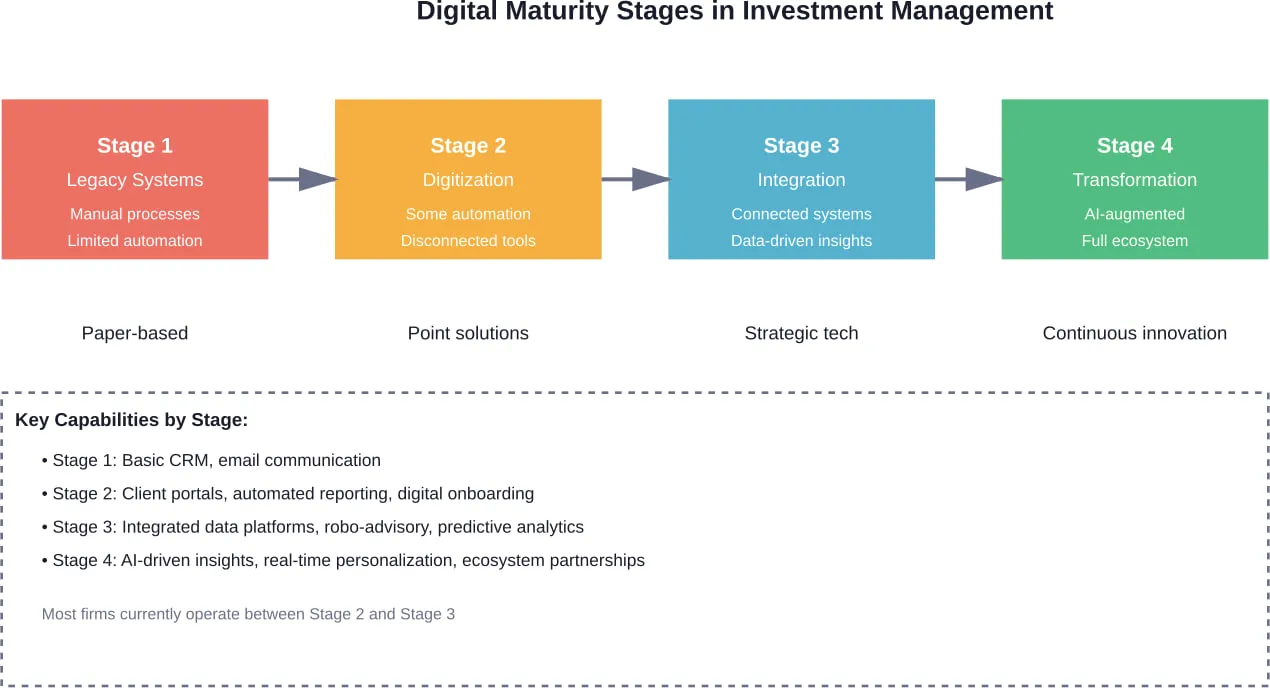
Best MVP Development Companies in India to Turn Your Idea Into Reality

When it comes to launching a new idea quickly and smartly, MVP development companies in India have become a top choice for startups worldwide. These teams specialize in building clean, functional minimum viable products that let founders test their concept without spending a fortune. With strong technical expertise, fast delivery, and affordable rates, the best MVP development companies in India help turn early-stage ideas into real, market-ready solutions that can attract users and investors.

Beyond just coding, leading MVP development companies in India offer full support – from idea validation and prototyping to intuitive design, thorough testing, and smooth iterations based on user feedback. They work agile, communicate clearly, and easily integrate with client teams across time zones, making the entire process feel seamless and collaborative. For many entrepreneurs, partnering with these experienced teams is the smartest way to validate assumptions fast and build a solid foundation for future growth.

1. Програмне забезпечення списку А

A-listware supports businesses that want to turn early ideas into working products through structured software development. We have built strong connections with the Indian talent market over many years and regularly work with skilled developers based in India. This link gives us quick access to experienced professionals who understand both local development practices and international project requirements.

We include MVP launch as part of our process after planning, business case work, architecture setup, and UI/UX design. This step creates a basic version that lets users interact with the core idea and provide feedback for further improvements. Clients often choose this route when they need fast validation combined with cost-effective development that the Indian market can deliver effectively.

Основні моменти:

  • Long-standing connections with Indian development talent
  • Planning and business case composition
  • Architecture and UI/UX design creation
  • MVP launch for real user feedback
  • Agile development and testing cycles
  • Dedicated development teams based in India
  • Smooth integration with client workflows

Послуги:

  • MVP development in India
  • Розробка програмного забезпечення на замовлення
  • Розробка програмного продукту
  • Розробка хмарних додатків
  • Розробка корпоративного програмного забезпечення
  • Виділені команди розробників
  • Розширення команди
  • UI/UX дизайн
  • Тестування та контроль якості
  • ІТ-консалтинг

Контактна інформація:

2. Aalpha Information Systems

Aalpha Information Systems starts MVP projects with careful requirement analysis and planning to understand the core idea, target audience, and business objectives. From there the work moves into wireframing and UI design to visualize the product, followed by agile development in short sprints that allow flexibility and steady progress. Testing and quality control come next to catch bugs and usability issues, then the product launches for initial users so feedback can be gathered and used for further iterations and scaling.

The company builds MVPs for web as well as Android and iOS platforms and often includes prototypes or proofs of concept in the early stages. Integration with analytics tools, payment gateways, and various APIs happens during development. Projects commonly appear in areas such as healthcare, education, logistics, fintech and real estate where clients look for practical solutions that can grow later.

Основні моменти:

  • Requirement analysis focused on core features
  • Wireframing and detailed UI design creation
  • Agile development delivered in sprints
  • Thorough testing for functionality and performance
  • Launch support with user feedback collection
  • Post-launch iteration and product refinement
  • Technology consultation for suitable architecture

Послуги:

  • Product discovery and strategy sessions
  • Prototype and proof of concept development
  • Custom MVP web and mobile app development
  • UI/UX design tailored for early-stage products
  • MVP testing and quality assurance
  • Integration with third-party tools and APIs
  • Post-MVP maintenance and feature updates

Контактна інформація:

  • Веб-сайт: www.aalpha.net
  • Телефон: +91-9845619104
  • Електронна пошта: contact@aalpha.net
  • Адреса: Блок #10, Daimond Corner Opp. Sawai Gandharava Hall, Deshpande Nagar, Hubli-580029, Карнатака Індія
  • LinkedIn: www.linkedin.com/company/aalphaindia
  • Facebook: www.facebook.com/aalphaindia
  • Twitter: x.com/aalphaindia

3. Eglobalindia

Eglobalindia delivers software and application development services with a clear focus on building minimum viable products. The company helps startups and businesses turn ideas into functional early versions that can be launched quickly and tested in the market. They combine web and mobile development with the possibility to integrate AI agents or smart features directly into the initial product.

Eglobalindia handles the full development cycle from concept discussion and planning through to final delivery and testing. Their approach emphasizes practical, cost-effective solutions that allow clients to validate concepts fast while keeping the foundation ready for future enhancements.

Основні моменти:

  • MVP development for early product validation
  • Розробка веб- та мобільних додатків
  • AI agent integration in initial versions
  • Full cycle software development
  • Practical solutions for startups

Послуги:

  • Розробка MVP
  • Розробка веб-додатків
  • Розробка мобільних додатків
  • Custom software creation
  • Інтеграція функцій ШІ
  • Software QA testing
  • Розробка електронної комерції

Контактна інформація:

  • Веб-сайт: www.eglobalindia.com
  • Телефон: +91-836-4262222
  • Електронна пошта: hi@eglobalindia.com
  • Адреса: 2-й поверх, 5-й Мейн, 6-й Крос Ганді Нагар, Бангалор-560009, Карнатака, Індія
  • Twitter: x.com/eglobalIndia

4. MindInventory

MindInventory begins MVP work with product discovery workshops where the team sits down with clients to clarify vision, goals, target users, and market context. This leads into prototyping that creates a basic version for early feedback and visualization. Feature scoping follows with business analysis to decide what should come first based on importance, feasibility, and available budget, after which custom development proceeds using agile methods and regular iterations.

The company also pays close attention to UI/UX design so the interfaces feel intuitive and match the intended brand. Consulting on technical feasibility, scalability options, and market validation strategies often forms part of the package. The overall flow stays flexible to adapt as the product idea evolves through real user input.

Основні моменти:

  • Product discovery workshops for vision alignment
  • Rapid prototyping for early validation
  • Detailed feature scoping and prioritization
  • Agile iterative development cycles
  • Intuitive UI/UX design work
  • Technical and market validation consulting
  • End-to-end support from idea to launch

Послуги:

  • Product discovery and strategy workshops
  • MVP prototyping
  • Індивідуальна розробка MVP
  • Application feature scoping
  • UI/UX design for MVPs
  • MVP consulting and feasibility advice
  • Agile development process
  • Market validation and strategy support

Контактна інформація:

  • Веб-сайт: www.mindinventory.com
  • Phone: +91-951-229-3490
  • Електронна пошта: sales@mindinventory.com
  • Address: 801, City Center 2, Science City Road, Sola-380060, Ahmedabad, Gujarat, India
  • LinkedIn: www.linkedin.com/company/mindinventory
  • Facebook: www.facebook.com/Mindiventory
  • Twitter: x.com/Mindinventory
  • Instagram: www.instagram.com/mindinventory

5. Classic Informatics

Classic Informatics creates MVP roadmaps by analyzing the product idea and breaking it down into essential features that deliver core value. The process uses agile sprints with rapid prototyping so progress stays visible and adjustable. Business analysis helps keep everything aligned with the actual business plan while technology choices get selected to fit the project needs.

Full-stack development covers both front-end and back-end parts, and the company offers options for single-feature MVPs when the goal is to test one main concept. Post-release support and input on market strategy often continue after the initial launch so the product can evolve based on real user responses.

Основні моменти:

  • MVP roadmap creation with feature breakdown
  • Rapid prototyping across agile sprints
  • Business analysis for alignment with goals
  • Technology selection guidance
  • Можливості для розробки повного стеку
  • Options for single-feature or custom MVPs
  • Post-release support and market strategy input

Послуги:

  • MVP designing with UI/UX focus
  • MVP consulting and roadmap building
  • Індивідуальна розробка MVP
  • Single feature MVP creation
  • Business analysis sessions
  • Agile sprint-based development
  • MVP marketing strategy support
  • Full-stack front-end and back-end work

Контактна інформація:

  • Веб-сайт: www.classicinformatics.com
  • Телефон: + 91 74 2829 0271
  • Електронна пошта: hello@classicinformatics.com
  • Адреса: LG 006, DLF Grand Mall, MG Road, DLF Фаза 1, Сектор 28, Хар'яна 122002
  • LinkedIn: www.linkedin.com/company/classic-informatics-private-limited
  • Facebook: www.facebook.com/classicinformatics
  • Twitter: x.com/classicinfo

6. Net Solutions

Net Solutions follows a structured MVP framework that begins with discovery and intelligence gathering to define the unique value proposition and key success indicators. The process then moves into creating a strategic roadmap, ruthless feature prioritization using methods like the MoSCoW framework, rapid prototyping with high-fidelity designs, and growth-led engineering through accelerated sprints. After launch the focus shifts to intelligent iteration driven by real-time user data and automated dashboards.

This approach integrates elements such as predictive analytics, behavioral testing, and growth loops directly into the product architecture. The company works on projects across sectors like education, sports and entertainment, retail, and media where clients aim to validate ideas quickly and gather actionable insights for future development. The flow emphasizes data-informed decisions at every stage rather than guesswork.

Основні моменти:

  • Discovery and intelligence gathering for value proposition
  • Strategic roadmap creation with risk assessment
  • Feature prioritization using established frameworks
  • High-fidelity rapid prototyping
  • Growth-led engineering in sprints
  • Real-time data analysis after launch
  • Intelligent iteration based on user behavior

Послуги:

  • MVP discovery and market research
  • Strategic product roadmap planning
  • High-fidelity prototyping
  • Agile MVP development with analytics integration
  • Automated testing and deployment
  • Post-launch monitoring and iteration support
  • Predictive analytics implementation

Контактна інформація:

  • Веб-сайт: www.netsolutions.com
  • Phone: +91 172 4315000
  • Email: info@netsolutions.com
  • Address: Site no. 15, Rajiv Gandhi, Chandigarh Technology Park, Chandigarh 160101, India
  • LinkedIn: www.linkedin.com/company/net-solutions
  • Facebook: www.facebook.com/NetSolutionsHQ
  • Twitter: x.com/netsolutions

7. ValueCoders

ValueCoders starts MVP app development with requirement gathering and planning to clarify the product vision, target users, and core problem that needs solving. Market research follows to understand competitors and user expectations, then comes technology stack selection and continuous testing throughout the build. The process wraps up with deployment, user feedback collection, and iterations to refine the product based on real usage data.

The company offers different engagement options including consulting for roadmaps, prototype designing, pilot MVP builds, and dedicated teams that can scale as needed. Work often covers various types of MVPs such as SaaS platforms, mobile apps, marketplace solutions, internal tools, and even AI-powered versions. Agile methodology helps keep development flexible and focused on delivering a market-ready version in a reasonable timeframe.

Основні моменти:

  • Requirement gathering and product vision clarification
  • Market research and competitor analysis
  • Technology stack evaluation and selection
  • Continuous testing integrated in the process
  • Feedback implementation and iteration cycles
  • Scalable architecture planning for future growth

Послуги:

  • MVP consulting and strategic roadmap creation
  • Interactive prototype designing
  • Pilot MVP development with core features
  • Виділені команди розробників
  • Комплексна розробка MVP
  • Забезпечення якості та тестування продуктивності
  • Full-scale development support after MVP
  • UI/UX design for early-stage products

Контактна інформація

  • Веб-сайт: www.valuecoders.com
  • Телефон: +91 888 210 8080
  • Адреса: 11-й поверх, Макс-сквер, Noida-Greater Noida Expy, Сектор 129, Нойда, Уттар-Прадеш 201304
  • LinkedIn: www.linkedin.com/company/valuecoders
  • Facebook: www.facebook.com/ValueCoders
  • Twitter: x.com/ValueCoders
  • Instagram: www.instagram.com/valuecodersofficial_

8. Moon Technolabs

Moon Technolabs specializes in custom software development and mobile app development. The company creates user-focused applications that help businesses solve specific challenges. Their work includes building web applications, APIs, CRM systems, and enterprise-level solutions.

Moon Technolabs also develops projects that require a quick launch to test an idea in the market. They handle the full development cycle – from gathering requirements to testing and release. This approach allows clients to get a working version of the product and collect real user feedback early on.

Основні моменти:

  • Software and application development services
  • Potential support for early-stage products

Послуги:

  • Розробка веб та мобільних додатків
  • Індивідуальні програмні рішення

Контактна інформація:

  • Website: www.moontechnolabs.com
  • Phone: +1 (620) 330-9814
  • Email: sales@moontechnolabs.com
  • Address: C/105, Ganesh Meridian, S.G. Highway, Ahmedabad, GJ 380060
  • LinkedIn: www.linkedin.com/company/moon-technolabs-pvt-ltd
  • Facebook: www.facebook.com/moontechnolabs
  • Twitter: x.com/moontechnolabs

9. Appinventiv

Appinventiv applies the Lean Startup Methodology together with agile practices when working on MVP development. The process involves forming hypotheses about user problems, conducting research and analysis based on user interactions, running scoping sessions, and focusing on key features that deliver maximum value with minimum functionality. Prototypes get built and tested quickly so real feedback can guide iterations before committing to full development.

This learn-build-measure approach helps break down product ideas into achievable milestones and supports faster market entry for testing assumptions. The company has experience turning ideas into functional products that serve as a foundation for startups looking to validate concepts and potentially attract interest from investors. Emphasis stays on customer feedback and iterative improvements rather than perfect upfront planning.

Основні моменти:

  • Lean Startup Methodology combined with agile
  • Hypothesis formation and user problem focus
  • Research and analysis based on user interactions
  • Rapid prototype building
  • Iterative design and development cycles
  • Feedback-driven improvements

Послуги:

  • MVP development using lean and agile methods
  • Product idea validation and scoping
  • Prototype creation and testing
  • User research and insight gathering
  • Iterative product building
  • Market entry support for early testing

Контактна інформація:

  • Веб-сайт: appinventiv.com
  • Телефон: +91-844-818-2018
  • Адреса: B-25, Сектор 58, Noida - 201301, Delhi-NCR, India, Sector 58, Noida - 201301, Delhi-NCR, India.
  • LinkedIn: www.linkedin.com/company/appinventiv
  • Twitter: x.com/appinventiv
  • Instagram: www.instagram.com/appinventiv

10. Agicent

Agicent structures its MVP development into clear phases that begin with ideation and discovery to clarify the product vision, define the problem statement, and conduct market research through surveys and interviews. Scope definition comes next using prioritization methods like the MoSCoW framework to focus on essential features, followed by prototyping with wireframes, high-fidelity designs, and usability testing. Implementation happens in incremental sprints with chosen technology stacks, then deployment includes infrastructure setup and soft launch, while feedback collection drives later iterations and scaling.

The process also covers costing with transparent breakdowns, testing enhanced by AI-powered tools for automated checks and bug detection, plus strategic elements like fundraising support and digital marketing guidance. Feasibility analysis and user-centric design receive attention early on to align the product with real user needs. Work spans various sectors such as e-commerce, social media, IoT, healthtech, edtech, fintech, on-demand services, entertainment, and travel where clients seek functional early versions.

Основні моменти:

  • Ideation and discovery with market research
  • Scope definition using feature prioritization
  • Прототипування та юзабіліті-тестування
  • Incremental implementation in sprints
  • Deployment with infrastructure setup
  • Feedback collection and iterative refinement
  • AI-supported testing and quality assurance
  • Strategic guidance for scaling and marketing

Послуги:

  • Prototype designing with interactive elements
  • Pilot MVP development for real-world testing
  • Feasibility analysis covering market and technical aspects
  • User-centric UX/UI design
  • Custom development using modern frameworks
  • Iterative enhancements based on user input
  • Забезпечення якості та тестування продуктивності
  • Cloud deployment and hosting
  • MVP consulting with strategic support

Контактна інформація:

  • Веб-сайт: www.agicent.com
  • Phone: +1 – 646-466-4369
  • Електронна пошта: sales@agicent.com
  • Address: C-102, Sector 65, Noida – 201301, Delhi – NCR, India
  • LinkedIn: www.linkedin.com/company/agicent-technologies
  • Facebook: www.facebook.com/agicentappcompany
  • Twitter: x.com/iPhoneDevChamps
  • Instagram: www.instagram.com/agicent_technologies

11. RipenApps Technologies

RipenApps Technologies works on software and mobile app development projects. The company creates applications that help businesses bring their ideas to life. Their services often cover the full development process, including work on early-stage products.

RipenApps Technologies handles projects where clients need a functional version to test their concept in the market. They follow a standard development flow that includes discovery, design, building, and testing phases.

Основні моменти:

  • General software and mobile app development
  • Potential involvement in early-stage product work
  • Standard development cycles for applications

Послуги:

  • Розробка веб-додатків
  • Розробка мобільних додатків
  • Custom software creation
  • Early-stage product support

Контактна інформація:

  • Веб-сайт: ripenapps.com
  • Телефон: +91 965-038-1015
  • Електронна пошта: sales@ripenapps.com
  • Адреса: H-143, 2-й поверх, Сектор 63, Нойда, Уттар-Прадеш 201301, Індія
  • LinkedIn: www.linkedin.com/company/ripenapps
  • Facebook: www.facebook.com/ripenapps
  • Twitter: x.com/ripenappstech
  • Instagram: www.instagram.com/ripenapps

12. Hidden Brains Infotech

Hidden Brains Infotech provides various software development services and works with artificial intelligence solutions. The company handles projects across different industries. Their work focuses on building custom applications and implementing AI-based features for business needs.

Hidden Brains Infotech supports early-stage product development through general software development practices. They create solutions that can serve as a starting point for testing ideas in the market.

Основні моменти:

  • Послуги з розробки програмного забезпечення
  • Рішення зі штучним інтелектом
  • Projects across different industries

Послуги:

  • Розробка програмного забезпечення на замовлення
  • Artificial intelligence implementation
  • Веб- та мобільні рішення
  • General application building

Контактна інформація:

  • Веб-сайт: www.hiddenbrains.co.uk
  • Телефон: +91-989-802-1433
  • Електронна пошта: biz@hiddenbrains.com
  • Адреса: 301, Sachet-4, навпроти ресторану Balaji Garden, Nr.Prernatirth Derasar, Satellite, Ahmedabad-380015, Gujarat
  • LinkedIn: www.linkedin.com/company/hiddenbrains-infotech-pvt-ltd
  • Facebook: www.facebook.com/HiddenBrains
  • Twitter: x.com/HiddenBrains

13. EnactOn Technologies

EnactOn Technologies lists MVP development among its services, drawing from general guidance available on the topic. The company typically addresses the full cycle for creating minimum viable products that concentrate on core functionality needed for initial validation. Planning and strategy help identify essential features before actual development begins.

Information on a detailed step-by-step MVP process remains rather general in the accessible guide rather than highly specific. The focus stays on producing practical versions that support idea testing in the market without unnecessary extras.

Основні моменти:

  • MVP development as a core service
  • Emphasis on core functionality in early versions
  • Planning and strategy for feature selection
  • Full cycle support for product creation

Послуги:

  • Розробка MVP
  • Product planning and strategy
  • Індивідуальні програмні рішення
  • Feature definition and scoping
  • General development guidance

Контактна інформація:

  • Website: www.enacton.com
  • Phone: (+91) 74260 60610
  • Email: contact@enacton.com
  • Address: 605, Luxuria Business Hub, Nr. V R Mall, Dumas Rd, Vesu, Surat, Gujarat, INDIA – 395007
  • LinkedIn: www.linkedin.com/company/enacton-technologies
  • Facebook: www.facebook.com/EnactOnTech
  • Twitter: x.com/EnactonT
  • Instagram: www.instagram.com/enacton.technologies

14. Suntec India

Suntec India follows a detailed MVP process that starts with product discovery to understand the business idea, target audience, and goals, then moves into market research and conceptualization with proof of concept creation. Requirement analysis leads to architecture design for frontend, backend, and database, followed by feature prioritization and prototype development for stakeholder feedback. Agile development implements core functionalities with UI design and integrations, while feedback collection through surveys, reviews, and analytics drives iterations before quality assurance, testing, and launch.

The approach uses controlled agile methods that allow changes with proper impact assessment and client approval. Combination testing covers manual and automated checks, and post-deployment support includes maintenance and growth strategies. Work spans sectors such as healthcare, retail, banking, travel, education, logistics, media, and automotive where clients seek practical early versions with seamless third-party integrations.

Основні моменти:

  • Product discovery and goal definition
  • Market research with proof of concept
  • Requirement analysis and architecture design
  • Feature prioritization and prototype creation
  • Agile implementation with feedback loops
  • Забезпечення якості та тестування продуктивності
  • Post-launch iteration and scaling support

Послуги:

  • MVP consulting services
  • Single-feature development
  • MVP enhancement services
  • Розробка MVP-додатків
  • MVP web development
  • End-to-end custom MVP development
  • Розробка прототипу
  • Тестування та забезпечення якості

Контактна інформація:

  • Website: www.suntecindia.net
  • Phone: +919311468458
  • Email: info@suntecindia.net
  • Address: Floor 3, Vardhman Times Plaza, Plot 13, DDA Community Centre, Road 44, Pitampura, New Delhi – 110 034, INDIA
  • LinkedIn: www.linkedin.com/company/suntecindiadotnet
  • Facebook: www.facebook.com/SuntecIndia.net1
  • Twitter: x.com/SunTecIndiaNet

15. Citrusbug Technolabs

Citrusbug Technolabs provides AI software development and custom solutions for businesses. The company creates tailored applications that help solve specific business challenges. Their work sometimes includes early-stage product development.

Citrusbug Technolabs works on projects that require a functional version to test an idea in the market. They follow general custom development practices from initial discussion through to final delivery. The focus remains on building custom applications using AI and other technologies.

Основні моменти:

  • Розробка програмного забезпечення для ШІ
  • Custom solutions for businesses
  • Potential early-stage product work

Послуги:

  • Розробка програмного забезпечення для ШІ
  • Створення індивідуальних додатків
  • General software solutions

Контактна інформація:

  • Website: citrusbug.com
  • Phone: +1 510 561 8188
  • Email: Hello@citrusbug.com
  • Address: A 411, Shivalik Corporate Park, Above D Mart, Satellite, Ahmedabad – 380015
  • LinkedIn: www.linkedin.com/company/citrusbug
  • Instagram: www.instagram.com/citrusbug_technolabs

16. SPEC INDIA

SPEC INDIA delivers MVP development through agile and lean methods that emphasize discovery and planning, followed by development, testing, and launch in smaller iterative stages. The process includes MVP prototyping with interactive visual models for early feedback, then full MVP product development that turns concepts into operational versions with core features. Custom software development tailors solutions to business goals and sectors, while MVP app and web development focus on mobile or web-first products ready for user testing and market fit validation.

Consulting services guide clients on strategy, user journey mapping, and technology selection. Detailed testing covers functionality, performance, usability, and security. The overall flow supports startups, enterprises, and SMBs with flexible engagement models such as full project delivery or team augmentation, and post-launch feedback helps with scaling decisions.

Основні моменти:

  • Discovery and planning phase
  • Agile and lean iterative development
  • Interactive MVP prototyping
  • Розробка продуктів на замовлення
  • Mobile and web MVP building
  • Comprehensive testing and validation
  • Post-launch feedback and scaling support

Послуги:

  • MVP prototyping with visual models
  • MVP product development
  • Custom MVP software development
  • MVP app development for iOS and Android
  • MVP web development
  • MVP testing and quality assurance
  • MVP consulting and strategy guidance
  • MVP services for startups

Контактна інформація:

  • Веб-сайт: www.spec-india.com
  • Телефон: +91-79-26404031
  • Електронна пошта: lead@spec-india.com
  • Адреса: SPEC House, Parth Complex, Near Swastik Cross Roads, Navarangpura, Ahmedabad 380009, INDIA
  • LinkedIn: www.linkedin.com/company/spec-india
  • Facebook: www.facebook.com/SPECINDIA.IT
  • Twitter: x.com/infospec_india
  • Instagram: www.instagram.com/spec_india


Висновок

Choosing the right partner for MVP development in India can feel like a big decision, especially when you’re trying to move fast and keep costs reasonable without compromising on quality. The good news is that India has plenty of experienced companies that know how to turn an early idea into something real and testable. What matters most in the end isn’t just technical skills – it’s finding a team that listens carefully, communicates clearly, and treats your project like it’s their own.

At the end of the day, the strongest collaborations happen when the relationship feels seamless, almost like an extension of your own side. Look for partners who ask smart questions, adapt quickly when things change, and stay focused on delivering real value rather than just lines of code. Whether you’re a startup founder validating your first concept or an established business testing a new feature, the right fit can save you time, reduce risk, and give your idea the best possible shot at success.

If you’re ready to take that next step and build something meaningful, reach out to explore your project needs. The sooner you start the conversation, the faster you can move from idea to a working product that actually resonates with users.

Leading Node.js Development Companies in India Deliver Scalable Solutions for Modern Projects

Node.js has become one of the go-to technologies for building real-time, scalable applications that handle heavy traffic without breaking a sweat. From streaming services and chat platforms to robust APIs and microservices, it powers some of the most dynamic digital experiences today. Many businesses looking to move quickly and cost-effectively turn to specialized teams in India, where a deep pool of experienced developers consistently delivers high-quality results.

What makes these Node.js development companies in India particularly appealing is the combination of technical excellence, flexible engagement models, and strong focus on long-term partnership. They understand how to turn complex requirements into clean, maintainable code while keeping projects on budget and on schedule. Whether the goal is to launch a startup MVP or modernize enterprise systems, these teams bring both speed and reliability to the table.

1. Програмне забезпечення списку А

At A-listware we provide software development and consulting services and regularly work with Node.js for backend needs in projects coming from the Indian market. Many clients in India look for partners who can deliver scalable web applications and efficient APIs, and we support those requirements through custom development and dedicated team setups. The Indian tech scene moves fast, so we focus on keeping our processes flexible to match the pace of local startups and established businesses alike.

We combine Node.js with cloud solutions and enterprise tools when building applications that need strong server-side performance. This approach works well for companies in India that want reliable backend systems without overcomplicating the stack. In the end, it helps projects stay on track whether the goal is a new platform or modernization of existing software.

Основні моменти:

  • Послуги з розробки програмного забезпечення
  • Backend work with Node.js
  • Створення індивідуальних додатків
  • Виділені команди розробників

Послуги:

  • Node.js development in India
  • Розробка програмного забезпечення на замовлення
  • Розробка хмарних додатків
  • Розробка корпоративного програмного забезпечення
  • Обслуговування та підтримка додатків

Контактна інформація:

2. eSparkBiz

eSparkBiz handles Node.js development with a clear focus on building scalable web applications and backend systems. The company works on projects that involve real-time features and complex data handling. Their structured approach starts with understanding project scope and moves through architecture planning all the way to deployment and ongoing support.

Developers at eSparkBiz use Node.js together with tools like Express.js, NestJS and MongoDB to create APIs, microservices and IoT solutions. The process includes careful testing and optimization steps so the final product performs reliably. Many clients appreciate the attention given to clean code and secure architecture in their Node.js projects.

Основні моменти:

  • Node.js web development
  • API development and microservices
  • Real-time web socket programming
  • Розробка додатків IoT
  • Node.js maintenance and support

Послуги:

  • Розробка CMS
  • Рішення для електронної комерції
  • Product development using Node.js
  • Інтеграція та тестування
  • Optimization and QA

Контактна інформація:

  • Веб-сайт: www.esparkinfo.com
  • Телефон: (+91) - 6353453248
  • Електронна пошта: sales@esparkinfo.com
  • Адреса: Оріон, біля храму Шрі Баладжі, SG Highway, Ахмедабад - 382481, Гуджарат
  • LinkedIn: www.linkedin.com/company/esparkinfo
  • Facebook: www.facebook.com/esparkbiz
  • Twitter: x.com/esparkbiz
  • Instagram: www.instagram.com/esparkbiz

3. Пальцевий.

Fingent delivers custom software development that includes full-stack capabilities with Node.js for backend needs. The company creates tailored applications for clients who need flexible web solutions. Their work covers various stages from initial planning to final delivery.

Development projects at Fingent emphasize practical implementation of backend technologies alongside other stack components. The approach allows for building systems that fit specific business requirements without unnecessary complexity. Clients often turn to them when looking for reliable custom development partners.

Основні моменти:

  • Розробка програмного забезпечення на замовлення
  • Full-stack web projects
  • Backend implementation with Node.js

Послуги:

  • Розробка веб-додатків
  • Custom solution building
  • Інтеграція технологій

Контактна інформація:

  • Веб-сайт: www.fingent.com
  • Телефон: +91 773 664 4544
  • Електронна пошта: info@fingent.com
  • Address: 3rd Floor Site No. 218, IndiQube Hexa, A & 191, Sector 6, HSR Layout, Bengaluru, Karnataka 560102
  • LinkedIn: www.linkedin.com/company/fingent-technologies
  • Facebook: www.facebook.com/Fingent
  • Twitter: x.com/fingent
  • Instagram: www.instagram.com/fingentcorporation

4. Великі літери

Capital Numbers provides custom software development services where Node.js forms part of the available technology stack. The company works on building applications that require solid backend foundations. Their focus stays on delivering functional solutions that match client specifications.

Projects handled by Capital Numbers often involve creating software that needs to perform well under different conditions. The team applies Node.js in scenarios where event-driven architecture brings advantages. This helps in developing responsive backend systems for various use cases.

Основні моменти:

  • Розробка програмного забезпечення на замовлення
  • Backend development using Node.js
  • Application building

Послуги:

  • Web-based solutions
  • Technology selection and implementation
  • Project delivery and support

Контактна інформація:

  • Веб-сайт: www.capitalnumbers.com
  • Phone: +91 33 6799 2222
  • Email: info@capitalnumbers.com
  • Address: Mani Casadona, Unit No 8E4, Action Area #2 F, New Town, Kolkata 700156, West Bengal, India
  • LinkedIn: www.linkedin.com/company/capitalnumbers
  • Facebook: www.facebook.com/CapitalNumbers
  • Twitter: x.com/_CNInfotech

5. Tridhya Tech

Tridhya Tech works on web and mobile application development with backend capabilities that include Node.js. The company delivers end-to-end solutions for clients building their digital presence. Their services cover both web platforms and supporting technologies like AI and IoT where relevant.

Development at Tridhya Tech aims at creating practical applications that help businesses operate online effectively. The team handles the full cycle from concept to working product. Node.js supports the backend layer in projects that need efficient data processing and server-side logic.

Основні моменти:

  • Розробка веб-додатків
  • Backend services with Node.js
  • Mobile app coordination

Послуги:

  • Розвиток електронної комерції
  • Digital solution building
  • Впровадження технології
  • Platform support

Контактна інформація:

  • Website: www.tridhyatech.com
  • Phone: +1 386 597 1231
  • Email: info@tridhyatech.com
  • Address: 401, One World West, Nr.Ambli T-Junction 200,S P Ring Road, Bopal, Ahmedabad, Gujarat 380058
  • LinkedIn: www.linkedin.com/company/tridhya-tech
  • Facebook: www.facebook.com/TridhyaTech
  • Twitter: x.com/tridhyaT
  • Instagram: www.instagram.com/tridhyatech

6. Radixweb

Radixweb works with Node.js for web development projects that need efficient server-side solutions. The company focuses on creating applications where backend performance matters for handling requests and data flow. Their process usually involves planning the architecture first before moving into actual coding and integration.

Node.js fits into their development work when clients look for event-driven setups or API-based systems. The approach stays practical with attention to how the backend connects with other parts of the application. Many who check similar providers note that such services help keep things running smoothly without overcomplicating the stack. Sometimes the projects require extra steps for optimization along the way.

Основні моменти:

  • Node.js web development
  • Backend architecture planning
  • API integration work
  • Event-driven application setup

Послуги:

  • Custom web solutions
  • Розробка програмного забезпечення
  • Впровадження технології

Контактна інформація:

  • Веб-сайт: www.radixweb.com
  • Телефон: +91-79-35200685
  • Електронна пошта: biz@radixweb.in
  • Адреса: Ekyarth, B/H Nirma, University, Chharodi, Ahmedabad - 382481 India - Індія.
  • LinkedIn: www.linkedin.com/company/radixweb
  • Facebook: www.facebook.com/radixweb
  • Twitter: x.com/radixweb
  • Instagram: www.instagram.com/radixweb

7. Unified Infotech

Unified Infotech handles custom web and software development across different project stages from initial ideas through to final deployment. The company builds solutions that include digital experiences and cloud components where needed. Node.js sits within their broader technology options for backend requirements.

Work at the company often covers full product engineering cycles along with data analytics and consulting elements. This setup allows clients to address multiple aspects of a project in one place. It all depends on the specific needs but the services stay flexible for various business scenarios. Some projects also touch on user interface improvements.

Основні моменти:

  • Індивідуальна веб-розробка
  • Інженерія програмних продуктів
  • Підтримка хмарної інженерії

Послуги:

  • Digital experience creation
  • Рішення для роботи з даними та аналітикою
  • ІТ-консалтинг
  • Digital strategy guidance

Контактна інформація:

  • Веб-сайт: www.unifiedinfotech.net
  • Телефон: +91 93309 01942
  • Email: sales@unifiedinfotech.net
  • Address: DN 53, Salt Lake City, Sec V, Kolkata, 700091, India
  • LinkedIn: www.linkedin.com/company/unifiedinfotech
  • Facebook: www.facebook.com/unifiedinfotech
  • Twitter: x.com/unified_infotec
  • Instagram: www.instagram.com/unified.infotech

8. TatvaSoft

TatvaSoft delivers custom software development services with support for different programming environments including Node.js for backend tasks. The company creates tailored applications that match client specifications across industries. Their development cycle runs from requirements gathering to complete implementation.

Projects at TatvaSoft emphasize building functional software that integrates well with existing systems. Node.js comes into play for parts of the application that benefit from asynchronous processing. Clients usually appreciate the straightforward way these solutions get delivered. The process includes testing phases that catch issues early.

Основні моменти:

  • Розробка програмного забезпечення на замовлення
  • Backend development with Node.js
  • Інтеграція додатків

Послуги:

  • Створення веб-додатків
  • Software solution delivery
  • Technology support

Контактна інформація:

  • Веб-сайт: www.tatvasoft.com 
  • Телефон: +91 960 142 1472
  • Електронна пошта: info@tatvasoft.com
  • LinkedIn: www.linkedin.com/company/tatvasoft
  • Facebook: www.facebook.com/TatvaSoft
  • Twitter: x.com/tatvasoft

9. Simform

Simform provides Node.js development services focused on backend and product engineering needs. The company works on building scalable applications where Node.js handles server-side logic effectively. Their services extend to full development cycles for web-based projects.

Development work at Simform includes creating solutions that require strong backend foundations alongside other technologies. The process covers everything from initial setup to ongoing adjustments. Many clients find this approach useful when they need reliable performance in dynamic environments. In some cases the work also involves connecting different data sources smoothly.

Основні моменти:

  • Node.js development
  • Внутрішні сервіси
  • Інжиніринг продукту
  • Server-side logic implementation

Послуги:

  • Розробка додатків на замовлення
  • Web solution building
  • Інтеграція технологій

Контактна інформація:

  • Веб-сайт: www.simform.com   
  • Телефон: 13212372727
  • LinkedIn: www.linkedin.com/company/simform
  • Facebook: www.facebook.com/simform
  • Twitter: x.com/simform

10. Kellton

Kellton delivers custom software development and digital engineering services with Node.js included in the technology options. The company builds applications that require solid backend foundations for various business needs. Development usually starts with requirement analysis and moves through design and implementation phases.

Node.js comes into use when projects call for efficient server-side processing and API creation. The approach focuses on integrating the backend smoothly with other system components. Some clients mention that this helps maintain consistent performance across different project stages.

Основні моменти:

  • Розробка програмного забезпечення на замовлення
  • Послуги цифрового інжинірингу
  • Node.js backend work
  • Розробка API

Послуги:

  • Web application creation
  • Mobile solution building
  • Інтеграція технологій
  • Підтримка цифрової трансформації

Контактна інформація:

  • Веб-сайт: www.kellton.com
  • Телефон: +91.124.469.8900
  • Електронна пошта: ask@kellton.com
  • Адреса: Ділянка № 1367, дорога № 45 Jubilee Hills, Хайдарабад, Телангана 500033
  • LinkedIn: www.linkedin.com/company/kellton-tech-solutions-limited
  • Facebook: www.facebook.com/people/Kellton/61577491124169
  • Twitter: x.com/kelltontech

11. Крапкові квадрати

Dotsquares works on web and mobile development projects where Node.js supports backend requirements. The company creates digital solutions that combine frontend interfaces with reliable server logic. Projects often involve building complete applications from concept to launch.

Backend development at Dotsquares includes Node.js for handling data operations and real-time features when needed. The process pays attention to how different parts of the application connect. It all depends on the project scope but the services stay adaptable to client specifications.

Основні моменти:

  • Веб-розробка
  • Мобільна розробка
  • Node.js backend services

Послуги:

  • Custom web solutions
  • Розробка додатків
  • Backend integration
  • Project maintenance

Контактна інформація:

  • Веб-сайт: www.dotsquares.com
  • Phone: +91 96600 77663
  • Електронна пошта: office@dotsquares.com
  • Address: CP4-228, 229, Apparel Park, Mahal Road, Hare Krishna Marg, Jagatpura, Jaipur, Rajasthan 302017
  • LinkedIn: www.linkedin.com/company/dotsquares
  • Facebook: www.facebook.com/dotsquaresuk
  • Twitter: x.com/dotsquares
  • Instagram: www.instagram.com/dotsquaresltd

12. Konstant Infosolutions

Konstant Infosolutions handles web and app development services with Node.js available for backend development. The company builds digital platforms that support online business activities and user interactions. Development includes both web-based and mobile components where required.

Projects at the company often combine frontend design with Node.js for server-side functionality. The approach emphasizes clean implementation and practical results. Clients sometimes note the flexibility in adjusting the technology choices according to project demands.

Основні моменти:

  • Веб-розробка
  • Розробка додатків
  • Node.js backend services
  • Digital platform building

Послуги:

  • Custom web solutions
  • Розробка мобільних додатків
  • Розробка бекенда
  • Project support

Контактна інформація:

  • Веб-сайт: www.konstantinfo.com
  • Телефон: +91-141-2291398
  • Електронна пошта: sales@konstantinfo.com
  • LinkedIn: www.linkedin.com/company/konstant-infosolutions-pvt-ltd
  • Facebook: www.facebook.com/konstant.info
  • Twitter: x.com/konstantinfo

13. Logistic Infotech

Logistic Infotech offers Node.js development services for building backend systems and web applications. The company focuses on projects that require efficient server-side solutions and real-time capabilities. Development work usually moves from initial planning through coding to final testing and deployment.

Node.js serves as a core part of the technology stack when clients need fast data processing and scalable architectures. The process includes careful attention to API creation and integration with other services. Some projects also involve ongoing maintenance after launch to keep everything running smoothly.

Основні моменти:

  • Node.js development services
  • Backend system building
  • Real-time application work
  • API creation

Послуги:

  • Розробка веб-додатків
  • Server-side solution delivery
  • Інтеграція технологій
  • Project testing

Контактна інформація:

  • Website: www.logisticinfotech.com
  • Phone: +91 7600 362 361
  • Email: info@logisticinfotech.com
  • Address: 401, Jaynath Complex Makkam Chowk Gondal Road Rajkot – 360002 Gujarat, India
  • LinkedIn: www.linkedin.com/company/logistic-infotech
  • Facebook: www.facebook.com/logisticinfotech
  • Twitter: x.com/logisticinfotec

14. CMARIX

CMARIX provides dedicated Node.js development for various web and mobile projects. The company builds solutions where backend performance plays a key role in overall application functionality. Work starts with understanding project goals and continues through full implementation.

Node.js gets used in scenarios that benefit from event-driven programming and quick response times. The development approach keeps code organized and adaptable to changing requirements. Clients often mention how this technology choice helps handle data-heavy operations without unnecessary complications.

Основні моменти:

  • Node.js development
  • Розробка бекенда
  • Web project implementation

Послуги:

  • Створення індивідуальних додатків
  • Розробка API
  • Підтримка мобільного бекенду
  • Project maintenance

Контактна інформація:

  • Веб-сайт: www.cmarix.com
  • Електронна пошта: biz@cmarix.com
  • Телефон: +91 800-005-0808
  • Адреса: 302-306, AWS 3, Opp. Манав Мандір, Drive-In Road, Мемнагар, Ахмедабад - 380052
  • Facebook: www.facebook.com/cmarixinfotech
  • Twitter: x.com/cmarixinfotech
  • LinkedIn: www.linkedin.com/company/cmarix
  • Instagram: www.instagram.com/cmarixinfotech

15. Space-O Technologies

Space-O Technologies offers Node.js development services with attention to real-time applications and backend solutions for both web and mobile projects. The company works on building systems that handle data flow efficiently and support interactive features. Development usually starts from understanding requirements and moves through implementation to final delivery.

Node.js fits into their work when projects call for responsive backend logic and smooth integration with frontend or mobile parts. The approach keeps things practical for applications that need quick updates or multitasking capabilities. It all depends on the project but the services stay focused on delivering functional results.

Основні моменти:

  • Node.js development services
  • Розробка додатків у реальному часі
  • Backend for web and mobile
  • API integration work

Послуги:

  • Node.js development in India
  • Створення веб-додатків
  • Підтримка мобільного бекенду
  • Real-time feature implementation

Контактна інформація:

  • Веб-сайт: www.spaceotechnologies.com
  • Phone: +91 9023468615
  • Електронна пошта: sales@spaceotechnologies.com
  • Address: 1005, 10th Floor, Abhishree Adroit, Mansi Circle, Ahmedabad, Gujarat 380015
  • LinkedIn: www.linkedin.com/company/space-o-technologies
  • Facebook: www.facebook.com/SpaceOTechnologies
  • Twitter: x.com/spaceotech

16. WeblineIndia

WeblineIndia provides Node.js development services with a focus on scalable web applications, APIs and real-time features. The company builds solutions that include microservices architecture and support for data streaming or collaborative tools. Projects often involve creating robust backends that work across different platforms.

Node.js gets used alongside frameworks like Express.js or Koa.js when clients need efficient handling of requests and low latency. The process covers everything from initial consultation to deployment and sometimes includes IoT or CMS elements. Many clients note how this helps keep applications responsive without unnecessary complexity.

Основні моменти:

  • Node.js web application development
  • Розробка API
  • Real-time features
  • Архітектура мікросервісів

Послуги:

  • Node.js development in India
  • Scalable app development
  • Real-time communication solutions
  • IoT application work
  • Node.js consultation

Контактна інформація:

  • Website: www.weblineindia.com
  • Phone: +91-79-26420897
  • Email: info@weblineindia.com
  • Address: 401, Citius Commercial Spaces, Opp. AMC Parking, Navrangpura, Ahmedabad, 380009.
  • LinkedIn: www.linkedin.com/company/weblineindia
  • Facebook: www.facebook.com/Weblineindia.Site
  • Twitter: x.com/weblineindia
  • Instagram: www.instagram.com/weblineindia


Висновок

Wrapping up this look at Node.js development companies in India, one thing stands out – the ecosystem here just keeps delivering practical, no-nonsense solutions for modern backend needs. Whether you’re racing to launch a real-time feature or scaling an API-heavy platform, the talent and experience available make it a solid choice for many projects. It’s not always about the flashiest tech; it’s more about finding partners who understand how to keep things fast, stable, and adaptable as your business grows.

At the end of the day, success usually comes down to clear communication and a good cultural fit rather than chasing perfection on paper. India’s Node.js scene has plenty of options that can match different budgets and timelines, especially when you’re balancing speed with long-term maintainability. Take your time to talk with a few teams, ask about similar projects they’ve handled, and see what feels right for your specific situation. In the end, the right collaboration can turn a solid idea into something that actually performs well in the real world.

Digital Transformation for Entertainment in 2026

Короткий виклад: Digital transformation in entertainment encompasses the adoption of cloud infrastructure, AI-powered content creation, streaming platforms, and immersive technologies that fundamentally reshape how media is produced, distributed, and consumed. The industry faces rapid evolution driven by mobile connectivity, data analytics, and changing audience expectations, with OTT services projected to reach 2.1 billion global subscriptions by 2028 and enterprise spending on generative AI expected to grow by 30%.

The entertainment landscape bears little resemblance to what existed a decade ago. Analog equipment has given way to digital workflows. Traditional distribution channels have fractured into countless streaming platforms. And audience expectations have evolved at a pace that leaves many companies scrambling to adapt.

Mobile search advertising in the US jumped from $14.7 billion in 2015 to $37.43 billion in 2020, reflecting how consumption patterns have shifted. But the transformation goes deeper than advertising spend. The fundamental infrastructure of how content gets made, delivered, and monetized has changed.

Here’s what’s driving this evolution and how entertainment companies are responding.

What Digital Transformation Means for Entertainment

Digital transformation in media and entertainment represents the comprehensive integration of digital technologies across every aspect of operations. This isn’t just about putting content online or launching a streaming app.

The Society of Motion Picture & Television Engineers (SMPTE) has developed standards and recommended practices that reflect the technical complexity of this shift. SMPTE ST 2110, designed to replace the long-lived Serial Digital Interface (SDI), exemplifies how even foundational broadcast infrastructure is being rebuilt from the ground up.

The transformation touches three core areas:

  • Content creation processes, where cameras and microphones use sensors to translate images and sounds into bits and bytes
  • Distribution models, where streaming and on-demand access replace scheduled programming
  • Audience engagement strategies, driven by data analytics and personalization

Sound familiar? Most entertainment companies are somewhere in the middle of this journey, dealing with legacy systems while trying to build new capabilities.

The Technology Stack Driving Change

Several technologies form the backbone of entertainment’s digital transformation. Understanding which ones matter most helps prioritize investments.

Хмарна інфраструктура

Cloud platforms have become essential for scaling operations and managing massive content libraries. Performance improvement reaches up to 40% with cloud infrastructure, allowing better user experience and more responsive operations.

Operational costs drop significantly when companies move from maintaining physical data centers to cloud-based systems. The flexibility to scale resources up or down based on demand makes economic sense, especially for companies dealing with variable traffic patterns.

Штучний інтелект і машинне навчання

According to Deloitte predictions, enterprise spending on generative AI is expected to grow by 30%. Media companies are developing AI models to drive productivity and unlock innovation across multiple use cases.

AI applications in entertainment include:

  • Content recommendation engines that personalize viewer experiences
  • Automated content tagging and metadata generation
  • Predictive analytics for audience preferences
  • Production tools that assist with editing, color correction, and effects

The rapid emergence of AI-powered virtual celebrities is reshaping the landscape, introducing new paradigms in performance, fandom, and cultural production. Virtual idols in East Asia demonstrate how AI blurs the boundaries between human and machine in entertainment sectors.

Mobile and Connected Platforms

Mobile technologies and cloud computing fuel the streaming revolution. Audiences expect to access content anywhere, on any device, without friction.

Digital advertising on mobile and connected TVs is surging with anticipated 9.5% annual growth, driven by data-targeted and personalized ads. This growth reflects not just where audiences consume content, but how advertisers reach them.

How key technologies contribute to entertainment transformation and operational improvements

Build Better Entertainment Platforms With A-listware

Entertainment businesses often rely on software behind content delivery, internal operations, user platforms, and reporting. Програмне забезпечення списку А provides software development, IT consulting, infrastructure services, cybersecurity, data analytics, and dedicated development teams. The company can support entertainment companies with custom software, platform improvements, and extra engineering capacity for ongoing digital projects.

Need a Team to Build or Improve Entertainment Software?

Поговоріть з програмним забезпеченням A-list для:

  • build custom digital platforms and internal tools
  • modernize legacy systems and infrastructure
  • додати розробників, DevOps, спеціалістів з обробки даних або безпеки

Почніть із запиту на консультацію з A-listware.

How Content Production Has Changed

The film industry rarely involves film anymore. Directors and editors manipulate raw footage on computers rather than with light tables and physical cuts. This shift accelerated during recent years when remote production became necessity.

Digital workflows enable:

  • Real-time collaboration across distributed teams
  • Immediate preview of effects and edits
  • Version control and asset management at scale
  • Integration of virtual production techniques

Modern 3D technologies act as catalysts for digital transformation across education and industry applications, expanding how creators approach visual storytelling.

The Streaming Revolution Continues

Over-the-top (OTT) video services are expected to reach 2.1 billion global subscriptions by 2028. That’s not just growth—it’s a fundamental restructuring of how content reaches audiences.

Universal/Comcast’s “Trolls World Tour” made almost $100 million in pay-per-view when it launched directly to video-on-demand, with the majority going straight to the studio. Warner/AT&T announced their entire 2021 slate would open simultaneously on streaming, signaling that even blockbuster productions would embrace hybrid distribution.

The economics make sense for studios. Traditional theatrical releases involve complex revenue splits with exhibitors. Direct streaming relationships put studios in control of pricing, timing, and customer data.

But wait. This creates tension with established partners and raises questions about long-term sustainability. Can subscription services support the volume of content being produced? How many streaming services will audiences tolerate before fatigue sets in?

Data-Driven Audience Engagement

Customer data and feedback loops provide the information needed to refine content strategies over time. Entertainment companies now track viewing patterns, completion rates, engagement metrics, and preference signals at granular levels.

This data informs decisions about:

  • Which shows to renew or cancel
  • How to market new releases
  • What content gaps exist in libraries
  • When to schedule releases for maximum impact

Omnichannel user experience ensures consistency and visibility across platforms without data loss between different touchpoints. The challenge lies in unifying data from multiple sources while respecting privacy regulations and audience concerns.

Challenges Facing Digital Transformation

The media and entertainment industry navigates a period of major disruptions and rapid change, requiring better strategic planning and more flexible operations. Market predictions for 2024 underscored ongoing volatility, with continued layoffs and potential revenue declines.

Застаріла інфраструктура

Many established entertainment companies operate hybrid systems—modern cloud platforms alongside decades-old equipment and workflows. Migrating without disrupting ongoing operations takes careful planning.

Прогалини у навичках

Digital transformation demands new competencies. Teams need expertise in data analytics, cloud architecture, AI implementation, and digital marketing alongside traditional creative skills. Finding talent that bridges these worlds proves difficult.

Business Model Disruption

According to IEEE research, the music industry had a value of $21.5 billion in 1995 based on sales of CDs, cassette tapes, and vinyl records. Since then, industry value has dropped more than 50 percent as digital distribution fundamentally altered revenue models.

Mature markets suffer when transformation accelerates. Companies must cannibalize existing revenue streams to build new ones, creating financial pressure during transition periods.

Зона викликівВпливMitigation Approach 
Застарілі системиSlow deployment, integration issuesPhased migration, API layers
Skills ShortageDelayed projects, higher costsTraining programs, strategic hiring
Revenue DisruptionFinancial volatilityHybrid models, diversified streams
Data PrivacyRegulatory compliance complexityPrivacy-by-design, governance frameworks
Content OverloadAudience fragmentationQuality focus, strategic partnerships

Emerging Technologies Reshaping Experiences

Virtual and augmented reality technologies create immersive experiences that go beyond passive viewing. While adoption has been slower than early predictions suggested, the technology continues maturing.

Interactive content blurs the line between entertainment and gaming. Audiences increasingly expect agency in how stories unfold, not just linear narratives.

Direct interaction with artists, athletes, and content creators through social media, live chats, and virtual events fosters deeper engagement. Digital platforms enable relationships that weren’t possible in traditional broadcast models.

Industry Standards and Technical Evolution

Technical standards play a critical role in enabling transformation. SMPTE’s work on standards for professional media creation, distribution, and archiving ensures interoperability across vendors and platforms.

The shift from Serial Digital Interface to IP-based workflows represented years of collaboration among broadcasters, facilities, studios, vendors, trade associations, and global engineering teams. This collective effort demonstrates how industry-wide transformation requires coordinated standards development.

Major milestones in entertainment's digital transformation with projected growth through 2028

What Success Looks Like

Successful digital transformation in entertainment isn’t about adopting every new technology. It’s about strategic choices aligned with business goals and audience needs.

Companies that thrive focus on:

  • Building flexible infrastructure that adapts as technology evolves
  • Investing in data capabilities that inform better decisions
  • Maintaining creative excellence while leveraging technological tools
  • Creating seamless experiences across all audience touchpoints

The transformation continues accelerating. Technologies that seemed futuristic five years ago are now standard expectations. What comes next will likely surprise us, but the direction is clear—more personalized, more interactive, more data-driven, and more distributed.

Поширені запитання

  1. What is digital transformation in the entertainment industry?

Digital transformation in entertainment refers to integrating digital technologies across content creation, distribution, and audience engagement. This includes cloud infrastructure, AI tools, streaming platforms, data analytics, and mobile delivery systems that fundamentally change how media companies operate.

  1. How is AI being used in entertainment?

According to industry data, enterprise spending on generative AI is expected to grow by 30%. Entertainment companies use AI for content recommendations, automated metadata tagging, predictive analytics for audience preferences, production assistance, and even creating virtual celebrities and performers.

  1. What are OTT services and why do they matter?

Over-the-top (OTT) services deliver video content directly to consumers via the internet, bypassing traditional cable or broadcast distribution. These services are expected to reach 2.1 billion global subscriptions by 2028, representing a fundamental shift in how audiences access entertainment.

  1. What challenges do entertainment companies face during digital transformation?

Major challenges include integrating legacy infrastructure with modern systems, addressing skills gaps in technical capabilities, managing business model disruption, ensuring data privacy compliance, and navigating financial volatility during transition periods.

  1. How has streaming changed entertainment economics?

Streaming enables direct studio-to-consumer relationships, eliminating traditional revenue splits with theaters and distributors. Films like “Trolls World Tour” demonstrated this potential by generating nearly $100 million through direct video-on-demand, with most revenue going directly to the studio.

  1. What role do industry standards play in transformation?

Organizations like SMPTE develop technical standards and recommended practices that ensure interoperability across vendors and platforms. These guidelines enable industry-wide transformation by creating common frameworks for new technologies like IP-based workflows.

  1. How important is mobile to entertainment’s digital future?

Mobile is central to transformation strategies. Mobile search advertising in the US grew from $14.7 billion in 2015 to $37.43 billion in 2020. Digital advertising on mobile and connected TVs continues growing at 9.5% annually, driven by targeted and personalized ad capabilities.

Рухаємося вперед

Entertainment’s digital transformation isn’t a destination—it’s an ongoing evolution. The companies that succeed won’t be those that implement every technology, but those that strategically align digital capabilities with creative vision and audience needs.

The pace of change continues accelerating. Infrastructure decisions made today will shape competitive positioning for years. But the core principle remains constant: technology serves the story, the experience, and ultimately the audience.

Ready to transform how your organization approaches entertainment technology? Start by assessing where your current infrastructure creates friction, where audience data reveals opportunities, and where strategic investments in cloud, AI, and distribution platforms can deliver measurable impact.

Digital Transformation for Operations: 2026 Guide

Короткий виклад: Digital transformation for operations modernizes how businesses execute core activities through AI, automation, cloud computing, and data analytics. It goes beyond technology adoption to fundamentally restructure workflows, eliminate inefficiencies, and create agile, data-driven operations that respond quickly to market changes. Organizations implementing operational digital transformation see measurable improvements in productivity, cost reduction, and competitive positioning.

Operations have always been the backbone of business performance. But here’s the thing: traditional operational models built on manual processes, siloed systems, and reactive decision-making can’t keep pace with modern market demands.

Digital transformation for operations isn’t about slapping new software onto old problems. It’s a fundamental rethinking of how work gets done, how decisions get made, and how value flows through the organization.

According to McKinsey research, digital leaders achieved about 65% greater annual total shareholder returns than digital laggards between 2018 and 2022. That’s not a marginal advantage—it’s a competitive chasm.

The National Institute of Standards and Technology emphasizes the importance of information management in digital transformation. Digital operations require treating information as a strategic asset. Organizations that master operational data and analytics gain unprecedented visibility and control.

What Digital Transformation for Operations Actually Means

Digital transformation in operations represents the integration of digital technologies across all operational functions—from supply chain and manufacturing to service delivery and support operations. It modernizes processes, products, operations, and the underlying technology stack to enhance efficiency and accelerate delivery.

But wait. This goes deeper than technology implementation.

Operational transformation requires cultural shifts, new skill sets, and different ways of measuring success. It’s about creating operations that are agile, data-driven, and continuously improving through feedback loops.

The transformation typically impacts several operational domains simultaneously:

  • Process operations: Automating and optimizing workflows
  • Product operations: Enhancing how products are developed, manufactured, and delivered
  • Customer operations: Improving service delivery and customer interactions
  • Technology operations: Modernizing infrastructure through cloud and edge computing
  • Security operations: Protecting operational technology and data assets

Manufacturing represents a particularly critical focus area. The National Institute of Standards and Technology announced plans to launch a competition for a new Manufacturing USA institute focused on using artificial intelligence to improve U.S. manufacturing resilience. NIST anticipated $70 million in federal funds investment over five years.

Core Technologies Driving Operational Transformation

Several technologies form the foundation of modern digital operations. Understanding how they work together creates the blueprint for transformation.

Штучний інтелект і машинне навчання

AI transforms operations from reactive to predictive. Machine learning algorithms analyze operational data to identify patterns, predict failures before they occur, and optimize resource allocation in real time.

Harvard Business School research notes that while many organizations are eager to harness AI’s potential, successful implementation requires significant investment in technology, data infrastructure, integration capabilities, and specialized talent. Becoming an AI-enabled organization is a long-term commitment, not a quick fix.

AI applications in operations include:

  • Predictive maintenance that reduces downtime
  • Quality control through computer vision
  • Demand forecasting for inventory optimization
  • Process optimization through continuous learning
  • Intelligent scheduling and resource allocation

Automation and Hyperautomation

Automation eliminates repetitive manual tasks, but hyperautomation takes this further by combining multiple technologies—robotic process automation, AI, machine learning, and process mining—to automate complex, end-to-end processes.

IEEE research on optimizing digital approvals demonstrates how transforming manual processes enhances efficiency in business operations. Transformation of manual processes to digital automated workflows can enhance efficiency in business operations.

Cloud Computing and Edge Architecture

Cloud infrastructure provides the scalability and flexibility modern operations demand. It enables remote monitoring, distributed teams, and rapid deployment of new operational capabilities.

Edge computing brings processing power closer to where data is generated—on the factory floor, in field operations, or at customer touchpoints. This reduces latency, improves real-time decision-making, and decreases bandwidth requirements.

Internet of Things and Operational Technology

IoT sensors and connected devices generate the data streams that power intelligent operations. From manufacturing equipment to logistics tracking to building management systems, IoT creates visibility into operational performance.

The National Institute of Standards and Technology focuses heavily on cybersecurity for industrial control systems and operational technology environments. As Michael Pease, a cybersecurity expert at NIST with over 25 years of experience, emphasizes, securing operational technology is critical as organizations digitalize manufacturing and industrial operations.

Real talk: IoT without proper security creates massive vulnerabilities. Operations leaders must balance connectivity benefits with cybersecurity requirements.

The technology stack for digital operations showing how different layers integrate to create intelligent, automated workflows

Improve Operations Systems With A-listware

Operations teams often run into slow workflows, outdated software, and systems that are hard to maintain. Програмне забезпечення списку А provides software development, IT consulting, infrastructure services, data analytics, cybersecurity, and dedicated development teams. The company can help businesses build custom operational tools, replace older systems, and support internal transformation work with additional engineers.

Need Technical Support for Operations Software?

Поговоріть з програмним забезпеченням A-list для:

  • build software for internal workflows and reporting
  • modernize outdated operational systems
  • add developers, infrastructure, or data specialists

Почніть із запиту на консультацію з A-listware.

Measurable Benefits of Operational Digital Transformation

Organizations don’t transform operations for abstract strategic reasons. They do it for concrete business outcomes.

Операційна ефективність та скорочення витрат

Automation eliminates waste, reduces cycle times, and minimizes errors. Digital workflows process transactions faster than manual ones while maintaining higher accuracy.

Organizations report significant efficiency gains after digital transformation implementation. Process automation can significantly reduce processing time for routine operational tasks.

Enhanced Decision-Making Through Data

Digital operations generate continuous data streams. Analytics platforms transform this data into actionable insights that improve decision quality at every organizational level.

Real-time dashboards replace monthly reports. Predictive models replace gut instinct. Data-driven operations respond to problems before they escalate into crises.

Покращений клієнтський досвід

Operational transformation directly impacts customer satisfaction. Faster order processing, accurate delivery predictions, proactive service notifications, and responsive support all stem from digitalized operations.

Research shows that 61% of consumers will pay more for personalized experiences. Digital operations enable the customization and responsiveness that modern customers demand.

Competitive Advantage and Market Position

Operational agility creates competitive advantage. Organizations with digital operations can:

  • Launch new products faster
  • Adapt to market changes more quickly
  • Scale operations up or down efficiently
  • Enter new markets with lower friction
  • Respond to competitive threats proactively

MIT Sloan Management Review research found that digitally maturing businesses focus on integrating technologies to transform how their businesses work, while less mature organizations simply solve discrete problems with individual technologies.

Strategy Comes Before Technology

Here’s where many transformations fail: organizations start with technology selection instead of strategic planning.

According to MIT Sloan Management Review and Deloitte research, only 15% of respondents from companies at early stages of digital maturity say their organizations have a clear and coherent digital strategy. Among digitally maturing organizations, more than 80% report having clear digital strategy.

The short answer? Strategy drives technology selection, not the other way around.

Building a Digital Operations Strategy

Effective operational transformation starts with clear objectives tied to business outcomes. What specific problems need solving? Which operational bottlenecks create the most friction? Where does the organization lose competitive ground?

Strategic planning should address:

  • Current state assessment of operational capabilities
  • Future state vision defining target capabilities
  • Gap analysis identifying transformation requirements
  • Prioritization framework for sequencing initiatives
  • Resource allocation including budget, talent, and time
  • Success metrics and measurement approaches

Now, this is where it gets interesting. The best strategies don’t try to transform everything simultaneously. They identify high-impact areas where digital transformation delivers quick wins that build momentum for larger initiatives.

Change Management and Stakeholder Engagement

Technology implementation is the easy part. Organizational change is hard.

According to research, 20% of change professionals cite insufficient stakeholder engagement as their greatest obstacle. Change management facilitates engagement with key stakeholders to boost adoption and success rates.

Operational transformation affects how people work daily. Without proper change management, even technically sound implementations fail due to user resistance or poor adoption.

Change Management ElementЧому це важливоПідхід до реалізації
Executive SponsorshipProvides resources and removes barriersSecure visible, active leadership commitment
Stakeholder CommunicationBuilds understanding and reduces resistanceRegular updates through multiple channels
Навчання та сприянняEnsures users can operate new systemsRole-based training before and after launch
Feedback MechanismsIdentifies issues and improvement opportunitiesStructured channels for user input
Success RecognitionReinforces positive behavior and outcomesCelebrate wins and share success stories

Implementation Roadmap for Digital Operations

Transforming operations requires a phased approach that balances ambition with pragmatism.

Phase 1: Assessment and Foundation

Begin with comprehensive operational assessment. Map existing processes, identify pain points, measure current performance, and document system dependencies.

Build the data infrastructure foundation. Clean, accessible data is prerequisite for AI, analytics, and automation. Organizations often underestimate the data preparation work required.

Establish governance frameworks that define decision rights, set standards, and create accountability structures for the transformation initiative.

Phase 2: Pilot and Proof of Value

Launch focused pilots in contained operational areas. Choose pilots that are important enough to matter but small enough to manage risk.

Measure everything. Document baseline performance, track pilot metrics, and quantify business impact. These early wins justify continued investment and build organizational confidence.

Learn and iterate. Pilots reveal unexpected challenges and opportunities. Incorporate lessons into the broader rollout plan.

Phase 3: Scale and Integration

Expand successful pilots across the organization. Scaling requires addressing integration complexity, managing change at scale, and maintaining performance as scope increases.

Integration work connects new digital operations capabilities with existing systems. APIs, data pipelines, and middleware become critical infrastructure.

This phase typically takes longer than expected. Plan for it.

Phase 4: Optimization and Continuous Improvement

Digital operations aren’t a destination—they’re a capability for continuous evolution. Establish processes for ongoing optimization, regular capability updates, and performance refinement.

Build feedback loops that capture operational learnings and drive system improvements. Create cultures where experimentation is encouraged and failures become learning opportunities.

Phased approach to implementing digital operations showing typical duration and key activities for each stage

Industry-Specific Operational Transformation

While core principles apply universally, different industries face unique operational challenges that shape transformation approaches.

Manufacturing and Industrial Operations

Manufacturing represents one of the most active areas for operational digitalization. Smart manufacturing combines IoT sensors, AI-driven quality control, predictive maintenance, and automated material handling.

The National Institute of Standards and Technology partners with organizations like CESMII (the Clean Energy Smart Manufacturing Innovation Institute) to boost U.S. manufacturing capabilities through digital transformation. These partnerships focus on practical implementation of Industry 4.0 technologies.

IEEE research on sustainability-based frameworks for digital transformation in industrial sectors emphasizes that successful manufacturing transformation balances productivity gains with environmental sustainability and operational resilience.

Service Operations and Support

Service operations benefit from AI-powered chatbots, intelligent routing, automated case management, and predictive service scheduling. Digital service operations reduce response times and improve first-contact resolution rates.

California Management Review research on relationship-first digital transformation notes that service transformation doesn’t have to privilege scale and automation to be effective. Small organizations can compete by focusing on personalized, digitally-enhanced service experiences.

Supply Chain and Logistics

Supply chain operations gain visibility, flexibility, and efficiency through digital transformation. Real-time tracking, predictive analytics for demand planning, automated warehouse operations, and optimized routing transform logistics performance.

Digital supply chains respond to disruptions faster and maintain service levels despite volatility.

Поширені проблеми та шляхи їх подолання

Every operational transformation hits obstacles. Anticipating them improves success odds.

Інтеграція застарілих систем

Most organizations operate critical systems built decades ago. These legacy systems can’t simply be replaced—they run essential operations.

The National Institute of Standards and Technology addresses this challenge directly, focusing on supporting digital transformation while maintaining legacy components. The key is building integration layers that allow modern and legacy systems to coexist and exchange data.

APIs, middleware platforms, and data integration tools create bridges between old and new. Modernization becomes evolutionary rather than revolutionary.

Прогалини у навичках та дефіцит талантів

Digital operations require different skills than traditional operations. Data analysis, system integration, automation configuration, and cybersecurity expertise often don’t exist in existing operational teams.

Organizations address this through:

  • Upskilling existing staff through training programs
  • Hiring specialized talent for critical roles
  • Partnering with external experts for implementation
  • Building internal centers of excellence
  • Creating development programs for emerging capabilities

Cybersecurity and Operational Technology Protection

Connecting operational systems creates security exposure. Industrial control systems, manufacturing equipment, and building management systems weren’t designed with internet connectivity in mind.

NIST emphasizes cybersecurity for operational technology environments as critical infrastructure becomes increasingly connected. Security must be built into operational transformation from the start, not added as an afterthought.

Measuring ROI and Justifying Investment

Operational transformation requires significant investment. Justifying spend demands clear ROI calculations and measurable business cases.

But here’s the challenge: some benefits are easy to quantify (labor cost reduction, throughput increases), while others are harder (improved agility, better decision quality, competitive positioning).

Build business cases that combine quantitative and qualitative benefits. Track metrics from the beginning to demonstrate value realization.

ВикликВплив на бізнесСтратегія пом'якшення наслідків
Інтеграція застарілих системDelays, cost overruns, functionality gapsAPI layers, phased modernization, middleware
Прогалини у навичкахImplementation delays, suboptimal useTraining programs, strategic hiring, partnerships
User ResistanceLow adoption, continued workaroundsChange management, early involvement, quick wins
Питання якості данихPoor insights, flawed automationData governance, cleansing projects, quality controls
Ризики кібербезпекиBreaches, operational disruptionSecurity-by-design, OT security frameworks, monitoring

The Future of Digital Operations

Operational transformation isn’t a one-time project. It’s an ongoing evolution as technologies mature and business requirements change.

Emerging Technologies Shaping Operations

Several technologies are moving from experimental to operational:

  • Генеративний ШІ is beginning to impact operational planning, documentation generation, and problem-solving. Large language models can analyze operational logs, suggest optimizations, and even generate code for automation workflows.
  • Digital twins create virtual replicas of physical operations. Manufacturers can test process changes in simulation before implementing them on actual production lines. Facilities managers can model building performance under different scenarios.
  • Autonomous systems are expanding beyond warehouses into broader operational applications. Autonomous vehicles, drones, and robots handle increasingly complex operational tasks with minimal human intervention.

Market Growth and Investment Trends

The digital transformation market shows explosive growth. According to IDC, global digital transformation spending is forecast to reach $3.9 trillion in 2027, with a five-year compound annual growth rate (CAGR) of 16.1%

This isn’t hype—it’s capital flowing toward operational modernization across every industry. Organizations that delay transformation fall further behind competitors who are already realizing benefits.

Getting Started: First Steps for Operations Leaders

Ready to begin operational transformation? 

Start here:

  1. Assess current state honestly. Don’t sugarcoat operational challenges or overestimate current digital maturity. Clear-eyed assessment reveals where transformation will create the most value.
  2. Define specific outcomes. Vague goals like “become more digital” don’t drive action. Specific targets like “reduce order processing time by 40%” or “increase machine uptime to 95%” create clear success criteria.
  3. Start with a focused pilot. Choose an operational area that’s important, manageable, and measurable. Success here builds momentum for broader transformation.
  4. Invest in data infrastructure. Clean, accessible, integrated data is the foundation for everything else. This work isn’t glamorous, but it’s essential.
  5. Engage people early. Operational transformation succeeds or fails based on user adoption. Involve frontline staff in planning, listen to their concerns, and address them seriously.
  6. Plan for the long term. Operational transformation takes years, not months. Set realistic expectations and maintain consistent investment even when results take time to materialize.

Поширені запитання

  1. What is digital transformation for operations?

Digital transformation for operations is the integration of digital technologies—including AI, automation, cloud computing, IoT, and analytics—across operational functions to modernize processes, improve efficiency, and create data-driven decision-making capabilities. It goes beyond implementing new tools to fundamentally restructuring how operational work gets done.

  1. How long does operational digital transformation take?

Most operational transformations require 12-24 months to reach full operational maturity, though initial pilots can show results in 3-6 months. The timeline depends on organizational size, current digital maturity, scope of transformation, and complexity of legacy systems. Transformation is ongoing—optimization and capability expansion continue indefinitely.

  1. У чому різниця між оцифруванням та цифровою трансформацією?

Digitization simply converts analog information to digital format (paper documents to PDFs, for example). Digital transformation fundamentally changes how operations function by integrating digital technologies into core processes, enabling new capabilities that weren’t possible before. It’s the difference between scanning a form and eliminating the form entirely through automated workflows.

  1. How do you measure ROI for operational transformation?

ROI measurement combines quantitative metrics (cost reduction, throughput increase, error reduction, cycle time improvement) with qualitative benefits (improved agility, better decision quality, enhanced customer satisfaction). Track baseline performance before transformation, establish clear metrics tied to business objectives, and measure continuously. Most organizations see measurable ROI within 12-18 months, though full value realization takes longer.

  1. What are the biggest risks in operational digital transformation?

The primary risks include insufficient strategic planning leading to technology-first approaches, inadequate change management causing poor user adoption, cybersecurity vulnerabilities in newly connected operational systems, underestimating integration complexity with legacy systems, and skills gaps preventing effective implementation. Proper planning, change management, security frameworks, and talent development mitigate these risks.

  1. Can small organizations benefit from operational transformation?

Absolutely. While large enterprises have more resources, small organizations often transform more quickly due to lower complexity and less legacy infrastructure. Cloud-based solutions provide enterprise capabilities without massive capital investment. Research from California Management Review shows small organizations can compete effectively by focusing on relationship-first digital experiences rather than trying to match large competitors on scale and automation.

  1. What role does AI play in digital operations?

AI enables predictive and prescriptive capabilities that transform operations from reactive to proactive. Machine learning analyzes operational data to predict failures, optimize resource allocation, improve quality control, and automate complex decision-making. However, successful AI implementation requires significant investment in data infrastructure, integration capabilities, and specialized talent. Organizations should view AI as a long-term capability build, not a quick implementation.

Висновок

Digital transformation for operations represents one of the most impactful investments organizations can make. It modernizes how work gets done, eliminates waste, improves decision-making, and creates competitive advantage that compounds over time.

The organizations winning in their markets aren’t necessarily the ones with the best products or the lowest costs. They’re the ones with operations that respond faster, adapt more quickly, and execute more efficiently than competitors.

Research shows digital leaders achieve 65% greater returns than laggards. That gap isn’t closing—it’s widening as digital capabilities become more sophisticated and embedded in operational DNA.

The question isn’t whether to transform operations digitally. It’s whether to start now and capture the benefits, or delay and fall further behind. With digital transformation spending projected to reach $3.9 trillion by 2027, the market has already decided.

Start with assessment. Build strategy before selecting technology. Launch focused pilots that prove value. Scale what works. Optimize continuously.

The future of operations is digital. The best time to begin was yesterday. The second best time is now.

Digital Transformation for Software Teams in 2026

Короткий виклад: Digital transformation for software teams represents a fundamental shift in how development organizations operate, integrating modern technologies, agile processes, and collaborative tools across the entire software lifecycle. Successful transformation requires aligning technology adoption with organizational culture, measurement frameworks, and security standards while avoiding the pitfall that claims 70% of initiatives. Teams that embrace incremental change, prioritize capability assessment, and leverage frameworks from organizations like NIST achieve measurably better outcomes.

Software teams sit at the epicenter of organizational digital transformation. But here’s the thing—most initiatives don’t actually succeed.

Studies show that up to 70% of digital transformation projects fail to meet their intended goals. That’s a sobering statistic when organizations are pouring massive resources into transformation initiatives across every sector.

So what separates the teams that deliver real business value from those that become cautionary tales? The answer isn’t just about adopting the latest technologies. It’s about fundamentally rethinking how software teams operate, collaborate, and deliver value.

What Digital Transformation Actually Means for Software Teams

Digital transformation is a business strategy initiative that incorporates digital technology across all areas of an organization. For software teams specifically, this means evaluating and modernizing processes, products, operations, and the entire technology stack.

The goal? Enhanced efficiency and getting products to market faster.

But transformation goes deeper than just adopting new tools. It requires software teams to examine how digital resources impact practices, people, and organizational culture. How do these technologies increase adaptability? How do they support ongoing strategic initiatives?

Real transformation touches every aspect of the software development lifecycle—from requirements gathering and architecture decisions to deployment strategies and post-production monitoring.

Why Digital Transformation Matters More Than Ever

The COVID-19 pandemic exposed many organizations’ digital failure points. McKinsey’s Global Survey of executives revealed that the COVID-19 pandemic accelerated organizations’ adoption of digital technologies by about seven years, compressing what would have taken half a decade into a matter of months.

McKinsey research found that between 2018-2022, digital leaders achieved about 65% greater annual total shareholder returns than digital “laggards.” That’s not a marginal difference—it’s a competitive chasm.

Software teams driving successful transformation help companies increase customer loyalty, attract talented employees, foster competitive advantage, and build measurable business value. The stakes couldn’t be higher.

Core Pillars of Software Team Transformation

Successful digital transformation for software teams rests on several interconnected pillars. Understanding these helps teams avoid the common pitfalls that contribute to that 70% failure rate.

Technology Stack Modernization

Cloud migration sits at the heart of most transformation initiatives. Moving from on-premises infrastructure to cloud platforms enables teams to scale dynamically, reduce operational overhead, and access cutting-edge services.

But modernization extends beyond infrastructure. It includes adopting containerization, microservices architectures, API-first design, and continuous integration/continuous deployment (CI/CD) pipelines.

The National Institute of Standards and Technology (NIST) has published guidance on supporting digital transformation even when working with legacy components—a common challenge for established organizations. This recognition matters because complete rewrites often aren’t feasible or economically justified.

Process and Workflow Evolution

Traditional waterfall development methodologies don’t align well with transformation goals. Software teams need to embrace agile methodologies, DevOps practices, and iterative development cycles.

This shift enables faster feedback loops, reduced time-to-market, and better alignment between development efforts and business objectives. Teams that successfully transform their processes see dramatic improvements in deployment frequency and mean time to recovery.

Collaboration and Communication Tools

Modern software development is inherently collaborative. Digital transformation initiatives must address how teams communicate, share knowledge, and coordinate across distributed environments.

Integrated development environments, version control systems, project management platforms, and real-time communication tools form the nervous system of transformed software organizations.

Security and Compliance Frameworks

The NIST Cybersecurity Framework helps organizations better understand and improve their management of cybersecurity risk. As Michael Pease from NIST’s Engineering Lab emphasizes, cybersecurity considerations must extend across both IT and operational technology environments.

Software teams can’t treat security as an afterthought. Transformation requires embedding security practices throughout the development lifecycle—a shift-left approach that identifies vulnerabilities early when they’re cheapest to fix.

The four foundational pillars supporting successful software team transformation initiatives

Add Engineering Support for Software Team Transformation

Software teams often need extra capacity when digital transformation involves rebuilding systems, modernizing platforms, or improving infrastructure. Програмне забезпечення списку А provides software development, IT consulting, cybersecurity, infrastructure services, data analytics, and dedicated development teams. The company can support internal software teams with custom development, legacy modernization, and outside engineers who can extend delivery capacity.

Need Extra Developers for Transformation Work?

Поговоріть з програмним забезпеченням A-list для:

  • build and update internal software systems
  • modernize older platforms and technical architecture
  • add developers, QA, DevOps, data, or security specialists

Почніть із запиту на консультацію з A-listware.

Capability Assessment and Maturity Models

Before embarking on transformation, software teams need to understand their current capabilities. The ISO Digital Capability Maturity Assessment Models provide structured frameworks for evaluating digital readiness.

These assessment models align with ISO’s Strategy 2030 and demonstrate commitment to enhancing digital capabilities within standardization frameworks. The models help teams identify capability gaps and prioritize improvement efforts.

ISO/IEC TS 30105-9:2023 specifically provides guidelines on extending process capability assessment for digital transformation in IT-enabled services and business process outsourcing contexts. Published in 2023, this technical specification offers a standardized approach to measuring transformation progress.

Capability assessment shouldn’t be a one-time exercise. Teams benefit from periodic reassessment to track improvement trajectories and identify emerging gaps as technology evolves.

Поширені проблеми та шляхи їх подолання

Even with the right frameworks and tools, software teams face predictable obstacles during transformation initiatives. Recognizing these challenges early enables proactive mitigation.

Resistance to Cultural Change

Technology changes are often easier than cultural shifts. Team members comfortable with existing workflows may resist new methodologies, tools, or processes.

Successful transformation requires leadership to address cultural resistance through clear communication, training programs, and demonstrable quick wins that build confidence in new approaches.

Legacy System Constraints

Most organizations can’t simply discard existing systems. As NIST research acknowledges, supporting digital transformation with legacy components represents a real-world constraint that teams must navigate thoughtfully.

Strategies include creating abstraction layers, implementing strangler fig patterns for gradual migration, and using APIs to bridge legacy and modern systems.

Skill Gaps and Training Needs

New technologies and methodologies require new skills. Teams face gaps in cloud architecture expertise, security best practices, automation tooling, and modern development frameworks.

Organizations must invest in continuous learning—whether through formal training, certification programs, or allocating time for experimentation and skill development.

Measurement and ROI Uncertainty

Leaders naturally want to quantify transformation success. But measuring return on investment for broad initiatives proves challenging.

Teams need to establish baseline metrics before transformation begins, then track specific KPIs like deployment frequency, lead time for changes, mean time to recovery, and customer satisfaction scores. These concrete measurements help justify continued investment.

ВикликВпливСтратегія пом'якшення наслідків
Культурний опірSlow adoption, parallel workflowsClear communication, quick wins, training
Застарілі системиTechnical debt, integration complexityAbstraction layers, gradual migration patterns
Skill GapsDelayed implementation, quality issuesTraining programs, hiring, mentorship
ROI UncertaintyBudget constraints, leadership skepticismBaseline metrics, KPI tracking, regular reporting

Low-Code Platforms and Accelerated Development

Low-code development platforms have emerged as powerful tools for accelerating digital transformation. These platforms enable teams to build applications with minimal hand-coding through visual interfaces and pre-built components.

Corporate investment in digital tools and technologies has been rising for years. The pandemic exposed many organizations’ digital failure points and drove increased interest in developing new ways to connect and conduct business online.

Low-code platforms help software teams overcome several transformation challenges simultaneously. They reduce the time required to build and deploy applications, lower technical barriers for business users, and enable faster experimentation.

That said, low-code isn’t a universal solution. Complex systems, performance-critical applications, and highly specialized requirements often still demand traditional development approaches. The key is understanding when low-code accelerates transformation versus when it introduces limitations.

Standards and Compliance Considerations

Software teams operating in regulated industries face additional transformation complexity. Standards from organizations like IEEE provide guidance for technical professionals navigating compliance requirements.

IEEE standards help technology work in unison, ensure device safety, and promote interoperability. Though compliance with these standards is critical, they can be difficult to navigate, especially with novel technologies.

For instance, IEEE/ISO/IEC 26516-2025 provides international standards for systems and software engineering related to development and production of instructional videos. This seemingly narrow standard actually reflects broader transformation themes—how teams document, train, and support systems in digital environments.

Standards mastery represents a key element of professional credibility for software teams driving transformation initiatives. Teams can’t simply ignore compliance considerations in pursuit of speed.

Typical timeline and phases for software team digital transformation initiatives

Building a Transformation Strategy That Works

Strategy matters more than speed. Software teams that rush into transformation without clear objectives often create more problems than they solve.

Effective strategies start with honest assessment. What capabilities does the team currently possess? What gaps exist? Where do the biggest inefficiencies occur in current processes?

Next comes prioritization. Not every system needs transformation simultaneously. Focus on high-impact areas where modernization delivers clear business value—customer-facing applications, bottlenecks in deployment pipelines, or systems with mounting technical debt.

Successful strategies also include explicit change management components. How will the organization communicate transformation goals? What training will teams receive? How will success be measured and celebrated?

Documentation throughout the transformation process proves invaluable. Teams benefit from recording architectural decisions, migration patterns, lessons learned, and metrics that demonstrate progress.

The Role of Leadership in Transformation Success

Digital transformation can’t succeed as a purely bottom-up initiative. Leadership commitment proves essential for several reasons.

First, transformation requires sustained investment in tools, training, and often external expertise. Without executive buy-in, initiatives stall when competing priorities emerge.

Second, transformation frequently requires organizational restructuring. Breaking down silos between development, operations, and security teams demands authority that only leadership possesses.

Third, leaders set cultural tone. When executives demonstrate commitment to new methodologies and hold themselves accountable to transformation goals, teams follow suit.

Research on digital transformation strategies emphasizes that leaders must consider how digital tools impact business processes, practices, people, and culture holistically. Technology adoption without cultural alignment simply creates expensive new problems.

Поширені запитання

  1. What’s the average timeline for software team digital transformation?

Transformation timelines vary widely based on organization size, existing technical debt, and scope. Smaller initiatives might show results in 6-12 months, while enterprise-wide transformation typically requires 18-36 months. The key is establishing incremental milestones rather than viewing transformation as a single event.

  1. Do all team members need technical training for transformation?

Training needs depend on roles and existing skills. Developers typically need training on new frameworks, architectures, and tools. Operations teams need cloud platform expertise. Product managers benefit from agile methodology training. The investment in skill development directly correlates with transformation success rates.

  1. Can small software teams achieve meaningful digital transformation?

Absolutely. Smaller teams often transform more easily than large organizations because they face less organizational inertia. Small teams can adopt new tools, processes, and methodologies with less coordination overhead. The principles remain consistent regardless of team size.

  1. How do security requirements impact transformation timelines?

Security considerations extend timelines but can’t be shortcut. Following frameworks like the NIST Cybersecurity Framework helps teams systematically address risk management. Building security into transformation planning from the start proves more efficient than retrofitting security controls later.

  1. What role do third-party consultants play in transformation?

Consultants can accelerate transformation by bringing specialized expertise, proven methodologies, and objective outside perspectives. They’re particularly valuable for capability assessment, architecture design, and training. However, lasting transformation requires internal teams to own the changes rather than depending permanently on external resources.

  1. How should teams handle failed transformation initiatives?

Failure provides learning opportunities. Teams should conduct retrospectives to understand what went wrong—was it technical challenges, cultural resistance, insufficient resources, or unclear objectives? That analysis informs subsequent attempts. Many successful transformations follow one or more earlier failed initiatives.

  1. What metrics best indicate transformation progress?

Effective metrics include deployment frequency, lead time for changes, mean time to recovery from incidents, change failure rate, and customer satisfaction scores. Business metrics like time-to-market for new features and operational costs also matter. The specific metrics should align with transformation objectives established during planning.

Впевнено рухаємося вперед

Digital transformation for software teams isn’t optional anymore. The competitive advantages enjoyed by digital leaders—that 65% greater shareholder return McKinsey identified—create pressure that organizations can’t ignore.

But avoiding the 70% failure rate requires thoughtful planning, cultural commitment, and willingness to learn from setbacks. Teams that leverage established frameworks from organizations like NIST and ISO, invest in capability assessment, and prioritize security alongside speed position themselves for success.

The path forward starts with honest evaluation of current state and clear articulation of desired outcomes. What specific business problems will transformation solve? Which technologies and methodologies align with those goals? How will the organization measure progress?

Transformation represents a journey rather than a destination. Technology continues evolving, business requirements shift, and new opportunities emerge. Software teams that embrace continuous improvement—iterating on processes, adopting emerging tools thoughtfully, and maintaining learning cultures—sustain competitive advantages over the long term.

Start small if necessary. Pilot programs that demonstrate value build momentum and confidence. Quick wins create advocates who champion broader transformation efforts.

The digital era has fundamentally reshaped how businesses operate. Software teams driving successful transformation don’t just adopt new technologies—they reimagine how development organizations create value, collaborate across boundaries, and deliver exceptional products.

Ready to begin your transformation journey? Assess current capabilities, engage stakeholders across the organization, and commit to sustained investment in both technology and people. The teams that thrive in 2026 and beyond are the ones embracing change today.

Digital Transformation for Taxi Companies: 2026 Guide

Короткий виклад: Digital transformation is revolutionizing taxi companies through AI-powered dispatch systems, mobile booking apps, predictive analytics, and automated payment processing. According to the Bureau of Labor Statistics, the taxi industry employed 92% self-employed drivers in 2022 and is projected to grow 21% through 2032, making technology adoption critical for competitive survival against ride-hailing platforms.

The taxi industry stands at a crossroads. Traditional operators face mounting pressure from digital-first competitors while grappling with outdated dispatch systems and manual processes.

But here’s the thing—transformation doesn’t mean abandoning what works. It means leveraging technology to amplify existing strengths.

The Bureau of Labor Statistics reports that taxi drivers represent one of the fastest-growing self-employed occupations, with 92% self-employed in 2022 and projected to grow 21% through 2032. This growth trajectory, paired with digital innovation, creates unprecedented opportunities for operators willing to modernize.

The Digital Disruption That Changed Everything

Ride-hailing platforms didn’t just introduce an app. They fundamentally rewired customer expectations around convenience, transparency, and pricing.

Traditional taxi services operated on phone calls, street hails, and cash payments. Uber’s entrance broke the monopoly taxi drivers held in airports and city centers by creating a marketplace where supply met demand instantly through mobile technology.

The impact? Taxi companies responded by lowering rates and developing their own app services. What seemed like an existential threat became a catalyst for industry-wide modernization.

Transportation digitalization affects at least 8% of workers in states with large transportation sectors, according to Brookings Institution research. The scale of disruption extends far beyond individual companies—entire labor markets are adapting to automation and AI-driven efficiency.

AI-Powered Dispatch: The Game-Changing Technology

Traditional GPS-based dispatch assigns rides manually or through basic proximity algorithms. AI-powered systems operate on an entirely different level.

The core difference? Predictive intelligence versus reactive assignment.

Comparison of traditional GPS dispatch versus AI-powered systems showing key operational differences and efficiency improvements

Research on predictive dispatching in ride-sharing systems demonstrates passenger waiting times dropped by 30% on average—and up to 55% in high-demand areas—when AI algorithms replaced traditional methods.

AI taxi dispatch analyzes historical trip data, weather patterns, local events, and time-based trends to forecast where demand will spike before it happens. Drivers get positioned strategically rather than wandering aimlessly between fares.

ОсобливістьAI Taxi DispatchTraditional GPS Dispatch
Ride AllocationAI algorithms considering location, traffic, driver performanceManual assignment or basic proximity
Route PlanningReal-time traffic analysis with dynamic reroutingStatic GPS navigation
Demand ForecastingPredictive analytics based on multiple data sourcesHistorical averages only
Driver UtilizationOptimized for minimal idle timeReactive to incoming requests
Клієнтський досвідAccurate ETAs, minimal waitingVariable service quality

Get Development Support for Taxi Software

Taxi companies often depend on software for dispatch, booking, internal coordination, reporting, and customer service. Програмне забезпечення списку А provides software development, IT consulting, infrastructure services, cybersecurity, data analytics, and dedicated development teams. The company can help taxi businesses build custom software, update legacy systems, and add technical support for operational platforms.

Need a Team to Build or Update Taxi Systems?

Поговоріть з програмним забезпеченням A-list для:

  • build custom software for booking and daily operations
  • modernize outdated systems used by internal teams
  • додати розробників, DevOps, спеціалістів з обробки даних або безпеки

Почніть із запиту на консультацію з A-listware.

Mobile Apps: The Front Door to Modern Taxi Services

A mobile booking app isn’t optional anymore. It’s the minimum entry point for customer engagement.

One e-hailing taxi service deployed across 65 US cities now supports over 100,000 drivers and facilitates millions rides monthly. That scale wouldn’t exist without mobile-first infrastructure.

But apps do more than book rides. 

They provide:

  • Real-time vehicle tracking with live map updates
  • Transparent upfront pricing eliminating fare disputes
  • Digital payment processing reducing cash handling risks
  • Driver ratings creating accountability loops
  • Ride history for business expense tracking

The shift to digital payments through customer apps particularly transforms operations. Cash reconciliation disappears. Transaction disputes become traceable. Revenue visibility improves dramatically.

Predictive Analytics: Anticipating Demand Before It Arrives

Forecasting demand separates reactive taxi companies from strategic operators.

AI systems ingest massive datasets—past trip patterns, weather forecasts, concert schedules, flight arrivals, conference calendars—to predict where riders will need taxis before those riders open their apps.

This isn’t speculation. The technology analyzes correlations invisible to human dispatchers.

Rain forecast in 30 minutes? The system positions more vehicles near transit hubs and residential areas. Major sporting event ending? Drivers get routed toward stadium exits before the final whistle.

The economic impact extends beyond customer satisfaction. Reduced idle time means drivers earn more per shift. Better vehicle utilization cuts operational costs. Predictable demand allows dynamic pricing that balances supply without gouging customers.

Fleet Management Technology: Operational Efficiency at Scale

Digital transformation reaches beyond customer-facing apps into backend fleet operations.

Modern fleet management platforms integrate:

  • Vehicle maintenance scheduling based on mileage and diagnostics
  • Fuel consumption tracking identifying inefficient routes
  • Driver behavior monitoring for safety and performance
  • Real-time location tracking for security and coordination
  • Automated compliance reporting for regulatory requirements

IEEE research on fleet operations demonstrates simulation platforms can evaluate taxi system performance under various scenarios, optimizing terminal operations and reducing congestion. These aren’t theoretical models—operators use simulation to test dispatch strategies before deploying them to live fleets.

Phased approach to implementing digital transformation technologies in taxi operations, from basic mobile apps to full automation

Implementation Challenges Taxi Operators Face

Technology adoption isn’t frictionless. Operators encounter real obstacles:

  • Cost barriers: Small fleet operators struggle with upfront investment in software platforms and hardware infrastructure. ROI timelines stretch longer for companies with limited capital.
  • Driver resistance: Veteran drivers accustomed to manual dispatch systems resist app-based workflows. Training becomes essential but time-consuming.
  • Integration complexity: Legacy systems don’t communicate with modern APIs. Data migration creates technical headaches.
  • Regulatory compliance: Local transportation authorities impose requirements that digital platforms must accommodate. One-size-fits-all solutions rarely work across multiple jurisdictions.
  • That said, phased implementation mitigates these challenges. Start with customer-facing mobile apps. Add AI dispatch once baseline data accumulates. Layer in predictive analytics as patterns emerge.

The Autonomous Future: What’s Actually Coming

Autonomous vehicles dominate transformation discussions, but timelines remain uncertain.

IEEE research on autonomous mobility shows pilots are hitting streets in controlled environments. Yet full deployment faces technical, regulatory, and insurance hurdles that won’t resolve overnight.

The autonomous vehicle industry could eventually involve significant workforce impacts according to Brookings Institution analysis. States with large transportation sectors—particularly the Midwest and Southeast—employ above-average shares in roles affected by digitalization.

For taxi operators, this creates both opportunity and urgency. Companies building digital infrastructure now will adapt more easily to autonomous fleets later. Those waiting risk obsolescence.

How to Start Digital Transformation Today

Transformation doesn’t require massive budgets or complete operational overhauls.

Begin with these practical steps:

  1. Deploy a customer-facing mobile app with booking and payment capabilities
  2. Implement GPS tracking for real-time vehicle visibility
  3. Collect trip data systematically to enable future analytics
  4. Train drivers on digital tools with ongoing support
  5. Evaluate AI dispatch platforms through pilot programs
  6. Integrate digital payment systems to reduce cash handling
  7. Monitor performance metrics to measure improvement

Small fleets can start with cloud-based platforms offering subscription pricing. Pricing varies by vendor and fleet size; consult platform providers for current rates.

The key? Start somewhere. Perfection kills momentum.

Поширені запитання

  1. What is AI-powered taxi dispatch?

AI-powered dispatch uses machine learning algorithms to automatically assign rides based on multiple factors including driver location, traffic conditions, historical performance data, and predicted demand patterns. Unlike traditional GPS systems that rely on proximity alone, AI dispatch optimizes for overall system efficiency and reduced passenger wait times.

  1. How much does digital transformation cost for small taxi fleets?

Implementation costs vary significantly based on fleet size and chosen technologies. Cloud-based platforms typically offer subscription models ranging from per-vehicle monthly fees to percentage-based revenue sharing. Pricing varies by vendor and fleet size; consult platform providers for current rates. Many providers offer scalable solutions specifically designed for smaller operators.

  1. Will AI replace human dispatchers completely?

AI augments rather than replaces human dispatchers in most implementations. Automated systems handle routine ride allocation and optimization, while human operators manage exceptions, customer service escalations, and strategic decisions. The role evolves from manual assignment to system oversight and problem-solving.

  1. How long does it take to implement AI dispatch systems?

Typical implementation timelines range from 3-6 months for basic deployment to 12-18 months for full integration with predictive analytics and fleet management. Phased rollouts allow operators to validate performance before expanding functionality. Data collection periods influence how quickly AI models deliver optimized results.

  1. Can traditional taxi companies compete with ride-hailing platforms?

Traditional operators possess advantages including existing fleet assets, established regulatory relationships, and local market knowledge. Digital transformation levels the technology playing field. Companies that modernize dispatch systems, deploy mobile apps, and improve customer experience demonstrate they can compete effectively. The taxi industry’s projected 21% employment growth from 2022-2032 according to Bureau of Labor Statistics data suggests significant market opportunity remains.

  1. What data security concerns arise with digital taxi platforms?

Digital platforms collect sensitive customer data including location history, payment information, and personal contact details. Operators must implement encryption, secure payment processing, data privacy compliance, and regular security audits. Regulatory requirements vary by jurisdiction, making compliance frameworks essential infrastructure components.

  1. How does predictive demand forecasting actually work?

Predictive systems analyze historical trip data combined with external variables like weather forecasts, event schedules, flight arrivals, and time patterns to forecast where ride demand will emerge. Machine learning models identify correlations and generate probability distributions that inform driver positioning recommendations. Accuracy improves continuously as systems ingest more operational data.

Moving Forward in a Digital-First Industry

Digital transformation isn’t a destination—it’s continuous adaptation to evolving customer expectations and competitive pressures.

The taxi industry’s fundamentals remain strong. People need transportation. But delivery mechanisms have shifted permanently toward mobile-first, data-driven experiences.

Operators who embrace AI dispatch, predictive analytics, and customer-facing technology won’t just survive—they’ll thrive in markets where convenience and efficiency determine winners.

The question isn’t whether to transform. It’s how quickly implementation begins and how effectively technology gets deployed to serve both drivers and passengers.

Start with mobile booking. Add smart dispatch. Layer in predictive positioning. Build systematically toward the automated future that’s already arriving.

Your competition is already moving. The technology exists. The roadmap is proven. Now execution determines market position.

Контакти Нас
Британський офіс:
Телефон:
Ідіть за нами:
A-listware готова стати вашим стратегічним рішенням для ІТ-аутсорсингу

    Згода на обробку персональних даних
    Завантажити файл