PHP Web Development Companies in India You Can Actually Work With

There’s no shortage of PHP developers in India, and that’s exactly the problem. On paper, almost every company can build a website or an app, but once you get into timelines, communication, and ongoing support, the differences start to show. Some teams move fast but cut corners. Others are solid technically but hard to coordinate with once the project grows.

What tends to matter more over time isn’t just how well they write code, but how they handle everything around it – updates, bugs, small changes that weren’t in scope, and those moments when things don’t go as planned. The companies in this space vary a lot in how they approach that. Some integrate closely with your team, others stay more independent, but the better ones usually have one thing in common: they make the work feel manageable, not heavier.

1. Програмне забезпечення списку А

At A-listware, we approach PHP web development as part of a broader system. We work on web portals, business websites, and web applications that often need to connect with existing tools or internal systems. In practice, that usually means dealing with things like data flows, user roles, and integrations that don’t always behave perfectly on the first try. We provide our services in India, supporting companies that need both initial development and ongoing adjustments after launch.

What tends to define our work is how we manage the process around development. We spend time on scoping and communication early on, mostly to avoid situations where expectations drift halfway through the project. Some clients come to us with a clear idea, others with something more vague, and we’ve had to adapt to both. We also stay involved after delivery – not in a heavy way, but enough to handle updates, fixes, or small changes that naturally come up once the system is in use.

Основні моменти:

  • Work on web portals for customers, partners, and internal teams
  • Experience building both simple websites and more complex web applications
  • Involvement across the full development cycle, from analysis to support
  • Flexible communication setup depending on project size and structure

Послуги:

  • PHP web development
  • Розробка веб-додатків
  • Розробка веб-порталу
  • Розвиток електронної комерції
  • Розробка бекенда та інтеграції
  • UI та UX дизайн
  • Тестування та контроль якості
  • Постійна підтримка та обслуговування

Контактна інформація:

2. SunTec Індія

SunTec India works across a mix of PHP web development and broader digital engineering services, and that mix shows in how they approach projects. They don’t just focus on building a single application – their work often includes CMS platforms, APIs, and integrations that need to function across different systems. SunTec India tend to work with both business-facing platforms and internal tools where data handling and structure matter just as much as the interface.

One thing that stands out is how much of their PHP work connects to ongoing changes rather than one-time builds. They mention re-engineering, migration, and extension development quite often, which suggests they deal with projects that already exist and need adjustments rather than starting from zero every time. In real terms, that usually means fixing older code, adapting to new frameworks, or adding features without breaking what’s already there – something that sounds simple but rarely is.

Основні моменти:

  • Work across PHP web apps, CMS, and business platforms
  • Experience with migration and re-engineering of existing systems
  • Involvement in API development and multi-system integrations
  • Focus on maintaining compatibility across platforms

Послуги:

  • PHP web development
  • Розробка та інтеграція API
  • PHP application re-engineering
  • Міграція та портування
  • Підтримка та обслуговування

Контактна інформація:

  • Веб-сайт: www.suntecindia.com
  • Електронна пошта: info@suntecindia.com
  • Facebook: www.facebook.com/SuntecIndia
  • Twitter: x.com/SuntecIndia
  • LinkedIn: www.linkedin.com/company/suntecindia
  • Instagram: www.instagram.com/suntec_india
  • Адреса: Поверх 3, Вардхман Таймс Плаза, ділянка 13, DDA Community Centre Road 44, Пітампура Нью-Делі - 110 034
  • Телефон: +91 11 4264 4425

3. Binstellar

Binstellar focuses on PHP development with a noticeable emphasis on how systems behave under real usage conditions. Their work often relates to platforms that need to handle changing loads – for example, e-commerce systems during peak traffic or content-heavy applications that grow over time. Their approach leans toward building solutions that can be adjusted without needing full rebuilds later.

Instead of keeping things generic, Binstellar seems to tie development closely to industry-specific use cases. They talk about education platforms, real estate systems, and manufacturing tools, which suggests they adapt the structure of the application depending on how it will actually be used. In practice, that often means dealing with details like filtering large datasets, managing content flows, or making sure interfaces make sense for non-technical users – things that don’t always show up in a feature list but affect the final result.

Основні моменти:

  • Work on industry-specific PHP applications across different sectors
  • Use of frameworks like Laravel and CodeIgniter in development
  • Focus on scalability and handling varying traffic loads

Послуги:

  • Custom PHP web application development
  • PHP CMS development
  • Розробка CRM та ERP-систем
  • PHP API development and integration
  • Migration and upgrade of existing applications
  • Backend development for mobile apps

Контактна інформація:

  • Веб-сайт: www.binstellar.com
  • Електронна пошта: hello@binstellar.com
  • Facebook: www.facebook.com/BinStellarTechnologies
  • Twitter: x.com/binstellartech
  • LinkedIn: www.linkedin.com/company/binstellar-technologies-pvt-ltd
  • Instagram: www.instagram.com/lifeatbinstellar
  • Адреса: D-402 Ganesh Meridian, Opp Kargil Petrol Pump, Sarkhej - Gandhinagar Hwy, Sola, Ahmedabad, Gujarat 380061
  • Телефон: +91 8866-8877-26

4.  N-iX

N-iX approaches PHP development as part of a larger engineering setup rather than a separate service. They work on backend systems, application architecture, and integrations, often in environments where PHP is just one part of a broader stack. N-iX provides services in India alongside other regions, which gives them a distributed delivery model that can be useful for companies running projects across time zones.

Their work tends to involve both building new systems and adapting older ones. There’s a noticeable focus on modernization and performance tuning, which usually comes up when applications have been running for a while and start showing limitations. N-iX often works on restructuring parts of the system, improving APIs, or adjusting architecture so the application can keep evolving without constant rewrites.

Основні моменти:

  • Work on backend systems and application architecture using PHP
  • Experience with modernization of legacy PHP applications
  • Involvement in API development and system integrations
  • Flexible cooperation models including team extension

Послуги:

  • Індивідуальна розробка PHP на замовлення
  • PHP consulting
  • Модернізація програми
  • CMS and CRM development

Контактна інформація:

  • Веб-сайт: www.n-ix.com
  • Електронна пошта: contact@n-ix.com
  • Facebook: www.facebook.com/N.iX.Company
  • Twitter: x.com/N_iX_Global
  • LinkedIn: www.linkedin.com/company/n-ix
  • Address: No.121, Estate Building 7th Floor, Dickenson Road Yellappa Garden, Bangalore, India
  • Телефон: +17273415669

5. Помаранчева мантра

OrangeMantra works with PHP as part of a broader development setup that includes web platforms, enterprise tools, and customer-facing systems. Their projects often sit somewhere between standard websites and more structured business applications, where workflows, permissions, and integrations matter just as much as the interface. OrangeMantra is involved in building systems that support ongoing business operations rather than one-off launches.

Their PHP work usually connects to larger digital initiatives, so it’s not uncommon for a simple request to turn into something more layered over time. For example, a basic portal might later require integration with internal systems or additional user roles. OrangeMantra tends to approach this by keeping the architecture flexible enough to expand without needing a full rebuild, which is often where projects start to get complicated.

Основні моменти:

  • Work on PHP-based web platforms and business applications
  • Experience with systems that require integrations and role-based access
  • Involvement in projects that evolve beyond initial scope
  • Focus on maintaining adaptable architecture

Послуги:

  • PHP web development
  • Розробка веб-додатків на замовлення
  • Розробка корпоративних додатків
  • Розробка та інтеграція API

Контактна інформація:

  • Веб-сайт: www.orangemantra.com
  • Електронна пошта: contact@orangemantra.com
  • Facebook: www.facebook.com/OrangeMantraIndia
  • Twitter: x.com/OrangeMantraggn
  • LinkedIn: in.linkedin.com/company/orangemantra
  • Instagram: www.instagram.com/orange_mantra
  • Адреса: Блок № 650, 6-й поверх, вежа А, Spaze iTech Park, Sohna - Gurgaon Rd, Block S, Sector 49, Gurugram, Haryana 122018
  • Телефон: +919870289050

6. Рішення Vofox

Vofox Solutions focuses on PHP development alongside a wider mix of web and software services. Their work ranges from smaller websites to more complex web applications and portals, often built using frameworks like Laravel or CodeIgniter. Vofox Solutions also handles offshore development setups, which means part of their work includes coordinating teams and managing delivery across different locations, not just writing code.

A noticeable part of their PHP work is tied to ongoing updates and changes. They highlight migration, upgrades, and maintenance quite heavily, which usually points to projects that have been running for a while and need to be adjusted rather than replaced. In practical terms, that might involve improving performance, updating frameworks, or fixing parts of the system that no longer fit current requirements.

Основні моменти:

  • Work with PHP frameworks such as Laravel, CodeIgniter, and Symfony
  • Experience with both new builds and existing application upgrades
  • Involvement in offshore development and distributed teams
  • Focus on testing and quality checks throughout development

Послуги:

  • PHP web application development
  • Розвиток електронної комерції
  • Розробка та інтеграція API
  • PHP migration and upgrades
  • Розробка CMS

Контактна інформація:

  • Веб-сайт: vofoxsolutions.com
  • Електронна пошта: info@vofoxsolutions.com
  • Facebook: www.facebook.com/vofox
  • Twitter: x.com/VofoxS
  • LinkedIn: www.linkedin.com/company/vofox-solutions-pvt-ltd
  • Адреса: VIP Road, станція метро JLN Stadium, Kaloor, Kochi-682017 Kerala, India
  • Телефон: +91-484-4049006

7. Pixlogix

Pixlogix works on PHP projects that are often closely tied to websites, e-commerce platforms, and content-driven systems. Their work leans toward building applications that need to be updated regularly, which is why CMS development and integrations show up quite often in their services. Pixlogix also works with different PHP frameworks, adapting the structure depending on the project rather than sticking to a single approach.

There’s also a noticeable focus on how projects behave after launch. Pixlogix puts effort into things like performance tuning, version control, and ongoing maintenance, which usually becomes important once traffic grows or new features are added. In smaller projects, that might mean simple updates.

Основні моменти:

  • Work on PHP-based websites, CMS platforms, and e-commerce systems
  • Experience with frameworks like Laravel, Symfony, and CodeIgniter
  • Involvement in both development and post-launch improvements

Послуги:

  • Custom PHP web development
  • PHP website development
  • Розробка CMS
  • Розвиток електронної комерції
  • Розробка API та інтеграції
  • PHP migration and upgrades
  • Обслуговування та підтримка

Контактна інформація:

  • Website: www.pixlogix.com
  • E-mail: info@pixlogix.com
  • Facebook: www.facebook.com/pixlogix
  • Twitter: x.com/pixlogix
  • LinkedIn: www.linkedin.com/company/pixlogix
  • Instagram: www.instagram.com/pixlogix
  • Address: 704, Zion Z1, Nr. Avalon Hotel, Sindhu Bhavan Road, Bodakdev, Ahmedabad, Gujarat 380054, India
  • Phone: +91 7778865391

8. Dynamic Dreamz

Dynamic Dreamz works mainly with PHP and MySQL, and their projects often stay close to practical use cases like e-commerce stores, CMS-based websites, and custom web apps. A lot of their work is tied to platforms like Laravel, Craft CMS, and Prestashop, which suggests they focus on building systems that clients can manage and extend later without too much friction. Dynamic Dreamz handles both standalone projects and white-label work, so some of what they build ends up being delivered under another company’s name.

Their development process is fairly straightforward – planning, building, testing, and then staying involved after launch. What stands out is the amount of ongoing support they include, especially for CMS and e-commerce systems where small issues tend to appear over time. That might mean fixing a plugin conflict, updating a module, or adjusting how an API behaves when something external changes.

Основні моменти:

  • Work with PHP and MySQL for web applications
  • Experience with Laravel, Craft CMS, and Prestashop
  • Involvement in white-label development projects
  • Focus on maintenance for CMS and e-commerce platforms

Послуги:

  • Індивідуальна розробка PHP на замовлення
  • Laravel application development
  • Розробка та інтеграція API
  • Розробка CMS
  • Розвиток електронної комерції
  • Розробка плагінів та модулів

Контактна інформація:

  • Website: www.dynamicdreamz.com
  • E-mail: info@dynamicdreamz.com
  • LinkedIn: www.linkedin.com/company/dynamic-dreamz-websolutions
  • Instagram: www.instagram.com/dynamicdreamz_surat
  • Address: Balaji House, Chamunda Restaurant Lane, Opp. Sub Jail, Near Udhna Darwaja, Surat, Gujarat 395002, India
  • Phone: +91 9327642007

9. Clarion Technologies

Clarion Technologies approaches PHP development as part of outsourced engineering teams rather than isolated projects. Their work often involves building or extending teams that handle web applications, CRM systems, and internal platforms over a longer period. Instead of focusing only on delivery, Clarion Technologies puts effort into how teams are structured and managed, which becomes more noticeable in projects that run for months rather than weeks.

They also work quite a bit with existing systems. Modernization, upgrades, and migrations come up frequently, which usually means stepping into projects that already have some history behind them. Work is less about building something new and more about improving stability, updating frameworks, or making sure the system can handle future changes without constant rework.

Основні моменти:

  • Work through dedicated teams and long-term collaboration models
  • Experience with modernization of existing PHP applications
  • Use of frameworks such as Laravel, Symfony, and CodeIgniter
  • Focus on structured development processes and team setup

Послуги:

  • Індивідуальна розробка PHP на замовлення
  • Повностекова розробка
  • Розробка та інтеграція API
  • CMS and platform development
  • Application migration and upgrades

Контактна інформація:

  • Веб-сайт: www.clariontech.com
  • Електронна пошта: info@clariontech.com
  • Twitter: x.com/Clarion_Tech
  • LinkedIn: in.linkedin.com/company/clariontechnologies
  • Instagram: www.instagram.com/clarion_technologies
  • Адреса: The Hive, Raja Bahadur Mill Rd, поруч з готелем Sheraton Grand Hotel, Sangamvadi, Pune - 411001
  • Телефон: +1 (888)-551-0371

10. IndiaInternets

IndiaInternets focuses on PHP development with a strong emphasis on frameworks like Laravel, CodeIgniter, and Yii. Their work includes web portals, CMS platforms, and e-commerce solutions, often built with both frontend and backend considerations in mind. IndiaInternets also spends time on selecting the right framework for each project, which can make a difference when the requirements are not fully defined at the start.

They have been working with PHP for a long time, and that shows in how they handle common issues like bugs, performance, and updates. Instead of treating development as a one-time process, they include support and maintenance as part of the workflow.

Основні моменти:

  • Work with multiple PHP frameworks including Laravel and CodeIgniter
  • Experience building web portals, CMS, and e-commerce systems
  • Involvement in both development and post-launch support

Послуги:

  • Індивідуальна розробка PHP на замовлення
  • Розробка веб-додатків
  • Розробка API
  • PHP customization
  • Міграція та модернізація
  • Консультування
  • Підтримка та обслуговування 

Контактна інформація:

  • Website: www.indiainternets.com
  • E-mail: sales@indiainternets.com
  • Facebook: www.facebook.com/indiainternets
  • LinkedIn: www.linkedin.com/company/alliance-web-solution-pvt-ltd
  • Instagram: www.instagram.com/indiainternets
  • Address: Alliance Tower, 112, B Block Rd, B Block, Sector 64, Noida, Uttar Pradesh 201309, India
  • Phone: +91 956 043 3318

11. Vrinsoft

Vrinsoft focuses a lot on providing PHP developers as part of a flexible team setup rather than only delivering fixed projects. Their work includes web applications, portals, CMS platforms, and API-based systems, often built through dedicated or extended teams.

They also seem comfortable working across different stages of a project. Some clients come in with early ideas, others with existing systems that need restructuring or scaling. Vrinsoft handles both, which in practice can mean building something from scratch in one case and refactoring an older system in another.

Основні моменти:

  • Work through dedicated developers and flexible hiring models
  • Experience with both new builds and legacy system updates
  • Involvement in API development and system integrations
  • Focus on structured development and code quality

Послуги:

  • Індивідуальна розробка PHP на замовлення
  • Розробка веб-додатків
  • Розробка CMS та порталів

Контактна інформація:

  • Веб-сайт: www.vrinsofts.com
  • Електронна пошта: sales@vrinsofts.com
  • Facebook: www.facebook.com/vrinsofts
  • Twitter: x.com/Vrinsofts
  • LinkedIn: www.linkedin.com/company/vrinsoft-technologies-pvt-ltd
  • Instagram: www.instagram.com/vrinsofts
  • Адреса: 707, Елітний бізнес-парк, провулок автосалону AUDI - Shapath Hexa, S G Highway, Ахмедабад - 380060, Гуджарат, Індія
  • Телефон: +91 7227 906118

12. mTouch Labs

mTouch Labs works with PHP in a more structured, process-driven way, following a clear sequence from planning through to post-launch support. Their projects typically include business websites and web applications where performance and usability need to be balanced. They rely on frameworks like Laravel and Symfony, which suggests they prefer organized architectures.

One thing that stands out is how they treat post-launch work as part of the same cycle rather than a separate phase. That usually matters when applications start to evolve – new features, small fixes, or performance tweaks.

Основні моменти:

  • Use of structured development process from planning to support
  • Experience with frameworks such as Laravel, Symfony, and CodeIgniter
  • Focus on performance, testing, and usability
  • Involvement in post-launch updates and improvements

Послуги:

  • PHP web development
  • Розробка веб-додатків на замовлення
  • UI та UX дизайн
  • Testing and optimization
  • Deployment and launch support
  • Поточне обслуговування

Контактна інформація:

  • Website: www.mtouchlabs.com
  • E-mail: contact@mtouchlabs.com
  • Facebook: www.facebook.com/MTouchLabs
  • Twitter: x.com/mtouchlabs
  • LinkedIn: www.linkedin.com/company/mtouchlabs
  • Instagram: www.instagram.com/mtouch_labs
  • Address: Manjeera Trinity Corporate, 514, JNTU – Hitech City Rd, Kukatpally Housing Board Colony, K P H B Phase 3, Kukatpally, Hyderabad, Telangana 500072, India
  • Phone: +91 9390683154

13. MetaDesign Solutions

MetaDesign Solutions works on PHP development with a focus on web applications, CMS platforms, and e-commerce systems. Their work tends to combine backend functionality with practical business use cases, where the system needs to handle content, transactions, or internal workflows without becoming overly complex.

Their approach seems to follow a structured path from planning through to deployment, with attention to code structure and maintainability. That often becomes important later – when teams need to update features, connect new systems, or scale the application without rewriting everything. MetaDesign Solutions appears to work with that longer-term view in mind rather than focusing only on the initial release.

Основні моменти:

  • Work on PHP-based web applications, CMS, and e-commerce platforms
  • Use of structured development approach with focus on maintainability
  • Flexible engagement models depending on project scope

Послуги:

  • Індивідуальна розробка PHP на замовлення
  • Розробка CMS
  • Розвиток електронної комерції
  • Розробка веб-додатків
  • Інтеграція з API
  • Міграція та оновлення

Контактна інформація:

  • Website: www.metadesignsolutions.com
  • E-mail: sales@metadesignsolutions.com
  • LinkedIn: www.linkedin.com/company/metadesign-solutions
  • Instagram: www.instagram.com/metadesign_solutions
  • Address: Plot 28, 29, Electronic City, Phase IV, Udyog Vihar, Sector 18, Gurugram, Haryana 122001 India
  • Phone: +91-76-69-913462

14. Intellistall

Intellistall positions its PHP work around building full web systems rather than just standalone websites. Their projects often include applications like ERP systems, CRMs, and e-commerce platforms, which suggests they work on solutions tied closely to internal business processes, not only public-facing interfaces. They also reference API development and integrations, which usually means their projects need to connect with other tools, platforms, or services.

Another noticeable aspect is their focus on newer approaches like headless CMS setups and serverless environments. In practice, this points to projects where scalability or multi-channel delivery matters, for example when the same backend supports web, mobile, or third-party integrations. Alongside that, they mention structured architectures and security practices, which typically become important once systems grow and need to be maintained over time.

Основні моменти:

  • Work on ERP, CRM, and e-commerce systems using PHP
  • Experience with API development and third-party integrations
  • Use of modern approaches like headless CMS and serverless setups
  • Focus on scalable architecture and security practices

Послуги:

  • Custom PHP application development
  • Розвиток електронної комерції
  • Розробка та інтеграція API
  • Розробка веб-додатків
  • Розробка CMS
  • Обслуговування та підтримка 

Контактна інформація:

  • Website: www.intellistall.com
  • E-mail: info@intellistall.com
  • Facebook: www.facebook.com/intellistall.digitalmarketing
  • Twitter: x.com/intellistall
  • LinkedIn: www.linkedin.com/company/intellistall
  • Instagram: www.instagram.com/intellistall
  • Address: SCO 84, 1st & 2nd Floor, Jagadhari Rd, Adjoining Gagan Banquets, Ambala Cantt, Haryana 133001
  • Phone: +917494955535

15. AMITKK

AMITKK focuses on PHP development for business websites and web applications, often combining development with redesign or improvement of existing platforms. Their work includes building custom applications, CMS-based websites, and e-commerce solutions, with an emphasis on keeping projects adaptable as requirements evolve.

They also highlight ongoing involvement through maintenance, testing, and updates, which suggests they work with clients beyond the initial launch. In many cases, this kind of setup works for businesses that expect to keep adjusting their platform over time, whether that means adding features, improving performance, or adapting to new requirements.

Основні моменти:

  • Work on both new builds and redesign of existing platforms
  • Experience with CMS, CRM, and e-commerce solutions
  • Focus on scalability and adaptability of web applications
  • Ongoing support, testing, and updates after launch

Послуги:

  • Індивідуальна розробка PHP на замовлення
  • Розробка веб-додатків
  • Розробка та інтеграція API
  • Розробка CMS
  • CRM and portal development
  • Розвиток електронної комерції
  • Міграція та оновлення

Контактна інформація:

  • Website: www.amitkk.com
  • E-mail: amit@amitkk.com
  • Facebook: www.facebook.com/Amitkk-110578507216727
  • LinkedIn: www.linkedin.com/in/amitkhare588
  • Instagram: www.instagram.com/_amitkk_
  • Address: Second Floor, 1172, Sector-45, Near DPS School, Gurgaon, Haryana-122002
  • Phone: +91-9695 871 040

16. Webindia Master

Webindia Master approaches PHP development mainly from the perspective of building business websites and web applications that need to remain flexible and relatively easy to manage. Their work covers a range of projects, including CMS platforms, e-commerce solutions, and custom web applications, often tailored to different business sizes.

They also emphasize compatibility and cross-platform support, which usually matters when projects need to run across different environments or integrate with common systems. Their experience with frameworks like Laravel, CodeIgniter, and Magento suggests they work within established ecosystems rather than building everything from scratch.

Основні моменти:

  • Work on websites, CMS platforms, and e-commerce solutions
  • Experience with frameworks like Laravel, CodeIgniter, and Magento
  • Focus on compatibility across platforms and environments

Послуги:

  • Індивідуальна розробка PHP на замовлення
  • Розробка веб-додатків
  • Розробка CMS
  • Розвиток електронної комерції
  • Дизайн та розробка веб-сайтів
  • Framework-based development

Контактна інформація:

  • Website: www.webindiamaster.com
  • E-mail: info@webindiamaster.com
  • Facebook: www.facebook.com/Webindia.Master
  • Twitter: x.com/webindiamaster
  • LinkedIn: in.linkedin.com/company/webindiamaster
  • Instagram: www.instagram.com/webindia_master
  • Address: 1201 Tower-S3, Cloud 9, Sector-1 Vaishali, Ghaziabad – 201010 Uttar Pradesh, India
  • Phone: +91 98712 82862


Висновок

If you look across these PHP web development companies, the differences aren’t really about the language itself – PHP is just the baseline. What actually separates them is how they approach real projects. Some lean into long-term systems like CRMs or internal tools, others focus more on e-commerce or fast-moving web platforms. And that’s usually where the decision starts to make sense. It’s less about finding “the best” company and more about finding one that already works in the kind of environment you’re dealing with.

There’s also something worth noticing – a lot of these teams aren’t just building from scratch anymore. They’re stepping into existing systems, cleaning things up, extending them, or slowly modernizing them without breaking everything in the process. That’s often the harder job. So if you’re choosing a partner, it helps to look beyond the tech stack and pay attention to how they handle change, maintenance, and growth over time. Because in most cases, the real work starts after the first version goes live.

AI Agents Course: Master Agentic AI in 2026

Короткий виклад: AI agents courses teach developers and business professionals how to build intelligent systems that can autonomously accomplish tasks using large language models, reasoning capabilities, and tool integration. Top programs from universities like UT Austin, Johns Hopkins, and Temple University offer hands-on training in agentic AI frameworks, prompt engineering, and multi-agent orchestration, with options ranging from free beginner courses to advanced certifications.

The shift from static AI models to dynamic, reasoning agents represents one of the most significant developments in artificial intelligence. AI agents don’t just respond to prompts—they plan, execute multi-step workflows, use tools, and adapt their behavior based on observations.

And the demand for professionals who can build these systems? Through the roof.

According to OpenAI’s practical guide (published in late 2024), large language models have unlocked a new category of systems known as agents through advances in reasoning, multimodality, and tool use. This isn’t theoretical anymore. Organizations across industries are deploying agent-based solutions right now.

What Makes AI Agents Different

Traditional AI models generate outputs based on inputs. Simple enough. AI agents take things several steps further by operating in cycles of thought, action, and observation.

Ось що їх відрізняє:

  • Tool use: Agents can call external APIs, query databases, execute code, and interact with software systems
  • Multi-step reasoning: They break down complex tasks into manageable steps and adjust their approach based on results
  • Memory and context: Agents maintain state across interactions, learning from previous actions
  • Autonomous operation: Once given a goal, agents can work independently to accomplish it

The National Institute of Standards and Technology announced its AI Agent Standards Initiative in February 2026, recognizing the critical need for interoperable and secure agentic systems. This government backing signals just how seriously the industry is taking this technology.

Build Your AI Agent Prototypes with Dedicated Developers

Learning to build AI agents is the first step, but moving from a course project to a production-ready system requires consistent engineering capacity. Many companies find that the primary obstacle to deploying autonomous agents is the difficulty of hiring developers who can handle complex LLM integrations and infrastructure. A-Listware provides dedicated development teams and IT staff augmentation, giving you the technical talent needed to turn AI agent concepts into functional software without the delays of traditional recruitment.

  • Vetted AI Talent: Access developers skilled in Python, machine learning, and API-first architecture.
  • Faster Development: Skip the lengthy hiring cycle and start building your AI solutions immediately.
  • Scalable Engineering: Expand or reduce your team size based on your current development phase.
  • Пряма співпраця: Dedicated specialists work as an extension of your team to maintain and update your AI agents.

Почніть свою цифрову трансформацію з Програмне забезпечення A-List.

Top AI Agents Courses for 2026

The landscape of AI agents training has exploded over the past year. Universities, tech companies, and online platforms are all racing to provide comprehensive education in this space.

University-Backed Programs

Academic institutions have launched specialized programs that combine theoretical foundations with practical application. These courses carry significant weight on resumes and offer structured learning paths.

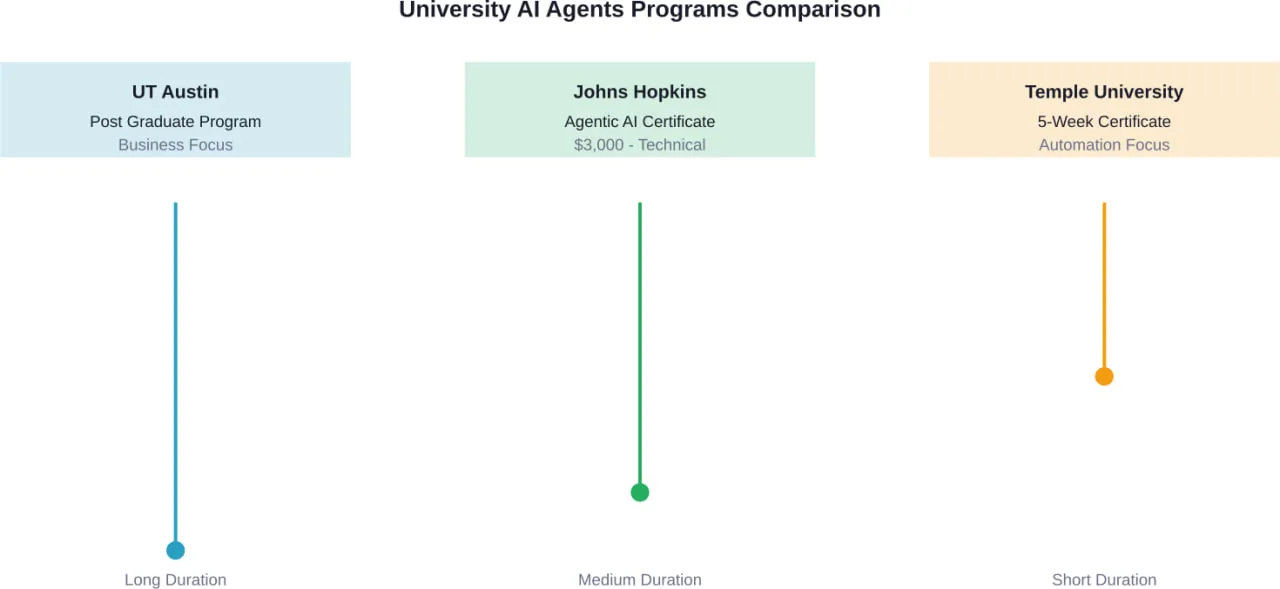
The University of Texas at Austin offers a Post Graduate Program in AI Agents for Business Applications through its McCombs School of Business. This 12-week online program focuses on leveraging agentic AI to drive efficiency and innovation, with flexible tracks for both technical and non-technical learners. Students learn to build AI agents powered by Generative AI and Large Language Models, with specific attention to real business applications.

Johns Hopkins University’s Agentic AI Certificate Program takes a hands-on approach. The program costs $3,000 with financing options available through third-party partners such as Affirm or Climb, including payment plans up to 12 monthly installments. Students build AI agents through practical projects designed to develop real-world skills.

Temple University offers a 5-week AI Automation and Agentic AI Basics certificate course (pricing: $2,300, currently $1,700 with 26% discount for upcoming sessions in April, May, and June 2026) in collaboration with Ziplines Education. The program includes both on-demand content and live sessions (two-hour online sessions once a week) with expert AI practitioners who help students fine-tune workflows for immediate job application. The university issues a certificate of completion that verifies hands-on experience in key AI automation concepts.

Duration and focus comparison of top university AI agents programs

Free Learning Paths

Not everyone needs a paid certification to start building agents. Several high-quality free courses provide solid foundations.

Microsoft’s AI Agents for Beginners course offers 10 lessons that take learners from concept to code, with text, code examples, and video content included. The curriculum covers fundamentals of building AI agents. Each lesson builds progressively, making it accessible for those new to agentic AI.

Hugging Face provides an AI Agents Course that covers tools, thoughts, actions, and observations—the core components of agent architectures. The course sets learners up with the necessary tools and platforms, with hands-on exercises throughout.

Salesforce offers free AI agent training through Trailhead, teaching how to build, optimize, and deploy intelligent workflows. The course focuses on how AI agents automate tasks, make decisions, and interact with data to enhance efficiency.

Specialized Developer Training

For those looking to develop production-ready agent systems, specialized developer courses offer advanced technical training.

Coursera hosts the AI Agent Developer Specialization taught by Dr. Jules White (6-course series, beginner level, approximately 2 months to complete), focusing on designing, building, and refining intelligent software agents using Python, generative AI, and agentic architectures. Throughout the specialization, learners complete hands-on projects that involve building functional AI agents to solve real-world problems across various industries.

Coursera offers various AI courses, but the ‘Building AI Agents with OpenAI Specialization’ is not an Edureka-partnered program on the platform. Basic Python programming and familiarity with APIs are recommended, though no prior experience with agent frameworks is required.

Core Skills Taught in AI Agents Courses

Regardless of which program you choose, certain competencies appear consistently across quality AI agents training.

Skill CategoryWhat It CoversЧому це важливо
Prompt EngineeringCrafting instructions that guide agent behavior, chain-of-thought prompting, few-shot learningDetermines how effectively agents understand and execute tasks
Tool IntegrationConnecting agents to APIs, databases, code execution environments, external systemsEnables agents to take real actions beyond text generation
RAG ImplementationRetrieval-Augmented Generation for grounding agent responses in specific knowledge basesReduces hallucination and improves accuracy for domain-specific tasks
Multi-Agent OrchestrationCoordinating multiple specialized agents to work together on complex workflowsScales agent capabilities beyond what single agents can accomplish
Safety and GuardrailsImplementing constraints, monitoring, and controls to prevent harmful agent behaviorCritical for production deployment and regulatory compliance

OpenAI’s Deep Research API and Agents SDK provide frameworks for building agentic research workflows, demonstrating how these skills come together in practice. The SDK allows developers to orchestrate single and multi-agent pipelines with structured tooling.

Choosing the Right Course for Your Goals

The best AI agents course depends on where you’re starting and where you need to go.

For complete beginners with no coding background, programs like Temple University’s 5-week course or Salesforce’s Trailhead provide accessible entry points. These focus on concepts and no-code tools before diving into technical implementation.

Developers with Python experience but new to AI should consider Microsoft’s free course or Hugging Face’s curriculum. Both provide solid technical foundations without assuming prior AI knowledge.

Business professionals looking to implement agents in organizational contexts benefit most from UT Austin’s business-focused program, which bridges technical concepts with strategic application.

Advanced practitioners aiming for specialized expertise should explore Johns Hopkins’ certificate program or Coursera’s developer specialization. These assume baseline AI knowledge and move quickly into sophisticated implementation patterns.

Time and Budget Considerations

Free courses work well for exploration and foundational learning. But they typically lack structured support, career services, and recognized credentials.

University certificates range from a few hundred to several thousand dollars. Check official websites for current pricing, as rates and financing options change frequently. These programs offer structured curricula, expert instruction, and certificates that carry weight with employers.

The time commitment varies significantly. Short courses run 5-10 weeks with a few hours weekly. Comprehensive specializations may require 3-6 months of consistent effort.

What the AI Agent Standards Initiative Means

The NIST AI Agent Standards Initiative, announced in February 2026, aims to ensure the next generation of AI can function securely on behalf of users and interoperate smoothly across the digital ecosystem.

For learners, this matters because courses that align with emerging standards will provide more lasting value. The initiative focuses on:

  • Trust and security frameworks for autonomous systems
  • Interoperability protocols so agents from different platforms can work together
  • Safety guidelines for deployed agent systems
  • Privacy protections for agent-mediated interactions

Quality courses increasingly incorporate these considerations into their curricula, preparing students for a standardized agentic ecosystem.

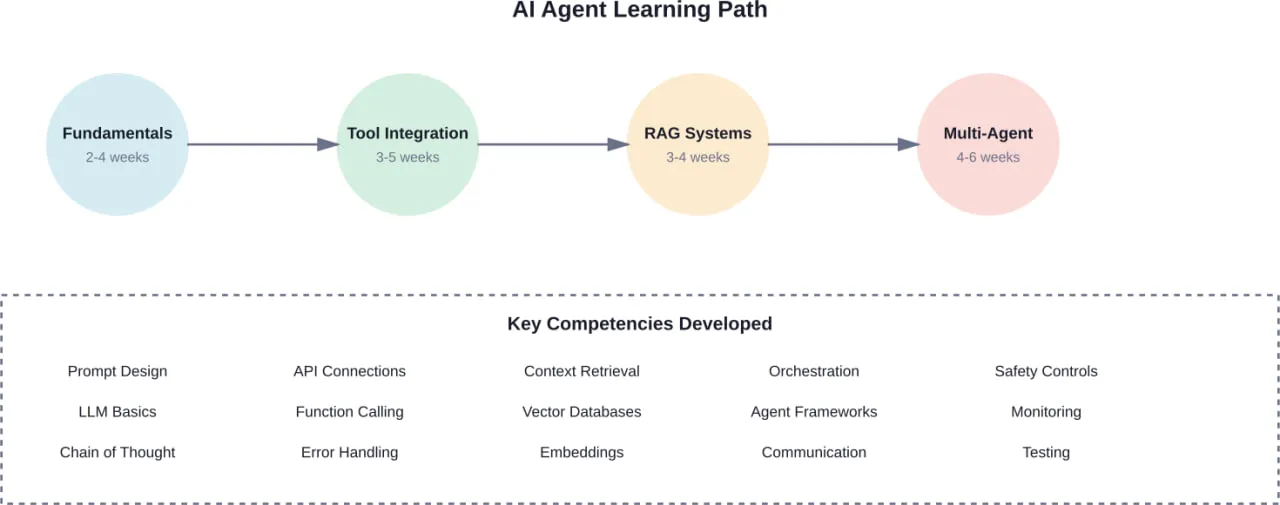
Progressive learning path for mastering AI agent development

Practical Applications You’ll Build

The best courses emphasize hands-on projects that mirror real-world use cases.

Common project types include:

  • Research agents that gather information from multiple sources, synthesize findings, and produce comprehensive reports. These demonstrate multi-step reasoning and tool use.
  • Customer service agents that handle inquiries, access knowledge bases, and escalate complex issues appropriately. These showcase conversational AI and business integration.
  • Code generation agents that analyze requirements, write code, test it, and iterate based on results. These highlight autonomous problem-solving capabilities.
  • Data analysis agents that query databases, perform calculations, create visualizations, and explain insights. These combine technical skills with communication abilities.

Building these projects provides portfolio pieces that demonstrate capabilities to potential employers or clients.

Поширені запитання

  1. Do I need coding experience for an AI agents course?

It depends on the course. Programs like Temple University’s certificate and Salesforce’s Trailhead cater to non-technical learners with no-code approaches. However, most comprehensive courses require at least basic Python knowledge. For developer-focused programs like those from Johns Hopkins or Coursera specializations, programming experience is essential.

  1. How long does it take to learn AI agent development?

Foundational understanding can be gained in 5-10 weeks through structured courses. Building production-ready skills typically requires 3-6 months of consistent learning and practice. Advanced mastery with multi-agent orchestration and specialized frameworks may take 6-12 months depending on prior AI experience.

  1. What’s the difference between agentic AI and regular AI?

Regular AI models generate responses based on inputs but don’t take actions beyond producing text or predictions. Agentic AI systems can plan multi-step workflows, use external tools, maintain memory across interactions, and autonomously work toward goals. Think of the difference between a calculator that solves one equation versus a system that identifies what equations to solve and executes the full analysis.

  1. Are free AI agents courses as good as paid ones?

Free courses from Microsoft, Hugging Face, and Salesforce provide solid foundational knowledge and are excellent for exploration. Paid university programs offer structured curricula, expert instruction, career support, and recognized credentials. Free courses work well for self-motivated learners comfortable with independent study. Paid programs provide more support and validation of skills.

  1. What tools and frameworks do AI agents courses teach?

Most courses cover OpenAI’s API and AgentKit, LangChain for agent orchestration, vector databases for RAG implementations, and Python frameworks for building custom agents. University programs often include multiple frameworks to provide broader exposure. The specific tools vary by course focus and recency.

  1. Can I get certified in AI agents?

Yes, several universities offer certificates upon completion, including Johns Hopkins, UT Austin, and Temple University. These certificates verify hands-on experience and knowledge. Some platforms like Coursera also provide certificates, though university-issued credentials typically carry more weight with employers.

  1. What jobs can I get after completing an AI agents course?

Common roles include AI Agent Developer, Machine Learning Engineer specializing in agentic systems, AI Solutions Architect, Automation Engineer focused on AI workflows, and Applied AI Researcher. Business-focused programs prepare learners for roles in AI strategy, implementation management, and digital transformation.

Getting Started Today

The agent revolution isn’t coming—it’s here. Organizations are deploying these systems now, and the skills gap is real.

Start with a free course if you’re exploring the field or unsure about your commitment. Microsoft’s 10-lesson program or Hugging Face’s curriculum provide solid foundations without financial risk.

If you’re serious about career advancement or organizational implementation, invest in a recognized certificate program. The structured learning, expert instruction, and credential will accelerate your progress significantly.

Either way, the key is starting. Agent architectures are becoming foundational to AI applications across industries. The knowledge you build now will compound as the technology matures and standards solidify.

Check official program websites for current pricing, enrollment dates, and prerequisite requirements. Many universities offer information sessions where prospective students can ask questions and assess fit before committing.

The tools exist. The courses are available. The demand is growing. What happens next depends on action.

Digital Transformation for NGOs: A 2026 Practical Guide

Короткий виклад: Digital transformation for NGOs involves strategically adopting technology to streamline operations, enhance donor engagement, and maximize mission impact. The journey requires focusing on three core elements—people, process, and platform—while addressing challenges like limited budgets and technical expertise. Successful digital transformation can reduce operational costs by 40% and support wait times by 87%, enabling nonprofits to serve more beneficiaries with fewer resources.

Nonprofit organizations and NGOs face mounting pressure to do more with less. Donor expectations are rising, beneficiaries need faster support, and operational complexity keeps growing. Technology isn’t optional anymore—it’s fundamental to survival.

But here’s the thing: digital transformation isn’t about buying the latest software or moving everything to the cloud. It’s about fundamentally rethinking how an organization operates, serves its community, and achieves its mission through strategic technology adoption.

Many NGOs struggle with where to start. The good news? Organizations that get this right are seeing remarkable results.

What Digital Transformation Actually Means for NGOs

Digital transformation represents the process of making operations easier and more effective through technology. For nonprofits, this goes far beyond digitizing paperwork or setting up a website.

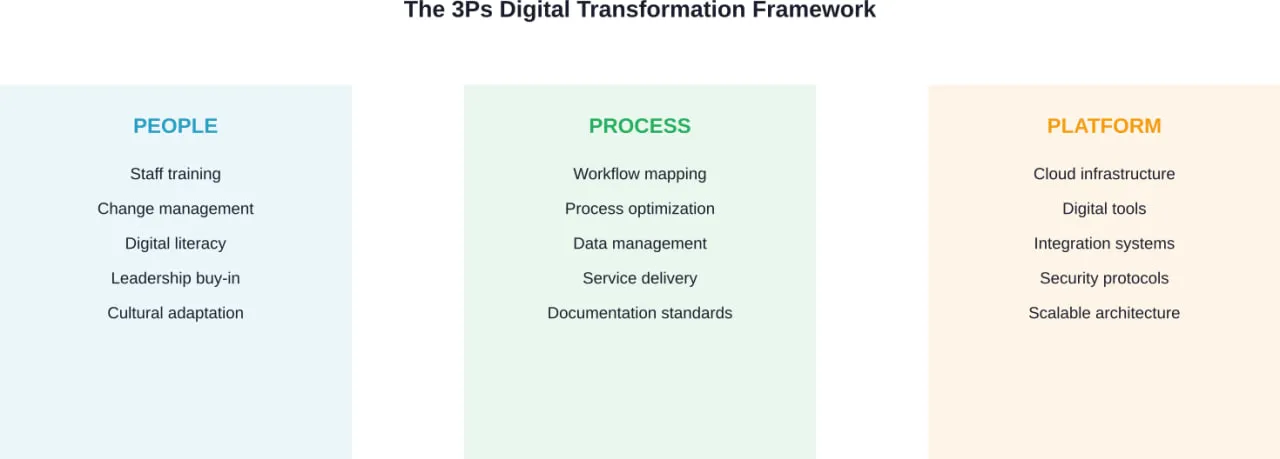
The transformation journey consists of three elements, known as the 3Ps: people, process, and platform and technology. Each component plays an essential role, and neglecting any one of them undermines the entire effort.

People are the foundation. Staff need training, support, and buy-in. Without addressing the human element, even the best technology sits unused.

Process optimization comes next. Before implementing new tools, organizations must examine current workflows. Automating a broken process just creates digital chaos faster.

Platform and technology selection matters, but it’s the final piece—not the starting point. The right technology supports the people and processes already in place.

Modernize Your NGO Operations with Specialized Technical Teams

Implementing digital tools for donor management, field data collection, or automated reporting requires technical expertise that many non-profits lack internally. Hiring full-time, in-house developers can be cost-prohibitive and slow, delaying essential updates to mission-critical systems. A-Listware helps NGOs bridge this gap by providing dedicated development teams and staff augmentation that align with specific project goals and budget constraints.

  • Targeted Expertise: Access developers experienced in cloud platforms, mobile apps, and data security.
  • Cost Management: Reduce the overhead associated with traditional recruitment and office space.
  • Rapid Deployment: Scale your technical capacity quickly to meet grant deadlines or emergency needs.
  • Flexible Engagement: Dedicated specialists work as an extension of your team for as long as required.

Почніть свою цифрову трансформацію з Програмне забезпечення A-List.

Why NGOs Can’t Afford to Ignore Digital Transformation

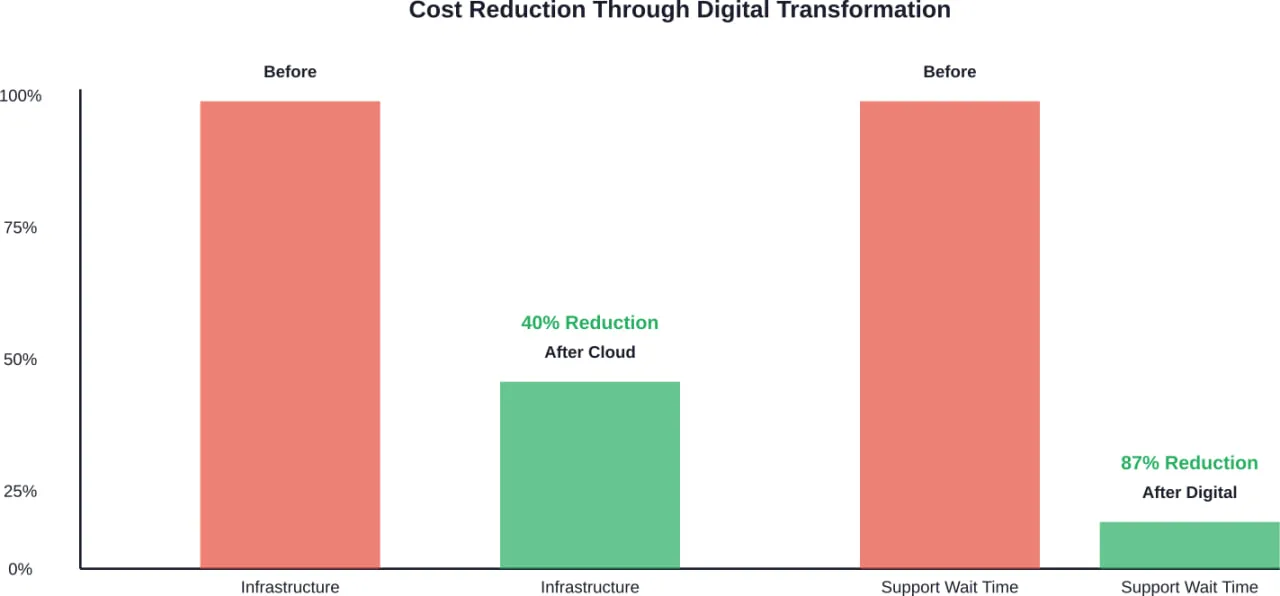
The numbers tell a compelling story. Organizations that embrace cloud technology report a 40 percent reduction in infrastructure costs. That’s significant when every dollar counts toward mission delivery.

Operational efficiency improvements are even more dramatic. Streamlining internal processes through cloud-based collaboration tools reduced support wait times by an estimated 87% for some nonprofits. Think about what that means for beneficiaries in crisis situations.

Generally speaking, sustainability-focused organizations face unique challenges. Environmental NPOs and NGOs work on conservation, restoration, and research projects that generate massive amounts of data. Managing this information without modern digital infrastructure becomes nearly impossible at scale.

The three interdependent pillars of successful digital transformation in nonprofit organizations

Key Steps to Developing a Digital Transformation Strategy

There are 10 key steps to developing a digital transformation program, though not every organization needs to follow them sequentially. The journey looks different for a small local charity versus an international NGO.

Assess Current Digital Maturity

Understanding where an organization stands is critical. This means taking honest stock of existing technology, staff capabilities, and process efficiency.

Many nonprofits discover significant gaps during this assessment. That’s actually good news—it identifies exactly where to focus resources for maximum impact.

Define Clear Objectives Aligned With Mission

Technology for technology’s sake wastes money and frustrates staff. Every digital initiative should connect directly to mission outcomes.

Want to serve more beneficiaries? Improve donor retention? Increase program transparency? Those specific goals drive technology decisions, not the other way around.

Prioritize Quick Wins and Long-Term Investments

Balancing immediate improvements with strategic infrastructure is tricky but essential. Quick wins build momentum and demonstrate value to skeptical stakeholders.

Cloud migration might be a long-term project, but implementing a donor management system could show results within weeks.

Build Internal Capacity and Skills

Training isn’t a one-time event. Digital transformation requires ongoing learning and adaptation as technology evolves.

Organizations that invest in building internal technical capacity reduce dependence on expensive consultants and respond faster to changing needs.

Select Technology That Scales

Small NGOs often start with free or low-cost tools, which makes sense. But outgrowing those tools and migrating data later creates headaches.

Choosing platforms that can scale—even if all features aren’t needed immediately—prevents costly future migrations.

ВикликТрадиційний підхідDigital SolutionВплив
Donor communicationManual emails, spreadsheetsCRM with automationIncreased retention rates
Program data collectionPaper forms, manual entryMobile apps, cloud databasesReal-time insights, reduced errors
Financial trackingLocal accounting softwareCloud-based platformsTransparency, remote access
Beneficiary supportPhone, in-person onlyMulti-channel digital serviceFaster response, broader reach

The Role of Cloud Technology in Nonprofit Transformation

Cloud infrastructure has become foundational for modern NGO operations. It provides scalability and cost-efficiency that on-premises systems simply can’t match.

Achieving scalability with cloud platforms means organizations pay only for resources they use. During fundraising campaigns or disaster response, capacity expands instantly. During slower periods, costs decrease automatically.

Security concerns often arise, but major cloud providers invest far more in security than individual nonprofits ever could. For organizations handling sensitive beneficiary data, this actually improves protection.

Streamlining internal processes through cloud collaboration tools enables distributed teams to work effectively. This became especially apparent during global disruptions that forced remote work—organizations already using cloud platforms adapted seamlessly.

Digital Tools That Drive Social Impact

The right digital tools amplify an organization’s ability to deliver on its mission. But “right” varies dramatically based on sector and size.

Environmental sustainability organizations benefit from data analytics platforms that process research findings and track conservation metrics across vast geographical areas. These tools foster research and innovation that would be impossible with manual methods.

Service delivery nonprofits need case management systems that track beneficiary interactions, outcomes, and program effectiveness. These platforms reduce administrative burden while improving service quality.

Social media and communication platforms extend reach beyond what traditional methods allow. Community discussions around nonprofit work happen online, and organizations that participate effectively build stronger supporter networks.

Documented cost and efficiency improvements from digital transformation initiatives in nonprofit organizations

Challenges Nonprofits Face During Digital Transformation

Real talk: this journey isn’t easy. NGOs face obstacles that for-profit companies don’t encounter.

Limited budgets top the list. Technology requires investment, and convincing boards to allocate scarce resources to infrastructure instead of direct services is challenging.

But wait—there’s a counterargument. Technology that reduces operational costs by 40% actually frees up resources for programs. It’s an investment that pays dividends.

Technical expertise gaps create another barrier. Small nonprofits often lack dedicated IT staff. Relying on volunteers or overextended administrators to manage complex systems isn’t sustainable.

Resistance to change affects organizations of all sizes. Long-tenured staff comfortable with existing processes may view new technology as threatening rather than enabling.

Addressing these challenges requires patience, clear communication about benefits, and involving staff in the selection and implementation process.

Building Donor Trust Through Digital Transparency

Full transparency for donors is crucial for maintaining trust and engagement. Digital platforms make this easier than ever.

Cloud-based financial systems provide real-time access to how funds are used. Donors increasingly expect this level of openness, and organizations that provide it strengthen relationships.

Program impact tracking through digital tools creates compelling stories backed by data. Instead of vague claims about helping communities, organizations can show specific metrics and outcomes.

This approach optimized costs and provided the accountability that modern philanthropy demands.

Поширені запитання

  1. What is digital transformation for NGOs?

Digital transformation for NGOs is the strategic process of integrating technology across all areas of nonprofit operations to improve efficiency, reduce costs, and enhance mission impact. It encompasses the 3Ps framework: people, process, and platform technology working together to fundamentally change how organizations operate and deliver value.

  1. How much does digital transformation cost for small nonprofits?

Costs vary widely based on organization size and existing infrastructure. Many cloud platforms offer nonprofit discounts or free tiers for smaller organizations. The investment can range from minimal (using free tools and existing staff) to significant (comprehensive platform migrations). However, organizations report 40% infrastructure cost reductions through cloud adoption.

  1. What are the biggest barriers to digital transformation in NGOs?

The primary barriers include limited budgets, lack of technical expertise, staff resistance to change, and difficulty prioritizing technology investments over direct program spending. Many organizations also struggle with legacy systems and data migration challenges. Successful transformations address these through phased implementation, staff training, and demonstrating quick wins that build organizational buy-in.

  1. How long does digital transformation take for nonprofits?

Digital transformation is an ongoing journey rather than a destination. Initial implementations of specific tools might take weeks to months, while comprehensive organizational transformation typically unfolds over 2-3 years. The timeline depends on organization size, complexity, existing technical maturity, and available resources. Starting with high-impact quick wins creates momentum for longer-term initiatives.

  1. Can digital transformation actually improve program outcomes?

Absolutely. Organizations that streamline processes through digital tools report support wait time reductions by an estimated 87%, allowing them to serve more beneficiaries with existing staff. Data analytics enable evidence-based program adjustments, while communication platforms expand reach. The technology itself doesn’t improve outcomes—but it enables staff to work more effectively and make better-informed decisions.

  1. What technology should NGOs prioritize first?

Priorities depend on organizational pain points. Organizations struggling with donor relationships should focus on CRM systems. Those with data management challenges benefit from cloud storage and collaboration platforms. Service delivery organizations might prioritize case management tools. The key is assessing current needs and selecting technology that addresses the most pressing operational bottlenecks affecting mission delivery.

  1. How do NGOs measure digital transformation success?

Success metrics should align with mission objectives. Common measures include operational cost reductions, time saved on administrative tasks, increased donor retention rates, faster beneficiary response times, expanded program reach, and improved data accuracy. Organizations should establish baseline metrics before implementation and track changes over time to demonstrate ROI and justify continued investment.

Рухаємося вперед з цифровою трансформацією

Digital transformation represents both a challenge and an opportunity for nonprofit organizations. The path forward requires strategic thinking, careful planning, and commitment to organizational change.

Organizations that embrace this journey position themselves to maximize impact in an increasingly digital world. Those that delay risk falling behind in operational efficiency, donor expectations, and program effectiveness.

The evidence is clear: technology reduces costs, improves service delivery, and strengthens mission achievement. But technology alone isn’t the answer—it’s the combination of people, process, and platform working together that creates lasting change.

Start with an honest assessment of where the organization stands today. Identify the biggest pain points affecting mission delivery. Then take one step forward, whether that’s implementing a single new tool or launching a comprehensive transformation program.

The time to begin is now. Every day spent with inefficient systems is a day with reduced impact for the communities nonprofits serve.

Digital Transformation for Healthcare Payers in 2026

Короткий виклад: Digital transformation for healthcare payers involves modernizing operations through AI, cloud computing, and interoperability standards like FHIR to improve member experiences, reduce administrative costs by up to 30%, and enable real-time data exchange. With CMS regulatory requirements driving adoption and telehealth utilization having surged 3,800% during the pandemic, payers must shift from technology experimentation to value-driven implementation focused on outcomes, simplified communications, and integrated care coordination.

Healthcare payers are operating in an environment that’s fundamentally different from just a few years ago. The pandemic forced rapid digitalization—telehealth exploded, member expectations shifted overnight, and regulatory bodies started demanding interoperability at scale.

But here’s the thing: many payers invested heavily in digital tools without seeing the returns they expected. Bold investments were made, systems were upgraded, and apps were launched. Yet member confusion persists, administrative costs remain stubbornly high, and data still sits in silos.

The question isn’t whether digital transformation is necessary. It’s how to execute it in a way that delivers actual value—not just technology for technology’s sake.

What Digital Transformation Means for Healthcare Payers

Digital transformation in healthcare payer services goes beyond implementing new software. It’s about fundamentally rewiring operations to be data-driven, member-centric, and interoperable with the broader healthcare ecosystem.

According to CMS, the agency is taking bold steps to modernize the nation’s digital health ecosystem with a focus on empowering Medicare beneficiaries through greater access to innovative health technologies. Outdated infrastructure and disconnected data have made it harder for patients and providers to access critical information.

For payers specifically, transformation touches everything: claims processing, member communications, provider networks, care coordination, and regulatory compliance. The Centers for Medicare & Medicaid Services (CMS) has established interoperability requirements as a series of mandatory regulations (such as the CMS Interoperability and Patient Access Final Rule).

Real talk: this isn’t about chasing the latest tech trends. It’s about solving persistent operational inefficiencies and member experience problems that have plagued the industry for decades.

The Core Components of Payer Digital Transformation

Several technology pillars underpin successful healthcare payer digital transformation:

  • Interoperability and data exchange: Implementing FHIR-based standards to share data seamlessly with providers, patients, and other payers
  • AI and automation: Reducing manual work in claims processing, prior authorization, and member services
  • Cloud infrastructure: Enabling scalability, real-time analytics, and faster innovation cycles
  • Member engagement platforms: Providing transparent, personalized digital experiences through apps and portals
  • Data analytics: Leveraging predictive tools to identify high-risk members and optimize care pathways

The HL7 FHIR Implementation Guide for Payer Data Exchange defines a standard interface to health insurers’ insurance plans, their associated networks, and the organizations and providers that participate in these networks. This standardization enables third parties to develop applications that help patients understand their coverage options.

Build Scalable Healthtech Solutions with Dedicated Engineering Teams

Modernizing claims processing and member engagement platforms requires specialized technical expertise and high standards for data security. Finding and retaining local talent with experience in healthcare interoperability and cloud architecture can be a slow and expensive process. A-Listware addresses this by providing dedicated development teams and IT staff augmentation, allowing healthcare payers to accelerate their digital roadmaps without the overhead of traditional recruitment.

  • Нішева технічна експертиза: Доступ до перевірених розробників, які мають досвід роботи зі штучним інтелектом, великими даними та безпечною хмарною інфраструктурою.
  • Efficient Scaling: Quickly expand your engineering capacity to meet project deadlines or regulatory changes.
  • Пряма інтеграція: Dedicated teams that work as a seamless extension of your internal IT department.
  • Resource Optimization: Reduce operational costs by utilizing a flexible, high-performance delivery model.

Почніть свою цифрову трансформацію з Програмне забезпечення A-List.

Why Payers Struggled with Early Digital Investments

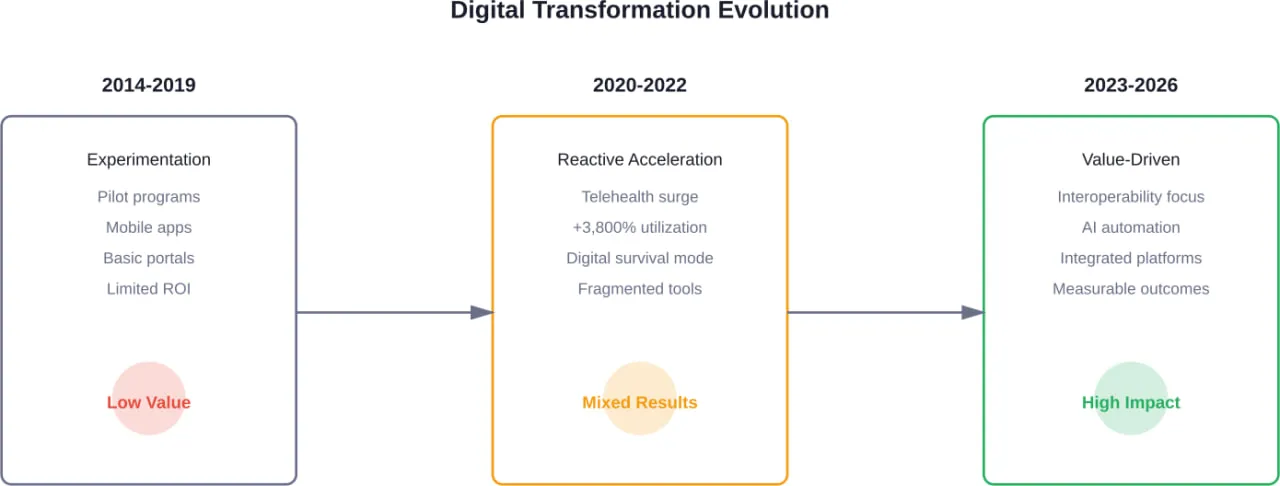
The healthcare industry made bold digital investments over the past several years, accelerated by the pandemic and a growing need to modernize. Telehealth utilization rose by over 3,800% between February and April 2020 at the pandemic’s peak.

But today, many organizations are reflecting on a critical question: Are we truly realizing the value we envisioned?

Several factors contributed to underwhelming results:

  • Technology without strategy. Payers deployed digital tools reactively—implementing telehealth, member apps, and home pharmacy services just to survive—without integrating them into a cohesive member journey.
  • Data fragmentation persisted. New front-end systems were built on top of legacy infrastructure. Data remained trapped in silos, preventing the seamless experience members expected.
  • Complex communications continued. According to research, 51% of insured adults have at least some difficulties understanding their health insurance eligibility. When members don’t understand their coverage, they make suboptimal healthcare decisions and lose trust in their payers.

The short answer? Many payers focused on digitizing existing processes rather than fundamentally rethinking how those processes should work in a digital-first world.

The evolution of digital transformation in healthcare payers from experimental phase to value-focused implementation

The Regulatory Push: CMS Requirements Driving Change

Regulatory requirements are now a major catalyst for digital transformation. The CMS Interoperability Framework represents a call to action for health data networks that want to move faster—to make what should already work, actually work.

Participation in TEFCA is voluntary for non-federal entities, but CMS mandates specific interoperability standards (API access) for regulated payers regardless of network alignment. It’s open, standards-based, and market-friendly, designed so the industry can stop theoretical planning and start executing.

Key Interoperability Mandates

CMS has established several programs and policies aimed at improving patient care through secure data exchange:

  • The Promoting Interoperability Program is a quality program with the goal of driving quality improvement, safety, and efficiency of healthcare by promoting and prioritizing interoperability and the exchange of health care data through certified electronic health record technology.
  • TEFCA (Trusted Exchange Framework and Common Agreement) operates in the United States as a nationwide framework for health information sharing. Created by the Department of Health & Human Services, TEFCA was designed to remove barriers for sharing health records electronically among healthcare providers, patients, public health agencies, and payers.

CMS-0057 (CMS Interoperability and Prior Authorization Final Rule) includes requirements for payers to implement FHIR-based APIs for patient data access, provider directory information, and payer-to-payer data exchange. As of January 2026, the healthcare industry continues to move from planning to active implementation of standardized data exchange, with the first phase of CMS-0057-F having taken effect.

According to Health IT data, nearly half (46%) of HIOs mapped from non-standard laboratory test or result codes to LOINC codes when accessing data from labs. Health information organizations were more likely to send data that adheres to USCDI v1 or v2, but less likely to receive data from participants that adheres to these standards.

This gap between sending and receiving capabilities highlights the ongoing challenge of achieving true bidirectional interoperability across the healthcare ecosystem.

Simplifying Healthcare Communications to Build Trust

Complex healthcare communications cause member confusion and payer inefficiencies. Simplifying products, standardizing documents, and using AI automation can improve operations and satisfaction.

The problem is significant: lack of clarity in complex, confusing language leads to misinterpretations, unexpected costs, and diminished trust between members and payers. When members don’t understand their coverage, they’re less likely to seek preventive care, more likely to face surprise bills, and increasingly frustrated with their payer.

Six Measures to Simplify Health Insurance Documents

Simplification isn’t just about plain language—it requires systematic changes to how payers structure and deliver information:

Simplification StrategyПідхід до реалізаціїВплив на членів організації 
Standardize document templatesCreate consistent layouts across all member materialsEasier navigation and comparison
Use plain languageReplace industry jargon with clear explanationsBetter comprehension of coverage
Visualize complex informationUse charts, icons, and graphics for key conceptsFaster understanding of benefits
Personalize communicationsTailor information based on member needs and usageRelevant, actionable guidance
Implement AI-powered toolsChatbots and virtual assistants for instant answers24/7 support without wait times
Test with actual membersUser testing and feedback loops before wide releaseCommunications that actually work

Health insurance digital transformation can enable personalized care and proactive member guidance through integrated data. When payers connect claims history, clinical data, and member preferences, they can deliver communications that anticipate needs rather than simply responding to inquiries.

AI and Automation: Where the Real Savings Happen

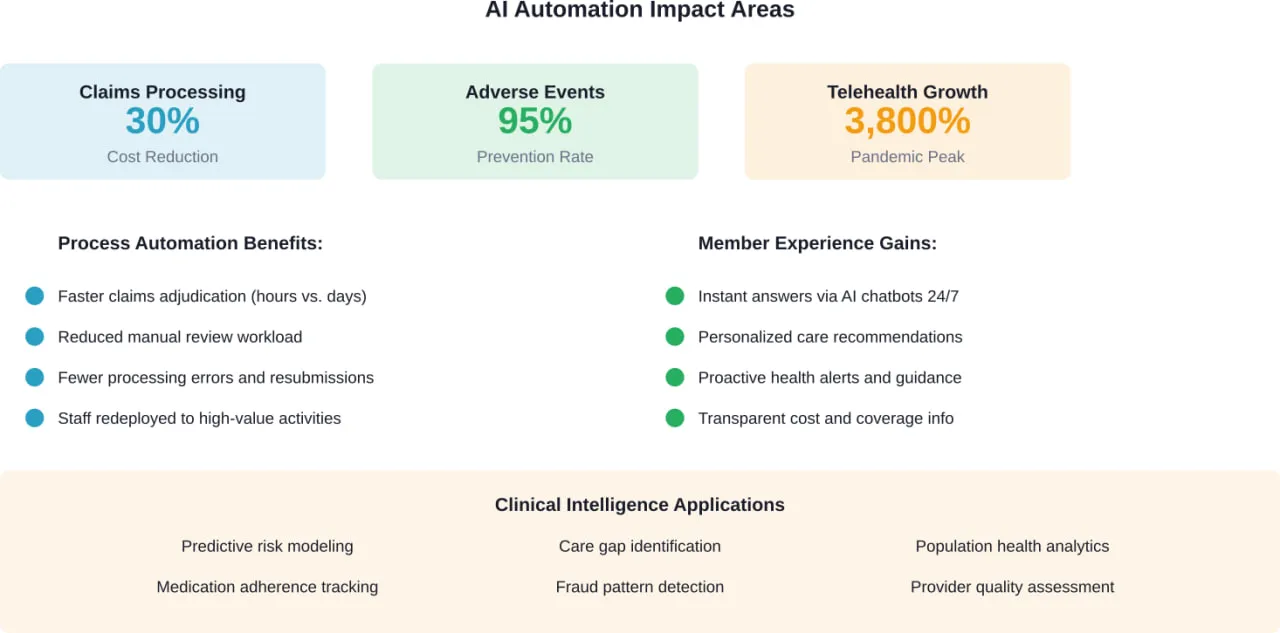
Automation is where digital transformation moves from “nice to have” to “essential for survival.” When automation is scaled properly, payers can achieve up to 30% admin cost savings in claims processing.

But wait—automation isn’t just about cost reduction. It’s about redeploying human talent from repetitive tasks to complex problem-solving and member advocacy.

High-Impact Automation Use Cases

  • Claims processing and adjudication. AI can review claims against policy rules, flag anomalies, and auto-approve straightforward cases. The result: faster processing times, fewer errors, and reduced administrative burden.
  • Prior authorization. This has long been a pain point for providers and patients. Automated systems can evaluate requests against clinical criteria in real-time, approve routine cases instantly, and route complex cases to clinical reviewers with relevant context already assembled.
  • Member service inquiries. Natural language processing enables chatbots to handle common questions about benefits, claims status, and provider networks. When escalation is needed, the system routes members to the right specialist with full conversation history.
  • Fraud detection. Machine learning models can identify suspicious patterns across millions of claims—patterns that would be impossible for human reviewers to spot at scale.

By leveraging digital tools, healthcare providers can enhance the quality of care they provide and improve patient outcomes. This includes preventing up to 95% of adverse drug events and reducing duplicate testing.

Key areas where AI and automation deliver measurable impact for healthcare payers

Data Integration and Analytics: The Foundation

None of the fancy front-end experiences matter if the data foundation is broken. Streamlining data operations is essential for improved business agility.

Real-time data access can both speed up and improve decision-making. Digital transformation has led 65% of U.S. hospitals to use AI-assisted predictive tools embedded in their EHR systems.

For payers, integrated data platforms enable:

  • Unified member profiles combining claims, clinical, pharmacy, and social determinants data
  • Real-time eligibility verification and benefits checking
  • Predictive analytics to identify members at risk for high-cost events
  • Performance dashboards tracking quality measures and outcomes
  • Population health management at scale

CMS continues to evolve Meaningful Measures 2.0 and the Cascade of Meaningful Measures framework to reflect the quality measurement priorities of the agency. When first introduced in 2017, the Meaningful Measures objective was to reduce the number of Medicare quality measures and ease the burden on measured entities.

This shift toward streamlined, meaningful measurement requires payers to have clean, integrated data that can feed reporting requirements without manual intervention.

The FHIR Standard: Making Interoperability Real

HL7 FHIR (Fast Healthcare Interoperability Resources) has emerged as the standard for health data exchange. The Da Vinci Project provides implementation guides specifically designed for payer use cases:

  • Payer Data Exchange (PDex): Enables payers to share clinical and claims data with members and other payers
  • Coverage Requirements Discovery (CRD): Helps providers understand coverage requirements during care planning
  • Prior Authorization Support (PAS): Automates prior authorization submission and status checking
  • Documentation Templates and Rules (DTR): Streamlines documentation collection for prior auth

These aren’t theoretical specifications. They’re battle-tested implementation guides with real-world adoption across major payers and health systems.

Member Experience: Personalization at Scale

Benefits of simplification include personalized products and care delivered through digital channels. Members expect the same level of digital experience from their health plan that they get from retail and banking apps.

Sound familiar? Members want to:

  • Check benefits and coverage with a few taps
  • Compare costs for different providers and treatment options
  • Access virtual care when and where they need it
  • Receive proactive guidance about preventive care and medications
  • Understand their bills without needing a decoder ring

The way forward for health insurers involves building these capabilities on top of integrated data platforms. Personalization requires understanding each member’s unique health journey, preferences, and needs.

Building Effective Member Engagement Platforms

Effective member portals and apps go beyond basic features like ID card access and claims history. They provide:

  • Contextual information. Rather than generic educational content, members receive information relevant to their conditions, medications, and care plan.
  • Cost transparency. Before scheduling a procedure, members can see estimated costs based on their specific benefits and deductible status.
  • Care navigation. Guided pathways help members find the right care at the right time—whether that’s a telehealth visit, urgent care, or specialist referral.
  • Health action plans. Personalized reminders for preventive screenings, medication refills, and chronic condition management.

Now, this is where it gets interesting: when these digital touchpoints are connected to care management teams, they create a seamless hybrid experience. Digital tools handle routine interactions, while human support is available when complexity or empathy is needed.

Value-Based Care and Outcomes Measurement

Digital transformation enables payers to participate more effectively in value-based care arrangements. With integrated data and analytics, payers can:

  • Track quality metrics in real-time rather than retrospectively
  • Identify care gaps and coordinate outreach to close them
  • Attribute outcomes to specific interventions and providers
  • Share actionable insights with provider partners
  • Adjust care strategies based on what’s working

The shift from fee-for-service to value-based payment models requires this level of operational sophistication. Payers can’t just pay claims differently—they need to fundamentally change how they manage populations and partner with providers.

Traditional Payer ModelDigitally Transformed Model
Reactive claims processingProactive care management
Provider as vendorProvider as partner
Volume-based paymentsOutcome-based contracts
Annual quality reportingReal-time performance tracking
Siloed data systemsIntegrated health information
Generic member communicationsPersonalized engagement
Manual workflowsАвтоматизація на основі штучного інтелекту

Проблеми впровадження та шляхи їх вирішення

Okay, so what about the obstacles? Healthcare payers face several significant challenges when executing digital transformation:

Інтеграція застарілих систем

Most payers operate on core administration platforms that are decades old. These systems contain critical business logic and historical data that can’t simply be replaced overnight.

The solution isn’t always rip-and-replace. Many successful transformations use an incremental approach: building modern API layers on top of legacy systems, gradually migrating functionality to cloud-based microservices, and maintaining parallel systems during transition periods.

Data Quality and Standardization

Even with FHIR standards, data quality remains a challenge. Nearly half of HIOs must map from non-standard codes to standardized formats. Incomplete member records, inconsistent provider directories, and fragmented care histories all undermine digital initiatives.

Addressing this requires dedicated data governance: establishing master data management processes, implementing validation rules at point of entry, and continuous monitoring of data quality metrics.

Change Management and Culture

Technology is often the easy part. The harder challenge is getting people to change how they work. Staff members who’ve processed claims manually for years may resist automation. Clinical teams might be skeptical of AI recommendations.

Successful transformations invest heavily in change management: communicating the vision clearly, involving frontline staff in design decisions, providing thorough training, and celebrating early wins to build momentum.

Security and Privacy Concerns

Healthcare data is among the most sensitive information that exists. Any digital transformation must maintain rigorous security and privacy protections while enabling data flow.

This requires a zero-trust security architecture, comprehensive encryption, regular audits, and privacy-preserving technologies that allow data use for analytics while protecting individual identities.

A phased approach to healthcare payer digital transformation with key success factors and pitfalls

Looking Ahead: The Future of Payer Digital Transformation

As we move deeper into 2026, several trends are shaping the next phase of healthcare payer digital transformation:

  • Generative AI for documentation and communications. Large language models can draft member correspondence, summarize clinical documentation for care managers, and even assist with appeals and grievance responses—all while maintaining compliance and appropriate oversight.
  • Real-time benefit authorization. As interoperability matures, the vision of real-time benefit checking and prior authorization at the point of care becomes achievable. Providers get instant answers, members avoid surprise denials, and payers reduce administrative rework.
  • Social determinants integration. Digital platforms are beginning to incorporate data on housing, food security, transportation, and other social factors that heavily influence health outcomes. This enables more holistic member support.
  • Ecosystem partnerships. Payers are moving beyond bilateral integrations to participate in multi-party data networks. TEFCA and CMS-Aligned Networks represent the infrastructure for this connected ecosystem.

The healthcare industry continues to move from planning to active implementation. Organizations that execute well on digital transformation fundamentals—interoperability, automation, data integration, and member experience—will be positioned to lead.

Поширені запитання

  1. What is digital transformation for healthcare payers?

Digital transformation for healthcare payers involves modernizing core operations through cloud computing, AI automation, interoperability standards like FHIR, and integrated data platforms. The goal is to improve member experiences, reduce administrative costs (up to 30% in claims processing), enable value-based care models, and meet regulatory requirements for data exchange. It’s not just about implementing new technology—it’s about fundamentally rewiring how payers operate to be data-driven and member-centric.

  1. Why are healthcare payers investing in digital transformation now?

Several factors are driving urgency: CMS regulatory requirements for interoperability and data exchange that took effect in recent years, the pandemic’s acceleration of telehealth and digital expectations (telehealth use rose 3,800% at peak), persistent member confusion with 51% of insured adults struggling to understand their coverage, competitive pressure from digitally-native entrants, and the opportunity to reduce administrative costs through automation. Payers that don’t modernize risk regulatory non-compliance and member attrition.

  1. What are the biggest challenges in healthcare payer digital transformation?

The primary challenges include integrating with decades-old legacy core administration systems, ensuring data quality and standardization (nearly half of health information organizations must map from non-standard codes), managing organizational change and culture resistance, maintaining security and privacy while enabling data flow, and demonstrating clear ROI to justify continued investment. Technical implementation is often easier than getting people and processes to change.

  1. How does FHIR enable payer digital transformation?

HL7 FHIR provides standardized APIs for healthcare data exchange, enabling payers to share information with providers, members, and other payers without custom integrations. The Da Vinci Project offers payer-specific implementation guides for use cases like member data access, prior authorization, coverage requirements discovery, and payer-to-payer exchange. FHIR compliance is now required by CMS regulations, making it essential infrastructure rather than optional. It allows systems to “speak the same language” for health data.

  1. What ROI can payers expect from digital transformation?

When scaled properly, automation can deliver up to 30% cost savings in claims processing, while AI can prevent up to 95% of adverse drug events. Beyond direct cost reduction, benefits include improved member retention through better experiences, reduced manual rework through automation, faster claims processing (hours vs. days), fewer prior authorization delays, and better performance in value-based contracts through real-time quality tracking. The key is focusing on high-impact use cases rather than trying to transform everything at once.

  1. How long does healthcare payer digital transformation take?

Enterprise-wide transformation typically requires 18-36 months, but value delivery should start much earlier—within 6-9 months for initial pilots and quick wins. The most successful approaches are phased: assessment and planning (months 1-3), foundational data and cloud work (months 3-12), pilot automation and member portal launches (months 6-15), and enterprise scaling (months 12+). Attempting to transform everything simultaneously usually fails. Incremental delivery with measurable milestones maintains momentum and executive support.

  1. What role does AI play in payer digital transformation?

AI powers multiple high-value use cases including claims auto-adjudication, prior authorization evaluation against clinical criteria, fraud detection through pattern analysis, member service chatbots using natural language processing, predictive modeling to identify at-risk members, personalized care recommendations, and documentation summarization. The technology has matured significantly, with 65% of U.S. hospitals now using AI-assisted predictive tools. For payers, AI enables both cost reduction through automation and quality improvement through better decision support.

Conclusion: From Strategy to Execution

Digital transformation for healthcare payers has moved from strategic aspiration to operational necessity. CMS regulations require it, members expect it, and economic pressures demand it.

The payers that will succeed aren’t necessarily those with the biggest technology budgets. They’re the ones that maintain ruthless focus on value delivery—measuring outcomes, iterating based on results, and avoiding the temptation to chase every new technology trend.

The fundamentals remain critical: interoperability that enables seamless data flow, automation that reduces administrative burden, integrated data platforms that provide a single source of truth, and member experiences that are simple, transparent, and personalized.

As the healthcare ecosystem continues evolving toward value-based care and integrated delivery models, digitally mature payers will be positioned as strategic partners rather than transactional processors. The work of transformation is challenging, but the cost of standing still is far greater.

The question isn’t whether to transform—it’s how quickly and effectively your organization can execute on the fundamentals while maintaining focus on measurable business value.

Next.js vs React: Choosing the Right Tool for Your Project

If you work with modern web applications, you have almost certainly run into the Next.js vs React question. On the surface, it sounds like a comparison between two competing tools. In reality, it is more about understanding layers and tradeoffs than picking a winner.

React is a flexible UI library that gives you full control over how your application is built. Next.js sits on top of React and adds structure, defaults, and server-side capabilities that many teams need once projects grow. The right choice depends less on trends and more on what you are actually building, how it will be used, and how much complexity you want to manage yourself.

This article takes a grounded look at Next.js and React without marketing fluff or theoretical extremes. The goal is simple: help you make a confident, practical decision based on real use cases, technical tradeoffs, and long-term maintainability.

Understanding React at Its Core

React is a JavaScript library designed to build user interfaces through reusable components. Its strength comes from how it manages UI state and updates the browser efficiently when something changes.

At its heart, React introduced a mental model that felt different when it first appeared. Instead of manually manipulating the DOM, you describe how the interface should look for a given state, and React takes care of updating the page when that state changes.

What React Is Really Good At

React shines when the application behavior is highly interactive. Dashboards, internal tools, media platforms, and SaaS products often depend on frequent UI updates, conditional rendering, and complex client-side logic.

Key characteristics of React include:

  • Component-based architecture that encourages reuse.
  • Virtual DOM for efficient UI updates.
  • One-way data flow that keeps state predictable.
  • A flexible ecosystem that lets you choose your own tools.

React does not dictate how you organize files, how you handle routing, or how data is fetched. That freedom is both its biggest strength and, for some teams, its biggest challenge.

Where React Starts to Show Its Limits

React by itself is focused entirely on the client side. Out of the box, it does not handle server-side rendering, static generation, or routing. None of these are flaws, but they do mean extra work once your project grows.

In most real-world React applications, teams eventually add:

  • A routing library.
  • A build and bundling setup.
  • A backend or API layer.
  • Performance optimizations.
  • SEO-related rendering strategies.

This is where frameworks like Next.js enter the picture. They do not replace React. They formalize and automate the pieces teams usually add later.


What Next.js Adds on Top of React

Next.js is a framework built on top of React that focuses on production concerns. It answers questions React intentionally leaves open.

Instead of asking developers to assemble everything themselves, Next.js provides defaults that work well for many common scenarios. That includes rendering strategies, routing, performance optimizations, and even backend capabilities.

Next.js does not change how you write React components. You still use JSX, hooks, and familiar patterns. What changes is how those components are rendered and delivered.


Supporting Web Projects at Any Stage of the Stack

За адресою Програмне забезпечення списку А, we help clients build and maintain modern web applications by providing experienced software engineers, UI/UX designers, and full development teams. While the choice between tools like React and Next.js often depends on rendering models, routing needs, or SEO goals, success also hinges on execution. That’s where we come in.

We support both frontend and backend development with a focus on long-term maintainability, seamless team integration, and infrastructure support. Our specialists work across a wide stack that includes web, mobile, cloud platforms, and databases. Whether our clients are building single-page interfaces, scaling enterprise platforms, or modernizing legacy systems, we help them move forward with the right people and practices in place.

Instead of choosing between flexibility or structure, some teams need both at different points. We step in with engineers who can work within your chosen architecture and deliver consistent results, whether your project leans toward a flexible UI library or a structured full-stack framework.

Key Comparison Features to Consider

React and Next.js share the same core – both rely on components, JSX, and the virtual DOM – but how they handle critical features like rendering, routing, performance, and backend integration is where things start to diverge. These aren’t just technical details. They shape how you structure your codebase, what kind of talent you need, and how your application performs in the real world.

Rendering Models Explained Without the Buzzwords

One of the most important differences between Next.js and React is how pages are rendered. This topic is often wrapped in jargon, so it is worth slowing down and making it concrete.

Client-Side Rendering

This is React’s default model. The browser loads a minimal HTML file, downloads JavaScript, and then renders the interface.

This works well for applications where SEO is not critical and users are already authenticated, such as dashboards or internal tools.

Server-Side Rendering

With server-side rendering, the HTML for a page is generated on the server for each request. The browser receives a fully formed page and then React takes over on the client.

Next.js supports this out of the box. It improves initial load speed and makes content easier for search engines to index.

Static Site Generation

Static generation means pages are built ahead of time during deployment. They are fast, cacheable, and cheap to serve.

Next.js allows you to statically generate pages while still using React for interactivity.

React does not support server-side rendering or static site generation by default. These approaches require external libraries or frameworks, such as ReactDOMServer or Next.js.

Routing: Flexibility vs Convention

Routing is another area where the difference between React and Next.js becomes obvious.

In a plain React setup, routing is explicit. You define routes in code, choose your routing library, and control everything manually. This is powerful, especially for applications with unusual navigation patterns.

Next.js uses file-based routing. The folder structure defines URLs. This feels restrictive at first, but it removes a large amount of boilerplate and makes routes easy to reason about.

The tradeoff looks like this:

  • React gives you control and flexibility.
  • Next.js gives you speed and consistency.

Neither approach is inherently better. The right choice depends on how complex your routing needs really are.

Performance in Practice, Not in Theory

Performance comparisons between React and Next.js often miss an important point. React is not slow. Next.js is not magically fast.

The real difference is how much performance work you need to do yourself.

Next.js includes automatic code splitting, image optimization, and smart loading strategies by default. These features matter more as applications grow.

With React, you can achieve similar results, but you need to assemble the pieces yourself. For experienced teams, this can be an advantage. For smaller teams or fast-moving projects, it can become overhead.

SEO Considerations That Actually Matter

SEO is often mentioned in React vs Next.js discussions, sometimes without nuance.

React apps can be indexed by search engines, but it often requires additional setup to ensure reliability, especially for dynamic or frequently changing content. Next.js reduces that risk by delivering HTML directly through server rendering or static generation.

If organic search traffic is a meaningful part of your business model, Next.js usually makes sense. If SEO is irrelevant, such as in internal tools or authenticated platforms, React alone is often enough.

Backend Capabilities and API Routes

Next.js provides API Routes for lightweight backend tasks such as form handling or proxying, but they are not a full replacement for dedicated backend systems.

Common uses include:

  • Authentication logic.
  • Form submissions.
  • Lightweight integrations.
  • Proxying external APIs.

React does not include anything similar. You need a separate backend or server framework.

This difference alone can influence architecture decisions, especially for small to mid-sized projects.

Tooling, Ecosystem, and Learning Curve

React has a larger ecosystem and a broader talent pool. There are more libraries, more tutorials, and more developers familiar with it.

Next.js builds on that foundation but introduces its own conventions. Developers who already know React usually adapt quickly, but beginners may find the added concepts overwhelming at first.

From a hiring and onboarding perspective:

  • React skills are easier to find.
  • Next.js skills are increasingly common but still more specialized.

Next.js vs React: Side-by-Side Comparison

КатегоріяРеагуватиNext.js
TypeUI libraryFramework built on React
RenderingClient-side by defaultSSR, SSG, and hybrid
RoutingManual setupFile-based routing
SEORequires extra setupSEO-friendly by default
Performance toolsManual configurationBuilt-in optimizations
Backend supportExternal onlyBuilt-in API routes
ГнучкістьДуже високийStructured but configurable
Learning curveLower at startEasier with React knowledge


When React Alone Is the Better Choice

There are many situations where adding Next.js does not make sense.

React alone is often the right choice when:

  • You are building a single-page application.
  • SEO is not a priority.
  • You already have a backend in place.
  • You need complete control over routing and architecture.
  • You are targeting web and mobile with shared logic.

React excels as a foundation for highly interactive applications where the UI is the main product.


When Next.js Is the Better Choice

Next.js tends to shine when delivery and performance matter as much as UI logic.

Next.js is usually the better option when:

  • SEO plays a meaningful role.
  • Initial page load speed matters.
  • You need static pages with dynamic elements.
  • You want backend and frontend in one stack.
  • You want sensible defaults instead of assembling everything yourself.

Marketing sites, blogs, ecommerce platforms, and content-heavy applications often benefit from these strengths.


The Question Teams Should Actually Ask

Instead of asking whether Next.js is better than React, a more useful question is this:

How much structure do we want, and how much are we willing to manage ourselves?

React gives you freedom and flexibility, while Next.js provides structure and sensible defaults. Both approaches can lead to excellent results when used intentionally.


Will Next.js Replace React?

No, and it does not need to. React remains the foundation. Next.js depends on it. As long as React exists, frameworks like Next.js will continue to evolve around it.

For many teams, the journey looks like this: Start with React. Add complexity. Adopt Next.js when the project demands it. That progression is natural, not a failure of either tool.


Заключні думки

Next.js vs React is not a rivalry. It is a layering decision. React is about building interfaces. Next.js is about shipping them efficiently. Once you stop treating the choice as a competition, it becomes easier to pick the right setup for each project. The best decision is the one that aligns with your goals, your team’s experience, and the real demands of your product, not the loudest opinions online. If you understand those factors, both React and Next.js can be excellent tools in the right context.


ПОШИРЕНІ ЗАПИТАННЯ

  1. Is Next.js just a replacement for React?

Not exactly. Next.js is built on top of React, so it doesn’t replace it, it extends it. You still write React components, use JSX, and manage state the same way. What Next.js brings to the table is everything around that: routing, rendering, performance features, and server-side capabilities. If React is the engine, Next.js is the full vehicle.

  1. Do I need to learn React before jumping into Next.js?

Yes, and honestly, you’ll thank yourself later. Next.js assumes you already understand how React works. If you’re not comfortable with components, props, and state yet, you’ll probably feel a bit lost. Once you’ve got the basics of React down, though, Next.js will feel like a natural upgrade.

  1. Which is better for SEO: React or Next.js?

Next.js, hands down. React apps are client-side by default, which can be tricky for search engines to crawl reliably. Next.js supports server-side rendering and static generation out of the box, which means your pages get delivered with actual HTML content already in place. That’s a big win for discoverability.

  1. Can I use Next.js for large-scale applications?

Absolutely. Next.js was made for production use, and many companies run big, complex apps on it, including platforms with dynamic content, eCommerce, and hybrid rendering needs. That said, you still need to architect things properly. It’s a framework, not magic.

  1. What if I already have a backend? Do I still need Next.js?

Maybe, maybe not. If your backend already handles routing, APIs, and data rendering well, React on its own might be enough. But if you’re looking for a smoother frontend experience with things like file-based routing, fast page loads, and better SEO, Next.js could still be worth the switch, even with an existing backend.

  1. Is React dead if everyone’s using frameworks like Next.js now?

Not even close. React is still at the core of many modern web apps, including those built with Next.js. Frameworks come and go, but the library they’re built on tends to stick around. React isn’t going anywhere – it’s just evolving with new tools layered on top.


Альтернативи Zipkin, які підходять для сучасних розподілених систем

Zipkin допоміг багатьом командам зробити перші кроки у розподіленому трасуванні. Він простий, з відкритим вихідним кодом і добре справляється з основними завданнями. Але в міру того, як системи стають складнішими, ця простота може почати здаватися обмежувальною. Більше сервісів, більше середовищ, більше шуму - і раптом трасування вже не зводиться лише до відстеження шляху запиту.

Багато команд сьогодні хочуть, щоб трасування природно вписувалося в процес створення та постачання програмного забезпечення. Менше ручних налаштувань, менше рухомих частин, які потрібно обслуговувати, і кращий контекст журналів, метрик та інфраструктури. Ось тут і з'являються альтернативи Zipkin. Деякі з них зосереджені на більш глибокому спостереженні, інші - на простоті використання або тіснішій інтеграції з хмарою. Правильний вибір зазвичай залежить від того, як швидко рухається ваша команда, і скільки накладних витрат ви готові нести, щоб бачити, що відбувається у вашій системі.

1. AppFirst

AppFirst підходить до розмови про трасування з незвичного боку. Вони не намагаються замінити функцію Zipkin функцією. Замість цього вони розглядають спостережність як щось, що вже має бути присутнім під час запуску програми, а не як щось, що команди додають пізніше. Трасування, журнали та метрики живуть у ширшому середовищі, де розробники визначають, що потрібно їхньому додатку, а платформа керує інфраструктурою, яка стоїть за цим. На практиці це означає, що дані трасування відображаються як частина життєвого циклу програми, а не як окрема система, яку хтось повинен з'єднати разом.

Особливістю AppFirst є те, як вона розподіляє відповідальність. Розробники зберігають право власності на додаток від початку до кінця, але їх не втягують у файли Terraform, хмарні політики чи запити на вилучення даних лише для того, щоб отримати видимість. Для команд, які звикли, що Zipkin працює як ще один сервіс, який потрібно підтримувати, це може здатися перезавантаженням. Трасування - це не стільки управління колекторами і сховищем, скільки бачення поведінки в контексті - який сервіс, яке середовище і скільки коштує його запуск. Це не чистий інструмент для відстеження, але для деяких команд це саме те, що потрібно.

Основні моменти:

  • Підхід до спостережуваності та інфраструктури, орієнтований на додатки
  • Вбудована функція відстеження, а також ведення журналів і моніторингу
  • Централізовані аудиторські сліди для змін в інфраструктурі
  • Прозорість витрат у прив'язці до програм і середовищ
  • Працює з AWS, Azure та GCP
  • Варіанти розгортання SaaS та самостійного хостингу

Для кого це найкраще:

  • Команди розробників, які не хочуть керувати інфраструктурою трасування
  • Швидка доставка для команд з обмеженою пропускною здатністю DevOps
  • Організації, що стандартизують розгортання та моніторинг програм
  • Розробники, яким потрібна трасування без вивчення хмарних інструментів

Контактна інформація:

2. Єгер.

Jaeger часто є першою серйозною альтернативою Zipkin, на яку звертають увагу альтернативні команди, особливо коли розподілені системи починають давати збої. Вони зосереджуються саме на відстеженні: відстежують запити в різних сервісах, розуміють затримки і виявляють, де щось сповільнюється або виходить з ладу. Jaeger зазвичай дає більше контролю, більше варіантів конфігурації та кращу видимість складних графіків сервісів.

Існує також сильна орієнтація на спільноту. Jaeger має відкритий вихідний код, управляється відкрито і тісно пов'язаний з OpenTelemetry. Це важливо для команд, які хочуть уникнути замкнутості або покладатися на широко прийняті стандарти. Компроміс - це зусилля. Належне використання Jaeger означає, що потрібно думати про зберігання, вибірку та масштабування. Він підходить командам, яким комфортно володіти цією складністю і налаштовувати її з часом, а не очікувати, що трасування з'явиться за замовчуванням.

Основні моменти:

  • Розподілена трасувальна платформа з відкритим вихідним кодом
  • Розроблено для мікросервісів і складних робочих процесів
  • Глибока інтеграція з OpenTelemetry
  • Аналіз залежності від сервісів та затримок
  • Активна спільнота та довгострокова зрілість проекту

Для кого це найкраще:

  • Інженерні команди, які вже запускають мікросервіси у великих масштабах
  • Організації, прихильні до інструментарію з відкритим кодом
  • Команди, яким потрібен точний контроль над поведінкою трасування

Контактна інформація:

  • Веб-сайт: www.jaegertracing.io
  • Twitter: x.com/JaegerTracing

графана

3. Grafana Tempo

Grafana Tempo йде іншим шляхом, ніж класичні системи типу Zipkin. Замість того, щоб індексувати кожну трасу, вони зосереджуються на дешевому зберіганні великих обсягів даних трасування і зв'язують їх з метриками і журналами, коли це необхідно. Для команд, які досягли межі масштабування Zipkin, цей підхід може виявитися більш практичним, особливо коли обсяг трасування зростає швидше, ніж очікувалося.

Темп зазвичай використовується разом з іншими інструментами Grafana, що визначає те, як команди працюють з ним. Трасування - це не завжди перше, що ви запитуєте самостійно. Замість цього інженери переходять від метричного шипа або лінії журналу прямо до трасування. Такий робочий процес робить Tempo менш орієнтованим на перегляд трас і більш орієнтованим на з'єднання сигналів. Це добре працює, якщо ви вже працюєте з дашбордами Grafana, але може здатися незвичним, якщо ви очікуєте, що трасування буде окремим процесом.

Основні моменти:

  • Масштабний бекенд трасування, створений для зберігання об'єктів
  • Підтримує протоколи Zipkin, Jaeger та OpenTelemetry
  • Тісна інтеграція з Grafana, Loki та Prometheus
  • Призначений для роботи з дуже великими обсягами трасування
  • Відкритий код з самокерованими та хмарними опціями

Для кого це найкраще:

  • Системи, що генерують великі обсяги даних трасування
  • Організації, орієнтовані на економічно ефективне довгострокове зберігання
  • Інженери, які співставляють траси з журналами та метриками, а не просто переглядають траси

Контактна інформація:

  • Веб-сайт: grafana.com
  • Facebook: www.facebook.com/grafana
  • Twitter: x.com/grafana
  • LinkedIn: www.linkedin.com/company/grafana-labs

4. SigNoz

SigNoz зазвичай розглядається як альтернатива самостійному запуску Zipkin. Він розглядає трасування як частину більш широкого підходу до спостережуваності, інтегруючи його з логами та метриками, а не тримаючи його окремо. Для команд, які спочатку використовували Zipkin, а потім включили інші інструменти, SigNoz часто стає актуальним, коли їх набір інструментів відчуває себе розрізненим. Його дизайн від самого початку обертається навколо OpenTelemetry, впливаючи на збір даних і різних сигналів під час налагодження.

Команди швидко помічають переваги робочого процесу. Замість того, щоб перемикатися між різними інструментами трасування, ведення журналів і метрик, SigNoz зберігає ці види інтегрованими. Повільна кінцева точка може привести безпосередньо до трасування, а потім до пов'язаних журналів без втрати контексту. Він не такий легкий, як Zipkin, але це компроміс. Ви отримуєте більше контексту, але також маєте більшу систему для роботи. Деякі команди вважають це прийнятним, оскільки їхні системи перевершують базові потреби в трасуванні.

Основні моменти:

  • OpenTelemetry - власний дизайн для трас, журналів та метрик
  • Використовує стовпчикову базу даних для обробки даних спостережень
  • Можна розміщувати на власному хостингу або використовувати як керовану послугу
  • Зосередьтеся на кореляції сигналів під час налагодження

Для кого це найкраще:

  • Команди, які вже використовують OpenTelemetry в різних сервісах
  • Інженери втомилися зшивати воєдино численні інструменти спостереження
  • Командам зручно працювати з ширшим стеком спостережень

Контактна інформація:

  • Веб-сайт: signoz.io
  • Twitter: x.com/SigNozHQ
  • LinkedIn: www.linkedin.com/company/signozio

5. OpenTelemetry

OpenTelemetry не є єдиним інструментом, який ви розгортаєте, а забезпечує спільну мову для створення та переміщення трас, метрик та журналів. Багато команд замінюють Zipkin, стандартизуючи OpenTelemetry для інструментарію, а потім обирають бекенд пізніше.

Такий підхід змінює спосіб прийняття рішень щодо відстеження. Замість того, щоб заздалегідь прив'язуватися до однієї системи, команди використовують інструменти один раз і тримають свої можливості відкритими. Сервіс може почати з надсилання трас до простого бекенду, а згодом перейти до чогось більш просунутого, не торкаючись коду програми. Така гнучкість є привабливою, але вона вимагає відповідальності. Хтось все одно повинен вирішувати, куди йдуть дані і як вони зберігаються. OpenTelemetry не позбавляє вас цієї роботи, вона просто уникає жорстких залежностей.

Основні моменти:

  • Незалежні від постачальника API та SDK для трасування, журналів і метрик
  • Підтримує багато мов і фреймворків з коробки
  • Розроблено для роботи з декількома бекендами, а не для їх заміни
  • Відкритий вихідний код з розробкою, керованою спільнотою

Для кого це найкраще:

  • Команди, які планують відійти від Zipkin без бекенд-блокування
  • Організації, що стандартизують інструментарій для різних послуг
  • Інженерні групи, яким потрібна гнучкість в інструментах спостереження

Контактна інформація:

  • Веб-сайт: opentelemetry.io

6. Вгору.

Uptrace зазвичай розглядається, коли командам потрібно більше, ніж Zipkin, але вони не хочуть самостійно збирати повний стек спостережуваності. Вони зосереджуються на розподіленому трасуванні, але зберігають метрики і логи досить близько, щоб налагодження залишалося практичним. Трасування зберігається і запитується таким чином, що працює добре, навіть коли окремі запити стають великими, що має значення, коли сервіси починають розгалужуватися на багато залежностей.

Однією з особливостей є те, як Uptrace балансує між контролем і зручністю. Команди можуть запускати його самостійно або використовувати кероване налаштування, але досвід залишається досить схожим. Інженери часто описують перехід з Zipkin як менш болючий, ніж очікувалося, в основному тому, що OpenTelemetry працює з приладами, а Uptrace фокусується на тому, що відбувається після надходження даних. Це більше схоже на систему, яка спочатку відстежує, ніж на платформу "все в одному", якій віддають перевагу деякі команди.

Основні моменти:

  • Розподілена трасування на основі OpenTelemetry
  • Підтримує великі траси з багатьма прольотами
  • Працює як самостійний хостинг, так і керований варіант
  • Траси, метрики та журнали доступні в одному місці

Для кого це найкраще:

  • Системи зі складними шляхами запитів і великими трасами
  • Інженери, які хочуть OpenTelemetry, не будуючи все самостійно

Контактна інформація:

  • Веб-сайт: uptrace.dev
  • Електронна пошта: support@uptrace.dev

7. Apache SkyWalking

До Apache SkyWalking зазвичай звертаються, коли Zipkin починає здаватися занадто вузьким для того, що насправді потрібно командам щодня. Вони розглядають трасування як частину ширшої картини продуктивності додатків, особливо для мікросервісів та систем на основі Kubernetes. Замість того, щоб зосереджуватися лише на шляхах запитів, SkyWalking використовує топологію сервісів, уявлення про залежності та поведінку сервісів в цілому. На практиці команди часто використовують його, щоб відповісти на питання, чому один сервіс сповільнює роботу всіх інших, а не тільки там, де одна трасування не спрацювала.

SkyWalking відрізняється тим, що намагається охопити якомога більше в одному місці. Траси, метрики і журнали можуть проходити через одну систему, навіть якщо вони надходять з різних джерел, таких як Zipkin або OpenTelemetry. Така широта може бути корисною, але вона також означає, що SkyWalking працює найкраще, коли хтось бере на себе відповідальність за нього.

Основні моменти:

  • Розподілена трасування з переглядом топології сервісів
  • Призначено для мікросервісів і середовищ з великою кількістю контейнерів
  • Підтримує декілька форматів телеметрії, включаючи Zipkin та OpenTelemetry
  • Агенти доступні для широкого спектру мов
  • Вбудовані трубопроводи оповіщення та телеметрії
  • Опція власної бази даних спостережуваності

Для кого це найкраще:

  • Команди, що працюють зі складними мікросервісними архітектурами
  • Середовища, де сервісні відносини мають таке ж значення, як і окремі сліди
  • Організації, які хочуть отримати трасування та APM в одній системі
  • Інженерним командам зручно керувати більшою платформою спостереження

Контактна інформація:

  • Веб-сайт: skywalking.apache.org
  • Twitter: x.com/asfskywalking
  • Адреса: 1000 N West Street, Suite 1200 Wilmington, DE 19801 USA

Datadog

8. Datadog

Datadog підходить до альтернатив Zipkin з точки зору платформи. Розподілена трасування знаходиться поряд з журналами, метриками, профілюванням і довгим списком інших сигналів. Команди зазвичай звертаються до Datadog, коли Zipkin відповідає на деякі питання, але залишає занадто багато прогалин в контексті, особливо коли системи охоплюють кілька хмар або команд.

У реальному використанні трасування за допомогою Datadog часто з'являється під час аналізу інцидентів. Хтось починає з повільної дії користувача, стежить за трасуванням, а потім переходить до журналів або метрик інфраструктури без перемикання інструментів. Зручність полягає в тому, що все тісно інтегровано, але це також означає, що Datadog менш модульний, ніж інструменти трасування з відкритим вихідним кодом. Ви використовуєте трасування як частину ширшої екосистеми, а не як окрему послугу.

Основні моменти:

  • Розподілене трасування, інтегроване з журналами та метриками
  • Автоматична підтримка багатьох мов
  • Візуальне дослідження траси з поданням сервісів і залежностей
  • Взаємозв'язок між даними програми та інфраструктури

Для кого це найкраще:

  • Команди, які хочуть, щоб трасування було тісно пов'язане з іншими даними спостережень
  • Організації, що керують великими або змішаними хмарними середовищами
  • Інженерні групи, які віддають перевагу єдиній платформі перед кількома інструментами

Контактна інформація:

  • Веб-сайт: www.datadoghq.com
  • Електронна пошта: info@datadoghq.com
  • Twitter: x.com/datadoghq
  • LinkedIn: www.linkedin.com/company/datadog
  • Instagram: www.instagram.com/datadoghq
  • Адреса: 620 8th Ave 45th Floor New York, NY 10018 USA
  • Телефон: 866 329 4466

9. Соти

Honeycomb фокусується на даних високої кардинальності і дозволяє інженерам задавати питання після факту, а не просто переглядати заздалегідь визначені дашборди. Трасування в Honeycomb має дослідницький характер. Люди натискають на трасування, розрізають його за користувацькими полями і слідкують за закономірностями, а не за окремими збоями.

Цей досвід більше дослідницький, ніж операційний. Команди іноді описують Honeycomb як щось, що вони відкривають, коли проблема здається дивною або її важко відтворити. Це робить його хорошим інструментом для налагодження невідомої поведінки, але він може відрізнятися від традиційних інструментів моніторингу. Ви не просто спостерігаєте за слідами, які прокручуються повз. Ви копаєтесь у них.

Основні моменти:

  • Розподілена трасування на основі даних високої кардинальності
  • Сильний акцент на робочі процеси дослідницької налагодження
  • Тісна інтеграція з приладами OpenTelemetry
  • Подання трасування, призначені для дослідження всією командою

Для кого це найкраще:

  • Команди, які налагоджують складну або непередбачувану поведінку системи
  • Інженерні культури, які надають перевагу глибокому дослідженню, а не інформаційним панелям

Контактна інформація:

  • Веб-сайт: www.honeycomb.io
  • LinkedIn: www.linkedin.com/company/honeycomb.io

10. Вартовий

Sentry, як правило, вступає в розмову про заміну Zipkin з точки зору налагодження. Вони зосереджуються на підключенні трасування до реальних проблем програми, таких як повільні кінцеві точки, невдалі фонові завдання або збої, з якими насправді стикаються користувачі. Трасування розглядається не як окрема карта сервісів, а як контекст навколо помилок і проблем з продуктивністю. Наприклад, розробник, який стежить за повільним процесом оформлення замовлення, може перестрибнути з фронтенду на бекенд і побачити, де зникає час.

Sentry відрізняється від інших тим, що робочий процес має власну думку. Замість того, щоб переглядати траси заради них самих, команди зазвичай потрапляють на траси через проблеми, сповіщення або регресії після розгортання. Це може бути корисно для команд, які зосереджені на продукті, але менш привабливо, якщо ви хочете бачити трасування як нейтральне уявлення про інфраструктуру. Sentry найкраще працює, коли трасування є частиною повсякденного налагодження, а не чимось, що відкривають лише SRE.

Основні моменти:

  • Розподілене трасування тісно пов'язане з помилками та проблемами продуктивності
  • Наскрізний контекст від фронт-енд дій до бекенд сервісів
  • Метрики рівня прольоту для відстеження затримок і збоїв
  • Траси, пов'язані з розгортанням та змінами коду

Для кого це найкраще:

  • Продуктові команди налагоджують реальні проблеми, з якими стикаються користувачі
  • Розробники, які хочуть, щоб трасування було безпосередньо пов'язане з помилками
  • Команди, які більше дбають про усунення проблем, ніж про вивчення сервісних карт

Контактна інформація:

  • Веб-сайт: sentry.io
  • Twitter: x.com/sentry
  • LinkedIn: www.linkedin.com/company/getsentry
  • Instagram: www.instagram.com/getsentry

11. Тире0

Dash0 позиціонує трасування як щось, що має бути швидким і приносити користь, а не те, з чим потрібно няньчитися тижнями. Вони будують все навколо OpenTelemetry і припускають, що команди вже хочуть мати стандартні інструменти замість специфічних агентів. Трасування, журнали та метрики представлені разом, але трасування часто виступає в ролі хребта, який з'єднує все інше. Інженери зазвичай починають з підозрілого запиту і починають з нього.

Процес роботи навмисно спрощено. Фільтрація трас за атрибутами більше схожа на пошук коду, ніж на налаштування дашбордів, а конфігурація як код з'являється на ранніх стадіях робочого процесу. Dash0 - це не стільки довгостроковий історичний аналіз, скільки швидкі відповіді під час розробки та інцидентів. Це робить його привабливим для команд, які вважають традиційні інструменти спостереження важкими або повільними для навігації.

Основні моменти:

  • Підтримка OpenTelemetry для трас, журналів і метрик
  • Фільтрація трас високої кардинальності та швидкий пошук
  • Підтримка конфігурації як коду для дашбордів та сповіщень
  • Тісна кореляція між сигналами без ручного підключення

Для кого це найкраще:

  • Команди вже стандартизовані на OpenTelemetry
  • Інженери, які віддають перевагу швидкому дослідженню, а не складним дашбордам
  • Платформні команди, які хочуть, щоб спостережуваність розглядалася як код

Контактна інформація:

  • Веб-сайт: www.dash0.com
  • Електронна пошта: hi@dash0.com
  • Twitter: x.com/dash0hq
  • LinkedIn: www.linkedin.com/company/dash0hq
  • Адреса: 169 Madison Ave STE 38218 New York, NY 10016 United States

12. Еластичний АПМ

Elastic APM часто замінює Zipkin, коли трасування має відбуватися поряд з пошуком, журналами та ширшими системними даними. Вони розглядають розподілене трасування як один сигнал у більш широкій системі спостереження, побудованій на моделі даних Elastic. Трасування можна відстежувати в різних сервісах, а потім співвідносити з журналами, метриками або навіть кастомними полями, які команди вже зберігають в Elastic.

Що виділяється, так це гнучкість. Еластичний APM добре працює в змішаних середовищах, де деякі сервіси є сучасними, а інші - ні. Трасування не вимагає підходу з чистого аркуша. Команди можуть поступово встановлювати інструменти, вводити дані OpenTelemetry і аналізувати все через звичний інтерфейс. Він не мінімальний, але масштабується природним чином для організацій, які вже використовують Elastic з інших причин.

Основні моменти:

  • Розподілене трасування, інтегроване з журналами та пошуком
  • Підтримка приладів на базі OpenTelemetry
  • Аналіз залежності від сервісів та затримок
  • Працює з сучасними та застарілими програмами

Для кого це найкраще:

  • Організації з різноманітними або застарілими системами
  • Інженери, які хочуть прив'язати трасування до пошуку та журналів

Контактна інформація:

  • Веб-сайт: www.elastic.co
  • Електронна пошта: info@elastic.co
  • Facebook: www.facebook.com/elastic.co
  • Twitter: x.com/elastic
  • LinkedIn: www.linkedin.com/company/elastic-co
  • Адреса: 5 Southampton Street London WC2E 7HA


13. Камон.

Kamon фокусується на тому, щоб допомогти розробникам зрозуміти затримки та збої, не потребуючи глибоких знань у сфері моніторингу. Трасування поєднується з метриками та журналами, але користувальницький інтерфейс підштовхує користувачів до практичних питань, наприклад, яка кінцева точка сповільнила роботу або який виклик до бази даних спричинив сплеск після розгортання.

Також існує сильна орієнтація на конкретні екосистеми. Kamon природно вписується в стеки, побудовані за допомогою сервісів на базі Akka, Play або JVM, де автоматичні інструменти зменшують тертя при налаштуванні. У порівнянні з ширшими платформами, Kamon здається вужчим, але це може бути перевагою. Команди часто обирають його, оскільки він відповідає на їхні щоденні запитання, не вимагаючи від них переробляти свій підхід до моніторингу.

Основні моменти:

  • Розподілене трасування, орієнтоване на бекенд-сервіси
  • Потужна підтримка стеків на основі JVM та Scala
  • Корельовані метрики та траси для аналізу затримок
  • Мінімальні витрати на інфраструктуру та налаштування

Для кого це найкраще:

  • Команди розробників з важким бекендом
  • Системи на основі JVM та Akka
  • Розробники, яким потрібна проста, практична трасування без складних інструментів

Контактна інформація:

  • Веб-сайт: kamon.io
  • Twitter: x.com/kamonteam


Висновок

Підводячи підсумок, вихід за межі Zipkin полягає не стільки в гонитві за функціоналом, скільки в тому, щоб вирішити, як ви хочете, щоб трасування вписувалося в повсякденну роботу. Деякі команди хочуть, щоб трасування було тісно пов'язане з помилками та розгортаннями, щоб налагодження залишалося близьким до коду. Іншим важливіше бачити, як сервіси взаємодіють в масштабі, або об'єднати трасування з логами і метриками без жонглювання інструментами.

Серед цих альтернатив виділяється те, що не існує єдиного шляху оновлення, який підходить для всіх. Правильний вибір зазвичай відображає те, як команда створює, постачає та виправляє програмне забезпечення, а не те, наскільки вражаюче виглядає інтерфейс трасування. 

Контакти Нас
Британський офіс:
Телефон:
Ідіть за нами:
A-listware готова стати вашим стратегічним рішенням для ІТ-аутсорсингу

    Згода на обробку персональних даних
    Завантажити файл