Digital Transformation for Operations: 2026 Guide

Короткий виклад: Digital transformation for operations modernizes how businesses execute core activities through AI, automation, cloud computing, and data analytics. It goes beyond technology adoption to fundamentally restructure workflows, eliminate inefficiencies, and create agile, data-driven operations that respond quickly to market changes. Organizations implementing operational digital transformation see measurable improvements in productivity, cost reduction, and competitive positioning.

Operations have always been the backbone of business performance. But here’s the thing: traditional operational models built on manual processes, siloed systems, and reactive decision-making can’t keep pace with modern market demands.

Digital transformation for operations isn’t about slapping new software onto old problems. It’s a fundamental rethinking of how work gets done, how decisions get made, and how value flows through the organization.

According to McKinsey research, digital leaders achieved about 65% greater annual total shareholder returns than digital laggards between 2018 and 2022. That’s not a marginal advantage—it’s a competitive chasm.

The National Institute of Standards and Technology emphasizes the importance of information management in digital transformation. Digital operations require treating information as a strategic asset. Organizations that master operational data and analytics gain unprecedented visibility and control.

What Digital Transformation for Operations Actually Means

Digital transformation in operations represents the integration of digital technologies across all operational functions—from supply chain and manufacturing to service delivery and support operations. It modernizes processes, products, operations, and the underlying technology stack to enhance efficiency and accelerate delivery.

But wait. This goes deeper than technology implementation.

Operational transformation requires cultural shifts, new skill sets, and different ways of measuring success. It’s about creating operations that are agile, data-driven, and continuously improving through feedback loops.

The transformation typically impacts several operational domains simultaneously:

  • Process operations: Automating and optimizing workflows
  • Product operations: Enhancing how products are developed, manufactured, and delivered
  • Customer operations: Improving service delivery and customer interactions
  • Technology operations: Modernizing infrastructure through cloud and edge computing
  • Security operations: Protecting operational technology and data assets

Manufacturing represents a particularly critical focus area. The National Institute of Standards and Technology announced plans to launch a competition for a new Manufacturing USA institute focused on using artificial intelligence to improve U.S. manufacturing resilience. NIST anticipated $70 million in federal funds investment over five years.

Core Technologies Driving Operational Transformation

Several technologies form the foundation of modern digital operations. Understanding how they work together creates the blueprint for transformation.

Штучний інтелект і машинне навчання

AI transforms operations from reactive to predictive. Machine learning algorithms analyze operational data to identify patterns, predict failures before they occur, and optimize resource allocation in real time.

Harvard Business School research notes that while many organizations are eager to harness AI’s potential, successful implementation requires significant investment in technology, data infrastructure, integration capabilities, and specialized talent. Becoming an AI-enabled organization is a long-term commitment, not a quick fix.

AI applications in operations include:

  • Predictive maintenance that reduces downtime
  • Quality control through computer vision
  • Demand forecasting for inventory optimization
  • Process optimization through continuous learning
  • Intelligent scheduling and resource allocation

Automation and Hyperautomation

Automation eliminates repetitive manual tasks, but hyperautomation takes this further by combining multiple technologies—robotic process automation, AI, machine learning, and process mining—to automate complex, end-to-end processes.

IEEE research on optimizing digital approvals demonstrates how transforming manual processes enhances efficiency in business operations. Transformation of manual processes to digital automated workflows can enhance efficiency in business operations.

Cloud Computing and Edge Architecture

Cloud infrastructure provides the scalability and flexibility modern operations demand. It enables remote monitoring, distributed teams, and rapid deployment of new operational capabilities.

Edge computing brings processing power closer to where data is generated—on the factory floor, in field operations, or at customer touchpoints. This reduces latency, improves real-time decision-making, and decreases bandwidth requirements.

Internet of Things and Operational Technology

IoT sensors and connected devices generate the data streams that power intelligent operations. From manufacturing equipment to logistics tracking to building management systems, IoT creates visibility into operational performance.

The National Institute of Standards and Technology focuses heavily on cybersecurity for industrial control systems and operational technology environments. As Michael Pease, a cybersecurity expert at NIST with over 25 years of experience, emphasizes, securing operational technology is critical as organizations digitalize manufacturing and industrial operations.

Real talk: IoT without proper security creates massive vulnerabilities. Operations leaders must balance connectivity benefits with cybersecurity requirements.

The technology stack for digital operations showing how different layers integrate to create intelligent, automated workflows

Improve Operations Systems With A-listware

Operations teams often run into slow workflows, outdated software, and systems that are hard to maintain. Програмне забезпечення списку А provides software development, IT consulting, infrastructure services, data analytics, cybersecurity, and dedicated development teams. The company can help businesses build custom operational tools, replace older systems, and support internal transformation work with additional engineers.

Need Technical Support for Operations Software?

Поговоріть з програмним забезпеченням A-list для:

  • build software for internal workflows and reporting
  • modernize outdated operational systems
  • add developers, infrastructure, or data specialists

Почніть із запиту на консультацію з A-listware.

Measurable Benefits of Operational Digital Transformation

Organizations don’t transform operations for abstract strategic reasons. They do it for concrete business outcomes.

Операційна ефективність та скорочення витрат

Automation eliminates waste, reduces cycle times, and minimizes errors. Digital workflows process transactions faster than manual ones while maintaining higher accuracy.

Organizations report significant efficiency gains after digital transformation implementation. Process automation can significantly reduce processing time for routine operational tasks.

Enhanced Decision-Making Through Data

Digital operations generate continuous data streams. Analytics platforms transform this data into actionable insights that improve decision quality at every organizational level.

Real-time dashboards replace monthly reports. Predictive models replace gut instinct. Data-driven operations respond to problems before they escalate into crises.

Покращений клієнтський досвід

Operational transformation directly impacts customer satisfaction. Faster order processing, accurate delivery predictions, proactive service notifications, and responsive support all stem from digitalized operations.

Research shows that 61% of consumers will pay more for personalized experiences. Digital operations enable the customization and responsiveness that modern customers demand.

Competitive Advantage and Market Position

Operational agility creates competitive advantage. Organizations with digital operations can:

  • Launch new products faster
  • Adapt to market changes more quickly
  • Scale operations up or down efficiently
  • Enter new markets with lower friction
  • Respond to competitive threats proactively

MIT Sloan Management Review research found that digitally maturing businesses focus on integrating technologies to transform how their businesses work, while less mature organizations simply solve discrete problems with individual technologies.

Strategy Comes Before Technology

Here’s where many transformations fail: organizations start with technology selection instead of strategic planning.

According to MIT Sloan Management Review and Deloitte research, only 15% of respondents from companies at early stages of digital maturity say their organizations have a clear and coherent digital strategy. Among digitally maturing organizations, more than 80% report having clear digital strategy.

The short answer? Strategy drives technology selection, not the other way around.

Building a Digital Operations Strategy

Effective operational transformation starts with clear objectives tied to business outcomes. What specific problems need solving? Which operational bottlenecks create the most friction? Where does the organization lose competitive ground?

Strategic planning should address:

  • Current state assessment of operational capabilities
  • Future state vision defining target capabilities
  • Gap analysis identifying transformation requirements
  • Prioritization framework for sequencing initiatives
  • Resource allocation including budget, talent, and time
  • Success metrics and measurement approaches

Now, this is where it gets interesting. The best strategies don’t try to transform everything simultaneously. They identify high-impact areas where digital transformation delivers quick wins that build momentum for larger initiatives.

Change Management and Stakeholder Engagement

Technology implementation is the easy part. Organizational change is hard.

According to research, 20% of change professionals cite insufficient stakeholder engagement as their greatest obstacle. Change management facilitates engagement with key stakeholders to boost adoption and success rates.

Operational transformation affects how people work daily. Without proper change management, even technically sound implementations fail due to user resistance or poor adoption.

Change Management ElementЧому це важливоПідхід до реалізації
Executive SponsorshipProvides resources and removes barriersSecure visible, active leadership commitment
Stakeholder CommunicationBuilds understanding and reduces resistanceRegular updates through multiple channels
Навчання та сприянняEnsures users can operate new systemsRole-based training before and after launch
Feedback MechanismsIdentifies issues and improvement opportunitiesStructured channels for user input
Success RecognitionReinforces positive behavior and outcomesCelebrate wins and share success stories

Implementation Roadmap for Digital Operations

Transforming operations requires a phased approach that balances ambition with pragmatism.

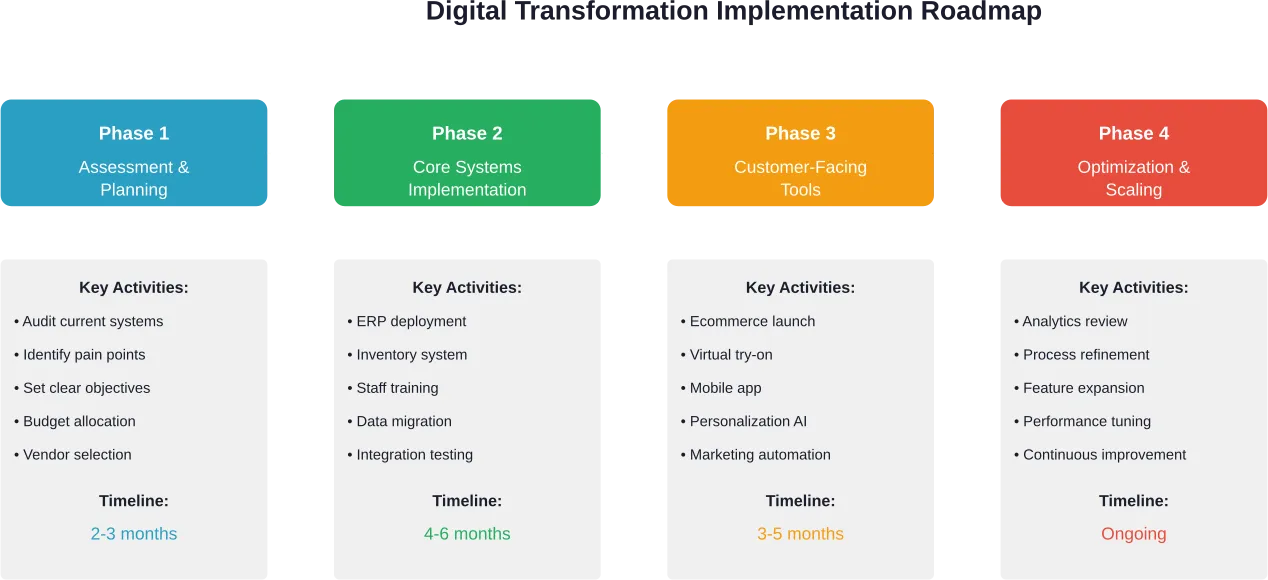
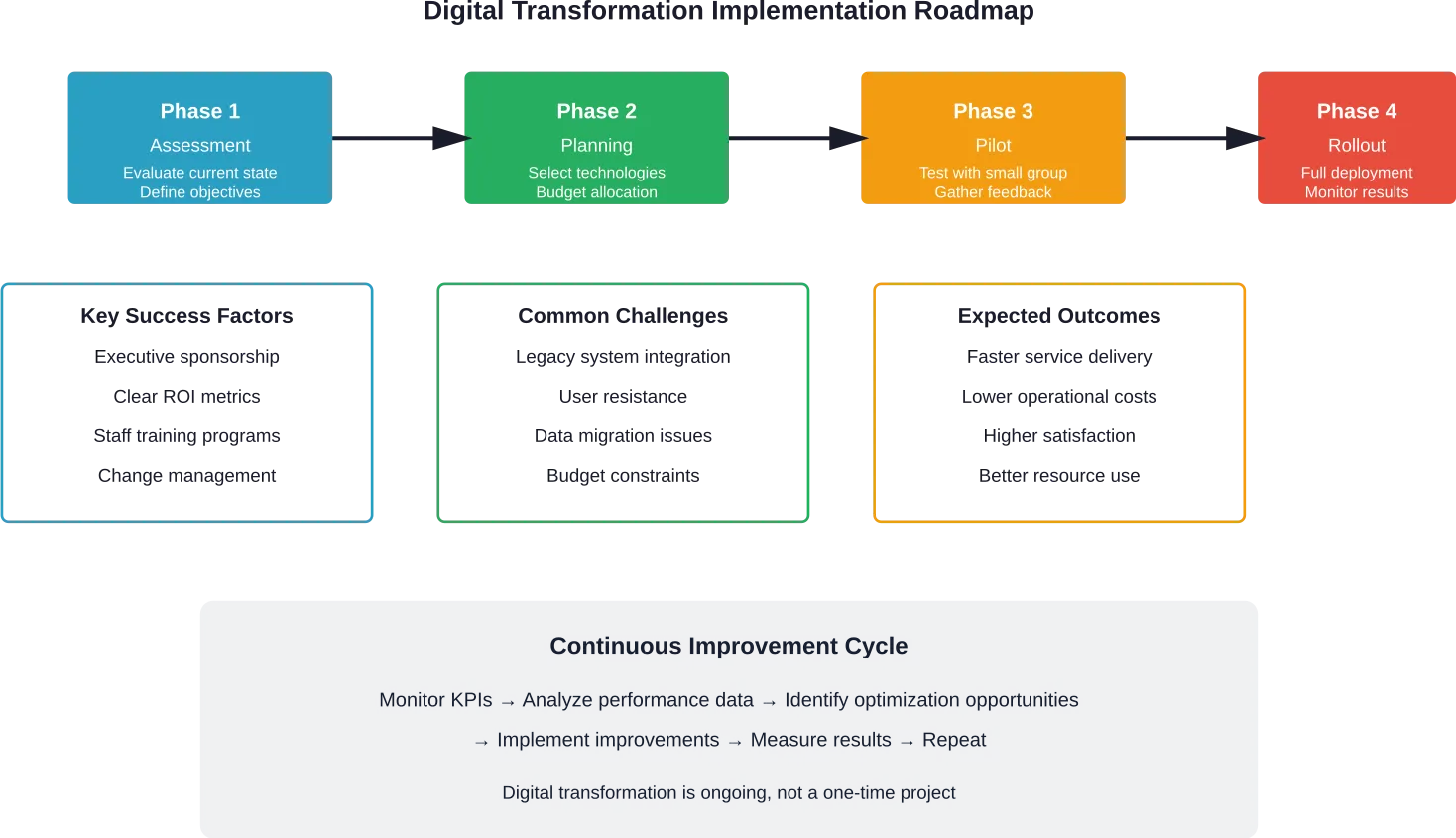
Phase 1: Assessment and Foundation

Begin with comprehensive operational assessment. Map existing processes, identify pain points, measure current performance, and document system dependencies.

Build the data infrastructure foundation. Clean, accessible data is prerequisite for AI, analytics, and automation. Organizations often underestimate the data preparation work required.

Establish governance frameworks that define decision rights, set standards, and create accountability structures for the transformation initiative.

Phase 2: Pilot and Proof of Value

Launch focused pilots in contained operational areas. Choose pilots that are important enough to matter but small enough to manage risk.

Measure everything. Document baseline performance, track pilot metrics, and quantify business impact. These early wins justify continued investment and build organizational confidence.

Learn and iterate. Pilots reveal unexpected challenges and opportunities. Incorporate lessons into the broader rollout plan.

Phase 3: Scale and Integration

Expand successful pilots across the organization. Scaling requires addressing integration complexity, managing change at scale, and maintaining performance as scope increases.

Integration work connects new digital operations capabilities with existing systems. APIs, data pipelines, and middleware become critical infrastructure.

This phase typically takes longer than expected. Plan for it.

Phase 4: Optimization and Continuous Improvement

Digital operations aren’t a destination—they’re a capability for continuous evolution. Establish processes for ongoing optimization, regular capability updates, and performance refinement.

Build feedback loops that capture operational learnings and drive system improvements. Create cultures where experimentation is encouraged and failures become learning opportunities.

Phased approach to implementing digital operations showing typical duration and key activities for each stage

Industry-Specific Operational Transformation

While core principles apply universally, different industries face unique operational challenges that shape transformation approaches.

Manufacturing and Industrial Operations

Manufacturing represents one of the most active areas for operational digitalization. Smart manufacturing combines IoT sensors, AI-driven quality control, predictive maintenance, and automated material handling.

The National Institute of Standards and Technology partners with organizations like CESMII (the Clean Energy Smart Manufacturing Innovation Institute) to boost U.S. manufacturing capabilities through digital transformation. These partnerships focus on practical implementation of Industry 4.0 technologies.

IEEE research on sustainability-based frameworks for digital transformation in industrial sectors emphasizes that successful manufacturing transformation balances productivity gains with environmental sustainability and operational resilience.

Service Operations and Support

Service operations benefit from AI-powered chatbots, intelligent routing, automated case management, and predictive service scheduling. Digital service operations reduce response times and improve first-contact resolution rates.

California Management Review research on relationship-first digital transformation notes that service transformation doesn’t have to privilege scale and automation to be effective. Small organizations can compete by focusing on personalized, digitally-enhanced service experiences.

Supply Chain and Logistics

Supply chain operations gain visibility, flexibility, and efficiency through digital transformation. Real-time tracking, predictive analytics for demand planning, automated warehouse operations, and optimized routing transform logistics performance.

Digital supply chains respond to disruptions faster and maintain service levels despite volatility.

Поширені проблеми та шляхи їх подолання

Every operational transformation hits obstacles. Anticipating them improves success odds.

Інтеграція застарілих систем

Most organizations operate critical systems built decades ago. These legacy systems can’t simply be replaced—they run essential operations.

The National Institute of Standards and Technology addresses this challenge directly, focusing on supporting digital transformation while maintaining legacy components. The key is building integration layers that allow modern and legacy systems to coexist and exchange data.

APIs, middleware platforms, and data integration tools create bridges between old and new. Modernization becomes evolutionary rather than revolutionary.

Прогалини у навичках та дефіцит талантів

Digital operations require different skills than traditional operations. Data analysis, system integration, automation configuration, and cybersecurity expertise often don’t exist in existing operational teams.

Organizations address this through:

  • Upskilling existing staff through training programs
  • Hiring specialized talent for critical roles
  • Partnering with external experts for implementation
  • Building internal centers of excellence
  • Creating development programs for emerging capabilities

Cybersecurity and Operational Technology Protection

Connecting operational systems creates security exposure. Industrial control systems, manufacturing equipment, and building management systems weren’t designed with internet connectivity in mind.

NIST emphasizes cybersecurity for operational technology environments as critical infrastructure becomes increasingly connected. Security must be built into operational transformation from the start, not added as an afterthought.

Measuring ROI and Justifying Investment

Operational transformation requires significant investment. Justifying spend demands clear ROI calculations and measurable business cases.

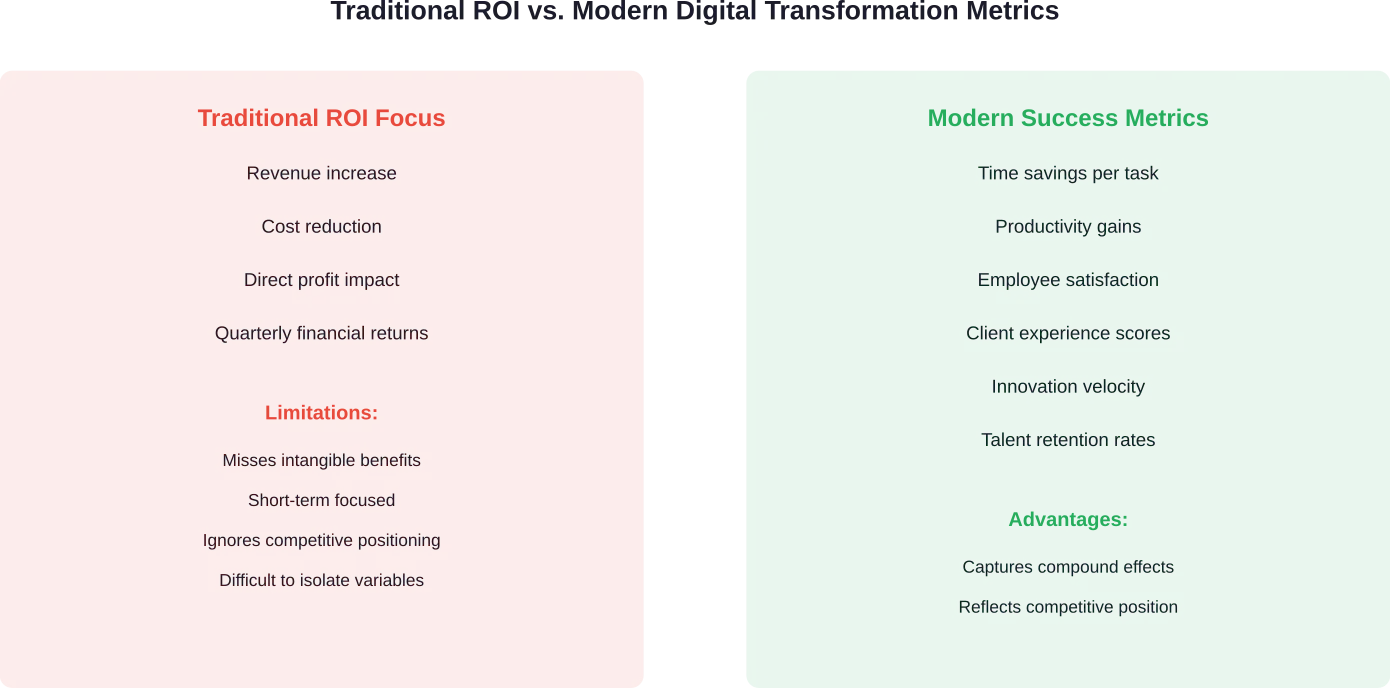
But here’s the challenge: some benefits are easy to quantify (labor cost reduction, throughput increases), while others are harder (improved agility, better decision quality, competitive positioning).

Build business cases that combine quantitative and qualitative benefits. Track metrics from the beginning to demonstrate value realization.

ВикликВплив на бізнесСтратегія пом'якшення наслідків
Інтеграція застарілих системDelays, cost overruns, functionality gapsAPI layers, phased modernization, middleware
Прогалини у навичкахImplementation delays, suboptimal useTraining programs, strategic hiring, partnerships
User ResistanceLow adoption, continued workaroundsChange management, early involvement, quick wins
Питання якості данихPoor insights, flawed automationData governance, cleansing projects, quality controls
Ризики кібербезпекиBreaches, operational disruptionSecurity-by-design, OT security frameworks, monitoring

The Future of Digital Operations

Operational transformation isn’t a one-time project. It’s an ongoing evolution as technologies mature and business requirements change.

Emerging Technologies Shaping Operations

Several technologies are moving from experimental to operational:

  • Генеративний ШІ is beginning to impact operational planning, documentation generation, and problem-solving. Large language models can analyze operational logs, suggest optimizations, and even generate code for automation workflows.
  • Digital twins create virtual replicas of physical operations. Manufacturers can test process changes in simulation before implementing them on actual production lines. Facilities managers can model building performance under different scenarios.
  • Autonomous systems are expanding beyond warehouses into broader operational applications. Autonomous vehicles, drones, and robots handle increasingly complex operational tasks with minimal human intervention.

Market Growth and Investment Trends

The digital transformation market shows explosive growth. According to IDC, global digital transformation spending is forecast to reach $3.9 trillion in 2027, with a five-year compound annual growth rate (CAGR) of 16.1%

This isn’t hype—it’s capital flowing toward operational modernization across every industry. Organizations that delay transformation fall further behind competitors who are already realizing benefits.

Getting Started: First Steps for Operations Leaders

Ready to begin operational transformation? 

Start here:

  1. Assess current state honestly. Don’t sugarcoat operational challenges or overestimate current digital maturity. Clear-eyed assessment reveals where transformation will create the most value.
  2. Define specific outcomes. Vague goals like “become more digital” don’t drive action. Specific targets like “reduce order processing time by 40%” or “increase machine uptime to 95%” create clear success criteria.
  3. Start with a focused pilot. Choose an operational area that’s important, manageable, and measurable. Success here builds momentum for broader transformation.
  4. Invest in data infrastructure. Clean, accessible, integrated data is the foundation for everything else. This work isn’t glamorous, but it’s essential.
  5. Engage people early. Operational transformation succeeds or fails based on user adoption. Involve frontline staff in planning, listen to their concerns, and address them seriously.
  6. Plan for the long term. Operational transformation takes years, not months. Set realistic expectations and maintain consistent investment even when results take time to materialize.

Поширені запитання

  1. What is digital transformation for operations?

Digital transformation for operations is the integration of digital technologies—including AI, automation, cloud computing, IoT, and analytics—across operational functions to modernize processes, improve efficiency, and create data-driven decision-making capabilities. It goes beyond implementing new tools to fundamentally restructuring how operational work gets done.

  1. How long does operational digital transformation take?

Most operational transformations require 12-24 months to reach full operational maturity, though initial pilots can show results in 3-6 months. The timeline depends on organizational size, current digital maturity, scope of transformation, and complexity of legacy systems. Transformation is ongoing—optimization and capability expansion continue indefinitely.

  1. У чому різниця між оцифруванням та цифровою трансформацією?

Digitization simply converts analog information to digital format (paper documents to PDFs, for example). Digital transformation fundamentally changes how operations function by integrating digital technologies into core processes, enabling new capabilities that weren’t possible before. It’s the difference between scanning a form and eliminating the form entirely through automated workflows.

  1. How do you measure ROI for operational transformation?

ROI measurement combines quantitative metrics (cost reduction, throughput increase, error reduction, cycle time improvement) with qualitative benefits (improved agility, better decision quality, enhanced customer satisfaction). Track baseline performance before transformation, establish clear metrics tied to business objectives, and measure continuously. Most organizations see measurable ROI within 12-18 months, though full value realization takes longer.

  1. What are the biggest risks in operational digital transformation?

The primary risks include insufficient strategic planning leading to technology-first approaches, inadequate change management causing poor user adoption, cybersecurity vulnerabilities in newly connected operational systems, underestimating integration complexity with legacy systems, and skills gaps preventing effective implementation. Proper planning, change management, security frameworks, and talent development mitigate these risks.

  1. Can small organizations benefit from operational transformation?

Absolutely. While large enterprises have more resources, small organizations often transform more quickly due to lower complexity and less legacy infrastructure. Cloud-based solutions provide enterprise capabilities without massive capital investment. Research from California Management Review shows small organizations can compete effectively by focusing on relationship-first digital experiences rather than trying to match large competitors on scale and automation.

  1. What role does AI play in digital operations?

AI enables predictive and prescriptive capabilities that transform operations from reactive to proactive. Machine learning analyzes operational data to predict failures, optimize resource allocation, improve quality control, and automate complex decision-making. However, successful AI implementation requires significant investment in data infrastructure, integration capabilities, and specialized talent. Organizations should view AI as a long-term capability build, not a quick implementation.

Висновок

Digital transformation for operations represents one of the most impactful investments organizations can make. It modernizes how work gets done, eliminates waste, improves decision-making, and creates competitive advantage that compounds over time.

The organizations winning in their markets aren’t necessarily the ones with the best products or the lowest costs. They’re the ones with operations that respond faster, adapt more quickly, and execute more efficiently than competitors.

Research shows digital leaders achieve 65% greater returns than laggards. That gap isn’t closing—it’s widening as digital capabilities become more sophisticated and embedded in operational DNA.

The question isn’t whether to transform operations digitally. It’s whether to start now and capture the benefits, or delay and fall further behind. With digital transformation spending projected to reach $3.9 trillion by 2027, the market has already decided.

Start with assessment. Build strategy before selecting technology. Launch focused pilots that prove value. Scale what works. Optimize continuously.

The future of operations is digital. The best time to begin was yesterday. The second best time is now.

Digital Transformation for Software Teams in 2026

Короткий виклад: Digital transformation for software teams represents a fundamental shift in how development organizations operate, integrating modern technologies, agile processes, and collaborative tools across the entire software lifecycle. Successful transformation requires aligning technology adoption with organizational culture, measurement frameworks, and security standards while avoiding the pitfall that claims 70% of initiatives. Teams that embrace incremental change, prioritize capability assessment, and leverage frameworks from organizations like NIST achieve measurably better outcomes.

Software teams sit at the epicenter of organizational digital transformation. But here’s the thing—most initiatives don’t actually succeed.

Studies show that up to 70% of digital transformation projects fail to meet their intended goals. That’s a sobering statistic when organizations are pouring massive resources into transformation initiatives across every sector.

So what separates the teams that deliver real business value from those that become cautionary tales? The answer isn’t just about adopting the latest technologies. It’s about fundamentally rethinking how software teams operate, collaborate, and deliver value.

What Digital Transformation Actually Means for Software Teams

Digital transformation is a business strategy initiative that incorporates digital technology across all areas of an organization. For software teams specifically, this means evaluating and modernizing processes, products, operations, and the entire technology stack.

The goal? Enhanced efficiency and getting products to market faster.

But transformation goes deeper than just adopting new tools. It requires software teams to examine how digital resources impact practices, people, and organizational culture. How do these technologies increase adaptability? How do they support ongoing strategic initiatives?

Real transformation touches every aspect of the software development lifecycle—from requirements gathering and architecture decisions to deployment strategies and post-production monitoring.

Why Digital Transformation Matters More Than Ever

The COVID-19 pandemic exposed many organizations’ digital failure points. McKinsey’s Global Survey of executives revealed that the COVID-19 pandemic accelerated organizations’ adoption of digital technologies by about seven years, compressing what would have taken half a decade into a matter of months.

McKinsey research found that between 2018-2022, digital leaders achieved about 65% greater annual total shareholder returns than digital “laggards.” That’s not a marginal difference—it’s a competitive chasm.

Software teams driving successful transformation help companies increase customer loyalty, attract talented employees, foster competitive advantage, and build measurable business value. The stakes couldn’t be higher.

Core Pillars of Software Team Transformation

Successful digital transformation for software teams rests on several interconnected pillars. Understanding these helps teams avoid the common pitfalls that contribute to that 70% failure rate.

Technology Stack Modernization

Cloud migration sits at the heart of most transformation initiatives. Moving from on-premises infrastructure to cloud platforms enables teams to scale dynamically, reduce operational overhead, and access cutting-edge services.

But modernization extends beyond infrastructure. It includes adopting containerization, microservices architectures, API-first design, and continuous integration/continuous deployment (CI/CD) pipelines.

The National Institute of Standards and Technology (NIST) has published guidance on supporting digital transformation even when working with legacy components—a common challenge for established organizations. This recognition matters because complete rewrites often aren’t feasible or economically justified.

Process and Workflow Evolution

Traditional waterfall development methodologies don’t align well with transformation goals. Software teams need to embrace agile methodologies, DevOps practices, and iterative development cycles.

This shift enables faster feedback loops, reduced time-to-market, and better alignment between development efforts and business objectives. Teams that successfully transform their processes see dramatic improvements in deployment frequency and mean time to recovery.

Collaboration and Communication Tools

Modern software development is inherently collaborative. Digital transformation initiatives must address how teams communicate, share knowledge, and coordinate across distributed environments.

Integrated development environments, version control systems, project management platforms, and real-time communication tools form the nervous system of transformed software organizations.

Security and Compliance Frameworks

The NIST Cybersecurity Framework helps organizations better understand and improve their management of cybersecurity risk. As Michael Pease from NIST’s Engineering Lab emphasizes, cybersecurity considerations must extend across both IT and operational technology environments.

Software teams can’t treat security as an afterthought. Transformation requires embedding security practices throughout the development lifecycle—a shift-left approach that identifies vulnerabilities early when they’re cheapest to fix.

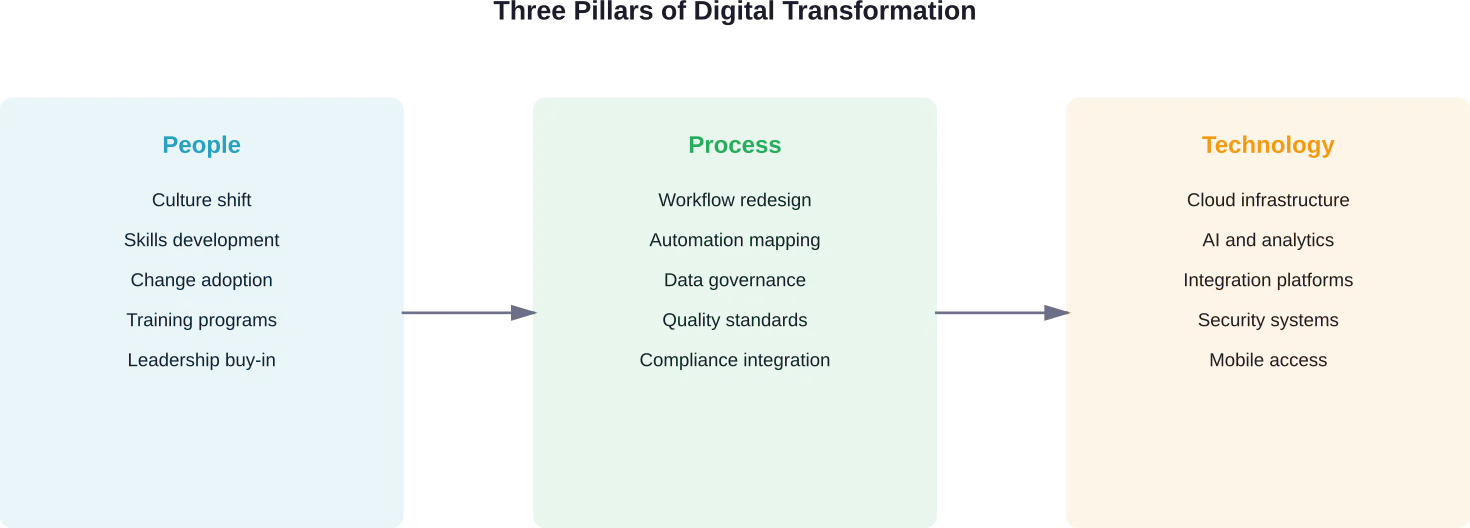
The four foundational pillars supporting successful software team transformation initiatives

Add Engineering Support for Software Team Transformation

Software teams often need extra capacity when digital transformation involves rebuilding systems, modernizing platforms, or improving infrastructure. Програмне забезпечення списку А provides software development, IT consulting, cybersecurity, infrastructure services, data analytics, and dedicated development teams. The company can support internal software teams with custom development, legacy modernization, and outside engineers who can extend delivery capacity.

Need Extra Developers for Transformation Work?

Поговоріть з програмним забезпеченням A-list для:

  • build and update internal software systems
  • modernize older platforms and technical architecture
  • add developers, QA, DevOps, data, or security specialists

Почніть із запиту на консультацію з A-listware.

Capability Assessment and Maturity Models

Before embarking on transformation, software teams need to understand their current capabilities. The ISO Digital Capability Maturity Assessment Models provide structured frameworks for evaluating digital readiness.

These assessment models align with ISO’s Strategy 2030 and demonstrate commitment to enhancing digital capabilities within standardization frameworks. The models help teams identify capability gaps and prioritize improvement efforts.

ISO/IEC TS 30105-9:2023 specifically provides guidelines on extending process capability assessment for digital transformation in IT-enabled services and business process outsourcing contexts. Published in 2023, this technical specification offers a standardized approach to measuring transformation progress.

Capability assessment shouldn’t be a one-time exercise. Teams benefit from periodic reassessment to track improvement trajectories and identify emerging gaps as technology evolves.

Поширені проблеми та шляхи їх подолання

Even with the right frameworks and tools, software teams face predictable obstacles during transformation initiatives. Recognizing these challenges early enables proactive mitigation.

Resistance to Cultural Change

Technology changes are often easier than cultural shifts. Team members comfortable with existing workflows may resist new methodologies, tools, or processes.

Successful transformation requires leadership to address cultural resistance through clear communication, training programs, and demonstrable quick wins that build confidence in new approaches.

Legacy System Constraints

Most organizations can’t simply discard existing systems. As NIST research acknowledges, supporting digital transformation with legacy components represents a real-world constraint that teams must navigate thoughtfully.

Strategies include creating abstraction layers, implementing strangler fig patterns for gradual migration, and using APIs to bridge legacy and modern systems.

Skill Gaps and Training Needs

New technologies and methodologies require new skills. Teams face gaps in cloud architecture expertise, security best practices, automation tooling, and modern development frameworks.

Organizations must invest in continuous learning—whether through formal training, certification programs, or allocating time for experimentation and skill development.

Measurement and ROI Uncertainty

Leaders naturally want to quantify transformation success. But measuring return on investment for broad initiatives proves challenging.

Teams need to establish baseline metrics before transformation begins, then track specific KPIs like deployment frequency, lead time for changes, mean time to recovery, and customer satisfaction scores. These concrete measurements help justify continued investment.

ВикликВпливСтратегія пом'якшення наслідків
Культурний опірSlow adoption, parallel workflowsClear communication, quick wins, training
Застарілі системиTechnical debt, integration complexityAbstraction layers, gradual migration patterns
Skill GapsDelayed implementation, quality issuesTraining programs, hiring, mentorship
ROI UncertaintyBudget constraints, leadership skepticismBaseline metrics, KPI tracking, regular reporting

Low-Code Platforms and Accelerated Development

Low-code development platforms have emerged as powerful tools for accelerating digital transformation. These platforms enable teams to build applications with minimal hand-coding through visual interfaces and pre-built components.

Corporate investment in digital tools and technologies has been rising for years. The pandemic exposed many organizations’ digital failure points and drove increased interest in developing new ways to connect and conduct business online.

Low-code platforms help software teams overcome several transformation challenges simultaneously. They reduce the time required to build and deploy applications, lower technical barriers for business users, and enable faster experimentation.

That said, low-code isn’t a universal solution. Complex systems, performance-critical applications, and highly specialized requirements often still demand traditional development approaches. The key is understanding when low-code accelerates transformation versus when it introduces limitations.

Standards and Compliance Considerations

Software teams operating in regulated industries face additional transformation complexity. Standards from organizations like IEEE provide guidance for technical professionals navigating compliance requirements.

IEEE standards help technology work in unison, ensure device safety, and promote interoperability. Though compliance with these standards is critical, they can be difficult to navigate, especially with novel technologies.

For instance, IEEE/ISO/IEC 26516-2025 provides international standards for systems and software engineering related to development and production of instructional videos. This seemingly narrow standard actually reflects broader transformation themes—how teams document, train, and support systems in digital environments.

Standards mastery represents a key element of professional credibility for software teams driving transformation initiatives. Teams can’t simply ignore compliance considerations in pursuit of speed.

Typical timeline and phases for software team digital transformation initiatives

Building a Transformation Strategy That Works

Strategy matters more than speed. Software teams that rush into transformation without clear objectives often create more problems than they solve.

Effective strategies start with honest assessment. What capabilities does the team currently possess? What gaps exist? Where do the biggest inefficiencies occur in current processes?

Next comes prioritization. Not every system needs transformation simultaneously. Focus on high-impact areas where modernization delivers clear business value—customer-facing applications, bottlenecks in deployment pipelines, or systems with mounting technical debt.

Successful strategies also include explicit change management components. How will the organization communicate transformation goals? What training will teams receive? How will success be measured and celebrated?

Documentation throughout the transformation process proves invaluable. Teams benefit from recording architectural decisions, migration patterns, lessons learned, and metrics that demonstrate progress.

The Role of Leadership in Transformation Success

Digital transformation can’t succeed as a purely bottom-up initiative. Leadership commitment proves essential for several reasons.

First, transformation requires sustained investment in tools, training, and often external expertise. Without executive buy-in, initiatives stall when competing priorities emerge.

Second, transformation frequently requires organizational restructuring. Breaking down silos between development, operations, and security teams demands authority that only leadership possesses.

Third, leaders set cultural tone. When executives demonstrate commitment to new methodologies and hold themselves accountable to transformation goals, teams follow suit.

Research on digital transformation strategies emphasizes that leaders must consider how digital tools impact business processes, practices, people, and culture holistically. Technology adoption without cultural alignment simply creates expensive new problems.

Поширені запитання

  1. What’s the average timeline for software team digital transformation?

Transformation timelines vary widely based on organization size, existing technical debt, and scope. Smaller initiatives might show results in 6-12 months, while enterprise-wide transformation typically requires 18-36 months. The key is establishing incremental milestones rather than viewing transformation as a single event.

  1. Do all team members need technical training for transformation?

Training needs depend on roles and existing skills. Developers typically need training on new frameworks, architectures, and tools. Operations teams need cloud platform expertise. Product managers benefit from agile methodology training. The investment in skill development directly correlates with transformation success rates.

  1. Can small software teams achieve meaningful digital transformation?

Absolutely. Smaller teams often transform more easily than large organizations because they face less organizational inertia. Small teams can adopt new tools, processes, and methodologies with less coordination overhead. The principles remain consistent regardless of team size.

  1. How do security requirements impact transformation timelines?

Security considerations extend timelines but can’t be shortcut. Following frameworks like the NIST Cybersecurity Framework helps teams systematically address risk management. Building security into transformation planning from the start proves more efficient than retrofitting security controls later.

  1. What role do third-party consultants play in transformation?

Consultants can accelerate transformation by bringing specialized expertise, proven methodologies, and objective outside perspectives. They’re particularly valuable for capability assessment, architecture design, and training. However, lasting transformation requires internal teams to own the changes rather than depending permanently on external resources.

  1. How should teams handle failed transformation initiatives?

Failure provides learning opportunities. Teams should conduct retrospectives to understand what went wrong—was it technical challenges, cultural resistance, insufficient resources, or unclear objectives? That analysis informs subsequent attempts. Many successful transformations follow one or more earlier failed initiatives.

  1. What metrics best indicate transformation progress?

Effective metrics include deployment frequency, lead time for changes, mean time to recovery from incidents, change failure rate, and customer satisfaction scores. Business metrics like time-to-market for new features and operational costs also matter. The specific metrics should align with transformation objectives established during planning.

Впевнено рухаємося вперед

Digital transformation for software teams isn’t optional anymore. The competitive advantages enjoyed by digital leaders—that 65% greater shareholder return McKinsey identified—create pressure that organizations can’t ignore.

But avoiding the 70% failure rate requires thoughtful planning, cultural commitment, and willingness to learn from setbacks. Teams that leverage established frameworks from organizations like NIST and ISO, invest in capability assessment, and prioritize security alongside speed position themselves for success.

The path forward starts with honest evaluation of current state and clear articulation of desired outcomes. What specific business problems will transformation solve? Which technologies and methodologies align with those goals? How will the organization measure progress?

Transformation represents a journey rather than a destination. Technology continues evolving, business requirements shift, and new opportunities emerge. Software teams that embrace continuous improvement—iterating on processes, adopting emerging tools thoughtfully, and maintaining learning cultures—sustain competitive advantages over the long term.

Start small if necessary. Pilot programs that demonstrate value build momentum and confidence. Quick wins create advocates who champion broader transformation efforts.

The digital era has fundamentally reshaped how businesses operate. Software teams driving successful transformation don’t just adopt new technologies—they reimagine how development organizations create value, collaborate across boundaries, and deliver exceptional products.

Ready to begin your transformation journey? Assess current capabilities, engage stakeholders across the organization, and commit to sustained investment in both technology and people. The teams that thrive in 2026 and beyond are the ones embracing change today.

Digital Transformation for Taxi Companies: 2026 Guide

Короткий виклад: Digital transformation is revolutionizing taxi companies through AI-powered dispatch systems, mobile booking apps, predictive analytics, and automated payment processing. According to the Bureau of Labor Statistics, the taxi industry employed 92% self-employed drivers in 2022 and is projected to grow 21% through 2032, making technology adoption critical for competitive survival against ride-hailing platforms.

The taxi industry stands at a crossroads. Traditional operators face mounting pressure from digital-first competitors while grappling with outdated dispatch systems and manual processes.

But here’s the thing—transformation doesn’t mean abandoning what works. It means leveraging technology to amplify existing strengths.

The Bureau of Labor Statistics reports that taxi drivers represent one of the fastest-growing self-employed occupations, with 92% self-employed in 2022 and projected to grow 21% through 2032. This growth trajectory, paired with digital innovation, creates unprecedented opportunities for operators willing to modernize.

The Digital Disruption That Changed Everything

Ride-hailing platforms didn’t just introduce an app. They fundamentally rewired customer expectations around convenience, transparency, and pricing.

Traditional taxi services operated on phone calls, street hails, and cash payments. Uber’s entrance broke the monopoly taxi drivers held in airports and city centers by creating a marketplace where supply met demand instantly through mobile technology.

The impact? Taxi companies responded by lowering rates and developing their own app services. What seemed like an existential threat became a catalyst for industry-wide modernization.

Transportation digitalization affects at least 8% of workers in states with large transportation sectors, according to Brookings Institution research. The scale of disruption extends far beyond individual companies—entire labor markets are adapting to automation and AI-driven efficiency.

AI-Powered Dispatch: The Game-Changing Technology

Traditional GPS-based dispatch assigns rides manually or through basic proximity algorithms. AI-powered systems operate on an entirely different level.

The core difference? Predictive intelligence versus reactive assignment.

Comparison of traditional GPS dispatch versus AI-powered systems showing key operational differences and efficiency improvements

Research on predictive dispatching in ride-sharing systems demonstrates passenger waiting times dropped by 30% on average—and up to 55% in high-demand areas—when AI algorithms replaced traditional methods.

AI taxi dispatch analyzes historical trip data, weather patterns, local events, and time-based trends to forecast where demand will spike before it happens. Drivers get positioned strategically rather than wandering aimlessly between fares.

ОсобливістьAI Taxi DispatchTraditional GPS Dispatch
Ride AllocationAI algorithms considering location, traffic, driver performanceManual assignment or basic proximity
Route PlanningReal-time traffic analysis with dynamic reroutingStatic GPS navigation
Demand ForecastingPredictive analytics based on multiple data sourcesHistorical averages only
Driver UtilizationOptimized for minimal idle timeReactive to incoming requests
Клієнтський досвідAccurate ETAs, minimal waitingVariable service quality

Get Development Support for Taxi Software

Taxi companies often depend on software for dispatch, booking, internal coordination, reporting, and customer service. Програмне забезпечення списку А provides software development, IT consulting, infrastructure services, cybersecurity, data analytics, and dedicated development teams. The company can help taxi businesses build custom software, update legacy systems, and add technical support for operational platforms.

Need a Team to Build or Update Taxi Systems?

Поговоріть з програмним забезпеченням A-list для:

  • build custom software for booking and daily operations
  • modernize outdated systems used by internal teams
  • додати розробників, DevOps, спеціалістів з обробки даних або безпеки

Почніть із запиту на консультацію з A-listware.

Mobile Apps: The Front Door to Modern Taxi Services

A mobile booking app isn’t optional anymore. It’s the minimum entry point for customer engagement.

One e-hailing taxi service deployed across 65 US cities now supports over 100,000 drivers and facilitates millions rides monthly. That scale wouldn’t exist without mobile-first infrastructure.

But apps do more than book rides. 

They provide:

  • Real-time vehicle tracking with live map updates
  • Transparent upfront pricing eliminating fare disputes
  • Digital payment processing reducing cash handling risks
  • Driver ratings creating accountability loops
  • Ride history for business expense tracking

The shift to digital payments through customer apps particularly transforms operations. Cash reconciliation disappears. Transaction disputes become traceable. Revenue visibility improves dramatically.

Predictive Analytics: Anticipating Demand Before It Arrives

Forecasting demand separates reactive taxi companies from strategic operators.

AI systems ingest massive datasets—past trip patterns, weather forecasts, concert schedules, flight arrivals, conference calendars—to predict where riders will need taxis before those riders open their apps.

This isn’t speculation. The technology analyzes correlations invisible to human dispatchers.

Rain forecast in 30 minutes? The system positions more vehicles near transit hubs and residential areas. Major sporting event ending? Drivers get routed toward stadium exits before the final whistle.

The economic impact extends beyond customer satisfaction. Reduced idle time means drivers earn more per shift. Better vehicle utilization cuts operational costs. Predictable demand allows dynamic pricing that balances supply without gouging customers.

Fleet Management Technology: Operational Efficiency at Scale

Digital transformation reaches beyond customer-facing apps into backend fleet operations.

Modern fleet management platforms integrate:

  • Vehicle maintenance scheduling based on mileage and diagnostics
  • Fuel consumption tracking identifying inefficient routes
  • Driver behavior monitoring for safety and performance
  • Real-time location tracking for security and coordination
  • Automated compliance reporting for regulatory requirements

IEEE research on fleet operations demonstrates simulation platforms can evaluate taxi system performance under various scenarios, optimizing terminal operations and reducing congestion. These aren’t theoretical models—operators use simulation to test dispatch strategies before deploying them to live fleets.

Phased approach to implementing digital transformation technologies in taxi operations, from basic mobile apps to full automation

Implementation Challenges Taxi Operators Face

Technology adoption isn’t frictionless. Operators encounter real obstacles:

  • Cost barriers: Small fleet operators struggle with upfront investment in software platforms and hardware infrastructure. ROI timelines stretch longer for companies with limited capital.
  • Driver resistance: Veteran drivers accustomed to manual dispatch systems resist app-based workflows. Training becomes essential but time-consuming.
  • Integration complexity: Legacy systems don’t communicate with modern APIs. Data migration creates technical headaches.
  • Regulatory compliance: Local transportation authorities impose requirements that digital platforms must accommodate. One-size-fits-all solutions rarely work across multiple jurisdictions.
  • That said, phased implementation mitigates these challenges. Start with customer-facing mobile apps. Add AI dispatch once baseline data accumulates. Layer in predictive analytics as patterns emerge.

The Autonomous Future: What’s Actually Coming

Autonomous vehicles dominate transformation discussions, but timelines remain uncertain.

IEEE research on autonomous mobility shows pilots are hitting streets in controlled environments. Yet full deployment faces technical, regulatory, and insurance hurdles that won’t resolve overnight.

The autonomous vehicle industry could eventually involve significant workforce impacts according to Brookings Institution analysis. States with large transportation sectors—particularly the Midwest and Southeast—employ above-average shares in roles affected by digitalization.

For taxi operators, this creates both opportunity and urgency. Companies building digital infrastructure now will adapt more easily to autonomous fleets later. Those waiting risk obsolescence.

How to Start Digital Transformation Today

Transformation doesn’t require massive budgets or complete operational overhauls.

Begin with these practical steps:

  1. Deploy a customer-facing mobile app with booking and payment capabilities
  2. Implement GPS tracking for real-time vehicle visibility
  3. Collect trip data systematically to enable future analytics
  4. Train drivers on digital tools with ongoing support
  5. Evaluate AI dispatch platforms through pilot programs
  6. Integrate digital payment systems to reduce cash handling
  7. Monitor performance metrics to measure improvement

Small fleets can start with cloud-based platforms offering subscription pricing. Pricing varies by vendor and fleet size; consult platform providers for current rates.

The key? Start somewhere. Perfection kills momentum.

Поширені запитання

  1. What is AI-powered taxi dispatch?

AI-powered dispatch uses machine learning algorithms to automatically assign rides based on multiple factors including driver location, traffic conditions, historical performance data, and predicted demand patterns. Unlike traditional GPS systems that rely on proximity alone, AI dispatch optimizes for overall system efficiency and reduced passenger wait times.

  1. How much does digital transformation cost for small taxi fleets?

Implementation costs vary significantly based on fleet size and chosen technologies. Cloud-based platforms typically offer subscription models ranging from per-vehicle monthly fees to percentage-based revenue sharing. Pricing varies by vendor and fleet size; consult platform providers for current rates. Many providers offer scalable solutions specifically designed for smaller operators.

  1. Will AI replace human dispatchers completely?

AI augments rather than replaces human dispatchers in most implementations. Automated systems handle routine ride allocation and optimization, while human operators manage exceptions, customer service escalations, and strategic decisions. The role evolves from manual assignment to system oversight and problem-solving.

  1. How long does it take to implement AI dispatch systems?

Typical implementation timelines range from 3-6 months for basic deployment to 12-18 months for full integration with predictive analytics and fleet management. Phased rollouts allow operators to validate performance before expanding functionality. Data collection periods influence how quickly AI models deliver optimized results.

  1. Can traditional taxi companies compete with ride-hailing platforms?

Traditional operators possess advantages including existing fleet assets, established regulatory relationships, and local market knowledge. Digital transformation levels the technology playing field. Companies that modernize dispatch systems, deploy mobile apps, and improve customer experience demonstrate they can compete effectively. The taxi industry’s projected 21% employment growth from 2022-2032 according to Bureau of Labor Statistics data suggests significant market opportunity remains.

  1. What data security concerns arise with digital taxi platforms?

Digital platforms collect sensitive customer data including location history, payment information, and personal contact details. Operators must implement encryption, secure payment processing, data privacy compliance, and regular security audits. Regulatory requirements vary by jurisdiction, making compliance frameworks essential infrastructure components.

  1. How does predictive demand forecasting actually work?

Predictive systems analyze historical trip data combined with external variables like weather forecasts, event schedules, flight arrivals, and time patterns to forecast where ride demand will emerge. Machine learning models identify correlations and generate probability distributions that inform driver positioning recommendations. Accuracy improves continuously as systems ingest more operational data.

Moving Forward in a Digital-First Industry

Digital transformation isn’t a destination—it’s continuous adaptation to evolving customer expectations and competitive pressures.

The taxi industry’s fundamentals remain strong. People need transportation. But delivery mechanisms have shifted permanently toward mobile-first, data-driven experiences.

Operators who embrace AI dispatch, predictive analytics, and customer-facing technology won’t just survive—they’ll thrive in markets where convenience and efficiency determine winners.

The question isn’t whether to transform. It’s how quickly implementation begins and how effectively technology gets deployed to serve both drivers and passengers.

Start with mobile booking. Add smart dispatch. Layer in predictive positioning. Build systematically toward the automated future that’s already arriving.

Your competition is already moving. The technology exists. The roadmap is proven. Now execution determines market position.

Digital Transformation for Councils: 2026 Guide

Короткий виклад: Digital transformation for councils involves modernising public services through technology adoption, automation, and data-driven decision making. With 85% of local government leaders recognising the importance of online services and examples like Hillingdon Council demonstrating that 35% of citizen contact is highly transactional, councils are leveraging digital tools to improve efficiency, reduce costs, and meet rising citizen expectations for 24/7 service access.

Local authorities across the UK face unprecedented pressure. Budget constraints tighten year after year. Citizens expect the same seamless digital experiences they get from private sector services. And the backlog of legacy systems keeps growing.

But here’s the thing—councils that embrace digital transformation aren’t just surviving these challenges. They’re thriving.

According to the Crown Commercial Service, citizens increasingly demand 24/7 service availability and digital access to council services. That shift has pushed local government technology from a “nice to have” into an absolute necessity.

This guide explores how councils are navigating digital transformation successfully, what technologies deliver the biggest impact, and how to overcome the barriers that slow progress.

What Digital Transformation Actually Means for Councils

Digital transformation isn’t just about putting forms online. It’s a fundamental reimagining of how councils operate and serve their communities.

The process involves three distinct stages that often get confused:

  • Digitisation converts paper records into digital formats. Scanning documents, creating digital archives, moving files from cabinets to servers.
  • Digitalisation takes those digital records and builds processes around them. Online applications replace paper forms. Email replaces postal mail. Databases replace filing systems.
  • Цифрова трансформація fundamentally changes how the organisation works. It connects systems, automates workflows, uses data for decision-making, and puts citizen needs at the centre of service design.

Most councils have completed digitisation. Many are somewhere in digitalisation. Real transformation? That’s where the significant benefits emerge.

Why Councils Can’t Ignore This Shift

The demand for digital services isn’t slowing down. Research shows that 85% of local government leaders recognise the importance of online services for bill payments, permit applications, and information retrieval.

Citizens now expect self-service options. They want to report issues, pay fees, and access information on their schedule—not during office hours. The same convenience they experience booking holidays or managing finances online.

And there’s a financial imperative too. Traditional service delivery costs significantly more than digital alternatives. According to federal IT worker surveys, 91% indicated their agencies made significant progress in digital modernisation efforts, driven partly by cost considerations.

Councils operating without digital transformation face three major problems:

  • Higher operational costs from manual processes and duplicated effort
  • Declining citizen satisfaction as expectations exceed service delivery
  • Staff burnout from repetitive tasks that could be automated
  • Data silos that prevent informed decision-making

Get Development Support for Council Systems

Councils often need better internal platforms, more stable infrastructure, and support for replacing outdated software. Програмне забезпечення списку А provides software development, IT consulting, data analytics, cybersecurity, infrastructure services, and dedicated development teams. The company can support councils with custom software, legacy system modernization, and added technical capacity for digital projects.

Need a Team to Build or Update Council Software?

Поговоріть з програмним забезпеченням A-list для:

  • modernize legacy systems and internal tools
  • build custom software for council operations
  • додати розробників, спеціалістів з обробки даних або безпеки

Почніть із запиту на консультацію з A-listware.

Real Success: Hillingdon Council’s AI-Driven Approach

Hillingdon Council became the first UK local authority to use voice automation and AI at scale, partnering with PwC and Amazon Web Services.

Their goal? Become a human-centred and digitally enabled council.

The council’s data revealed that at least 35% of all customer contact was highly transactional—simple queries that didn’t require human intervention. Things like bin collection dates, opening hours, basic service information.

By implementing an AI-driven citizen contact system, Hillingdon transformed how they handle these interactions. The technology freed up staff to focus on complex cases requiring human judgement whilst residents got instant answers to straightforward questions.

This wasn’t about replacing people. It was about using technology for what it does best, allowing humans to do what they do best.

How Hillingdon Council allocated resources based on contact type analysis

Measurable Benefits From Digital Transformation

The evidence from councils that have implemented digital transformation shows consistent patterns of improvement.

Emergency response times improved by 30% in councils that implemented digital resource allocation systems. Real-time data allowed better deployment decisions and faster reaction to incidents.

One council identified £250,000 in savings through efficient resource allocation enabled by connected systems and data analytics. That’s not abstract efficiency—that’s quarter of a million pounds redirected to frontline services.

Call centre volumes dropped by 25% when self-service options became available. Residents could find answers themselves for straightforward queries, freeing staff to handle complex issues requiring expertise.

According to Socitm’s Public Sector Digital Trends report, cities using AI-powered traffic lights, smart parking systems and real-time traffic monitoring have achieved a 20% reduction in traffic-related emissions alongside significant decreases in travel times.

The Cost-Efficiency Equation

Digital services consistently prove faster and more cost-effective than traditional delivery models. But the benefits extend beyond immediate savings.

Connected systems reduce duplicated effort. Staff don’t re-enter the same information across multiple databases. Citizens don’t provide the same details repeatedly for different services.

Data-driven decision making replaces guesswork. Councils can track service request patterns—like seasonal spikes in leaf clearing or grass cutting—and prepare resources accordingly rather than reacting after problems emerge.

Service Delivery ModelAverage CostДоступністьProcessing Time 
In-person counter serviceHighestOffice hours only15-30 minutes
Telephone serviceВисокийExtended hours10-20 minutes
Email serviceСередній24/7 submission24-48 hours
Digital self-serviceLowest24/7 instant2-5 minutes

Key Technologies Driving Council Transformation

Several technology categories consistently appear in successful council digital transformation projects.

Хмарна інфраструктура

Cloud platforms provide the foundation for modern council services. They offer scalability without massive upfront infrastructure investment, automatic updates, and accessibility from anywhere.

Legacy on-premise systems require constant maintenance, periodic hardware refreshes, and dedicated IT staff just to keep things running. Cloud services shift that burden to providers whilst giving councils access to enterprise-grade reliability.

Штучний інтелект та автоматизація

AI handles repetitive tasks, answers common questions, and processes routine applications. Voice automation fields phone enquiries. Chatbots provide instant answers to frequently asked questions. Machine learning identifies patterns in service requests.

The technology works best when deployed strategically—automating high-volume, low-complexity tasks first, then gradually expanding to more sophisticated applications.

Аналітика даних та бізнес-аналітика

Councils generate enormous amounts of data. Service requests, planning applications, social care records, environmental monitoring, transport usage—the list goes on.

Analytics platforms turn that data into insights. Which areas generate the most maintenance requests? What services see seasonal demand spikes? Where should resources be allocated for maximum impact?

One council tracks monthly submission patterns to identify common issues and service request trends. This allows proactive resource allocation rather than reactive firefighting.

Citizen Engagement Platforms

Modern engagement platforms connect councils with residents through their preferred channels. Mobile apps for service requests. Online portals for applications and payments. Social media integration for updates and consultations.

These tools increase transparency—citizens can track their requests, see progress on local projects, and access information without multiple phone calls or office visits.

Overcoming Barriers to Digital Transformation

Look, implementing digital transformation isn’t straightforward. Councils face legitimate obstacles that slow progress.

Бюджетні обмеження

This is the big one. Council budgets have been squeezed for years. Finding money for technology investment when frontline services need funding creates difficult choices.

But the business case often stacks up. The savings from efficiency improvements, reduced manual processing, and better resource allocation can fund the initial investment within months or a few years.

Phased implementation helps too. Start with high-impact, lower-cost projects that demonstrate quick wins, then use those successes to justify broader transformation.

Застарілі системи та технічний борг

Many councils run critical services on decades-old systems. These work (mostly), but they don’t integrate with modern platforms. Data gets trapped in silos. Updates require expensive specialist contractors.

Complete replacement isn’t always necessary or practical. Integration layers can connect legacy systems to new platforms, allowing gradual migration without disrupting services.

Skills and Capacity Gaps

According to Socitm’s analysis, skills and capacity represent a significant barrier to digital transformation. Councils need people who understand both technology and local government operations.

That combination is rare. And competing with private sector salaries makes recruitment harder.

Solutions include partnerships with technology providers, shared services between councils, and training programmes that upskill existing staff rather than relying entirely on external recruitment.

Change Management and Culture

Technology is the easy part. Changing how people work—that’s the challenge.

Staff might resist new systems that change familiar processes. Elected members might question spending on technology over visible services. Residents might struggle with digital-first approaches if they lack access or digital skills.

Successful councils address these human factors deliberately. They involve staff in design decisions. They maintain alternative access channels for those who need them. They communicate benefits clearly and demonstrate quick wins.

Barriers councils face and practical solutions to overcome them

Strategic Approaches That Work

Councils achieving successful digital transformation share common strategic approaches.

Start With Citizen Needs

Technology for technology’s sake doesn’t deliver value. The starting point should always be: what do citizens actually need?

User research reveals pain points in current services. Journey mapping identifies where digital tools could make the biggest difference. Testing with real residents ensures solutions work for everyone, not just the digitally confident.

Think Platforms, Not Projects

Individual project approaches lead to fragmented systems. Each department implements its own solution. Nothing connects. Data remains siloed.

Platform thinking creates shared infrastructure that multiple services can use. A common payment gateway. Unified identity management. Shared data standards. APIs that allow systems to communicate.

This approach costs more upfront but delivers exponentially more value as services connect and share capabilities.

Follow the Technology Code of Practice

The Crown Commercial Service guide for digital transformation in local government builds on the cross-government Technology Code of Practice. These frameworks provide tested approaches covering everything from architecture decisions to procurement strategies.

Following established standards also makes collaboration easier. Councils can share solutions, learn from each other’s experiences, and potentially pool resources for common needs.

Вимірюйте те, що важливо

Socitm’s benchmarking services help councils measure ICT performance objectively. Their modules include options such as the Delivery module (£1,165 + VAT), User Satisfaction module (£2,985 + VAT), Cost module (£2,995 + VAT), and Performance module (£1,165 + VAT)—providing recommendations grounded in data rather than assumptions.

Regular measurement allows course correction. Projects that aren’t delivering expected benefits can be adjusted or stopped. Successful initiatives can be expanded.

The Role of Partnerships and Procurement

Councils don’t need to build everything themselves. Strategic partnerships with technology providers, other councils, and service integrators can accelerate transformation.

The Crown Commercial Service technology agreements support digital transformation through effective and sustainable procurement. These frameworks simplify buying technology whilst ensuring value for money and compliance with standards.

Shared services between councils reduce costs and duplicate effort. Why should every council build their own planning portal when a shared platform could serve multiple authorities?

Real talk: partnerships require trust and clear governance. But when structured properly, they deliver capabilities far beyond what individual councils could achieve alone.

Looking Forward: Emerging Trends

Digital transformation isn’t a destination—it’s ongoing adaptation as technology and citizen expectations evolve.

According to Socitm’s Public Sector Digital Trends analysis, several key themes are shaping the future:

Reimagining services beyond current organisational boundaries. Services designed around citizen needs rather than departmental structures.

Technology for public good that actively improves community outcomes, not just administrative efficiency.

Community resilience built through digital tools that connect residents, enable participation, and strengthen local networks.

Local and national leadership that drives change whilst navigating political realities and competing priorities.

The next phase of transformation will likely emphasise integration—breaking down barriers between councils and other public services, creating seamless experiences for citizens regardless of which organisation technically delivers what.

Cybersecurity: The Non-Negotiable Element

Digital transformation expands the attack surface for cyber threats. Councils store sensitive personal data, manage critical infrastructure, and provide essential services.

That makes them targets.

Security can’t be an afterthought bolted onto systems after implementation. It needs to be embedded from the start—in architecture decisions, procurement requirements, staff training, and operational procedures.

Cloud platforms offer enterprise-grade security, but only if configured correctly. Access controls, encryption, regular patching, backup procedures, incident response plans—all essential elements of a security-conscious approach.

Security LayerМетаKey Actions
Мережева безпекаProtect infrastructureFirewalls, intrusion detection, segmentation
Identity managementControl accessMulti-factor authentication, role-based access
Захист данихSafeguard informationEncryption at rest and in transit, backups
Staff awarenessPrevent human errorRegular training, phishing tests, clear policies
Реагування на інцидентиHandle breachesDocumented procedures, regular drills, recovery plans

Practical Steps to Begin Your Transformation Journey

Where should councils start? Here’s a practical roadmap based on successful implementations:

Step 1: Assess current state

Map existing systems, processes, and pain points. Understand what works, what doesn’t, and where the biggest opportunities lie. Socitm’s benchmarking services can provide objective baselines.

Step 2: Define vision and strategy

What should services look like in three to five years? How should technology enable better outcomes? Get buy-in from elected members, senior leadership, and frontline staff.

Step 3: Prioritise quick wins

Identify high-impact, achievable projects that demonstrate value quickly. Success builds momentum and credibility for broader transformation.

Step 4: Build capabilities

Invest in skills through training, recruitment, or partnerships. Establish governance structures. Create standards and frameworks that guide implementation.

Step 5: Implement incrementally

Deploy in phases rather than attempting everything simultaneously. Learn from each implementation. Adjust based on feedback and results.

Step 6: Measure and iterate

Track performance against objectives. Celebrate successes. Address problems quickly. Continuously improve based on data and user feedback.

Поширені запитання

  1. What is digital transformation for councils?

Digital transformation for councils involves fundamentally changing how local authorities operate and deliver services through strategic use of technology. This goes beyond simply digitising paper forms—it means reimagining processes, connecting systems, using data for decision-making, and putting citizen needs at the centre of service design. The goal is improved efficiency, better outcomes, and services that meet modern expectations for accessibility and convenience.

  1. How much does digital transformation cost for a council?

Costs vary enormously depending on the scope, current infrastructure, and chosen approach. Councils can start with relatively low-cost projects focused on specific services or processes. Socitm’s benchmarking modules include options such as the Delivery module (£1,165 + VAT), User Satisfaction module (£2,985 + VAT), Cost module (£2,995 + VAT), and Performance module (£1,165 + VAT) for performance and cost analysis. Major platform implementations cost significantly more but often deliver returns through efficiency savings within months or a few years. Phased approaches allow councils to spread investment over time whilst demonstrating value at each stage.

  1. What are the biggest challenges councils face with digital transformation?

Budget constraints consistently rank as the primary barrier, with councils needing to balance technology investment against frontline service funding. Legacy systems create technical debt and integration challenges. Skills gaps make it difficult to recruit and retain people who understand both technology and local government. Change management—getting staff, members, and residents comfortable with new ways of working—often proves harder than the technical implementation itself.

  1. How can councils measure success in digital transformation?

Effective measurement combines quantitative metrics and qualitative feedback. Track cost savings, processing times, error rates, and service completion rates. Monitor citizen satisfaction, channel shift (movement from expensive channels like phone to cheaper digital channels), and staff productivity. Socitm’s benchmarking services provide objective comparison against peer councils. The key is establishing baselines before implementation and measuring consistently to identify genuine improvements rather than anecdotal successes.

  1. Do councils need to build their own digital solutions?

Not necessarily. Many successful councils use commercial platforms, shared services with other authorities, or framework agreements like those provided by Crown Commercial Service. Building custom solutions makes sense for truly unique needs, but standard services—payments, forms, case management—often benefit from proven commercial or shared platforms. The focus should be on integration and configuration to meet local needs rather than building everything from scratch.

  1. How does digital transformation improve citizen services?

Digital transformation enables 24/7 service access, faster processing times, and self-service options for straightforward transactions. Citizens can track requests, access information, and complete tasks on their schedule. Research shows 85% of local government leaders recognise that online services for bill payments, permit applications, and information retrieval significantly improve resident experience. Automation handles routine queries faster, freeing staff to provide better support for complex cases requiring human expertise.

  1. What role does AI play in council digital transformation?

AI handles high-volume, transactional contact that doesn’t require human judgement. Hillingdon Council found that at least 35% of citizen contact was highly transactional—perfect for AI automation. Voice systems answer phone queries, chatbots provide instant responses to common questions, and machine learning identifies patterns in service data. The technology works best when deployed strategically to free up staff for complex work rather than attempting to replace human judgement entirely.

Висновок: Шлях вперед

Digital transformation isn’t optional anymore. Citizen expectations, budget pressures, and the complexity of modern service delivery make it essential.

But successful transformation isn’t about technology alone. It’s about reimagining how councils work, putting residents at the centre, and using digital tools strategically to deliver better outcomes with limited resources.

The councils achieving real success share common characteristics: they start with citizen needs, build platforms rather than isolated projects, measure what matters, and invest in people alongside technology.

Challenges exist—budget constraints, legacy systems, skills gaps, change resistance. Yet these barriers aren’t insurmountable. The evidence from authorities like Hillingdon Council demonstrates what’s possible when councils commit to transformation strategically.

The journey starts with a single step. Assess where things stand now. Identify one high-impact area where digital tools could make a real difference. Build a business case. Get started.

Every council’s transformation journey will look different based on local priorities, existing capabilities, and community needs. That’s fine. What matters is taking deliberate action toward a future where technology enables better, more efficient, more responsive public services.

The councils that embrace this challenge now will be the ones thriving in an increasingly digital future—delivering exceptional value to their communities despite ongoing constraints.

Digital Transformation for Inspections: 2026 Guide

Короткий виклад: Digital transformation for inspections replaces paper-based processes with intelligent software, sensors, and AI-driven systems that capture real-time data, improve safety compliance, and reduce operational costs. Industries from construction to manufacturing are adopting digital inspection technology to shift from reactive maintenance to predictive, data-driven asset management. The global digital inspection market is projected to grow from USD 22.7 billion in 2023 to USD 34.6 billion by 2028, at a CAGR of 8.8%.

The inspection industry is undergoing a seismic shift. Paper checklists and manual data entry are giving way to intelligent systems that capture, analyze, and predict asset conditions in real time.

This transformation isn’t just about going paperless. It’s about fundamentally rethinking how organizations approach safety, compliance, and operational efficiency. According to market research, the digital inspection market is expanding rapidly—projected to grow from USD 22.7 billion in 2023 to USD 34.6 billion by 2028, at a CAGR of 8.8%.

But what does digital transformation actually mean for inspections? And how can organizations navigate this shift effectively?

The Problem with Traditional Inspection Methods

Traditional inspection processes create bottlenecks that ripple through entire operations.

Paper-based systems demand significant effort to digitize data after field work is complete. Inspectors scribble notes, take photos on personal devices, then spend hours transcribing everything into spreadsheets or reports. The lack of digital footprint means no centralized database, no trend analysis, and no way to catch patterns before they become problems.

Here’s the thing though—many organizations are still operating this way. A survey of civil engineering technicians found that among over 4,000 invited to participate, 94 responded (2.35% response rate), identifying the need for web-based inspection systems designed specifically for technical building assessments. The gap between need and implementation remains wide.

Manual processes also introduce human error. Handwriting gets misread. Forms get lost. Critical safety observations slip through the cracks. When inspection data lives in filing cabinets instead of searchable databases, organizations can’t leverage that information to improve processes or predict failures.

What Digital Transformation Means for Inspections

Digital transformation converts inspection workflows from analog to intelligent, data-driven processes.

At its core, this transformation involves three fundamental shifts:

  • Data capture modernization: Mobile apps, sensors, and IoT devices replace paper forms
  • Real-time analysis: AI and machine learning identify anomalies as they occur
  • Predictive capabilities: Historical data informs future maintenance schedules

According to ISO’s quality management standards, organizations asking how to improve the quality of their products and services and consistently meet their customers’ expectations need systematic approaches. The ISO 9000 family addresses various aspects of quality management, providing models for setting up and operating management systems that apply directly to inspection processes.

Digital inspection systems create a complete digital footprint. Every observation, measurement, and photo gets timestamped, geotagged, and stored in centralized databases. This enables trend analysis across multiple assets, sites, or time periods.

The three stages of inspection digital transformation, from traditional paper-based processes to AI-driven predictive systems

Key Technologies Driving Inspection Transformation

Several technological advances converge to make modern digital inspections possible.

ШІ та машинне навчання

AI-driven software solutions automate pattern recognition that previously required expert human judgment. Machine learning algorithms analyze thousands of inspection images to identify corrosion, cracks, or structural defects with accuracy levels that match or exceed human inspectors.

Microsoft’s inspection builder preview demonstrates how AI can transition organizations from paper to digital. The system uses Copilot and AI to help field service teams create digital inspection workflows without extensive technical knowledge.

IoT Sensors and Monitoring Systems

Continuous monitoring through sensors provides data streams that complement periodic manual inspections. Temperature sensors, vibration monitors, and pressure gauges feed real-time information into centralized platforms.

This shift transforms inspection from a periodic cost center into a continuous value generator. Organizations can detect anomalies immediately rather than waiting weeks or months between scheduled inspections.

Cloud-Based Data Platforms

Cloud infrastructure enables inspection data to flow seamlessly between field technicians, managers, and analytical systems. Web-based inspection systems allow authorized personnel to access current asset conditions from anywhere.

The FastFoam system, a web-based platform designed for technical building assessments, demonstrates this approach. The system structures inspection data around building elements (roof covering, guttering, structural components) and groups them logically for comprehensive assessment.

Modernize Inspection Systems With A-listware

Inspection work often relies on software for scheduling, reporting, field data, and internal coordination. Програмне забезпечення списку А provides software development, IT consulting, infrastructure services, cybersecurity, data analytics, and dedicated development teams. The company can help organizations build custom inspection software, improve existing platforms, and extend internal technical teams.

Need Development Support for Inspection Software?

Поговоріть з програмним забезпеченням A-list для:

  • build tools for reporting, workflows, and field operations
  • modernize outdated inspection systems
  • add developers, infrastructure, or data specialists

Почніть із запиту на консультацію з A-listware.

Галузеві застосування

Different sectors implement digital inspection transformation in ways that address their unique challenges.

Construction and Building Inspections

Construction inspections benefit enormously from digital transformation. Building projects involve hundreds of inspection points across foundations, structural elements, electrical systems, plumbing, and finish work.

Digital systems ensure nothing gets missed. Inspection templates guide field personnel through required checkpoints. Photo documentation attaches automatically to the correct building element. Compliance reports generate instantly for regulatory submissions.

Industrial and Manufacturing Safety

Industrial settings face high-stakes safety requirements. OSHA’s Process Safety Management standards require rigorous documentation of equipment conditions, maintenance activities, and safety procedures.

Digital inspection technology helps organizations meet these requirements while improving actual safety outcomes. Real-time alerts notify managers when critical equipment parameters drift outside acceptable ranges. Predictive analytics schedule maintenance before failures occur.

Industry SectorPrimary Inspection FocusDigital Transformation Benefit 
БудівництвоBuilding compliance, quality controlReal-time progress tracking, automated reporting
ВиробництвоEquipment condition, safety compliancePredictive maintenance, reduced downtime
Energy/UtilitiesAsset integrity, regulatory complianceContinuous monitoring, risk reduction
Охорона здоров'яFacility safety, equipment certificationAudit trails, compliance documentation

The AAA Framework for Data-Driven Inspections

Successful digital transformation follows a structured approach to managing inspection data.

The AAA framework—Acquire, Analyze, Act—provides a roadmap:

  • Acquire: Deploy sensors, mobile apps, and monitoring systems to capture inspection data at the source. This eliminates transcription errors and creates immediate digital records.
  • Analyze: Apply analytics and AI to identify patterns, predict failures, and prioritize maintenance activities. Raw data becomes actionable intelligence.
  • Act: Integrate insights into operational workflows. Trigger work orders automatically. Schedule predictive maintenance. Optimize resource allocation based on actual asset conditions.
  • This framework shifts inspection from a necessary expense to a strategic asset that drives efficiency, safety, and product lifecycle improvements.

Виклики та рішення щодо впровадження

Real talk: digital transformation isn’t easy.

Organizations face several common obstacles when implementing digital inspection systems:

  • Legacy system integration: Existing databases and workflows don’t always play nicely with new digital tools. Solution? Start with pilot programs in specific departments before full-scale rollout.
  • Change resistance: Field personnel accustomed to paper forms may resist digital tools. Solution? Demonstrate clear benefits—less duplicate work, faster reporting, better safety outcomes.
  • Data quality concerns: Digital systems expose data quality issues that paper processes hid. According to ISO 8000 standards on data quality, organizations need structured approaches to ensure data accuracy and completeness.
  • Upfront costs: Software licenses, hardware, and training require investment. But the ROI typically appears within months through reduced inspection time, fewer equipment failures, and improved compliance.

Measuring Success: Key Performance Indicators

How do organizations know if digital transformation is working?

Track these metrics:

  • Inspection completion time (should decrease 30-50%)
  • Data accuracy rates (should exceed 95%)
  • Time from inspection to report (should drop from days to hours)
  • Unplanned downtime (should decrease as predictive capabilities improve)
  • Safety incident rates (should decline with better monitoring)
  • Compliance audit performance (should improve with better documentation)

Typical performance improvements after digital inspection implementation: reduced time, increased error detection, and improved compliance

Future Trends in Digital Inspections

The trajectory is clear: inspections are becoming more autonomous, more predictive, and more integrated.

Emerging trends include:

  1. Autonomous inspection systems: Drones, robots, and automated vehicles conduct inspections in hazardous or hard-to-reach areas without human presence.
  2. Digital twins: Virtual replicas of physical assets update in real time based on sensor data and inspection results, enabling simulation and scenario planning.
  3. Augmented reality: Field technicians wearing AR glasses see overlay information about equipment history, specifications, and maintenance requirements during inspections.
  4. MIT Sloan Management Review’s research on digital transformation highlights that competitive advantages offered by digital technology continue to evolve. Organizations that treat digital transformation as an ongoing journey rather than a one-time project position themselves to capture emerging opportunities.

Поширені запитання

  1. What is digital transformation for inspections?

Digital transformation for inspections replaces manual, paper-based inspection processes with digital systems that use mobile apps, sensors, AI, and cloud platforms to capture, analyze, and act on inspection data in real time. This transformation improves accuracy, efficiency, and enables predictive maintenance strategies.

  1. How much does digital inspection software typically cost?

Costs vary widely depending on industry requirements, number of users, and feature complexity. Check vendor websites for current pricing, as subscription tiers and enterprise options differ significantly between providers.

  1. What industries benefit most from digital inspection transformation?

Construction, manufacturing, energy and utilities, healthcare facilities, and transportation infrastructure all see significant benefits. Any industry with regulatory compliance requirements, safety-critical equipment, or complex asset management needs gains value from digital inspection systems.

  1. How long does it take to implement a digital inspection system?

Pilot programs typically launch within 4-8 weeks. Full organizational rollout ranges from 3-12 months depending on company size, number of locations, and integration complexity with existing systems. Starting with a focused pilot in one department or facility reduces risk and builds organizational buy-in.

  1. Can digital inspection systems work offline in remote locations?

Many modern inspection platforms include offline capabilities. Field technicians can complete inspections without internet connectivity, then sync data automatically when connection is restored. This functionality is essential for remote construction sites, offshore facilities, or underground infrastructure.

  1. What data quality standards apply to digital inspections?

ISO 8000 standards address data quality management, while ISO 9000 family standards cover quality management systems that include inspection processes. Organizations should ensure their digital inspection systems support structured data entry, validation rules, and audit trails to maintain data integrity.

  1. How does AI improve inspection accuracy?

AI and machine learning algorithms analyze patterns across thousands of inspection images and sensor readings to identify anomalies that human inspectors might miss. The systems learn from historical data to predict failure modes, prioritize inspection activities, and reduce false positives that waste resources.

Taking the Next Step

Digital transformation for inspections represents a fundamental shift in how organizations approach safety, compliance, and asset management.

The market growth projections tell part of the story—USD 19.66 billion to USD 27.84 billion over just five years. But the real value lies in operational improvements: faster inspections, better data quality, predictive capabilities, and enhanced safety outcomes.

Organizations don’t need to transform everything overnight. Start with a pilot program in a single department or facility. Measure results. Build momentum with quick wins. Then scale systematically.

The inspection industry’s future is digital, predictive, and intelligent. Organizations that embrace this transformation position themselves for competitive advantage through improved efficiency, reduced risk, and better decision-making powered by quality data.

Ready to modernize your inspection processes? Evaluate your current workflows, identify pain points where digital tools would deliver the most value, and explore solutions that fit your industry’s specific requirements.

Digital Transformation for Travel Finance in 2026

Короткий виклад: Digital transformation for travel finance is revolutionizing how payments, expense management, and financial operations work across the travel industry. From Swift’s new framework enabling faster cross-border payments in major remittance markets to AI-powered expense platforms and contactless payment technologies, financial systems are becoming faster, more transparent, and more customer-centric. These changes are critical for travel companies looking to improve operational efficiency, reduce costs, and meet evolving traveler expectations.

The travel industry’s financial infrastructure is undergoing its most significant shift in decades. What once took days now happens in minutes. What required manual reconciliation now runs automatically. What confused travelers with hidden fees now offers complete transparency.

This isn’t just about making things faster. It’s about fundamentally rethinking how money moves through the travel ecosystem—from the moment someone books a flight to when an employee submits an expense report months later.

According to Swift, the ‘last mile’—the domestic leg of a transaction—accounts for 80% of the total time taken due to local regulations, market infrastructures, and practices. That’s changing rapidly. More than 25 banks have committed to processing payments under Swift’s new framework by June 2025, with over 50 banks signing up overall, designed to transform consumer payments with consistently fast, predictable, and transparent transactions.

For travel finance leaders, the stakes are clear. Companies that adapt to these technologies gain competitive advantages through lower costs, better customer experiences, and streamlined operations. Those that don’t risk being left behind in an increasingly digital marketplace.

The State of Travel Finance Technology in 2026

Travel has always been at the intersection of complex financial flows. Airlines, hotels, travel agencies, payment processors, banks, and customers all exchange money across borders, currencies, and regulatory frameworks.

The World Travel & Tourism Council revealed that smarter border management alone could add $401 billion to the global economy and create 14 million new jobs across G20, EU, and African Union nations by 2035. Financial technology plays a critical role in making that happen.

But here’s the thing—digital transformation in travel finance isn’t just one technology or trend. It’s a convergence of multiple innovations happening simultaneously.

Cross-Border Payments Get a Major Upgrade

International travel means international payments. And historically, that’s meant slow, expensive, and unpredictable transfers.

Swift announced in September 2025 that it would develop the new network rules with a voluntary coalition of earlier adopter banks to elevate the cross-border payment experience. By June 2025, more than 25 banks committed to processing payments under this new framework, with an initial group announced in March 2025.

The initial launch markets include five of the world’s biggest remittance markets: Bangladesh, China, Germany, Pakistan, and India—all in the top 10 countries for remittances received. Consumers and SMEs now have certainty around speed, price, and delivery when sending money internationally.

Recent upgrades have significantly improved the experience, enabling fully transparent transfers that exceed G20 targets. 75% of payments over Swift reach the destination bank within 10 minutes, meeting G20 targets, giving travelers visibility into exactly when their money will arrive and what it will cost.

The Contactless Revolution Hits Airports

Research on contactless technology implementation in European non-primary airports shows that despite substantial upfront costs, long-term operational savings and improved passenger experiences justify the investment.

Australian airports provide a concrete example. SmartGates use facial recognition technology to process arrivals and departures. By June 2025, 79% of all arrivals were eligible to use SmartGate technology, with around three-quarters of those travelers opting to use it. The result? Significantly reduced processing times and better resource allocation.

The financial implications extend beyond labor costs. Contactless systems reduce cash handling, minimize fraud, speed up transactions, and generate valuable data about passenger behavior and preferences.

Swift's payment framework rollout demonstrates rapid industry adoption of transparent cross-border payment standards

Key Technologies Driving Travel Finance Transformation

Several core technologies are reshaping how travel companies handle financial operations. Each brings distinct advantages, and together they create a more integrated, efficient system.

Штучний інтелект і машинне навчання

AI is transforming travel finance in practical, measurable ways. Expense management platforms now use machine learning to automatically categorize transactions, flag policy violations, and detect fraudulent claims before they’re approved.

According to the World Travel & Tourism Council and Trip.com Group’s report on technology game changers, AI-powered travel assistance and innovations are being pioneered to meet and exceed traveler expectations. This extends directly to financial operations.

Pattern recognition algorithms can identify unusual spending behavior that might indicate fraud or errors. Natural language processing helps chatbots handle routine finance queries, freeing up human staff for complex issues. Predictive analytics forecast cash flow needs based on booking patterns and seasonal trends.

Blockchain and Distributed Ledger Technology

While blockchain hasn’t lived up to all its hype, it’s finding practical applications in travel finance. The technology’s ability to create immutable transaction records appeals to industries dealing with complex, multi-party settlements.

Airlines and hotels can use blockchain to reconcile payments between booking platforms, payment processors, and their own systems more efficiently. Smart contracts automate refunds when flight cancellations occur, reducing processing time from days to minutes.

The transparency of distributed ledgers also helps with regulatory compliance, providing auditors with clear transaction histories across multiple parties.

Cloud-Based Financial Management Platforms

Cloud computing enables travel companies to scale financial operations without massive infrastructure investments. A startup travel agency can access the same sophisticated treasury management tools as a multinational hotel chain—just at a different price point.

Real-time data synchronization across global operations becomes possible. Finance teams in New York can see exactly what’s happening in Tokyo offices instantly. Cash positions, payment statuses, and expense reports all update in real time.

Integration capabilities matter too. Modern cloud platforms connect with booking systems, payment gateways, accounting software, and banking partners through APIs, creating seamless data flow.

Mobile-First Payment Solutions

Mobile devices have become the primary interface for financial transactions in travel. Travelers book trips, make payments, manage expenses, and track spending all from their phones.

For travel companies, this means investing in mobile-optimized payment experiences. Digital wallets, one-click payments, and mobile expense capture through photo receipts are now baseline expectations, not premium features.

The shift to mobile also generates valuable data about when, where, and how travelers make financial decisions—insights that inform everything from pricing strategies to fraud prevention.

Build Better Systems for Travel Finance With A-listware

Travel finance teams often depend on software for reporting, internal workflows, integrations, and secure data handling. Програмне забезпечення списку А provides software development, IT consulting, cybersecurity, infrastructure services, data analytics, and dedicated development teams. The company can support businesses that need to update financial systems, build custom tools, or add outside engineering support.

Need a Team to Build or Modernize Travel Finance Software?

Поговоріть з програмним забезпеченням A-list для:

  • build custom software for finance and reporting workflows
  • improve older internal systems and tools
  • додати розробників, спеціалістів з обробки даних або безпеки

Почніть із запиту на консультацію з A-listware.

Practical Applications Across Travel Finance Operations

Understanding the technologies is one thing. Seeing how they apply to specific finance functions is another. Here’s where digital transformation creates tangible value.

Expense Management and Corporate Travel

Business travel expense management has traditionally been painful for everyone involved. Employees save paper receipts, fill out forms weeks later, and wait for reimbursement. Finance teams manually review submissions, chase missing documentation, and reconcile credit card statements.

Digital platforms transform this completely. Employees photograph receipts immediately, and AI automatically extracts relevant data. GPS tracking can verify location claims. Credit card feeds import transactions automatically, matching them to trip itineraries.

Policy violations get flagged instantly—an employee books a business class flight when policy allows only economy? The system catches it before purchase, not during reimbursement review weeks later.

Real-time visibility helps companies manage travel budgets more effectively. Finance leaders can see spending patterns across departments, routes, and vendors, identifying opportunities for negotiated rates or policy adjustments.

Revenue Management and Dynamic Pricing

Airlines and hotels have used dynamic pricing for years, but AI and real-time data processing have made it far more sophisticated.

Modern revenue management systems process massive datasets—competitor pricing, weather forecasts, local events, historical booking patterns, current inventory levels, and market demand signals—to optimize pricing decisions thousands of times per day.

The financial impact is significant. Better pricing means higher yields without sacrificing occupancy or load factors. Automated systems also reduce the need for large revenue management teams constantly monitoring and adjusting prices manually.

Treasury and Cash Management

Travel companies operate across multiple currencies, countries, and banking relationships. Managing cash flow, foreign exchange exposure, and liquidity requirements gets complicated quickly.

Digital treasury management platforms provide real-time visibility into cash positions globally. Automated systems can move funds between accounts to optimize interest earned or minimize fees. AI-powered forecasting predicts cash needs based on booking patterns and payment cycles.

Foreign exchange management becomes more strategic. Instead of reactive currency conversions, companies can use predictive analytics to time exchanges more favorably or hedge exposure more effectively.

Fraud Detection and Prevention

Financial fraud in travel takes many forms—stolen credit cards booking flights, employees submitting fake expense claims, identity theft, payment diversion schemes, and more.

Machine learning models excel at fraud detection because they can identify patterns humans miss. An account that suddenly books multiple high-value international flights? Flagged. An expense report with receipts from a restaurant that doesn’t exist? Caught. A payment request with slight variations in vendor banking details? Blocked for review.

The systems learn continuously. Each confirmed fraud case improves the model’s accuracy. False positive rates drop over time as algorithms get better at distinguishing legitimate unusual behavior from actual fraud.

Digital transformation delivers measurable improvements across multiple travel finance operations with documented ROI

Challenges in Implementing Travel Finance Digital Transformation

Look, implementing these technologies isn’t as simple as flipping a switch. Travel companies face real obstacles that can derail even well-planned transformation initiatives.

Інтеграція застарілих систем

Many travel companies run on decades-old core systems. Reservation platforms, accounting software, and payment processors that were cutting-edge in 1995 but now struggle to integrate with modern technology.

Replacing these systems entirely is risky and expensive. A major airline can’t just shut down its reservation system for six months while migrating to a new platform. Revenue would stop flowing.

The solution often involves middleware and APIs that connect old and new systems. But this creates technical debt—layers of integration code that must be maintained, updated, and eventually replaced.

Regulatory Compliance Across Jurisdictions

Travel companies operate globally, which means dealing with different payment regulations, data privacy laws, tax requirements, and financial reporting standards in every market.

A payment solution that works perfectly in the United States might violate data residency requirements in the European Union. An expense management platform that’s compliant in Germany might not meet tax documentation requirements in China.

Staying compliant requires constant monitoring of regulatory changes and the flexibility to adjust systems quickly when rules change.

Data Security and Privacy Concerns

Financial data is among the most sensitive information companies handle. Credit card numbers, bank account details, personal identification information—all highly valuable to cybercriminals.

Digital transformation often means moving data to cloud platforms, connecting more systems, and enabling more access points. Each of these increases attack surface area if not properly secured.

Companies must balance accessibility with security. Finance teams need easy access to data for analysis and decision-making, but that access must be controlled, monitored, and audited to prevent breaches.

Управління змінами та навчання персоналу

Technology is only part of digital transformation. People have to actually use it effectively.

Finance professionals who’ve used the same processes for years may resist new workflows. IT teams comfortable with legacy systems may lack skills in cloud platforms or AI technologies. Executives may not understand why transformation requires significant upfront investment before delivering returns.

Successful implementations require comprehensive change management—communicating why changes are happening, training staff thoroughly, providing ongoing support, and celebrating early wins to build momentum.

Cost and Resource Constraints

Digital transformation requires investment. Software licenses, implementation consultants, staff training, system integration, data migration—costs add up quickly.

Many travel companies, particularly smaller ones, struggle to justify the business case when resources are tight. The benefits are often realized over years, while costs hit immediately.

Phased approaches help. Start with one high-impact area—perhaps expense management or payment processing—prove the value, then expand to other functions. This spreads costs over time and builds organizational confidence.

Кращі практики для успішного впровадження

Companies that successfully navigate travel finance digital transformation tend to follow similar patterns. These practices increase the odds of achieving intended outcomes.

Почніть з чітких бізнес-цілей

Don’t transform for transformation’s sake. Define specific goals: reduce expense processing time by 50%, cut payment processing costs by 30%, improve cash forecasting accuracy by 25%, or decrease fraud losses by 40%.

Clear objectives guide technology selection, implementation priorities, and success measurement. They also help secure executive support by connecting transformation to business outcomes.

Choose Scalable, Flexible Solutions

Travel demand fluctuates. A solution that works fine during normal operations might buckle under peak season load. Choose platforms that scale automatically to handle volume spikes.

Flexibility matters too. Business models change, new payment methods emerge, regulations shift. Systems need to adapt without requiring complete replacement every few years.

Prioritize User Experience

The most technically sophisticated solution fails if nobody uses it. Finance systems need to be intuitive for employees submitting expenses, finance teams processing payments, and executives reviewing dashboards.

Involve end users early in selection and implementation. Get their feedback on workflows and interfaces. Address pain points that make their jobs harder, not just what looks good in vendor demos.

Ensure Robust Data Governance

Financial data quality is critical. Garbage in, garbage out applies especially to finance operations.

Establish clear data ownership, validation rules, and quality metrics. Define who can access what data, how long it’s retained, and how it’s protected. Create processes for regular data audits and cleanup.

Plan for Ongoing Evolution

Digital transformation isn’t a project with an end date. It’s an ongoing process of continuous improvement.

Set aside resources for regular system updates, staff training refreshers, and periodic technology reassessment. Monitor industry trends to identify new capabilities worth adopting. Build a culture of experimentation where teams can test new approaches.

Етап впровадженняОсновні напрямки діяльностіТипова тривалістьПоказники успіху 
ОцінкаCurrent state analysis, gap identification, business case development4-8 weeksClear ROI projection, stakeholder alignment
Solution SelectionVendor evaluation, platform comparison, proof of concept testing6-12 weeksSelected platform meets requirements, budget approved
РеалізаціяSystem configuration, data migration, integration development, testing3-9 monthsSystems functional, integrations working, data migrated
Training and RolloutUser training, documentation, phased deployment, support readiness2-4 місяціUser adoption rate, support ticket volume
ОптимізаціяPerformance monitoring, process refinement, additional training, feature expansionТриваєAchieving target KPIs, user satisfaction, continuous improvement

The Role of Data Analytics in Travel Finance

Data is the fuel that powers modern travel finance operations. Every transaction, booking, expense report, and payment generates data points that, when analyzed properly, reveal insights for better decision-making.

Predictive Analytics for Financial Planning

Historical data combined with machine learning enables accurate forecasting. Travel companies can predict revenue by route, season, and market segment. They can forecast cash needs based on booking patterns and payment cycles.

This moves financial planning from reactive to proactive. Instead of scrambling to cover unexpected shortfalls, treasury teams anticipate needs weeks in advance and arrange financing efficiently.

Customer Behavior and Payment Preferences

Transaction data reveals how customers prefer to pay—credit cards versus digital wallets, installment plans versus full payment, mobile versus desktop checkout.

Companies can optimize payment options based on these preferences, reducing cart abandonment and improving conversion rates. Offering the right payment methods at the right time directly impacts revenue.

Cost Analysis and Vendor Management

Detailed spending data helps identify where money goes and whether it’s spent efficiently. Are certain vendors consistently more expensive? Do some routes have better margins than others? Which distribution channels deliver the best returns?

Analytics answers these questions with data rather than guesswork, enabling more strategic vendor negotiations and resource allocation decisions.

Real-Time Performance Dashboards

Finance leaders need current information, not last month’s reports. Real-time dashboards show cash positions, payment statuses, expense approvals, and key metrics updated continuously.

This visibility enables faster responses to emerging issues. A sudden spike in refund requests? Address it immediately rather than discovering it weeks later in monthly reports.

Future Trends Shaping Travel Finance

The pace of change isn’t slowing. Several emerging trends will further transform travel finance over the next few years.

Embedded Finance and Super Apps

According to WTTC and Trip.com Group’s research, Super Apps and AI-powered innovations are being pioneered to exceed traveler expectations. Embedded finance takes this further by integrating financial services directly into travel booking platforms.

Instead of leaving a travel app to arrange payment through a separate banking app, travelers complete everything in one place. Travel companies can offer financing options, insurance, currency exchange, and even savings accounts without partnering with traditional financial institutions.

Central Bank Digital Currencies

As central banks develop digital currencies, new opportunities emerge for cross-border payments. CBDCs could reduce transaction costs, settlement times, and foreign exchange complexity for international travel payments.

The timeline remains uncertain, but forward-thinking travel finance teams are monitoring developments and considering how CBDCs might integrate into their payment infrastructure.

Sustainability-Linked Finance

Environmental concerns are reshaping travel, and finance is following. Sustainability-linked loans offer better rates to companies meeting environmental targets. Green bonds fund eco-friendly infrastructure investments.

Travel finance teams will increasingly need to track and report on sustainability metrics, integrate them into financial planning, and structure deals that reward environmental performance.

Quantum-Resistant Cryptography

As quantum computing advances, current encryption methods may become vulnerable. Financial data security will require quantum-resistant cryptographic algorithms.

While practical quantum threats remain years away, companies making long-term technology investments should consider future-proofing security architectures against quantum computing capabilities.

Autonomous Finance Operations

AI and automation are moving toward truly autonomous finance functions where systems handle routine operations with minimal human oversight. Payments get processed, expenses get approved, cash gets moved between accounts, and reports get generated—all automatically based on predefined rules and machine learning models.

Humans shift from processing transactions to managing exceptions, making strategic decisions, and continuously improving automated systems.

Travel companies progress through maturity levels, with each stage delivering lower costs and higher accuracy through automation and intelligence

Industry Segments and Specialized Needs

Not all travel companies face identical finance challenges. Different segments have unique requirements that influence digital transformation approaches.

Airlines and Aviation

Airlines handle massive transaction volumes across global networks. Payment processing, fuel hedging, multi-currency operations, and complex revenue allocation between code-share partners create unique challenges.

Digital transformation priorities often include automated revenue accounting systems that handle ticket sales, baggage fees, seat upgrades, and loyalty program transactions. Treasury management systems that optimize cash deployment across hubs and subsidiaries. Real-time fuel cost monitoring integrated with hedging strategies.

Hotels and Accommodation

Hotels deal with varied payment timing—advance bookings, deposits, on-property charges, and post-stay billing. They also manage multiple revenue streams: rooms, food and beverage, events, parking, spa services.

Property management systems integrated with payment processors enable seamless billing. Dynamic pricing engines adjust rates based on demand, events, and competitor pricing. Expense management tools track franchise fees, management agreements, and shared services costs.

Online Travel Agencies and Booking Platforms

OTAs aggregate inventory from thousands of suppliers, process millions of transactions, and handle customer payments in numerous currencies. They essentially operate as financial intermediaries between travelers and service providers.

Platform economics require efficient settlement systems that reconcile bookings, cancellations, modifications, and commissions across vast supplier networks. Fraud detection becomes critical given the volume and variety of transactions. Payment method flexibility matters greatly for conversion optimization.

Corporate Travel Management Companies

TMCs serve business travelers, prioritizing policy compliance, expense integration, and consolidated reporting for corporate clients.

Virtual card programs that generate single-use card numbers for each booking improve security and simplify reconciliation. Integration with corporate expense platforms enables seamless data flow from booking to reimbursement. Analytics platforms provide corporate clients with spending visibility and policy compliance metrics.

Вимірювання успіху цифрової трансформації

How do you know if digital transformation is working? Success requires clear metrics and honest assessment.

Financial Metrics

The bottom line matters. Track transaction processing costs, payment processing fees, expense processing costs per report, days sales outstanding, and cash conversion cycle.

Compare metrics before and after implementation. A successful expense management platform should reduce processing costs significantly—if it doesn’t, something’s wrong.

Operational Metrics

Efficiency improvements show up in operational metrics. Time to process payments, expense report approval time, reconciliation cycle time, and error rates all should improve.

Automation should reduce manual work. If staff still spend hours on tasks that should be automated, the system isn’t configured properly or adoption is incomplete.

Показники клієнтського досвіду

Finance transformation affects customers too. Payment success rates, refund processing time, billing accuracy, and customer satisfaction with financial interactions matter.

According to a Booking.com survey, 72% of travelers in 2022 said traveling would be worth it in 2023. Meeting these expectations requires smooth financial experiences—easy booking, transparent pricing, quick refunds when needed.

Employee Satisfaction

Don’t ignore the people using these systems daily. Survey employees about system usability, time saved, frustration points, and overall satisfaction.

High adoption rates and positive user feedback indicate successful implementation. Resistance, workarounds, and complaints suggest problems that need addressing.

Метрична категоріяКлючові показники ефективностіПокращення цільових показників
Зниження витратTransaction processing cost, payment fees, operational expenses20-40% reduction
Speed and EfficiencyPayment processing time, expense approval time, reconciliation cycle50-70% швидше
AccuracyError rates, fraud detection rate, forecast accuracy60-80% improvement
Вплив на клієнтівPayment success rate, refund time, satisfaction scores15-25% improvement
Досвід співробітниківSystem adoption rate, user satisfaction, training requirements70%+ adoption, 4+ satisfaction

Vendor Selection Considerations

Choosing the right technology partners significantly impacts transformation success. What should travel finance leaders evaluate?

Travel Industry Expertise

Generic finance platforms lack understanding of travel-specific workflows. Does the vendor understand complex fare rules, multi-city itineraries, split ticketing, dynamic packaging, or hotel channel management?

Travel industry experience means faster implementation, better system configuration, and fewer surprises when unique scenarios emerge.

Integration Capabilities

No platform exists in isolation. It must connect with reservation systems, accounting software, payment gateways, banking platforms, and reporting tools.

Evaluate API quality, pre-built connectors for common systems, integration documentation, and the vendor’s track record with complex integrations.

Scalability and Performance

Travel demand is seasonal and unpredictable. Systems must handle peak loads without degrading performance.

Ask about architecture, load testing results, performance under stress, and how the platform scales. Cloud-native solutions typically scale more easily than legacy architectures.

Безпека та комплаєнс

Financial data security isn’t optional. Evaluate certifications (PCI DSS, SOC 2, ISO 27001), encryption standards, access controls, audit capabilities, and incident response procedures.

Compliance support for relevant jurisdictions matters too. Can the platform handle GDPR, different tax regimes, varied reporting requirements?

Total Cost of Ownership

Look beyond license fees. Implementation costs, integration expenses, training, ongoing support, future upgrades, and staff time all contribute to total cost.

Sometimes higher upfront costs for better platforms reduce long-term expenses through lower maintenance, fewer customizations, and better scalability.

Поширені запитання

  1. What is digital transformation in travel finance?

Digital transformation in travel finance refers to the comprehensive adoption of technologies like AI, cloud computing, mobile platforms, and automation to modernize financial operations. This includes payment processing, expense management, treasury operations, fraud detection, and financial reporting. The goal is to increase efficiency, reduce costs, improve accuracy, and enhance both employee and customer experiences with financial processes.

  1. How much does travel finance digital transformation typically cost?

Costs vary dramatically based on company size, scope, and existing infrastructure. Small travel agencies might implement cloud-based expense management for a few thousand dollars annually, while major airlines could invest millions in comprehensive treasury and payment modernization. Generally speaking, companies should budget for software licenses, implementation services, integration development, data migration, training, and ongoing support. Phased approaches spread costs over time and reduce risk.

  1. What ROI can companies expect from travel finance transformation?

According to Swift data, 75% of payments over Swift reach the destination bank within 10 minutes, meeting G20 targets. Companies typically see 20-40% reduction in transaction processing costs, 50-70% faster payment and expense processing, and significant improvements in fraud detection. ROI timeframes vary but often range from 12-36 months depending on implementation scope and organizational readiness.

  1. Which technologies are most important for travel finance transformation?

The most impactful technologies include AI and machine learning for automation and predictive analytics, cloud-based platforms for scalability and integration, mobile solutions for employee and customer convenience, and advanced payment processing systems with real-time transparency. More than 25 banks have committed to processing payments under Swift’s new framework by June 2026, with over 50 banks signing up overall—demonstrating the critical importance of modern payment infrastructure.

  1. How long does travel finance digital transformation take?

Implementation timelines depend on scope and complexity. A focused project like implementing an expense management platform might take 3-6 months from selection to full rollout. Comprehensive transformation involving multiple systems, complex integrations, and global rollout can take 18-36 months. Most successful initiatives follow phased approaches—starting with high-value, lower-complexity areas, proving value, then expanding to additional functions.

  1. What are the biggest challenges in travel finance transformation?

Legacy system integration poses significant technical challenges, as many travel companies run decades-old core platforms. Regulatory compliance across multiple jurisdictions requires constant attention and flexibility. Data security concerns intensify with cloud adoption and increased connectivity. Change management and staff adoption often determine success more than technology quality. Resource constraints, particularly for smaller companies, can limit transformation scope and speed.

  1. How can small travel companies compete with larger companies in digital finance?

Cloud-based platforms democratize access to sophisticated financial tools. Small companies can use the same AI-powered expense management, fraud detection, and payment optimization technologies as major corporations—just at different scale and price points. The key is focusing on high-impact areas rather than trying to transform everything simultaneously. Modern platforms’ pay-as-you-grow pricing models align costs with business growth, making transformation more accessible to smaller organizations.

Conclusion: The Imperative for Travel Finance Evolution

Digital transformation in travel finance isn’t optional anymore. It’s the difference between companies that thrive and those that struggle in an increasingly digital, competitive, and demanding marketplace.

Swift’s rollout of transparent payment frameworks across major remittance markets demonstrates how quickly industry standards are evolving. The 79% SmartGate eligibility rate at Australian airports shows travelers already embracing contactless, digital-first experiences. The World Travel & Tourism Council’s projection of $401 billion in economic potential from better border management illustrates the massive opportunities ahead.

Travel companies that move decisively—choosing the right technologies, implementing thoughtfully, managing change effectively, and measuring results honestly—will capture competitive advantages in cost efficiency, customer experience, and operational performance.

Those that delay face mounting challenges. Legacy systems become harder to maintain. Competitors pull further ahead. Employee and customer expectations continue rising. The gap between current capabilities and market requirements widens.

The good news? The path forward is clear. Technologies are mature, proven, and increasingly accessible. Implementation methodologies are well-established. Industry examples demonstrate what works and what doesn’t.

Start by identifying the highest-impact pain points in current finance operations. Evaluate solutions designed for travel industry requirements. Implement in phases that deliver quick wins and build momentum. Measure results rigorously and adjust based on data.

The transformation journey requires investment, commitment, and patience. But the destination—streamlined operations, lower costs, better experiences, and competitive advantage—makes it worthwhile.

Ready to transform your travel finance operations? The technologies, vendors, and expertise exist today to make it happen. The question isn’t whether to transform, but how quickly you can move.

Цифрова трансформація для портфельних компаній 2026

Короткий виклад: Цифрова трансформація стала основним важелем створення вартості для приватних інвестиційних компаній: цифрові ініціативи приносять 15-20% ROI, а в поєднанні зі штучним інтелектом - до 35%. Успіх вимагає структурованого управління портфелем технологій, пріоритетних інвестицій у хмарну інфраструктуру та платформи даних, а також дисциплінованого виконання протягом критично важливих перших 18 місяців після придбання.

Фірми прямого інвестування завжди досягали успіху в купівлі компаній, їх вдосконаленні та продажу з прибутком. Але основний механізм цього вдосконалення докорінно змінився.

Скорочення витрат та операційна оптимізація все ще мають значення. Але цього вже недостатньо.

В умовах, коли цінові мультиплікатори досягли історичних максимумів, а конкуренція за якісні угоди посилюється, виграють ті фірми, які розглядають цифрову трансформацію не як проект модернізації, а як основний двигун створення цінності.

Однак є одна річ - більшість компаній, що підтримуються приватними інвестиціями, борються з цифровою трансформацією. Дослідження Гарвардської бізнес-школи показує, що фірми прямих інвестицій все частіше роблять цифрові інвестиції у портфельні компанії, а дослідження вказують на зв'язок між цифровими витратами та покращенням операційних показників.

Чому цифрова трансформація стала непереборною для приватних компаній

Динаміка ринку кардинально змінилася. Коли ви платите преміальні мультиплікатори за поглинання, ви не можете покладатися лише на традиційні операційні покращення для отримання прибутку.

Згідно з нещодавнім опитуванням ІТ-покупців, одні лише цифрові ініціативи приносять від 151 до 201 мільярда доларів США, але коли ШІ будується на цих цифрових засадах, загальний прибуток може сягати від 301 до 351 мільярда доларів США.

Це не поступове покращення. Це трансформаційне створення цінності.

Час створення вартості прискорюється на 40%, коли компанії будують ШІ на зрілій цифровій інфраструктурі, а не намагаються пропустити фундаментальну роботу. Ця реальність змушує фірми прямого інвестування переосмислити всі свої підходи до створення цінності.

Згідно з аналізом альтернативних активів, проведеним компанією Preqin, розбудова цифрової інфраструктури для ШІ є однією з ключових тем, що стимулюватимуть зростання приватних ринків до 2030 року. До 2030 року глобальні альтернативні активи досягнуть 1 трлн 4 трлн 32 трлн доларів США, причому центральну роль відіграватиме створення вартості за допомогою технологій.

Критичні перші 18 місяців після придбання

Час має величезне значення у цифровій трансформації за підтримки приватного капіталу. Вікно можливостей є вузьким.

Більшість успішних цифрових трансформацій у портфельних компаніях відбуваються протягом перших 18 місяців після придбання. Цей період є критичним вікном, коли очікуються зміни в керівництві, перезавантажуються бюджети, а організація готується до змін.

Якщо чекати занадто довго, настає інерція. Рухатися занадто швидко без належної оцінки - і ви витрачаєте капітал на неправильні пріоритети.

Тож як насправді виглядає успіх у цьому вікні?

По-перше, проведення комплексної оцінки цифрової готовності протягом перших 90 днів. Це не поверхневий ІТ-аудит - це структурована оцінка зрілості технологій, технічного боргу, інфраструктури даних та готовності до штучного інтелекту в усій організації.

По-друге, встановлення чітких цифрових пріоритетів, які узгоджуються з інвестиційною тезою. Не кожна портфельна компанія потребує однакової цифрової стратегії. Компанія, що надає B2B-послуги, потребує інших можливостей, ніж роздрібний продавець, який працює зі споживачами.

Управління технологічним портфелем: Структурований підхід, який потрібен приватним компаніям

Управління портфелем технологій дає приватним інвестиційним компаніям дисципліновану структуру для оцінки технологічної зрілості, зменшення технічного боргу та перетворення цифрових ініціатив на вимірювану цінність.

Але що це означає на практиці?

Вона ставиться до технологічних інвестицій з тією ж суворістю, з якою приватні фірми підходять до рішень про розподіл капіталу. Кожна технологічна ініціатива повинна мати чіткі прогнози рентабельності інвестицій, визначені терміни та вимірювані бізнес-результати.

Структурований чотирифазний підхід до управління портфелем технологій забезпечує дисципліноване виконання та створення вимірюваної вартості протягом усього періоду володіння ПІ.

Ця система допомагає приватним компаніям уникнути двох поширених пасток: розпорошення ресурсів на надто велику кількість ініціатив та зосередження виключно на швидких перемогах, нехтуючи при цьому фундаментальною інфраструктурою.

Отримайте підтримку в розробці програмного забезпечення для портфельних компаній

Портфельні компанії часто потребують швидкого оновлення систем без створення великих внутрішніх технічних команд. Програмне забезпечення списку А надає послуги з розробки програмного забезпечення, ІТ-консалтингу, інфраструктурних послуг, кібербезпеки, аналізу даних та виділених команд розробників. Компанія може допомогти портфельним бізнесам створювати кастомне програмне забезпечення, модернізувати застарілі платформи та додати інженерну підтримку під час трансформаційних робіт.

Потрібна підтримка розвитку в різних портфельних операціях?

Поговоріть з програмним забезпеченням A-list для:

  • створюємо кастомне програмне забезпечення для внутрішніх потреб бізнесу
  • модернізувати старі системи та платформи
  • додати розробників, DevOps, спеціалістів з обробки даних або безпеки

Почніть із запиту на консультацію з A-listware.

П'ятискладовий посібник з цифрової трансформації

На основі аналізу успішних трансформацій за підтримки приватного капіталу можна виділити п'ять основних елементів, які постійно з'являються у високоефективних цифрових програмах.

1. Хмарна інфраструктура та платформи даних

Фундаментом залишається міграція до хмарної інфраструктури. Без нього все інше стає складнішим в геометричній прогресії.

Хмара забезпечує масштабованість, надає гнучкі обчислювальні ресурси для робочих навантажень штучного інтелекту і може допомогти знизити витрати на інфраструктуру. Але справжня цінність полягає не в економії коштів, а в оперативній гнучкості.

Портфельні компанії зі зрілою хмарною інфраструктурою можуть розгортати нові можливості за кілька тижнів, а не місяців. Вони можуть масштабуватися під час пікового попиту без надмірного резервування. Вони можуть впроваджувати нові інструменти штучного інтелекту без масштабних інфраструктурних проектів.

2. Стратегія та управління даними

Ініціативи в галузі штучного інтелекту живуть або вмирають залежно від якості даних. У більшості портфельних компаній дані розкидані по розрізнених системах, мають непослідовні визначення і не мають чіткого управління.

Створення єдиної платформи даних з належним управлінням - це не гламурна робота. Вона не приносить миттєвих перемог. Але саме в цьому полягає різниця між ініціативами у сфері ШІ, які приносять користь, і дорогими науковими проектами, які йдуть в нікуди.

Наприклад, освітнє видавництво Cengage наразі реалізує вісім проектів зі штучного інтелекту для підвищення продуктивності в таких сферах, як стимулювання продажів, обслуговування клієнтів, виробництво контенту, автоматизація продажів і розробка нових продуктів. Перші результати показують, що витрати знизилися на 40% в окремих процесах виробництва контенту.

3. Автоматизація процесів та інтелектуальні робочі процеси

Автоматизація забезпечує швидкі перемоги, одночасно створюючи можливості для більш складних додатків ШІ.

Починаючи з роботизованої автоматизації процесів для повторюваних завдань, ви отримуєте негайну рентабельність інвестицій, вивільняєте потенціал співробітників і демонструєте цінність цифрових ініціатив скептично налаштованим стейкхолдерам.

Але автоматизація має бути стратегічною, а не кон'юнктурною. Зосередьтеся на процесах, які безпосередньо впливають на клієнтський досвід, знижують операційні витрати або сприяють зростанню доходів.

4. Цифровий клієнтський досвід

Для B2C-компаній цифровий клієнтський досвід часто є найбільш цінною можливістю для трансформації.

Можливості електронної комерції, механізми персоналізації, мобільні додатки та багатоканальність безпосередньо впливають на дохід. Ці ініціативи повинні бути пріоритетними, виходячи з життєвої цінності клієнта та економії витрат на придбання.

Для B2B-компаній фокус зміщується на цифрові інструменти продажів, клієнтські портали та управління обліковими записами на основі даних.

5. ШІ та розширена аналітика

Ініціативи зі створення штучного інтелекту мають бути останніми, а не першими. Вони потребують зрілої цифрової інфраструктури, чистих даних та організаційної готовності.

Компанії, які намагаються одразу перейти до ШІ, не маючи базових цифрових можливостей, постійно демонструють низькі результати. Ті, хто будує ШІ на розвиненій інфраструктурі, отримують 40% швидшу окупність інвестицій і вищі загальні прибутки.

Справжня розмова: ШІ - це не магія. Це прикладна математика, що працює на хороших даних і надійній інфраструктурі.

Вимірювання створення вартості протягом усього періоду володіння

Цифрова трансформація потребує ретельного відстеження вартості з першого дня. Фірми прямих інвестицій не можуть чекати до виходу, щоб дізнатися, чи окупилися їхні цифрові інвестиції.

Метрика створення цінностіПідхід до вимірюванняЦільовий графік
Зростання доходівДохід від цифрових каналів, нові цифрові продукти, покращені показники конверсіїКвартали 3-8
Зниження витратЕкономія на автоматизації процесів, скорочення витрат на інфраструктуру, перерозподіл робочої силиКвартали 2-6
Операційна ефективністьСкорочення часу циклу, підвищення пропускної здатності, зменшення кількості помилокКвартали 2-8
Показники клієнтівПокращення NPS, підвищення рівня утримання клієнтів, зниження вартості залученняКвартали 4-10
Вихідний багаторазовий впливОцінка технологічного стеку, підвищення темпів зростання, збільшення маржіЗаключні 4 квартали

Ключовим моментом є встановлення базових показників до початку трансформації та щоквартальне відстеження прогресу. Ця документація стає критично важливою під час підготовки до виходу, коли покупці оцінюють стійкість покращень.

Типові помилки та як їх уникнути

Навіть добре профінансовані, стратегічно обґрунтовані цифрові трансформації можуть зазнати невдачі. Ось що зазвичай йде не так.

Недооцінка технічного боргу

Технічний борг - накопичена вартість минулих технологічних скорочень - часто значно недооцінюється під час первинних оцінок. Застарілі системи мають залежності, які не задокументовані. Міграція даних займає більше часу, ніж планувалося. Складність інтеграції дивує всіх.

Рішення? Створіть 30-40% часових та бюджетних буферів у проектах з погашення технічної заборгованості. Це не песимізм, а реалізм.

Пропуск управління змінами

Технології - це найлегша частина. Залучення людей до використання нових систем і процесів - ось де більшість перетворень гальмується.

Успішні програми вкладають значні бюджетні кошти в управління змінами - навчання, комунікацію, узгодження стимулів та організаційний дизайн. Це може здатися надмірним, поки ви не побачите, як впровадження системи вартістю $2 мільйони провалилося, тому що ніхто не потурбувався про навчання кінцевих користувачів.

Переслідування занадто великої кількості ініціатив одночасно

Портфельні компанії мають обмежену пропускну здатність. Увага керівництва обмежена. Спроба реалізувати десять великих цифрових ініціатив одночасно означає, що дев'ять з них не будуть виконані.

Найкращі фірми безжально розставляють пріоритети. Вони визначають 2-3 найцінніші ініціативи, виділяють на них належні ресурси, а все інше розставляють у порядку черговості.

Показники успішності ініціатив з цифрової трансформації суттєво різняться залежно від організаційної готовності та виконавської дисципліни, що є критичними факторами успіху.

Нехтування кібербезпекою

Цифрова трансформація розширює можливості для атак. Більше хмарних сервісів, більше інтеграцій, більше потоків даних - все це створює вразливості в системі безпеки.

Кібербезпека не може бути чимось другорядним. Вона повинна бути вбудована в кожну цифрову ініціативу з першого дня. Порушення даних під час утримання не лише призводить до витрат на виправлення, але й суттєво знижує оцінку на виході з проєкту.

Побудова бізнес-кейсу цифрової трансформації для затвердження Радою директорів

Щоб отримати схвалення ради директорів на значні цифрові інвестиції, потрібне переконливе економічне обґрунтування, яке виходить за рамки “всі займаються цифровими технологіями”.”

Бізнес-план повинен кількісно оцінити три речі: очікуване створення цінності, необхідні інвестиції та зменшення ризиків.

Очікуване створення цінності включає в себе зростання доходів від нових цифрових можливостей, зниження витрат завдяки автоматизації та ефективності, а також багаторазове розширення на виході з поліпшеної траєкторії зростання та операційної складності.

Необхідні інвестиції охоплюють витрати на технології, організаційні витрати та альтернативні витрати на увагу керівництва.

Пом'якшення ризиків стосується конкурентного позиціонування, операційної стійкості та можливості виходу з ринку.

Категорія ініціативиТипова інвестиціяОчікуваний діапазон рентабельності інвестиційTime to Value (Час до цінності)
Міграція в хмару$500K - $3M15-25%12-18 місяців
Платформа даних$750K - $5M20-30%18-24 місяці
Автоматизація процесів1ТП4Т250К - 1ТП4Т2М25-40%6-12 місяців
Цифровий клієнтський досвід$1M - $8M30-50%12-24 місяці
Можливості ШІ/ММ$500K - $4M35-60%18-30 місяців

Ці діапазони суттєво відрізняються залежно від розміру компанії, галузі та рівня зрілості існуючих технологій. Але вони дають певні орієнтири для бюджетування та очікувань.

Роль операційних партнерів та зовнішньої експертизи

Фірми все частіше створюють внутрішню цифрову експертизу за допомогою операційних партнерів та спеціалізованих команд підтримки портфелів.

Але внутрішні ресурси не можуть зробити все. Стратегічне партнерство з технологічними консультантами, системними інтеграторами та спеціалізованими постачальниками залишається критично важливим для виконання.

Головне - знати, коли використовувати внутрішні ресурси, а коли - зовнішню експертизу. Операційні партнери досягають успіху в стратегічній оцінці, визначенні пріоритетів ініціатив та відстеженні вартості. Зовнішні фахівці займаються технічною реалізацією, системною інтеграцією та передачею знань.

У дослідженні Лондонської бізнес-школи зазначається, що для залучення нового капіталу та перемоги над конкурентами фахівці з прямих інвестицій повинні вийти за рамки традиційних наративів операційної досконалості та продемонструвати складні можливості створення цифрової цінності.

Підготовка до виходу: Документування створення цифрової цінності

Робота не закінчується, коли системи починають працювати. Фірмам потрібно задокументувати та упакувати цінність цифрової трансформації для потенційних покупців.

Це означає ведення детальних записів базових показників, траєкторій вдосконалення, економії витрат і впливу на доходи. Це означає підготовку матеріалів технічної перевірки, які демонструють зрілу інфраструктуру, чисту архітектуру даних і масштабовані платформи.

Це також означає створення переконливої розповіді про те, що цифрові можливості сприяють зростанню, а не лише покращенню операційної діяльності.

Покупці платять премії компаніям, які продемонстрували цифрову витонченість, оскільки це свідчить про майбутній потенціал зростання та конкурентну обороноздатність.

Погляд у майбутнє: Цифрова інфраструктура для ШІ

Розмова вже переходить від цифрової трансформації до готовності до ШІ. Preqin визначає розбудову цифрової інфраструктури для ШІ як визначальну тему для приватних ринків до 2030 року.

Але ось що це насправді означає: Готовність до ШІ - це не розгортання чат-ботів чи купівля найновішої великої мовної моделі. Це означає наявність базової цифрової інфраструктури - хмарних платформ, чистих даних, автоматизованих процесів та організаційних можливостей, - які дають змогу ініціативам зі штучного інтелекту приносити реальну користь бізнесу.

Фірми, які інвестували в цифрову трансформацію протягом останніх 3-5 років, зараз мають всі шанси отримати прибуток від ШІ. Ті, хто запізнився, наздоганяють їх на обох фронтах одночасно.

Поширені запитання

  1. Скільки коштів слід виділяти приватним компаніям на цифрову трансформацію у портфельних компаніях?

Обсяги інвестицій залежать від розміру компанії та її цифрової зрілості, але загалом становлять від 3 до 81 трлн доларів США щорічно протягом періоду трансформації. Компаніям зі значним технічним боргом може знадобитися 10-12% у перший рік. Ключовим моментом є поетапне інвестування відповідно до розбудови потенціалу - спочатку фундаментальна інфраструктура, потім можливості для отримання прибутку, а потім передові додатки ШІ.

  1. Який типовий графік цифрової трансформації у портфельній компанії?

Більшість успішних перетворень відбуваються протягом 18-24 місяців для реалізації основних ініціатив, а поточна оптимізація триває протягом усього періоду очікування. Перші 90 днів зосереджуються на оцінці та плануванні. У 4-12 місяці досягаються швидкі перемоги та створюється фундаментальна інфраструктура. З 12 по 24 місяць реалізуються можливості для отримання прибутку та запускаються пілотні проекти зі штучного інтелекту. Цей графік передбачає типовий період очікування 4-6 років.

  1. Чи варто приватним компаніям наймати директора з цифрових технологій для портфельних компаній?

Це залежить від розміру компанії та масштабу трансформації. Компанії з доходом $100M+, які проходять значну цифрову трансформацію, зазвичай отримують вигоду від цілеспрямованого цифрового лідерства. Менші компанії часто досягають успіху завдяки сильному технічному або операційному директору, який очолює цифрові ініціативи за підтримки операційного партнера. Критично важливим фактором є не посада, а наявність вищого керівництва з технічним досвідом та діловою хваткою, яке має підтримку на рівні ради директорів.

  1. Як ви вимірюєте рентабельність інвестицій у цифрову трансформацію?

Рентабельність інвестицій у цифрову трансформацію слід вимірювати за кількома параметрами. Вплив на дохід включає зростання цифрових каналів, дохід від нових продуктів і покращення коефіцієнта конверсії. Скорочення витрат охоплює економію за рахунок автоматизації процесів, зменшення витрат на інфраструктуру та підвищення операційної ефективності. Стратегічна цінність охоплює клієнтські показники, конкурентне позиціонування та багатосторонній вплив на вихід. Щоквартально відстежуйте показники порівняно зі встановленими базовими показниками та документуйте створення цінності для підготовки до виходу.

  1. Якої найбільшої помилки припускаються фонди прямих інвестицій під час цифрової трансформації портфельних компаній?

Ставлення до цифрової трансформації як до ІТ-проекту, а не як до бізнес-трансформації. Технології необхідні, але не достатні. Найбільшими помилками є недостатня підтримка з боку керівництва, нечіткі ціннісні орієнтири, неналежне управління змінами, недооцінка технічного боргу та намагання впроваджувати надто багато ініціатив одночасно. Успішні трансформації мають сильну прихильність на рівні правління, чіткі цільові показники рентабельності інвестицій, належний розподіл ресурсів і дисципліновану розстановку пріоритетів.

  1. Чи можуть невеликі приватні фірми, які не мають спеціальних технологічних команд, успішно керувати цифровою трансформацією?

Безумовно. Менші фірми часто співпрацюють зі спеціалізованими консалтинговими компаніями або окремими технічними директорами для надання підтримки портфельним компаніям. Ключовим моментом є наявність чітких рамок створення цифрової цінності, дисциплінованих процесів оцінки та надійних зовнішніх партнерів, які розуміються як на технологіях, так і на створенні цінності для ПІ. Багато успішних трансформацій відбуваються під керівництвом управлінських команд портфельних компаній під наглядом ПІ-фірми та з залученням цільової зовнішньої експертизи.

  1. Як цифрова трансформація впливає на оцінку виходу?

Цифрова трансформація може збільшити мультиплікатор виходу на 15-30% за рахунок кількох механізмів. Зростання доходів від цифрових можливостей розширює базу оцінки. Підвищення маржі за рахунок операційної ефективності безпосередньо впливає на EBITDA. Зрілість технологічної інфраструктури знижує сприйняття ризику покупцем. Цифрові можливості сигналізують про майбутній потенціал зростання та конкурентний рів. Ключовим моментом є документування цінності трансформації протягом усього періоду володіння та створення переконливої розповіді про цифрові можливості для покупців.

Висновок: Цифрова трансформація як основна стратегія приватного підприємництва

Цифрова трансформація перетворилася з необов'язкової ініціативи з модернізації на основну стратегію створення цінності для приватних інвестиційних компаній. Цифри не брешуть - цифрові ініціативи забезпечують 15-20% ROI самі по собі та 30-35% загальних прибутків, коли вони створюють основу для можливостей штучного інтелекту.

Але успіх вимагає дисципліни. Для цього потрібно ставитися до технологічних інвестицій з тією ж суворістю, з якою приватні фірми ставляться до всіх рішень про розподіл капіталу. Він вимагає безжального визначення пріоритетів, належного забезпечення ресурсами та чесної оцінки організаційної готовності.

Найголовніше, що для цього потрібно починати з правильного фундаменту, а не гнатися за останніми технологічними трендами.

Фірми, які перемагають сьогодні, - це ті, що створили концепцію цифрової трансформації три роки тому. Фірми, які виграють завтра, - це ті, що впроваджують їх сьогодні.

Звучить знайомо? Тоді настав час оцінити, на якому етапі цифрової зрілості перебувають ваші портфельні компанії, та розробити дорожню карту, яка перетворить інвестиції в технології на створення вимірюваної цінності.

Digital Transformation for GLAM: 2026 Strategy Guide

Короткий виклад: Digital transformation for GLAM (Galleries, Libraries, Archives, and Museums) involves adopting modern technologies to enhance collections access, improve operational efficiency, and create engaging visitor experiences. Successful transformation requires strategic planning, stakeholder buy-in, and leveraging tools like AI, machine learning, and digital engagement platforms to meet evolving audience expectations while preserving cultural heritage.

Cultural institutions face unprecedented pressure to modernize. Visitor expectations have shifted dramatically, with audiences demanding seamless digital experiences that match what they’ve come to expect from commercial platforms. But digital transformation for GLAM institutions isn’t just about keeping up with trends.

It’s about fundamentally rethinking how cultural organizations operate, engage communities, and preserve heritage for future generations. The challenge? Many institutions struggle with legacy systems, limited budgets, and resistance to change.

Here’s the thing though—transformation doesn’t have to mean overhauling everything at once. Strategic, phased approaches can deliver meaningful results without breaking the bank.

Understanding the Digital Transformation Landscape for GLAM

The GLAM sector encompasses galleries, libraries, archives, and museums—institutions that share a common mission of preserving and providing access to cultural heritage. Digital transformation in this context means more than just digitizing collections or building a website.

It’s a comprehensive shift in how organizations function. This includes operational systems, audience engagement methods, collection management, and research support capabilities.

According to data from GLAM institutions, 33% of UK visitors to cultural attractions are influenced by online marketing. That single statistic reveals how critical digital presence has become for reaching audiences. Online marketing, social media, and mobile platforms aren’t optional extras anymore—they’re primary connection points.

Cultural institutions increasingly use digital technology to create participatory or personalized experiences. The expectations visitors bring from their daily digital interactions directly shape what they want from cultural institutions.

The Reality Check: Legacy Systems and Productivity Gaps

Many cultural organizations operate with technology infrastructure that’s either end-of-life or simply not fit for purpose. A recent organizational review revealed a 30% inefficiency in staff productivity caused by poor workflows and systems. That’s not a small problem.

When nearly a third of staff time gets lost to wrestling with inadequate tools, transformation becomes an operational necessity rather than a nice-to-have. These inefficiencies compound over time, affecting everything from collection management to visitor services.

Sound familiar? Legacy systems create bottlenecks that slow down even the most motivated teams.

Key factors driving digital transformation initiatives across GLAM institutions in 2026

Building the Business Case for Digital Investment

Getting organizational buy-in for digital transformation requires more than enthusiasm. Leadership needs concrete evidence that investment will deliver measurable returns.

The first step involves conducting a thorough review of existing systems and workflows. This assessment should identify inefficiencies, end-of-life systems, and productivity bottlenecks. Hard numbers matter here—quantifying the cost of inaction makes the case stronger.

When presenting to stakeholders, frame digital transformation as solving specific operational problems rather than chasing technology trends. Connect proposed solutions directly to institutional goals: improved visitor engagement, enhanced research capabilities, better collection accessibility, or operational cost savings.

Making the Financial Case

Budget constraints are real for cultural institutions. But transformation doesn’t always require massive upfront investment. Phased approaches spread costs over time while delivering incremental value.

Consider pilot projects that demonstrate proof of concept before scaling. The Computer History Museum received an IMLS Museums for America grant (specifically for Collections Stewardship) to enhance its digital collections using open-source tools and machine learning, but the widely cited ‘Rapid Prototyping’ AI pilot for Microsoft Cognitive Services in the GLAM sector is more accurately associated with projects like The Metropolitan Museum of Art’s collaboration or specific National Leadership Grants awarded to other consortia.

Grant funding, partnerships, and collaborative projects can offset costs while building internal capabilities. Organizations don’t have to go it alone.

Strategic Approaches to Digital Transformation

Effective digital transformation requires a coherent strategy that aligns technology initiatives with institutional mission and community needs. The Community Catalyst Initiative from the Institute of Museum and Library Services offers a framework worth examining.

This initiative challenges museums and libraries to transform how they collaborate with their communities. The concept positions institutions as catalysts that ignite transformational change by combining with community visions and plans. That combination sparks ideas, energy, and action.

Real talk: technology implementations fail when they’re driven purely by what’s technically possible rather than what communities actually need.

Key Components of a Digital Strategy

A comprehensive GLAM digital strategy typically addresses several interconnected areas:

  • Audience research and engagement – Understanding who visits (physically and digitally), what they need, and how they prefer to interact with collections
  • Collection digitization and management – Creating digital surrogates, implementing proper metadata standards, and ensuring long-term preservation
  • Digital access and discovery – Building platforms and tools that make collections searchable, browsable, and usable for diverse audiences
  • Research support capabilities – Providing scholars, students, and independent researchers with tools for working with digital collections
  • Internal systems and workflows – Modernizing operational technology to improve staff productivity and cross-functional collaboration

These components don’t exist in isolation. Decisions in one area affect possibilities in others, which is why piecemeal approaches often underdeliver.

Transformation PhaseОсновний фокусОсновні напрямки діяльностіІндикатори успіху 
ОцінкаUnderstanding current stateSystem audits, workflow mapping, stakeholder interviewsDocumented inefficiencies, prioritized pain points
Розробка стратегіїDefining vision and roadmapGoal setting, technology evaluation, budget planningApproved strategy document, secured funding
Pilot ImplementationProof of conceptLimited scope projects, testing, iterationMeasured improvements, stakeholder confidence
ScalingBroader deploymentOrganization-wide rollout, training, integrationAdoption rates, productivity metrics
ОптимізаціяContinuous improvementMonitoring, refinement, capability buildingSustained performance gains, innovation capacity

AI and Machine Learning in GLAM Collections

Artificial intelligence has moved from experimental to practical for cultural heritage institutions. The applications range from improving collection searchability to creating more inclusive visitor experiences.

Machine learning excels at tasks that would be impossibly time-consuming manually. Consider a museum with 50,000 digitized photographs. Creating detailed descriptions for each image manually might take years. Machine learning can generate initial descriptive metadata automatically, which staff can then review and refine.

The Computer History Museum’s work with machine learning demonstrates this approach. Their project focused on enhancing digital media collections through automated analysis and description. By partnering with technical specialists and leveraging grant funding, they developed capabilities that benefit not just their institution but the broader museum field.

AI for Accessibility and Inclusion

AI-powered tools can automatically generate alt text for images, create audio descriptions for visual content, provide real-time translation, and adapt interfaces for different accessibility needs. These capabilities transform who can engage with cultural collections.

But wait. Technology alone doesn’t guarantee inclusion. Successful implementation requires involving diverse communities in design and testing processes. The most sophisticated AI tool fails if it doesn’t address actual user needs.

Support Digital Projects in GLAM with A-Listware

Organizations in the GLAM sector – galleries, libraries, archives, and museums – are increasingly adopting digital systems to manage collections, preserve materials, and improve public access. A-Listware provides engineering teams that help institutions build and maintain the software needed for these initiatives.

Their developers work with organizations that need custom platforms, integrations between collection management systems, or additional technical capacity to support long term digital projects.

З A-Listware організації можуть це зробити:

  • build or improve digital collection platforms
  • integrate catalog, archive, and public access systems
  • extend internal teams with dedicated software engineers

Поговоріть з Програмне забезпечення A-List if you need technical support for GLAM digital transformation.

Digital Engagement and Participatory Experiences

Digital technology enables new forms of audience engagement that weren’t possible with traditional museum and library models. Interactive applications, personalized content recommendations, virtual exhibitions, and collaborative platforms create opportunities for deeper connection with collections.

Cultural institutions increasingly recognize that engagement doesn’t end at the physical visit. Digital platforms extend the relationship, allowing ongoing interaction with collections and communities.

Mobile technology plays a particularly important role. Visitors arrive with smartphones expecting relevant information, wayfinding assistance, and opportunities to capture and share their experience. Institutions that ignore mobile are missing primary engagement channels.

Creating Effective Digital Applications

Developing digital applications for the GLAM sector is often viewed as expensive and difficult. Many cultural heritage organizations lack resources for major technology projects. However, the reality is more nuanced.

Modern development approaches—including agile methodologies, open source platforms, and modular architectures—make digital applications more accessible than many institutions realize. Starting with clearly defined user needs and modest scope prevents projects from ballooning into unmanageable initiatives.

The key is establishing the project properly from the start. This means:

  • Defining specific goals and success metrics
  • Identifying target audiences and their needs
  • Setting realistic budgets and timelines
  • Building cross-functional teams with necessary skills
  • Planning for ongoing maintenance and iteration

Projects fail more often from unclear objectives than from technical limitations.

Structured approach to developing digital applications in the GLAM sector with iterative improvement cycles

Data Management and Digital Preservation

Digital transformation creates massive amounts of data—from digitized collections to analytics on visitor behavior. Managing this data effectively becomes critical for long-term success.

Cultural institutions have unique preservation responsibilities. Commercial platforms can sunset products without much consequence, but GLAM organizations serve as stewards of cultural heritage across generations. Digital preservation strategies must account for technological obsolescence, format migration, and long-term access.

This requires thinking beyond immediate project needs. Metadata standards, storage architectures, backup systems, and migration plans all need consideration during initial implementation rather than as afterthoughts.

Making Data Work Harder

Collections data can serve multiple purposes beyond basic catalog functions. Properly structured metadata enables advanced search, AI-powered discovery, data visualization projects, and research applications.

Data analysis and visualization tools help explore what some describe as digital soft power—the influence cultural institutions exert through their digital presence and collections. Understanding patterns in collection access, user engagement, and content relationships provides insights for strategic decision-making.

However, data quality determines what’s possible. Inconsistent metadata, incomplete records, and legacy data formats limit analytical capabilities. Cleaning and standardizing existing data often becomes necessary before advanced applications deliver value.

Подолання загальних проблем імплементації

Digital transformation projects face predictable obstacles. Recognizing these challenges early helps organizations prepare rather than react.

Resistance to change ranks among the most common barriers. Staff comfortable with existing systems may view new technology as threatening rather than enabling. Change management strategies that involve staff in design decisions, provide adequate training, and celebrate early wins help overcome resistance.

Technical complexity creates another hurdle. Cultural heritage professionals aren’t typically software developers or systems architects. Partnerships with technical specialists, whether consultants, academic collaborators, or vendor partners, can fill capability gaps.

Budget Realities and Creative Solutions

Limited budgets constrain most GLAM institutions. Creative funding strategies help: grant applications, collaborative projects that share costs, open source platforms that reduce licensing fees, and phased implementations that spread expenses over time.

The Institute of Museum and Library Services offers grant programs specifically supporting digital initiatives in libraries and museums. Other funding sources include humanities councils, foundation grants, and partnerships with academic institutions conducting relevant research.

Community collaboration can also reduce costs while increasing impact. The Community Catalyst Initiative demonstrates how museums and libraries working together with community partners can achieve more than individual institutions working alone.

ВикликВпливСтратегії пом'якшення наслідків
Staff resistance to changeLow adoption, workflow disruptionEarly involvement, comprehensive training, clear communication of benefits
Limited technical expertiseImplementation delays, suboptimal solutionsExternal partnerships, staff development, consultant engagement
Бюджетні обмеженняReduced scope, delayed timelinesGrant funding, phased approach, open source tools, collaborative projects
Інтеграція застарілих системСкупчення даних, неефективність робочих процесівAPI development, middleware solutions, strategic system replacement
Unclear success metricsInability to demonstrate valueDefine KPIs upfront, establish baseline measurements, regular reporting

Нові тенденції та майбутні напрямки

The GLAM digital transformation landscape continues evolving rapidly. Several trends are shaping where the sector is heading.

Artificial intelligence applications will become more sophisticated and accessible. Beyond current uses in metadata generation and image recognition, AI will enable more nuanced collection analysis, personalized visitor experiences, and automated conservation monitoring.

Virtual and augmented reality technologies offer new ways to experience collections. While early implementations focused on novelty, more institutions are finding practical applications for education, remote access, and contextualizing objects.

Platform thinking is replacing standalone project approaches. Rather than building isolated digital applications, organizations are creating integrated ecosystems where different tools and services connect and share data.

The Human Element Remains Central

Now, this is where it gets interesting. Despite all the technology discussion, successful digital transformation ultimately depends on people. The most sophisticated platform fails without staff who understand how to use it and visitors who find it valuable.

Community-centered approaches that position technology as enabling human connection rather than replacing it tend to deliver better outcomes. Digital tools should amplify what cultural institutions do best—facilitate discovery, spark curiosity, and create meaning.

The Community Catalyst Initiative framework captures this perspective. Technology serves as one ingredient among many. When combined with community vision, institutional mission, and collaborative energy, it can indeed catalyze transformation.

Practical Steps for Getting Started

Organizations at the beginning of their digital transformation journey benefit from starting with clear, manageable steps rather than trying to solve everything at once.

First, conduct an honest assessment of current capabilities and gaps. Document existing systems, workflows, and pain points. Involve staff across departments—digital transformation affects everyone from curatorial to operations.

Second, identify quick wins that can demonstrate value and build momentum. Perhaps a digital catalog that improves public access to collections, or workflow automation that saves staff time on repetitive tasks. Small successes create stakeholder confidence for larger initiatives.

Third, develop relationships with peer institutions facing similar challenges. The GLAM sector benefits from strong community collaboration. Other organizations have solved problems similar to yours and are often willing to share lessons learned.

Fourth, explore funding opportunities beyond operating budgets. Grant programs exist specifically to support digital innovation in cultural institutions. Collaborative applications with partner organizations can strengthen proposals.

Fifth, invest in staff development. Digital capabilities aren’t just about hiring technical specialists—they’re about building organizational capacity. Training programs, conference attendance, and professional development help staff grow skills while staying motivated.

Measuring Success and Demonstrating Impact

Digital transformation initiatives need clear success metrics from the outset. Without measurement frameworks, demonstrating value becomes difficult and course correction happens too late.

Relevant metrics vary by project type but might include:

  • Digital collection access statistics (searches, views, downloads)
  • User engagement metrics (time on site, return visits, interaction depth)
  • Operational efficiency gains (time saved, error reduction, workflow improvements)
  • Staff productivity improvements (tasks completed, backlogs reduced)
  • Audience reach expansion (new demographics, geographic distribution)
  • Research impact (citations, scholarly use, derivative works)

The short answer? Measure what matters to stakeholders. Board members care about different indicators than staff, and funders have their own requirements. Multi-layered measurement strategies address different audiences.

Baseline measurements before implementation provide comparison points. Documenting the 30% productivity loss from legacy systems creates a clear before state. Post-implementation measurements show whether new systems actually improved the situation.

Поширені запитання

  1. What does GLAM stand for in the context of digital transformation?

GLAM stands for Galleries, Libraries, Archives, and Museums—cultural heritage institutions that collect, preserve, and provide access to cultural materials. Digital transformation for GLAM refers to how these institutions adopt modern technologies to improve operations, enhance collection access, and engage audiences more effectively.

  1. How much does digital transformation typically cost for GLAM institutions?

Costs vary dramatically based on scope, institutional size, and existing infrastructure. Small pilot projects might cost $10,000-50,000, while comprehensive transformations can run into millions. However, phased approaches, grant funding, and open source platforms make transformation accessible even for institutions with limited budgets. Many successful initiatives start small and scale based on demonstrated value.

  1. Do we need to hire technical staff to implement digital transformation?

Not necessarily. While technical expertise is essential, it can come from various sources: consultants, academic partnerships, vendor support, or collaborative arrangements with other institutions. Some organizations build internal technical teams over time, while others maintain external partnerships. The right approach depends on institutional size, budget, and long-term strategic goals.

  1. How long does digital transformation take for a GLAM institution?

Digital transformation isn’t a one-time project with a defined end date—it’s an ongoing process of continuous improvement. Initial implementations might take 6-18 months for focused projects, while organization-wide transformation unfolds over 3-5 years or longer. Phased approaches deliver incremental value while building toward comprehensive change, making the journey manageable and demonstrating progress along the way.

  1. What role does AI play in GLAM digital transformation?

AI and machine learning serve multiple functions: automating metadata creation for large collections, improving search and discovery capabilities, enhancing accessibility through automatic captioning and description, personalizing visitor experiences, and identifying patterns in collection data. The Computer History Museum demonstrated how machine learning can make digital collections more accessible, providing a model other institutions can adapt.

  1. How can small institutions with limited budgets approach digital transformation?

Small institutions should focus on strategic priorities rather than trying to do everything. Start with assessment to identify the highest-impact opportunities, pursue grant funding from programs like those offered by the Institute of Museum and Library Services, leverage open source platforms to reduce licensing costs, collaborate with other institutions to share expenses, and implement in phases to spread costs over time. Many successful transformations started with modest pilot projects that proved value before scaling.

  1. What are the biggest mistakes institutions make during digital transformation?

Common mistakes include: starting without clear goals or success metrics, choosing technology before understanding user needs, underestimating change management requirements, neglecting staff training and development, failing to plan for long-term maintenance, implementing isolated projects without integration strategy, and ignoring data quality issues that limit what digital tools can achieve. Proper planning and stakeholder involvement prevent most of these pitfalls.

Впевнено рухаємося вперед

Digital transformation for GLAM institutions represents both challenge and opportunity. The pressure to modernize is real—audience expectations, operational inefficiencies, and competitive pressures aren’t going away. But transformation doesn’t require massive budgets or technical expertise that most institutions lack.

Strategic approaches that start with clear goals, involve stakeholders throughout the process, and deliver incremental value create sustainable change. The examples set by institutions like the Computer History Museum show what’s possible when cultural organizations thoughtfully apply technology to their missions.

The Community Catalyst Initiative framework offers valuable perspective: transformation happens when institutions combine their resources and expertise with community vision and collaborative energy. Technology serves as an enabler, not the solution itself.

Organizations that approach digital transformation as an ongoing journey rather than a destination tend to adapt more successfully. Building internal capacity, measuring progress, learning from both successes and failures, and maintaining focus on mission creates resilience.

The GLAM sector has unique strengths—deep subject expertise, commitment to public service, long-term preservation perspective, and strong collaborative traditions. Digital transformation works best when it amplifies these strengths rather than trying to make cultural institutions into something they’re not.

Start where your institution is, with the resources available and challenges you face. Identify one meaningful improvement that digital tools could enable. Build from there. The journey may be long, but each step forward creates value for the communities cultural institutions serve.

Whether improving collection accessibility through machine learning, enhancing visitor engagement through interactive platforms, or streamlining operations with modern workflow tools, digital transformation offers pathways to stronger, more effective cultural institutions. The question isn’t whether to transform—it’s how to do so thoughtfully, strategically, and sustainably.

Digital Transformation for Automotive: 2026 Trends & Guide

Короткий виклад: Digital transformation for automotive reshapes how vehicles are designed, manufactured, and experienced through AI, IoT, software-defined architectures, and connected vehicle technologies. The industry faces challenges including EV adoption slowdowns, cybersecurity threats, and complex supply chain transitions, while opportunities emerge in autonomous driving, predictive maintenance, and personalized customer experiences. Successful transformation requires integrated data strategies, robust cybersecurity frameworks like ISO/SAE 21434, and alignment between technology investments and core business objectives.

The automotive sector stands at a crossroads unlike any point in its 140-year history. Digital transformation isn’t just another buzzword—it’s fundamentally rewriting the rules for how vehicles come to life, reach customers, and deliver value throughout their lifecycle.

What started as a gradual shift toward computerization has accelerated into something far more profound. Vehicles themselves are becoming software platforms. Manufacturing plants operate as interconnected digital ecosystems. And customer relationships now extend long after the initial purchase through over-the-air updates and connected services.

The stakes couldn’t be higher. Companies that successfully navigate this transformation position themselves at the forefront of mobility’s future. Those that don’t? They risk becoming footnotes in automotive history.

What Digital Transformation Actually Means for Automotive

Digital transformation in the automotive industry represents the comprehensive integration of advanced technologies across design, manufacturing, supply chain, and customer engagement operations. But here’s the thing—it’s not about digitizing a few processes and calling it a day.

Real transformation touches every aspect of the automotive value chain. It means vehicles transitioning to software-defined architectures that support continuous feature updates. Manufacturing facilities leveraging IoT sensors and AI to predict equipment failures before they happen. Supply chains gaining unprecedented visibility through connected systems.

The shift goes beyond just technology implementation. It requires rethinking business models, organizational structures, and how value gets created and captured throughout a vehicle’s lifetime.

The Core Technologies Driving Change

Several key technologies form the foundation of automotive digital transformation:

Artificial Intelligence and Machine Learning power everything from autonomous driving systems to predictive quality control in manufacturing. These technologies enable vehicles to become more reliable and advanced while creating monetization opportunities through intelligent features.

Internet of Things (IoT) connects vehicles, manufacturing equipment, and supply chain components into unified networks. This connectivity enables real-time monitoring, remote diagnostics, and data-driven decision making at scale.

Software-Defined Vehicle Architectures represent a fundamental shift from hardware-centric to software-centric design. According to McKinsey research published in January 2026, the automotive software and electronics market is transitioning to zonal and central computing architectures that enable more scalable, software-defined vehicles supporting advanced features.

Predictive Analytics transforms raw data into actionable insights across operations. From forecasting maintenance needs to optimizing production schedules, analytics capabilities separate leaders from followers.

The four technology pillars supporting automotive digital transformation work in concert to enable comprehensive industry innovation.

Market Shifts and Growth Areas Through 2035

The automotive software and electronics market continues evolving in ways that demand strategic attention. McKinsey’s January 2026 research provides updated perspective on market trajectories through 2035, revealing where growth concentrates and where expectations need recalibration.

According to McKinsey analysis, vehicles with level 2 ADAS could make up 52 percent of vehicle sales by 2030. This represents significant opportunity in semi-autonomous capabilities even as fully autonomous systems face delays.

Here’s what’s actually happening: Advanced autonomous driving timelines have extended beyond initial projections. But that doesn’t mean the transformation stalled. Instead, growth concentrates in specific areas—many powered by AI—that deliver immediate value.

The Reality of EV Adoption

According to Georgetown University’s Global Business analysis, the shift from internal combustion engine vehicles to electric and software-defined mobility solutions is reshaping supply chains, business models, and competitive dynamics. However, this transition proves far more complex than anticipated.

Consumer adoption rates remain uneven across markets. Economic conditions, policy changes, and infrastructure readiness create variable adoption patterns that challenge planning assumptions. The transformation continues, but timelines and pathways vary significantly by region and segment.

Support Automotive Digital Transformation with A-Listware

Automotive companies are increasingly relying on digital systems to manage manufacturing data, supply chains, connected services, and internal operations. A-Listware provides engineering teams that help organizations build and maintain the software behind these initiatives.

Their developers work with companies that need custom platforms, integrations between existing systems, or additional technical capacity to support ongoing digital projects.

З A-Listware організації можуть це зробити:

  • develop platforms for operations, analytics, or connected services
  • integrate legacy automotive systems with modern applications
  • extend internal teams with dedicated software engineers

Поговоріть з Програмне забезпечення A-List if you need technical support for automotive digital transformation.

Manufacturing Transformation: Beyond Industry 4.0

Digital transformation in automotive manufacturing extends well beyond installing sensors and dashboards. It requires fundamental rethinking of how production facilities operate and optimize.

Traditional manufacturing operations often suffered from siloed approaches. The stamping shop, body shop, trim and chassis, and general assembly operated more as independent entities than as integrated systems. Data remained trapped in departmental silos rather than flowing across the plant to facilitate holistic optimization.

Modern digital transformation breaks down these barriers. Connected systems enable real-time visibility across all manufacturing processes. When issues emerge, they’re detected immediately rather than discovered hours or days later.

Predictive Maintenance Changes the Game

One of the most impactful applications involves predictive maintenance. Unexpected equipment shutdowns represent significant cost across large enterprises, according to industry analyses of fleet management challenges.

IoT sensors continuously monitor equipment health, feeding data into machine learning models that identify failure patterns before breakdowns occur. Maintenance shifts from reactive or time-based schedules to condition-based interventions that maximize equipment uptime while minimizing unnecessary service.

The results? Reduced downtime, lower maintenance costs, and improved production efficiency. But only when implementation goes beyond installing sensors to actually integrating data into decision-making processes.

Cybersecurity: The Critical Foundation

Greater connectivity creates greater vulnerability. As vehicles become more connected and software-defined, cybersecurity transforms from IT concern to safety imperative.

The ISO/SAE 21434:2021 standard defines engineering requirements for cybersecurity in road vehicles. Published in August 2021, this international standard focuses on processes and risk management rather than prescribing specific tools or solutions.

According to ISO, cybersecurity represents big business in automotive engineering. Internet technology enables vehicles to connect with external services, creating convenience while introducing vulnerabilities. Incidents involving security researchers demonstrating vehicle hacking capabilities highlight real risks that require careful attention.

Digital Twins and Security

The National Institute of Standards and Technology (NIST) published research on February 23, 2023 examining how digital twins could protect manufacturers from cyberattacks. Detailed virtual copies of physical objects open doors for better products across automotive, healthcare, aerospace and other industries.

Digital twins enable security testing in virtual environments before deploying changes to physical vehicles or manufacturing systems. This capability becomes increasingly critical as software updates move from dealership service bays to over-the-air deployment.

Effective automotive cybersecurity requires integrated defense across multiple layers, from governance frameworks to real-time monitoring capabilities.

Connected Vehicles and Over-the-Air Updates

Connected vehicle technology fundamentally changes the relationship between automakers and customers. Rather than ending at the point of sale, the relationship continues throughout vehicle ownership.

Over-the-air (OTA) updates enable automakers to deploy new features, performance improvements, and security patches remotely. This capability transforms vehicles from static products into evolving platforms that improve over time.

The ISO 24089:2023 standard addresses software update engineering for road vehicles, establishing frameworks for safe and secure update processes. This standardization proves critical as the industry scales connected vehicle deployments.

But here’s where it gets interesting: OTA capabilities create new revenue opportunities through feature subscriptions and post-purchase upgrades. The business model shifts from one-time sales to ongoing service relationships.

Scaling Challenges

Scaling connected vehicles with OTA capabilities presents technical and operational challenges. Managing software versions across millions of vehicles with varying hardware configurations requires sophisticated systems. Update failures in the field can strand vehicles or create safety issues.

Successful implementations require robust testing processes, staged rollout capabilities, and fail-safe mechanisms that ensure vehicles remain operational even if updates encounter problems.

Supply Chain Visibility and Resilience

Digital transformation extends beyond factory walls into the complex global networks that supply automotive manufacturing. Supply chain challenges have emerged as critical constraints on production capacity and transformation timelines.

Connected systems provide unprecedented visibility into supplier operations, inventory levels, and logistics status. When disruptions occur—and they will—digital supply chain capabilities enable faster response and alternative sourcing.

Predictive analytics help identify potential disruptions before they impact production. Machine learning models analyze multiple data sources to forecast supplier risks, transportation delays, and demand fluctuations.

Трансформація клієнтського досвіду

Digital transformation reshapes every customer touchpoint from initial research through ownership and eventual replacement. Personalized experiences become table stakes rather than differentiators.

Connected vehicles generate data about driving patterns, preferences, and vehicle health. When handled properly—with appropriate privacy protections—this data enables proactive service recommendations, personalized feature suggestions, and improved customer support.

Digital showrooms and online purchasing platforms complement traditional dealership experiences. The line between physical and digital retail continues blurring as customers expect seamless experiences across channels.

Customer Journey StageТрадиційний підхідЦифрова трансформація 
Research & DiscoveryBrochures, dealership visitsVirtual showrooms, AR visualization, personalized recommendations
PurchaseIn-person negotiationOnline configuration, transparent pricing, home delivery options
OwnershipScheduled maintenance, reactive servicePredictive maintenance, OTA updates, connected services
ПідтримкаPhone calls, service appointmentsRemote diagnostics, chatbots, predictive issue resolution
Trade-in/ReplacementManual valuation, separate transactionData-driven valuation, integrated replacement process

Implementation Strategies That Actually Work

Successful digital transformation requires more than technology deployment. It demands strategic alignment, organizational change, and sustained commitment.

Start by defining specific use cases that align with core business objectives. Companies that match their technology spending with main goals overcome implementation challenges more effectively than those pursuing transformation for its own sake.

Common Use Cases

Fleet Management leverages connected vehicle data and predictive analytics to optimize operations, reduce costs, and improve vehicle utilization across commercial and consumer applications.

Quality Control applies computer vision and machine learning to detect defects earlier in manufacturing processes, reducing waste and improving output quality.

Design Optimization uses simulation and digital twins to test concepts virtually, accelerating development cycles and reducing physical prototype requirements.

Energy Management for electric vehicles optimizes charging, thermal management, and range prediction through connected data and intelligent algorithms.

Organizational Considerations

Technology alone doesn’t transform organizations—people do. Successful implementations require:

  • Cross-functional collaboration breaking down traditional silos
  • Skills development preparing workforces for new technologies
  • Change management addressing cultural resistance
  • Leadership commitment providing resources and removing obstacles
  • Agile methodologies enabling faster iteration and learning

Key Challenges Facing the Industry

Real talk: Digital transformation isn’t smooth sailing. Multiple challenges complicate implementation and create uncertainty about timelines and outcomes.

According to Georgetown University research, parallel global risks and challenges complicate the industry transformation already underway. Consumer adoption slowdowns, macroeconomic pressures, policy changes, trade tensions, and geopolitical factors all shape the industry’s future.

Mapping transformation challenges by implementation difficulty and business impact helps prioritize initiatives and allocate resources effectively.

Technical Debt and Legacy Systems

Decades of accumulated systems, processes, and architectures create friction when implementing modern digital solutions. Legacy manufacturing equipment, enterprise software, and data formats often resist integration with newer technologies.

Organizations face difficult choices: gradual migration maintaining existing operations or more aggressive transformation accepting higher near-term disruption for faster capability gains.

Talent and Skills Gaps

Digital transformation requires skills that traditional automotive workforces may lack. Software development, data science, cybersecurity, and AI expertise become critical alongside mechanical and electrical engineering capabilities.

Competition for talent intensifies as technology companies, startups, and established automakers vie for the same skilled professionals. Developing internal capabilities through training and creating attractive work environments helps address talent challenges.

Data Integration and Quality

Advanced analytics and AI require high-quality, integrated data. But automotive organizations often struggle with fragmented data across systems, inconsistent formats, and quality issues that undermine analytical capabilities.

Building robust data foundations—while less exciting than deploying AI—often determines transformation success or failure.

Погляд у майбутнє: 2026 рік і далі

Several trends will shape automotive digital transformation in the coming years:

Accelerated AI Integration across design, manufacturing, and vehicle capabilities continues driving innovation. AI applications expand beyond autonomous driving into areas like supply chain optimization, customer service, and product development.

Edge Computing Architectures enable real-time processing in vehicles and factories, reducing latency and bandwidth requirements while supporting more sophisticated local intelligence.

Sustainability Integration connects digital transformation with environmental objectives. Connected systems optimize energy usage, enable circular economy approaches, and provide transparency into environmental impact.

Ecosystem Collaboration becomes more critical as no single company possesses all required capabilities. Partnerships between automakers, technology providers, suppliers, and service providers create integrated solutions.

ISO’s work on data communication standards through Technical Committee TC 22/SC 31 continues developing implementation-independent protocols for vehicle networking, supporting interoperability as the foundation for ecosystem collaboration.

Вимірювання успіху трансформації

How do organizations know if digital transformation delivers value? Clear metrics tied to business objectives provide answers.

КатегоріяКлючові показникиЦільовий вплив
Manufacturing EfficiencyEquipment uptime, cycle time, defect rates, energy consumption15-30% improvement
Розробка продуктуTime to market, prototype costs, simulation accuracy20-40% reduction in timeline
Клієнтський досвідNPS scores, service resolution time, feature adoption10-25 point NPS increase
Ланцюг постачанняInventory turns, supplier lead time, disruption response20-35% efficiency gain
RevenueConnected service revenue, aftermarket capture, customer lifetime value10-20% revenue growth

The specific metrics and targets vary by organization and context. What matters most is establishing clear baseline measurements, tracking progress consistently, and adjusting strategies based on results.

Practical Next Steps for Organizations

So where should organizations actually start? These actions create momentum while building foundations for broader transformation:

Assess Current State honestly. Map existing capabilities, identify gaps, and understand where digital maturity stands relative to industry benchmarks and strategic objectives.

Define Priority Use Cases aligned with business strategy. Not every possible application deserves immediate investment. Focus on areas delivering clear business value while building organizational capability.

Build Data Foundations systematically. Invest in data quality, integration, and governance even when results aren’t immediately visible. These foundations enable everything built on top.

Start With Pilots that test approaches before committing to full-scale deployment. Learn quickly, fail fast when necessary, and scale what works.

Address Cybersecurity From Day One rather than bolting it on later. Follow established frameworks like ISO/SAE 21434 and build security into architecture rather than treating it as afterthought.

Invest in People through training, hiring, and culture change. Technology enables transformation, but people drive it.

Поширені запитання

  1. What is digital transformation in the automotive industry?

Digital transformation in automotive represents the comprehensive integration of advanced technologies—including AI, IoT, software-defined architectures, and predictive analytics—across vehicle design, manufacturing, supply chain operations, and customer engagement. It extends beyond simply digitizing existing processes to fundamentally rethinking how value gets created throughout the automotive lifecycle.

  1. How does cybersecurity factor into automotive digital transformation?

Cybersecurity serves as a critical foundation rather than optional add-on. As vehicles become more connected and software-defined, security moves from IT concern to safety imperative. The ISO/SAE 21434 standard provides engineering frameworks for automotive cybersecurity, focusing on risk management processes throughout vehicle development and operation. Robust security protects not just data but vehicle functionality and passenger safety.

  1. What are software-defined vehicles and why do they matter?

Software-defined vehicles utilize central and zonal computing architectures that separate hardware from functionality, enabling features to be added, modified, or improved through software updates rather than hardware changes. This architecture supports over-the-air updates, continuous feature enhancement, and new business models based on subscription services. According to McKinsey research, the automotive software and electronics market is actively transitioning toward these scalable architectures through 2035.

  1. What challenges complicate automotive digital transformation?

Key challenges include integrating legacy systems and technical debt accumulated over decades, addressing cybersecurity threats in increasingly connected environments, closing skills gaps in software development and data science, breaking down organizational silos that fragment data and decision-making, managing complex global supply chain transitions, and navigating uncertain consumer adoption patterns particularly for electric vehicles. According to Georgetown University analysis, these challenges are compounded by macroeconomic pressures, policy changes, and geopolitical factors.

  1. How do over-the-air updates work for vehicles?

Over-the-air (OTA) updates enable automakers to remotely deploy software changes to vehicles without requiring service appointments. The ISO 24089 standard addresses software update engineering, establishing frameworks for safe and secure processes. Successful OTA implementations require robust testing, staged rollout capabilities, fail-safe mechanisms ensuring vehicles remain operational if updates fail, and security measures preventing unauthorized modifications. OTA technology transforms vehicles from static products into evolving platforms that improve over time.

  1. What role does AI play in automotive digital transformation?

Artificial intelligence powers autonomous driving systems, predictive maintenance in manufacturing, quality control automation, customer service chatbots, supply chain optimization, and personalized feature recommendations. According to academic research, AI and machine learning create significant monetization opportunities across the mobility sector. AI applications extend beyond autonomous vehicles into nearly every aspect of automotive operations, making vehicles more reliable and advanced while enabling new business models.

  1. How can organizations measure digital transformation success?

Success measurement requires clear metrics aligned with business objectives across multiple dimensions: manufacturing efficiency (equipment uptime, defect rates), product development (time to market, prototype costs), customer experience (satisfaction scores, feature adoption), supply chain performance (inventory efficiency, disruption response), and revenue impact (connected service growth, customer lifetime value). The specific metrics vary by organization, but what matters most is establishing baseline measurements, tracking progress consistently, and adjusting strategies based on results rather than assumptions.

Conclusion: Transformation as Continuous Journey

Digital transformation for automotive isn’t a destination reached through a single project or initiative. It represents an ongoing journey of adaptation, learning, and evolution as technologies advance and market conditions shift.

The organizations that thrive won’t necessarily be those that moved fastest or invested most heavily. Instead, success comes to those that align transformation efforts with core business objectives, build strong foundations in data and cybersecurity, develop organizational capabilities alongside technical systems, and maintain the agility to adjust course as conditions change.

The automotive industry’s 140-year history provides perspective on the current moment. Previous transformations—from hand assembly to mass production, from mechanical to electronic systems—fundamentally reshaped the industry while creating opportunities for those who adapted successfully.

This transformation will be no different. The shift to software-defined, connected, intelligent vehicles represents the most significant change in automotive history. But it’s still early in this transition. Organizations taking strategic action now position themselves to lead mobility’s next chapter.

Ready to accelerate digital transformation in automotive? Start by assessing current capabilities honestly, defining priority use cases aligned with business strategy, and building the data and security foundations that enable everything else. The journey begins with the first step.

Контакти Нас
Британський офіс:
Телефон:
Ідіть за нами:
A-listware готова стати вашим стратегічним рішенням для ІТ-аутсорсингу

    Згода на обробку персональних даних
    Завантажити файл